Quick Answer: Is the 2026 Porsche Macan EV Worth It?
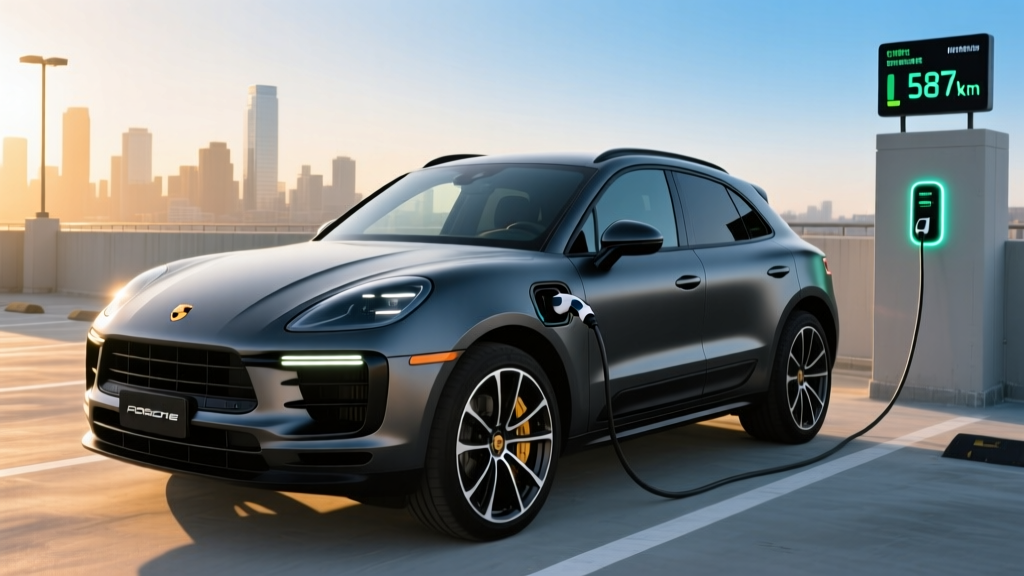
The 2026 Porsche Macan EV delivers an EPA-estimated 308 miles of range (Macan 4 Electric), peaks at 270 kW DC fast charging (10–80% in roughly 21 minutes), and starts around $78,800 before destination. It accelerates to 60 mph in as little as 3.3 seconds (Turbo trim) and offers a genuinely sports-car driving experience in an electric SUV package. However, it does not qualify for the federal §30D tax credit due to its MSRP exceeding the $80,000 SUV cap on higher trims and foreign battery sourcing on all trims. Real-world highway range drops to approximately 250–270 miles, and cold weather can shave another 15–25%. If you have home Level 2 charging and prioritize driving dynamics over maximum cargo space, it's one of the best electric luxury SUVs available.
Range, Battery, and Efficiency: Beyond the EPA Sticker
The 2026 Porsche Macan EV uses a 100 kWh gross battery (approximately 95 kWh usable) with NMC (nickel-manganese-cobalt) chemistry, housed in a 800-volt architecture shared with the Taycan. This high-voltage platform is the key to its impressive charging speeds and sustained performance under repeated hard acceleration.
| Spec | Macan 4 Electric | Macan Turbo Electric |
|---|---|---|
| EPA Range | 308 miles | 288 miles |
| Battery (usable/gross) | ~95 / 100 kWh, NMC | ~95 / 100 kWh, NMC |
| Horsepower | 402 hp | 630 hp (Launch Control) |
| 0–60 mph | 4.9 seconds | 3.3 seconds |
| MPGe (combined) | ~89 MPGe | ~82 MPGe |
| EPA Efficiency | ~38 kWh/100mi | ~41 kWh/100mi |
| Top Speed | 136 mph | 161 mph |
Real-World Range Reality
The EPA estimates 308 miles for the Macan 4 Electric. In real-world highway driving at 70–75 mph, expect approximately 250–270 miles. In cold weather (below 32°F), range can drop to 220–240 miles due to battery heating demands and cabin climate load. The Macan EV does include a heat pump as standard, which mitigates some cold-weather loss compared to resistive heating systems. City driving with regenerative braking can push range closer to or slightly above the EPA figure.
The 800V architecture means the Macan EV sustains higher speeds on long drives with less thermal strain on the battery. Porsche's thermal management system actively conditions the battery, which also translates to more consistent charging speeds in varied temperatures — a meaningful advantage over 400V competitors.
Charging Speed: 800V Architecture Advantage
This is where the Macan EV's 800-volt platform earns its keep. The vehicle supports up to 270 kW peak DC fast charging, among the fastest in the luxury electric SUV segment.
| Charging Level | Power (kW) | Miles Added per Hour | Notes |
|---|---|---|---|
| Level 1 (120V household) | ~1.4 kW | ~4–5 miles | Emergency/trickle only |
| Level 2 (240V home) | 11.5 kW (max onboard) | ~35–40 miles | Full charge in ~9 hours |
| DC Fast Charge (peak) | 270 kW | ~500+ miles/hr (peak) | 10–80% in ~21 min |
| DC Fast Charge (350 kW station) | 270 kW (vehicle-limited) | Varies by curve | Requires CCS or NACS adapter |
Charging curve reality: The 270 kW peak is achieved at low state of charge (roughly 10–30% SoC) and tapers progressively. From 10–80%, Porsche quotes approximately 21 minutes at a sufficiently powerful DC fast charger (350 kW capable). Expect the rate to drop significantly above 80% — charging from 80–100% can take an additional 20–25 minutes. For road trips, plan your stops around the 10–80% window for maximum efficiency.
The Macan EV uses the CCS1 connector natively in North America. Porsche provides a NACS adapter for access to Tesla Supercharger stations, expanding your public charging network considerably. At home, a Level 2 charger (such as a Porsche Mobile Charger Connect or third-party unit like a ChargePoint Home Flex) delivering 11.5 kW will fully replenish the battery overnight.
2026 Macan EV vs. Gas Macan: The Ownership Cost Breakdown
The most common question from luxury SUV shoppers: does going electric actually save money with the Macan? Here's a concrete five-year comparison using the Macan 4 Electric versus a comparably equipped gas-powered Macan S (starting around $67,000).
| Cost Category (5-Year) | 2026 Macan 4 Electric | 2026 Macan S (Gas) |
|---|---|---|
| Base MSRP | $78,800 | $67,000 |
| Federal Tax Credit (§30D) | $0 (MSRP/sourcing ineligible) | $0 |
| Estimated Fuel/Energy (15k mi/yr) | $3,900 ($0.13/kWh avg) | $11,250 ($3.75/gal, 20 MPG) |
| Maintenance (5 years) | ~$1,800 | ~$4,500 |
| Insurance (est. annual avg) | $2,400/yr ($12,000 total) | $2,100/yr ($10,500 total) |
| 5-Year Depreciation (est.) | ~$31,500 (40%) | ~$26,800 (40%) |
| Total 5-Year Cost | ~$127,000 | ~$120,050 |
Key takeaway: The Macan EV saves roughly $7,350 on energy and $2,700 on maintenance over five years, totaling about $10,050 in operational savings. However, the higher purchase price ($11,800 premium), elevated insurance costs ($1,500 more), and steeper depreciation partially offset those gains. The five-year total cost gap narrows to approximately $7,000 in favor of the gas Macan — and that's before factoring in any state incentives, off-peak electricity rates (which could widen EV savings), or rising gas prices.
If you charge primarily at home on off-peak rates (as low as $0.08–0.10/kWh in some regions), your energy costs could drop to $2,400–$3,000 over five years, improving the EV's position by $900–$1,500. Conversely, frequent DC fast charging at $0.35–0.50/kWh pushes energy costs closer to gas equivalence.
Federal Tax Credit and Incentive Reality
Under current IRS §30D rules, the 2026 Porsche Macan EV faces significant hurdles for the $7,500 federal tax credit:
- MSRP Cap: SUVs must be at or below $80,000. The Macan 4 Electric starts at $78,800 (technically under the cap before options), but destination charges and common option packages push most builds above $80,000.
- Battery Sourcing: The Macan EV's battery cells are manufactured outside the qualifying critical-mineral and battery-component supply chains required under §30D. This alone disqualifies most configurations.
- Buyer Income Cap: AGI limits apply ($150K single / $300K joint filers) regardless of vehicle eligibility.
Bottom line: do not count on the $7,500 federal credit when budgeting for a Macan EV. Check the latest eligibility list at fueleconomy.gov before purchasing, as sourcing rules and qualifying vehicle lists are updated periodically. Some states offer separate EV rebates or HOV-lane access — check your state's energy office for current programs. Consult a tax professional for personalized credit guidance.
First-Time EV Buyer: What You Need to Know
If the Macan EV is your first electric vehicle, several practical realities will shape your ownership experience:
Home Charging Is Essential
With a 100 kWh battery, relying on Level 1 (120V) charging is impractical — it would take over 70 hours for a full charge. Budget $800–$2,500 for a professional Level 2 (240V, 48-amp) home charger installation, depending on your electrical panel's capacity and the run distance from panel to garage. If your home has a 100-amp electrical panel, a panel upgrade to 200 amps could add $1,500–$3,500. Get a quote from a licensed electrician before committing to the vehicle.
Public Charging Network Realities
The Macan EV's CCS1 connector works with Electrify America, EVgo, ChargePoint, and other major networks. The included NACS adapter opens Tesla Supercharger access — a significant advantage for road trips. However, public charger reliability remains inconsistent: plan for a 10–15% failure rate at non-Tesla DC fast chargers based on industry surveys. For long trips, always identify backup charging stations along your route.
Cold Weather Preparation
If you live in a climate with sustained sub-freezing temperatures, preconditioning the battery while plugged in is critical. The Macan EV allows scheduled preconditioning through the Porsche Connect app, warming the battery to optimal temperature before you depart — preserving range and enabling faster DC charging upon departure. Without preconditioning, expect 15–25% range loss in cold weather and slower initial charging speeds.
| Common Misconception | The Reality |
|---|---|
| "The Macan EV gets 308 miles no matter how I drive." | 308 is the EPA combined estimate. Highway driving at 75 mph yields ~250–270 miles. Cold weather reduces this further. |
| "It charges at 270 kW the entire session." | 270 kW is peak rate at low SoC. Average rate over a 10–80% session is closer to 170–200 kW due to charge-curve tapering. |
| "EVs are cheaper to own in every scenario." | Higher purchase price, insurance, and depreciation can offset fuel/maintenance savings over 5 years. Break-even depends on your local electricity vs. gas prices and annual mileage. |
| "I don't need a home charger." | Public-only charging is expensive ($0.35–0.50/kWh) and time-consuming. Home Level 2 charging at $0.10–0.15/kWh is where EVs deliver their cost advantage. |
| "The battery will need expensive replacement soon." | Porsche warranties the battery for 8 years/100,000 miles with a 70% capacity retention threshold. Modern NMC batteries typically retain 85–90% capacity at 100,000 miles based on industry fleet data. |
Driving Dynamics and Technology
Porsche's reputation rests on driving dynamics, and the Macan EV delivers. The dual-motor all-wheel-drive system provides precise torque vectoring, and the available rear-axle steering (standard on Turbo, optional on Macan 4) reduces the turning radius and enhances high-speed stability. Air suspension with Porsche Active Suspension Management (PASM) is standard, offering adjustable ride height and damping.
The interior features a 12.6-inch curved digital instrument cluster and a 10.9-inch central touchscreen running Porsche Communication Management (PCM) with wireless Apple CarPlay and Android Auto. A passenger-side 10.9-inch display is available. The gear selector moves to the steering column, freeing up center-console space.
Driver assistance includes adaptive cruise control, lane-keeping assist, and surround-view cameras. Note that these features are SAE Level 2 — the driver must remain fully engaged and hands on or near the wheel at all times. This is not autonomous driving.
ADAS Limitation Notice
Porsche InnoDrive (adaptive cruise + lane centering) is a Level 2 driver-assistance system. It does not drive the car autonomously. You must monitor the road, keep hands available for steering input, and remain prepared to take over instantly. Performance degrades in heavy rain, construction zones, and faded lane markings.
Decision Framework: Should You Buy the 2026 Macan EV?
Choose the Macan EV If:
- You have (or can install) Level 2 home charging — this is non-negotiable for a 100 kWh battery.
- You prioritize driving dynamics, acceleration, and handling over maximum cargo volume or third-row seating.
- Your daily commute is under 150 miles round-trip, and you take road trips fewer than 6 times per year.
- You value the 800V charging architecture for faster DC stops on road trips.
- You're willing to pay a premium ($78,800+) for an electric luxury SUV with Porsche badge cachet.
Look Elsewhere If:
- You lack home charging access and your area has limited public DC fast-charging infrastructure.
- You need the federal $7,500 tax credit to make the math work — the Macan EV almost certainly won't qualify.
- Maximum range is your top priority — consider the Tesla Model X (348 mi EPA) or Rivian R1S (up to 410 mi with Max Pack).
- You regularly tow heavy loads — the Macan EV is rated for 4,409 lbs, which is adequate for light trailers but trails body-on-frame electric SUVs.
- Cargo space is paramount — the Macan EV offers 18.4 cu ft behind the rear seats (36.9 cu ft folded), which is less than the gas Macan and significantly less than midsize competitors.
Warranty and Long-Term Battery Outlook
Porsche covers the Macan EV's battery pack for 8 years or 100,000 miles (whichever comes first) with a minimum 70% state-of-health retention guarantee. The limited vehicle warranty is 4 years/50,000 miles. Porsche's roadside assistance covers 4 years with unlimited mileage.
Based on data from the Taycan (which shares the 800V platform and similar NMC chemistry), owners report approximately 3–5% degradation over the first 50,000 miles, with the curve flattening thereafter. A full battery replacement outside warranty would cost approximately $20,000–$28,000 based on current Porsche parts pricing — a worst-case scenario that the 8-year warranty is designed to prevent.
Frequently Asked Questions
Does the 2026 Porsche Macan EV qualify for the $7,500 federal tax credit?
Most configurations do not. The MSRP cap for SUVs is $80,000 under §30D, and the Macan 4 Electric starts just under that at $78,800 — but destination fees and common options push most builds over the limit. More critically, the battery's foreign-sourced components and critical minerals do not meet current domestic-sourcing requirements. Always verify at fueleconomy.gov before purchasing.
How long does it take to charge the Macan EV at home?
On a Level 2 charger delivering 11.5 kW (48 amps, 240V), a full 0–100% charge takes approximately 9 hours. Most owners plug in overnight and wake to a full battery. On a standard 120V outlet (Level 1), a full charge would take 65–70 hours — impractical for daily use.
What is the real-world highway range?
Expect 250–270 miles at highway speeds (70–75 mph) in moderate temperatures for the Macan 4 Electric. The Turbo trim, with its higher power output and wider tires, drops to roughly 235–255 miles in similar conditions. Cold weather (below 32°F) reduces these figures by an additional 15–25%.
Can the Macan EV use Tesla Superchargers?
Yes, with the included NACS adapter. Porsche provides a CCS-to-NACS adapter that enables access to Tesla's Supercharger network. This significantly expands your DC fast-charging options, particularly on road trips through areas where Electrify America or EVgo coverage is sparse.
How does cargo space compare to the gas Macan?
The Macan EV offers 18.4 cubic feet behind the rear seats and 36.9 cubic feet with the rear seats folded. The previous-generation gas Macan offered 17.6/52.9 cubic feet. The EV gains a slight advantage behind the second row but loses considerable space with seats folded due to the sloping roofline. There is also a small front trunk (frunk) for additional storage.
Is the Macan EV good in snow and winter conditions?
Yes. The dual-motor all-wheel-drive system provides excellent traction, and the low center of gravity (battery pack under the floor) enhances stability. Standard heat-pump climate control is more efficient than resistive heating, reducing winter range loss. Preconditioning while plugged in is strongly recommended to preserve range and charging speed in cold weather.