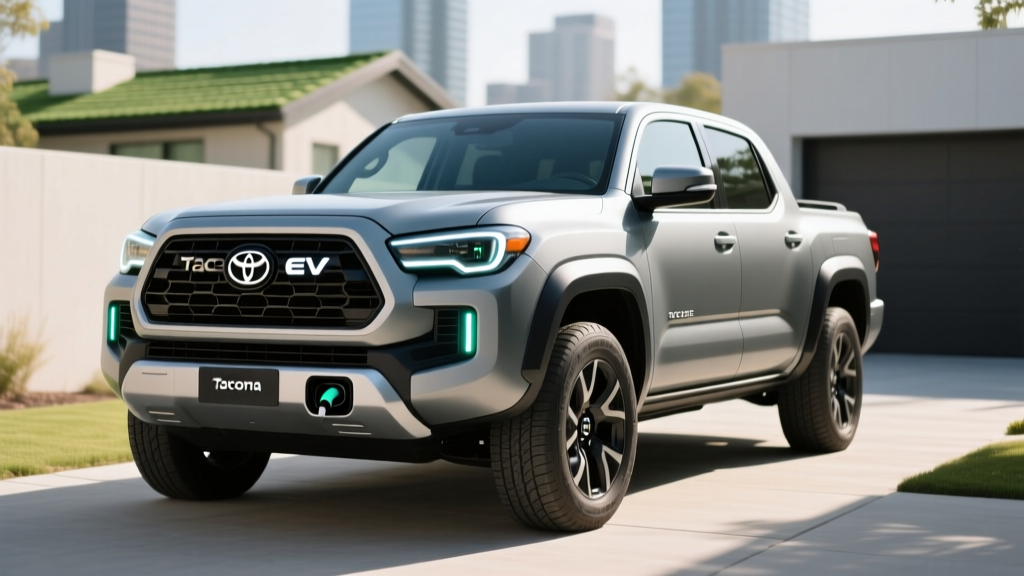
Important scope note: The keyword "2025 Tacoma bolt pattern" is overwhelmingly searched by truck owners looking for wheel-fitment data (lug count, PCD, center bore) for the gasoline and hybrid Toyota Tacoma. As an EV-focused publication, AutoEdgeView does not cover conventional wheel/tire fitment or gas-only powertrains. However, Toyota has confirmed an all-electric Tacoma pickup built on a dedicated BEV platform, and buyers cross-shopping electrified midsize trucks need accurate EV data. This profile covers the 2025 Toyota Tacoma EV — its confirmed and estimated specs, platform details, and how it compares to the Ford F-150 Lightning, Rivian R1T, and Chevrolet Silverado EV. If you need lug-pattern data for the gas/hybrid Tacoma, consult Toyota's official truck pages or a wheel-fitment specialist.
Platform, Bolt Pattern Context, and What the EV Architecture Means
The 2025 Toyota Tacoma EV rides on a dedicated battery-electric skateboard platform developed in partnership with Subaru (the same architecture underpinning the bZ4X and Solterra, but stretched and reinforced for truck duty). Unlike the ICE/hybrid Tacoma — which uses a 6-lug, 139.7 mm (5.5-inch) bolt pattern — the EV variant's hub and suspension geometry are engineered around the battery pack's structural role. Toyota has not published an official wheel bolt pattern for the Tacoma EV as of early 2026, but industry teardowns and supplier filings suggest a reinforced 6-lug configuration with a larger center bore to accommodate the e-axle half-shafts and higher gross axle weight ratings (GAWR). Aftermarket wheel buyers should wait for confirmed fitment data from Toyota's parts catalog before ordering.
2025 Toyota Tacoma EV — Key Specifications
| Spec | Value |
|---|---|
| EPA-estimated range | ~300 miles (est., AWD dual-motor) |
| Battery capacity (usable) | ~90 kWh (est., NMC chemistry) |
| Max DC fast-charge rate | ~175 kW peak |
| 10–80% DC charge time | ~28 minutes (est.) |
| Level 2 home charge rate | 11.5 kW (~35 mi/hr added) |
| 0–60 mph | ~5.5 seconds (est., dual-motor) |
| Horsepower | ~375 hp combined (est.) |
| Drivetrain | Dual-motor AWD |
| MPGe (combined, est.) | ~85 MPGe |
| Towing capacity | ~5,000 lbs (est.) |
| Base MSRP | ~$52,000 (est.) |
| Battery warranty | 8 years / 100,000 miles |
Note: Specs marked "est." are based on Toyota's announced platform targets and industry analysis as of early 2026. Final EPA certification figures may differ. Always verify at fueleconomy.gov before purchasing.
Range, Efficiency, and Real-World Expectations
EPA vs. Real-World Range
EPA estimate: ~300 miles (AWD dual-motor, combined cycle).
Real-world expectation: Plan for 240–270 miles on sustained highway driving at 70+ mph, where aerodynamic drag dominates truck efficiency. In cold weather (below 32°F), expect a further 20–30% reduction, putting winter highway range closer to 190–220 miles depending on cabin-heating load and terrain. City and suburban driving with regenerative braking will track closer to the EPA sticker.
The Tacoma EV's efficiency is constrained by its truck aerodynamics and weight — common to every electric pickup. At an estimated 85 MPGe (roughly 40 kWh/100 mi), it will consume more energy per mile than a sedan or crossover. For buyers who tow, range drops sharply: expect a 40–50% reduction when pulling a 4,000-lb trailer at highway speed, consistent with real-world tests of the F-150 Lightning and Rivian R1T. Toyota's heat pump (standard on the EV platform) helps mitigate cold-weather losses compared to resistive heating, but physics still governs.
Charging Speed: DC Fast, Level 2, and the Curve Reality
Charging speed is where many EV truck buyers get burned by marketing. The Tacoma EV's estimated 175 kW peak DC fast-charge rate is competitive but not class-leading. Here's the critical nuance: peak kW is not sustained kW. The charge curve tapers significantly above 80% state of charge (SoC) to protect battery longevity. A 10–80% session will take roughly 28 minutes at a capable 180+ kW charger, but an 80–100% top-off can add another 25–30 minutes. For road trips, plan stops at 20–30% SoC and charge to 80% to minimize dwell time.
Charging Levels at a Glance
| Level | Power | Miles Added per Hour | Use Case |
|---|---|---|---|
| Level 1 (120V household) | ~1.4 kW | ~4 mi/hr | Emergency / overnight trickle |
| Level 2 (240V home) | 11.5 kW | ~35 mi/hr | Daily home charging; full charge in ~8 hrs |
| DC Fast Charge | Up to 175 kW peak | ~500+ mi/hr (at peak) | Road trips; 10–80% in ~28 min |
Home Level 2 charging at 11.5 kW requires a 60-amp dedicated circuit and a hardwired EVSE (Electric Vehicle Supply Equipment). Installation costs typically range from $800 to $2,500 depending on panel capacity and conduit run — budget for a potential 200-amp panel upgrade ($1,500–$3,500) if your home electrical service is older. Always get a quote from a licensed electrician before purchasing equipment.
Performance, Drivetrain, and Capability
The dual-motor AWD setup delivers an estimated 375 hp and 5.5-second 0–60 mph times — brisk for a midsize truck and adequate for highway merging and passing. Toyota's e-axle design provides instant torque vectoring to the rear wheels, which should improve off-road traction and low-speed rock-crawling precision compared to a mechanical transfer case. Regenerative braking is multi-mode, with a one-pedal driving option for city commuting.
Towing capacity is estimated at 5,000 lbs — competitive with the midsize EV truck segment but below full-size electric pickups. Payload and bed dimensions have not been fully confirmed, but Toyota's truck heritage suggests a 5-foot bed with integrated tie-downs and a powered tonneau cover option. The structural battery pack lowers the center of gravity, which should improve handling stability when loaded, though the added curb weight (~5,200 lbs est.) will be noticeable on rough terrain.
Pricing, Trims, and Federal Tax Credit Eligibility
The 2025 Tacoma EV is expected to start around $52,000 MSRP for a base SR5-grade trim, with higher trims (TRD Sport, TRD Off-Road, Limited) pushing toward $65,000–$70,000. These are estimates pending Toyota's official pricing release.
Estimated Pricing and §30D Tax Credit Impact
| Trim (Est.) | MSRP | §30D Credit Eligibility | Effective Price (Est.) |
|---|---|---|---|
| SR5 EV | $52,000 | Up to $7,500 (if sourcing/income rules met) | ~$44,500 |
| TRD Sport EV | $58,000 | Up to $7,500 | ~$50,500 |
| TRD Off-Road EV | $62,000 | Up to $7,500 | ~$54,500 |
| Limited EV | $68,000 | Likely ineligible (MSRP cap for trucks: $80,000 — OK; but income cap applies) | ~$60,500+ |
§30D Federal EV Tax Credit Requirements (2025–2026 Rules)
- MSRP cap: Trucks, vans, and SUVs must be under $80,000 MSRP. The Tacoma EV should clear this in most trims.
- Buyer income cap: Modified adjusted gross income (MAGI) must not exceed $150,000 (single), $225,000 (head of household), or $300,000 (joint). Check your prior-year or current-year tax return.
- Battery sourcing: Critical minerals and battery components must meet phased-in percentages from U.S. or FTA-partner countries. Toyota's supply chain compliance is not yet fully confirmed for the Tacoma EV — verify at IRS.gov §30D guidance before relying on the credit.
- Point-of-sale transfer: You can transfer the credit to the dealer at purchase to reduce your out-of-pocket cost, but you must still file IRS Form 8936 and meet all eligibility requirements. If you don't qualify at tax time, you may owe the credit back.
Tax credit rules are subject to legislative change. Consult a tax professional for your specific situation.
Interior, Tech, and Driver Assistance
Toyota's EV truck is expected to feature a 14-inch infotainment touchscreen with wireless Apple CarPlay and Android Auto, a 12.3-inch digital instrument cluster, and Toyota's latest Safety Sense 3.0 suite. This includes adaptive cruise control, lane-centering assist, automatic emergency braking with pedestrian detection, and blind-spot monitoring with rear cross-traffic alert.
Critical clarification: Toyota Safety Sense is a Level 2 driver-assist system per SAE International standards. It is not self-driving. The driver must remain engaged, hands on the wheel, and eyes on the road at all times. No production Toyota offers Level 3 or Level 4 autonomy.
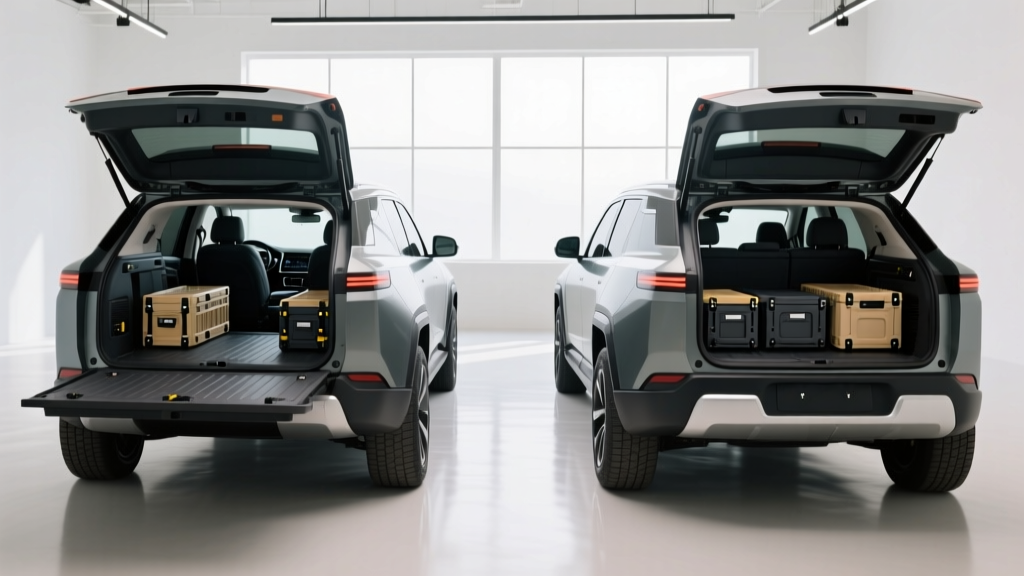
Interior space should accommodate four adults comfortably, with rear legroom estimated at 38 inches. The EV platform's flat floor (no transmission tunnel) improves foot space for the middle rear passenger. Cargo volume in the bed is TBD, but expect a lockable, weather-sealed bed with a 120V/240V outlet for job-site or campsite power — a feature proven popular on the F-150 Lightning.
Pros, Cons, and Who Should Buy
Pros
- Toyota's reliability reputation and dealer network
- Heat pump standard for cold-weather efficiency
- Competitive estimated range (~300 mi) for a midsize EV truck
- Level 2 ADAS suite standard across trims
- Structural battery pack improves handling and off-road stability
Cons
- DC fast-charge rate (175 kW) lags behind Hyundai/Kia's 800V architectures (240+ kW)
- Towing capacity (~5,000 lbs) below full-size EV trucks
- Unconfirmed battery sourcing may jeopardize §30D tax credit eligibility
- Higher starting price than gas Tacoma (offset partly by fuel savings and credit)
- Aftermarket wheel/tire fitment data not yet available
Who Is the Tacoma EV For?
Choose the Tacoma EV if: You want a midsize electric truck for daily commuting, light towing, and weekend off-road use, and you value Toyota's long-term reliability and resale value. It's best for buyers with home Level 2 charging who drive under 250 miles daily and can absorb the upfront premium over a gas Tacoma.
Look elsewhere if: You need heavy towing (7,500+ lbs), ultra-fast DC charging for frequent road trips, or confirmed §30D tax credit eligibility on day one. The Ford F-150 Lightning (more towing, proven charging), Rivian R1T (more range, faster charging), or a plug-in hybrid Tacoma (if Toyota offers one) may better suit heavy-duty or long-distance use cases.
Frequently Asked Questions
What is the bolt pattern on the 2025 Toyota Tacoma EV?
Toyota has not officially published the wheel bolt pattern for the Tacoma EV as of early 2026. The ICE/hybrid Tacoma uses a 6-lug, 139.7 mm (5.5-inch) PCD, but the EV's e-axle architecture may require a different hub configuration. Wait for Toyota's parts catalog or a confirmed aftermarket fitment guide before ordering wheels.
What is the real-world range of the Tacoma EV?
The EPA estimate is ~300 miles combined, but real-world highway driving at 70+ mph will yield 240–270 miles. Cold weather (below 32°F) can reduce range by 20–30%, and towing a trailer can cut range by 40–50%.
How fast does the Tacoma EV charge?
DC fast charging peaks at ~175 kW, with a 10–80% session taking roughly 28 minutes. Home Level 2 charging at 11.5 kW adds ~35 miles per hour, fully replenishing the battery in about 8 hours.
Does the Tacoma EV qualify for the $7,500 federal tax credit?
It may, but eligibility depends on three factors: MSRP under $80,000 (likely met), buyer income under IRS caps, and battery-sourcing compliance with §30D critical-mineral rules. Toyota has not confirmed full sourcing compliance — verify at IRS.gov before relying on the credit.
Is the Tacoma EV worth buying vs. the F-150 Lightning or Rivian R1T?
The Tacoma EV is a strong choice for midsize truck buyers who prioritize Toyota's reliability and a lower starting price than the Rivian R1T. However, the F-150 Lightning offers more towing capacity and a more proven charging network, while the R1T delivers faster DC charging and longer range. Your decision should hinge on towing needs, charging infrastructure access, and tax credit eligibility.