The 2026 Porsche Cayenne Turbo Electric at a Glance
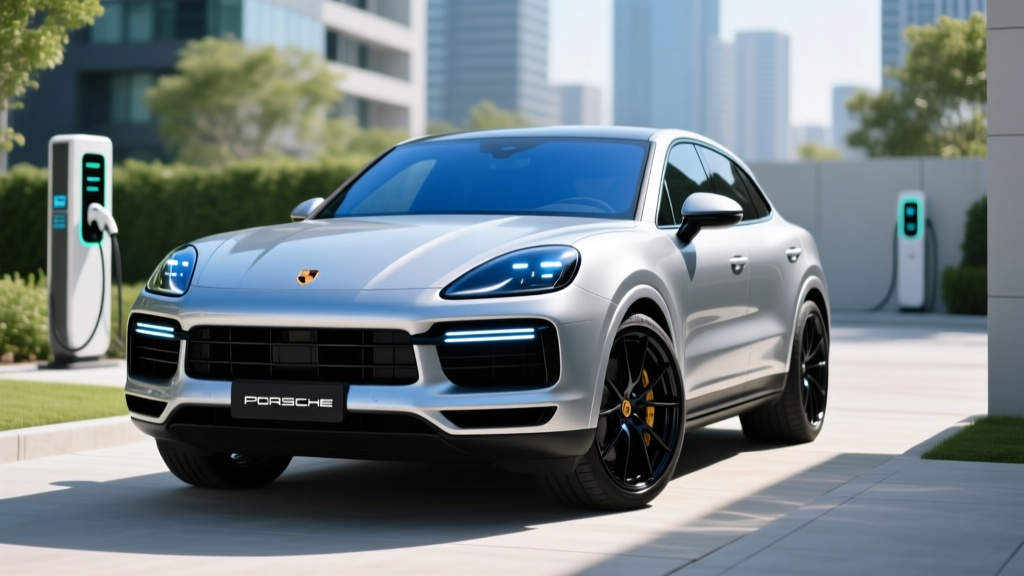
The 2026 Porsche Cayenne Turbo Electric is Porsche's flagship performance SUV on the PPE (Premium Platform Electric) architecture shared with the Macan EV and Audi Q6 e-tron. Based on Porsche's announced preliminary specs, the Turbo variant targets approximately 340 miles of EPA-estimated range from a ~100 kWh usable NMC battery, produces up to 1,139 horsepower with Launch Control, and supports DC fast charging at up to 270 kW (10–80% in roughly 21 minutes). Pricing is expected to start near $120,000 before options. It is not eligible for the federal §30D tax credit due to its MSRP exceeding the $80,000 SUV cap and likely battery-sourcing constraints. If you want a six-figure luxury performance EV that can genuinely replace a gas Cayenne Turbo on daily drives and road trips alike, this is the short list — but ownership economics differ sharply from the combustion model.
Range, Battery, and Efficiency: What the Numbers Actually Mean
Porsche rates the Cayenne Turbo Electric's battery at roughly 100 kWh of usable capacity (approximately 108 kWh gross), using an NMC (nickel-manganese-cobalt) chemistry optimized for both energy density and sustained power delivery. The PPE platform runs on an 800-volt architecture, which is the key enabler for both the high charge rate and the efficiency gains over older 400V systems.
EPA Range vs. Real-World Expectation
Preliminary EPA estimate: ~340 miles (Turbo trim, 20-inch wheels).
Real-world highway (70–80 mph, moderate climate): Expect 280–305 miles. Porsche SUVs are heavy and aerodynamically challenged at speed; efficiency typically lands around 2.5–2.8 mi/kWh on the interstate.
Cold weather (below 30°F): Plan for 220–260 miles. NMC chemistry loses more capacity to cold than LFP, and cabin heating draws significant power even with the standard heat pump.
Mountain/towing: Sustained climbs will slash range by 30–40%. Regenerative braking recovers some energy on descents, but not all.
| Specification | Value |
|---|---|
| Battery (usable / gross) | ~100 kWh / ~108 kWh (NMC) |
| Platform | PPE, 800V architecture |
| EPA Range (preliminary) | ~340 mi |
| Efficiency (est.) | ~2.6 mi/kWh combined (78 MPGe) |
| Peak Horsepower (Launch Control) | 1,139 hp |
| 0–60 mph | ~2.4 seconds |
| Top Speed | ~160 mph (electronically limited) |
| Max DC Charge Rate | 270 kW |
| 10–80% DC Fast Charge | ~21 minutes |
| Level 2 AC Charge (est.) | 11 kW (10–100% in ~10 hrs) |
| Estimated Base MSRP | ~$120,000 |
| Battery Warranty | 8 years / 100,000 miles (≥70% retention) |
The 270 kW peak charge rate is only sustained between roughly 10% and 35% State of Charge. Above 50%, the curve tapers significantly — expect around 150 kW by 60%, dropping to under 80 kW past 80%. This is normal for NMC packs protecting longevity, but it means a 10–90% session takes closer to 32–35 minutes, not 21. Plan road-trip stops accordingly, and use the Porsche Charging Planner for preconditioning, which warms the battery to optimal temperature before you arrive at the charger.
Charging at Home and on the Road
The Cayenne Turbo Electric uses the NACS (North American Charging Standard) connector, giving it native access to the Tesla Supercharger network — currently the most reliable DC fast-charging infrastructure in the U.S. Porsche also supports Plug & Charge on Electrify America stations.
Home Level 2 Charging Setup — Estimated Costs
| Item | Low Estimate | High Estimate |
|---|---|---|
| Level 2 charger (48A hardwired, e.g., ChargePoint Home Flex or Porsche Mobile Charger Connect) | $500 | $900 |
| Electrician labor (240V/60A circuit run, 40–60 ft from panel) | $800 | $2,500 |
| Permit & inspection | $100 | $400 |
| Electrical panel upgrade (if needed: 100A → 200A service) | $1,500 | $4,000 |
| Total (no panel upgrade) | $1,400 | $3,800 |
| Total (with panel upgrade) | $2,900 | $7,800 |
At 11 kW, a full overnight charge adds roughly 30–35 miles per hour of charging — enough to replenish the entire 100 kWh pack in about 10 hours. Most owners charging from 20% to 80% overnight will need only 6 hours on a 48A Level 2 circuit.
If you lack home charging access — condo living, street parking, or older apartments — this vehicle becomes significantly harder to own. Relying exclusively on public DC fast charging adds cost (typically $0.35–$0.55/kWh vs. $0.13–$0.18/kWh at home) and time. The Cayenne Electric is best suited for buyers who can install Level 2 at home.
Cayenne Turbo Electric vs. Gas Cayenne Turbo: Ownership Cost Breakdown
How does the electric flagship stack up against the combustion Cayenne Turbo over five years? Below is a data-driven comparison assuming 12,000 miles/year, national-average electricity at $0.16/kWh, and premium gasoline at $4.50/gallon.
| Cost Category | EV (Cayenne Turbo Electric) | Gas (Cayenne Turbo, 2025) |
|---|---|---|
| Purchase Price (base MSRP) | ~$120,000 | ~$145,000 |
| Federal Tax Credit (§30D) | $0 (MSRP exceeds cap) | $0 |
| Fuel/Energy (5 yrs, 60K mi) | ~$7,400 (home + some DCFC) | ~$16,200 (15 MPG combined, $4.50/gal) |
| Maintenance (5 yrs) | ~$2,800 | ~$6,500 |
| Insurance (5 yrs, est.) | ~$18,000 | ~$15,500 |
| Estimated Depreciation (5 yrs) | ~$54,000 (45%) | ~$65,250 (45%) |
| Total 5-Year Cost | ~$202,200 | ~$248,450 |
| Cost Per Mile | $3.37 | $4.14 |
Sources: EPA efficiency data via fueleconomy.gov; IRS §30D rules for credit eligibility.
The EV wins on fuel and maintenance savings by roughly $12,500 over five years, but note the insurance premium — EVs in this price bracket often cost 10–20% more to insure due to repair costs and battery replacement risk. Depreciation is the largest cost factor for both vehicles; Porsche's residual values are strong relative to other luxury brands but remain uncertain for a first-generation EV nameplate.
Federal Tax Credit: Why the Cayenne Turbo Electric Likely Doesn't Qualify
Under current IRS §30D rules, the new clean vehicle credit is capped at $80,000 MSRP for SUVs. The Cayenne Turbo Electric, at an estimated $120,000+ base price, far exceeds this cap. Additionally, the credit requires that a growing percentage of battery critical minerals and components be sourced from the U.S. or FTA-partner countries — a threshold that many European-built Porsches do not meet.
- MSRP cap for SUVs: $80,000 — Cayenne Turbo Electric does NOT qualify
- Buyer income cap: $300K joint / $150K single — irrelevant if MSRP fails
- Battery sourcing: 80% critical minerals (2026), 100% components (2026) — Porsche has not confirmed compliance
- Point-of-sale transfer: Available for qualifying vehicles, but again, this vehicle is ineligible
Do not factor any federal credit into your purchase budget for this vehicle. Some states (California, Colorado, Massachusetts) offer separate incentives that may apply — check your state's energy office for current programs.
Real-World Ownership Considerations
Driving Patterns
If your daily commute is under 80 miles round-trip, the Cayenne Turbo Electric handles it effortlessly with minimal charging — a nightly Level 2 session from 60% to 80% takes about 2 hours. For road trips exceeding 250 miles, you'll need one DC fast-charge stop; the 270 kW peak rate means a 15–20 minute break adds ~150 miles of range, which is competitive with the Audi Q8 e-tron and ahead of the BMW iX M60.
Climate Impact
Owners in northern-tier states (Minnesota, Maine, Montana) should budget for 25–35% range loss in sustained sub-freezing temperatures. The standard heat pump mitigates cabin heating draw, but battery chemistry inherently loses capacity in cold. Garage parking and preconditioning while plugged in are essential habits.
Towing
Porsche rates the Cayenne Electric at approximately 7,700 lbs towing capacity. However, towing a 5,000-lb trailer will reduce range to roughly 150–180 miles at highway speed. This is a significant limitation for frequent tower — the gas Cayenne Turbo is the better choice if you tow more than a few times per year.
Insurance
Expect annual premiums of $3,200–$4,200 depending on your driving record, location, and coverage level. EV insurance is typically 10–20% higher than equivalent gas vehicles. Get quotes from GEICO, Progressive, and Hagerty (if you qualify for collector-car programs) before committing.
Common Misconceptions — Fact vs. Fiction
| Myth | Fact |
|---|---|
| "The battery will need replacing in 5 years." | Porsche warrants the battery for 8 years/100,000 miles at ≥70% capacity retention. Real-world PPE and J1 platform data shows 8–12% degradation over 100K miles. A replacement pack (if ever needed out of warranty) would cost an estimated $20,000–$30,000. |
| "I can charge at any public station." | The NACS connector gives access to Tesla Superchargers and newer Electrify America/ChargePoint stalls with NACS cables. Older CCS1-only stations will require an adapter (included by Porsche). CHAdeMO stations are not compatible. |
| "It qualifies for the $7,500 federal tax credit." | It does not. The MSRP exceeds the $80,000 SUV cap, and battery sourcing likely fails §30D requirements. No federal credit applies. |
| "The 340-mile range means I can drive 340 miles before charging." | EPA range is a combined-cycle estimate. At sustained highway speeds (75+ mph), expect 280–305 miles. In cold weather, as low as 220 miles. Never plan trips to the EPA number. |
| "Level 2 driver assist means I don't have to pay attention." | Porsche InnoDrive is an SAE Level 2 system. You must keep hands on the wheel and eyes on the road at all times. It is not autonomous driving. |
Decision Framework: Should You Buy the Cayenne Turbo Electric?
Buy the Cayenne Turbo Electric If:
- You can install Level 2 charging at home (garage or driveway with a 240V circuit).
- You want supercar acceleration (2.4s 0–60) in a daily-drivable luxury SUV.
- Your typical road trips are under 400 miles or you're comfortable with one 20-minute charging stop.
- You value the Tesla Supercharger network access that NACS provides.
- You want lower per-mile operating costs than the gas Cayenne Turbo over 5+ years.
Stick with the Gas Cayenne Turbo (or Wait) If:
- You tow more than 4,000 lbs regularly — EV range collapses under heavy loads.
- You live in an apartment or lack reliable home charging access.
- You frequently drive in extreme cold (below 0°F) where range loss exceeds 35%.
- You need a proven first-generation platform — consider waiting for 2027 model-year reliability data.
- You were counting on the federal tax credit to offset the purchase price.
Frequently Asked Questions
What is the estimated price of the 2026 Porsche Cayenne Turbo Electric?
Base MSRP is expected at approximately $120,000. With typical Porsche options (Performance Battery Plus, Sport Chrono, premium packages), expect $130,000–$145,000 out the door. This positions it against the BMW iX M60 (~$115K), Mercedes EQS SUV 580 (~$120K), and Tesla Model X Plaid (~$110K).
Does the Cayenne Electric have a frunk?
Yes, but it's modest — approximately 3.5 cubic feet, enough for a charging cable bag or small soft duffel. The rear cargo area offers roughly 28 cu ft behind the second row and 60+ cu ft with seats folded.
How does charging speed compare to the Tesla Model X?
The Cayenne Electric peaks at 270 kW on an 800V system, while the Model X peaks at 250 kW on Tesla's 400V-derived architecture. In practice, the Porsche sustains its peak rate slightly longer (to ~35% SoC), giving it a marginal edge in 10–80% time (21 min vs. ~25 min for Model X). However, the Model X benefits from the Supercharger network's reliability and density.
Will the battery degrade significantly?
All lithium-ion batteries degrade. Based on data from the Taycan (which uses a similar J1/PPE architecture), expect roughly 8–12% capacity loss over the first 100,000 miles if you follow best practices: avoid frequent 100% charges, minimize DC fast charging to road trips only, and precondition before charging. Porsche's 8-year/100,000-mile warranty guarantees ≥70% capacity retention.
Is Porsche InnoDrive self-driving?
No. Porsche InnoDrive is an SAE Level 2 driver-assistance system that combines adaptive cruise control, lane centering, and predictive speed adjustment based on navigation data. You must remain fully engaged — hands on the wheel, eyes on the road. It is comparable to BMW Highway Assistant or Mercedes Drive Pilot (Level 2), not Waymo (Level 4).
What happens if I need a battery replacement out of warranty?
Full pack replacement would likely cost $20,000–$30,000 based on current PPE-platform estimates. However, module-level repair is increasingly available, and individual module replacement can cost $2,000–$5,000 depending on the failure. Most owners will never need this within the vehicle's typical ownership cycle.
Can I charge at Tesla Superchargers?
Yes. The 2026 Cayenne Electric uses the NACS connector natively, giving it full access to Tesla's Supercharger network — over 25,000 stalls in North America. This is a significant advantage over CCS-equipped competitors that still require adapters.
Note: Specs in this article are based on Porsche's announced preliminary data and industry estimates as of early 2026. Final EPA range, MSRP, and tax-credit eligibility will be confirmed at the vehicle's market launch. Always verify with your local Porsche dealer and consult IRS.gov for current §30D rules before purchasing.