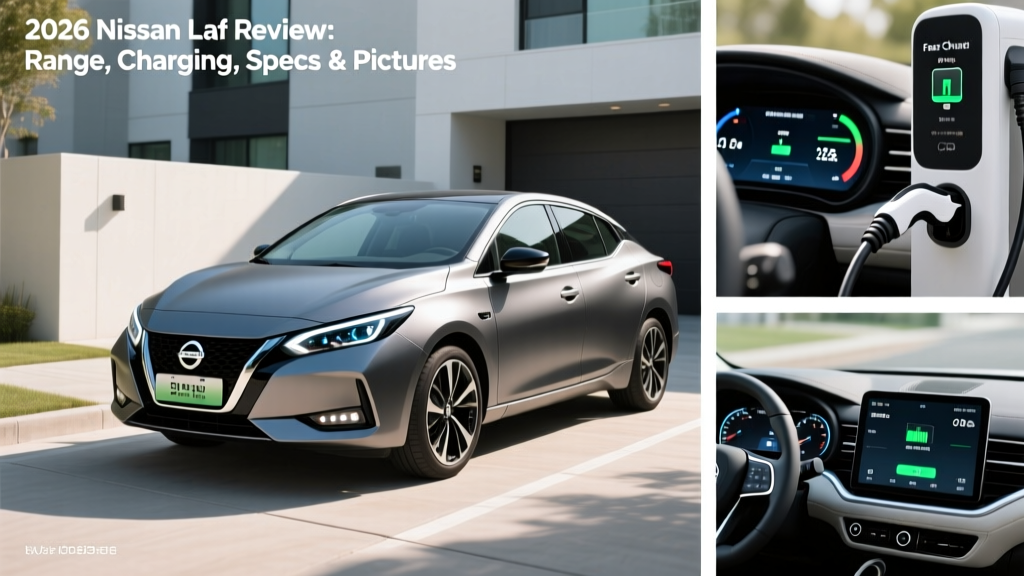
The Nissan Leaf holds a unique place in EV history as one of the first mass-market electric cars, and the 2026 model continues that legacy as an accessible, practical commuter EV. If you've been searching for pictures of the Nissan Leaf alongside real specs and ownership data, this review gives you the full picture — EPA range, charging realities, battery chemistry, pricing after federal tax credits, and how it stacks up against rivals like the Chevrolet Bolt EV and Hyundai Kona Electric.
For 2026, the Leaf carries over with two battery options, a proven front-wheel-drive powertrain, and a starting price that keeps it among the most affordable new EVs on the market. But with DC fast-charging limited to the aging CHAdeMO connector and no active liquid battery cooling, buyers need to understand exactly what they're getting before signing on the dotted line.
2026 Nissan Leaf at a Glance: Full Spec Sheet
| Specification | Leaf S (40 kWh) | Leaf SV Plus (60 kWh) |
|---|---|---|
| EPA Range | 149 miles | 212 miles |
| Battery Capacity (Usable) | ~39 kWh | ~60 kWh |
| Battery Chemistry | NMC (Lithium-ion) | NMC (Lithium-ion) |
| Battery Cooling | Passive (air-cooled) | Passive (air-cooled) |
| Motor Output | 110 kW (147 hp) | 160 kW (214 hp) |
| Drivetrain | FWD | FWD |
| 0–60 mph | ~7.9 seconds | ~6.5 seconds |
| Max DC Fast Charge | 50 kW (CHAdeMO) | 100 kW (CHAdeMO) |
| Level 2 Charge Rate | 6.6 kW | 6.6 kW |
| EPA Efficiency | 111 MPGe (30 kWh/100 mi) | 104 MPGe (32 kWh/100 mi) |
| Cargo Volume (rear seats up/down) | 23.6 / 30.0 cu ft | 23.6 / 30.0 cu ft |
| Rear Legroom | 33.5 inches | 33.5 inches |
| Battery Warranty | 8 yr / 100,000 mi | 8 yr / 100,000 mi |
| Base MSRP | $28,140 | $36,190 |
Sources: EPA fueleconomy.gov, Nissan USA specifications.
Real-World Range: What the EPA Sticker Doesn't Tell You
Leaf S (40 kWh): EPA 149 miles — expect ~125–135 miles on the highway at 70 mph; ~100–115 miles in sub-freezing winter conditions.
Leaf SV Plus (60 kWh): EPA 212 miles — expect ~180–195 miles on the highway at 70 mph; ~150–170 miles in sub-freezing winter conditions with cabin heat.
The 2026 Nissan Leaf SV Plus carries an EPA-estimated 212 miles of range, which is competitive for a sub-$40,000 EV. However, real-world results depend heavily on your driving profile. The Leaf's passive air-cooled battery management system means the pack temperature rises during sustained highway driving or repeated fast charging, which can reduce efficiency and trigger power limitations in hot weather — a phenomenon Nissan owners know as "Rapidgate."
In city driving with moderate regenerative braking, the SV Plus can actually exceed its EPA estimate thanks to the efficiency gains of stop-and-go regen. Highway driving at 75+ mph tells a different story: aerodynamic drag and the lack of a heat pump (the Leaf uses resistive PTC heating) mean cold-weather range loss can reach 25–35% compared to the EPA sticker.
If your commute is under 40 miles round-trip with access to home charging, the 40 kWh Leaf S's 149-mile EPA range is more than adequate. For longer commutes or the occasional road trip, the 60 kWh SV Plus is the clear choice.
Charging Speed: CHAdeMO in a CCS and NACS World
| Charging Level | Leaf S (40 kWh) | Leaf SV Plus (60 kWh) | Miles Added per Hour |
|---|---|---|---|
| Level 1 (120V, 12A) | ~1.4 kW | ~1.4 kW | ~4–5 mi/hr |
| Level 2 (240V, 6.6 kW) | 6.6 kW (~9 hr full) | 6.6 kW (~11 hr full) | ~22–25 mi/hr |
| DC Fast (CHAdeMO) | 50 kW peak | 100 kW peak | ~150–180 mi/hr (at peak) |
| 10–80% DC Fast Time | ~40 minutes | ~45 minutes |
The charging story is where the 2026 Leaf requires the most buyer awareness. Nissan continues to use the CHAdeMO DC fast-charging connector, which is being phased out across North America in favor of CCS and Tesla's NACS standard. As of 2026, Electrify America stations still maintain CHAdeMO connectors at many locations, but new installations increasingly prioritize CCS and NACS.
The SV Plus peaks at 100 kW on DC fast charging, but because the Leaf lacks active liquid thermal management, sustained charge rates taper significantly after the battery warms up. On a warm day after highway driving, expect peak rates to drop from 100 kW to 40–50 kW within 15–20 minutes. In practice, a 10–80% charge takes roughly 45 minutes under ideal conditions, but can stretch past 60 minutes in hot weather or after repeated same-day fast charges.
For home Level 2 charging, the onboard 6.6 kW charger is competitive. A full overnight charge from near-empty takes roughly 9–11 hours depending on the trim, which works well for commuters who plug in each evening. Installation of a 240V Level 2 circuit typically runs $500–$1,500 depending on your electrical panel's proximity to the garage.
Performance and Driving Dynamics
The SV Plus's 160 kW (214 hp) electric motor delivers 250 lb-ft of instant torque to the front wheels, pushing the Leaf from 0–60 mph in approximately 6.5 seconds. That's genuinely quick for a practical hatchback, and the one-pedal driving mode (Nissan calls it e-Pedal) provides strong regenerative braking that can bring the car to a complete stop without touching the brake pedal.
The base S trim's 110 kW (147 hp) motor feels adequate around town but less confident during highway merging. Neither trim offers all-wheel drive — the Leaf is strictly front-wheel drive, which is fine for most climates but limits its appeal in heavy snow regions compared to AWD competitors.
Ride quality is comfortable and compliant, with a suspension tuned for comfort over sportiness. Cabin noise levels are well-managed at city speeds, though wind and tire noise become noticeable above 65 mph. The steering is light and low-effort, ideal for urban driving but lacking the precision enthusiasts might want.
Interior, Cargo Space, and Technology
Inside, the 2026 Leaf features an 8-inch touchscreen infotainment system with wireless Apple CarPlay and wired Android Auto. The SV Plus adds built-in navigation, a Bose premium audio system, and a 360-degree Around View Monitor that's genuinely useful for parking.
Nissan's ProPILOT Assist comes standard on SV Plus trims, combining adaptive cruise control with lane-centering for hands-on highway driving. This is an SAE Level 2 driver-assistance system — it requires the driver to maintain hands on the wheel and full attention at all times. It is not autonomous driving.
Cargo space measures 23.6 cubic feet behind the rear seats and 30.0 cubic feet with the 60/40-split rear seats folded. That's competitive with the Bolt EV (23.0 cu ft) but trails the Kona Electric (25.8 cu ft). Rear-seat legroom at 33.5 inches is adequate for average-height adults but tight for taller passengers on longer rides.
One notable omission: the Leaf does not offer vehicle-to-load (V2L) capability, meaning you can't use the traction battery to power external devices or appliances — a feature increasingly common in newer EV platforms.
Pricing, Trims, and Federal Tax Credit Eligibility
| Trim | Base MSRP | Destination | Total Before Credits | Est. Price After §30D Credit* |
|---|---|---|---|---|
| Leaf S (40 kWh) | $28,140 | $1,095 | $29,235 | ~$21,735 |
| Leaf SV Plus (60 kWh) | $36,190 | $1,095 | $37,285 | ~$29,785 |
*Federal tax credit eligibility depends on multiple factors. See checklist below.
The 2026 Leaf qualifies as one of the most affordable new EVs in the U.S. market. The base S trim starts at $28,140, while the range-topping SV Plus begins at $36,190. Both trims fall well below the IRS §30D MSRP cap of $55,000 for passenger cars.
- MSRP Cap: ✅ Leaf MSRP is under $55,000 (passenger car limit)
- Buyer Income Cap: Adjusted gross income must not exceed $150,000 (single) / $225,000 (head of household) / $300,000 (joint)
- Battery Sourcing: Critical minerals and battery components must meet phased-in percentage thresholds per IRS rules — verify current-year compliance on the IRS qualified vehicles list
- Point-of-Sale Transfer: Eligible buyers can transfer the credit to the dealer at purchase, reducing the upfront price rather than waiting for a tax refund
- Assembly: Must be assembled in North America — the Leaf is built in Smyrna, Tennessee ✅
Important caveat: Battery component and critical mineral sourcing requirements tighten each year under the Inflation Reduction Act. Always verify the Leaf's current eligibility on the IRS qualified clean vehicle list before purchasing, as the credit amount can change based on sourcing compliance. Consult a tax professional for your specific situation.
How the 2026 Leaf Compares to Key Rivals
| Spec | 2026 Nissan Leaf SV Plus | 2026 Chevrolet Bolt EV | 2026 Hyundai Kona Electric |
|---|---|---|---|
| EPA Range | 212 mi | 259 mi | 261 mi |
| Battery | 60 kWh (NMC) | 65 kWh (NMC) | 64.8 kWh (NMC) |
| DC Fast Charge | 100 kW (CHAdeMO) | 115 kW (CCS) | 100+ kW (CCS/NACS) |
| 10–80% Time | ~45 min | ~30 min | ~43 min |
| 0–60 mph | ~6.5 sec | ~6.5 sec | ~6.8 sec |
| Horsepower | 214 hp | 200 hp | 201 hp |
| Cargo (seats up) | 23.6 cu ft | 23.0 cu ft | 25.8 cu ft |
| Base MSRP | $36,190 | ~$28,785 | ~$34,100 |
| Connector | CHAdeMO | CCS / NACS adapter | NACS (2025+) |
| Battery Cooling | Passive air | Liquid | Liquid |
The comparison reveals the Leaf's most significant competitive disadvantage: the CHAdeMO connector in a market rapidly standardizing on NACS and CCS. Both the Bolt EV and Kona Electric offer longer EPA range, liquid-cooled batteries for more consistent fast charging, and access to broader charging networks.
Where the Leaf wins is the combination of proven reliability (the platform has been refined since 2011), standard ProPILOT Assist on SV Plus, and the lowest entry price of any new EV at the S trim level. If you have reliable CHAdeMO charging infrastructure near your daily routes, the Leaf remains a strong value.
Pros and Cons
- Among the lowest starting MSRPs for any new EV ($28,140)
- Comfortable ride quality and quiet cabin at city speeds
- ProPILOT Assist standard on SV Plus (Level 2 adaptive cruise + lane centering)
- Strong 0–60 performance on SV Plus (6.5 sec, 214 hp)
- 8-year/100,000-mile battery warranty
- Built in Tennessee — qualifies for §30D credit assembly requirement
- e-Pedal one-pedal driving is intuitive and effective
- CHAdeMO connector is being deprecated; shrinking public charging access
- Passive air-cooled battery leads to charge tapering and Rapidgate in heat
- No heat pump — significant cold-weather range loss (25–35%)
- EPA range (212 mi max) trails Bolt EV (259 mi) and Kona Electric (261 mi)
- No V2L capability
- Rear seat legroom tight for taller passengers (33.5 in)
- DC fast charging slower than liquid-cooled competitors
Who Should Buy the 2026 Nissan Leaf?
- You need an affordable new EV primarily for commuting and errands under 40 miles round-trip
- You have reliable home Level 2 charging and access to CHAdeMO stations in your area
- You want a proven, long-running EV platform with strong dealer support
- You value a comfortable ride and standard driver-assist tech at a budget price
- You live in a moderate climate where extreme heat or cold won't stress the passive battery cooling
- You plan to road-trip regularly and need fast, reliable DC charging on CCS/NACS networks
- You live in a hot climate and expect to fast-charge multiple times per day
- You need AWD for snow or want more than 212 miles of EPA range
- You want V2L capability for camping or emergency backup power
Frequently Asked Questions
What is the real-world range of the 2026 Nissan Leaf?
The SV Plus (60 kWh) is EPA-rated at 212 miles. In real-world highway driving at 70 mph, expect roughly 180–195 miles. In winter conditions with cabin heating, plan for 150–170 miles. The base S trim (40 kWh) is EPA-rated at 149 miles and realistically delivers 125–135 highway miles.
How fast does the Nissan Leaf charge at home and on the road?
On a Level 2 home charger (240V), the Leaf charges at 6.6 kW, adding roughly 22–25 miles of range per hour. A full charge takes 9–11 hours. On DC fast charging (CHAdeMO), the SV Plus peaks at 100 kW but tapers due to passive battery cooling — expect a 10–80% charge in approximately 45 minutes under ideal conditions, longer in hot weather.
Does the 2026 Nissan Leaf qualify for the $7,500 federal EV tax credit?
The Leaf is assembled in Tennessee and falls under the $55,000 MSRP cap for passenger cars, meeting two key requirements. However, full credit eligibility depends on your income (capped at $150K single / $300K joint), battery component sourcing compliance, and critical mineral thresholds that tighten annually. Verify current eligibility on the IRS qualified vehicle list before purchasing. The credit can be transferred at point-of-sale to reduce your upfront cost.
Is the Nissan Leaf worth buying over the Chevy Bolt or Hyundai Kona Electric?
The Leaf's value proposition centers on its low starting price ($28,140 for the S trim), comfortable ride, and proven platform. However, the Bolt EV offers significantly more range (259 mi) at a lower price, and both the Bolt and Kona Electric use liquid-cooled batteries with CCS/NACS connectors for broader charging access. If CHAdeMO infrastructure is strong in your area and you prioritize comfort and dealer familiarity, the Leaf is compelling. If range and charging network flexibility matter more, the Bolt or Kona are stronger picks.
What is the Nissan Leaf battery warranty?
Nissan provides an 8-year/100,000-mile lithium-ion battery capacity warranty. If the battery degrades below a specified capacity threshold (displayed as bars on the dashboard capacity gauge) within that period, Nissan will repair or replace it. The powertrain warranty also covers 8 years/100,000 miles. Note that earlier Leaf generations experienced notable degradation due to the passive cooling system — the 60 kWh pack has shown improved longevity, but hot-climate buyers should monitor State of Health closely.
Can I use Tesla Superchargers with the Nissan Leaf?
No. The Leaf uses the CHAdeMO DC fast-charging standard, which is not compatible with Tesla's NACS connector or CCS. Adapters from CHAdeMO to NACS or CCS are not commercially available for the Leaf due to protocol and voltage differences. Your public DC charging options are limited to stations with CHAdeMO connectors, primarily found at Electrify America and some legacy ChargePoint and EVgo locations.
Does the Leaf have a heat pump for cold weather?
No. The 2026 Leaf uses resistive PTC (positive temperature coefficient) heating, which draws significantly more energy from the battery than a heat pump system. This is a primary reason for the Leaf's 25–35% range loss in freezing temperatures. Competitors like the Kona Electric and newer EV platforms include heat pumps as standard or optional equipment.
For the latest EPA efficiency data, visit fueleconomy.gov. For safety ratings, check NHTSA and IIHS. All pricing reflects 2026 model-year MSRP and is subject to change. Federal tax credit rules are current as of publication — verify with the IRS and a qualified tax professional.