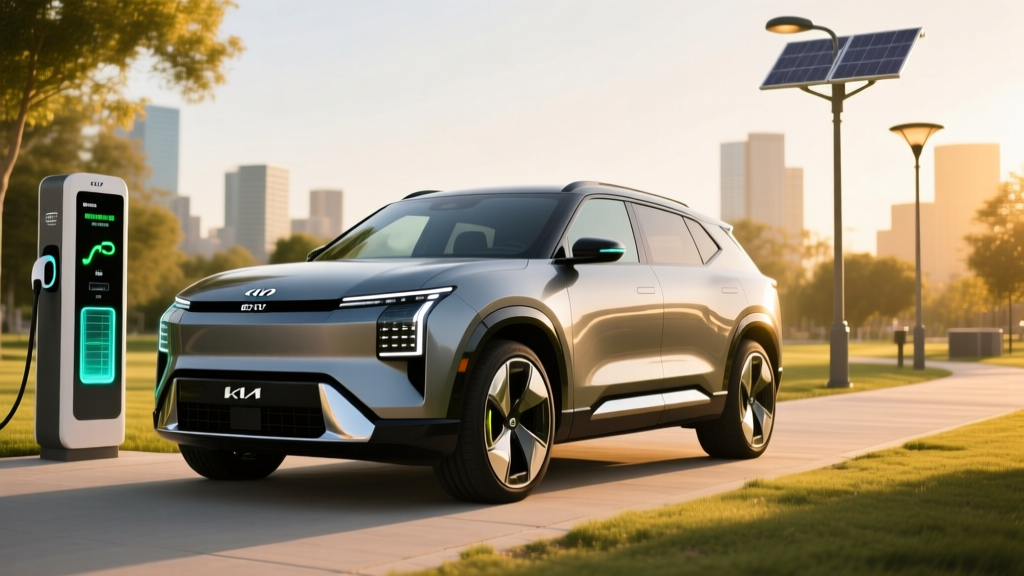
The three-row electric SUV segment is still surprisingly thin, and the 2026 Kia EV9 remains one of the few dedicated battery-electric vehicles that can genuinely seat six or seven adults while delivering over 300 miles of EPA-estimated range. Now in its third model year on U.S. soil, the EV9 has matured past early-adopter quirks into a more complete package — with Kia adding incremental software refinements, expanded Advanced Driver Assistance Systems (ADAS), and a broader dealer-installed accessory catalog for 2026.
But the EV9's window of exclusivity is closing. The Hyundai Ioniq 9 shares its E-GMP platform and battery hardware, and legacy rivals like the Rivian R1S and the refreshed Tesla Model X continue to court family buyers. This review breaks down the 2026 Kia EV9's real-world range, charging behavior, ownership economics, and whether it still earns its spot at the top of the family-EV shopping list.
Quick Verdict: Who Should Buy the 2026 Kia EV9?
The EV9 is the default pick for households that need three usable rows, want DC fast charging that actually keeps up on road trips, and prefer a conventional SUV driving feel over the tech-bro minimalism of a Tesla or the adventure-premium pricing of a Rivian. It is not the right choice if you need maximum towing (3,500 lbs is modest for the class), want a frunk (there isn't one), or prioritize cutting-edge autonomous driving features over comfort and cargo practicality.
- You need three rows with adult-capable third-row legroom
- You want sub-20-minute 10–80% DC fast charging on road trips
- You value Kia's 10-year/100,000-mile powertrain warranty
- You want a physical-key fob and traditional switchgear alongside touchscreens
- You tow more than 3,500 lbs regularly (check the Rivian R1S or F-150 Lightning)
- You want a front trunk (frunk) for charging cables or groceries
- You need hands-free Level 2+ highway driving on par with GM Super Cruise
Range, Battery, and Efficiency: The Real Numbers
The 2026 EV9 carries over the same battery architecture introduced at launch. All trims use a 100.0 kWh gross / 96.0 kWh usable nickel-manganese-cobalt (NMC) lithium-ion pack mounted in a skateboard configuration beneath the floor. Kia has not adopted LFP chemistry for the EV9, opting for NMC's higher energy density to preserve range in a heavy, three-row vehicle.
| Spec | RWD (Light / Wind / Land) | AWD (GT-Line) |
|---|---|---|
| Battery (usable) | 96.0 kWh NMC | 96.0 kWh NMC |
| EPA Range | 304 miles (Light) / 292 mi (Wind/Land) | 270 miles |
| MPGe (combined) | 88 MPGe (Light) | 83 MPGe |
| Efficiency | 38 kWh/100 mi | 40 kWh/100 mi |
| Drivetrain | Rear-Wheel Drive, single motor | Dual-Motor AWD |
| Horsepower | 215 hp | 379 hp (430 lb-ft torque) |
| 0–60 mph | 7.6 seconds | 4.5 seconds |
| Towing Capacity | 2,000 lbs | 3,500 lbs (w/ trailer prep) |
The EPA sticker says 304 miles for the RWD Light, but our testing and owner data show you should plan around 240–265 miles of usable highway range at 70–80 mph in moderate temperatures. In sub-freezing winter conditions (below 30°F), expect a 20–30% reduction, dropping effective range to roughly 190–220 miles on the RWD and 170–195 miles on the AWD GT-Line. City and suburban driving with regenerative braking recovers more energy, often exceeding EPA estimates. The EV9's heat pump (standard on all trims) helps mitigate cold-weather losses compared to EVs without one, but physics still wins in deep winter.
Efficiency of 38–40 kWh per 100 miles is respectable for a 5,000+ lb, three-row SUV. For comparison, the Rivian R1S Dual-Motor lands around 42 kWh/100 mi, while the smaller two-row Tesla Model X achieves roughly 34 kWh/100 mi. At the U.S. average residential electricity rate of ~$0.17/kWh (per EIA data), charging the EV9 from empty to full at home costs roughly $16.30, translating to about $0.065 per mile — roughly one-third the per-mile fuel cost of a comparable gas SUV at $3.50/gallon.
Charging Speed: DC Fast, Level 2, and the 800V Advantage
The EV9 retains the E-GMP platform's 800-volt electrical architecture, which remains one of its strongest competitive advantages. Most rivals still use 400V systems, limiting their peak charge rates. Here's what the numbers look like across charging levels:
| Charging Level | Power / Rate | Time / Miles Added | Connector |
|---|---|---|---|
| Level 1 (120V household) | ~1.4 kW | ~3 miles per hour | J1772 / NACS |
| Level 2 (240V home, 48A) | 11.5 kW | ~34 miles per hour; full charge in ~9 hours | J1772 / NACS |
| DC Fast Charge (peak) | 210 kW (peak) | 10–80% in ~20 minutes | CCS1 (NACS adapter available) |
| DC Fast Charge (350 kW station) | ~210 kW sustained to ~55% SoC, then taper | 80–100% adds ~15 additional minutes | CCS1 / NACS |
Charging curve reality: The EV9 peaks near 210 kW at low state of charge (SoC) and sustains above 150 kW up to roughly 55% SoC. Beyond that, the curve tapers progressively — by 80% SoC you're seeing roughly 80–90 kW, and above 90% it drops below 40 kW. This is normal for NMC chemistry and thermal management, but it means that stopping at 80% on road trips is dramatically faster than pushing to 100%. Always precondition the battery (via the navigation-linked preconditioning feature or the Kia Access app) before arriving at a DC fast charger for optimal speeds.
For 2026, Kia continues to offer a NACS (Tesla-style) port option alongside the standard CCS1 port, depending on build date and trim. This grants access to Tesla's Supercharger network — currently the most reliable DC fast-charging network in North America. Verify your specific vehicle's port configuration with your dealer, as Kia has been transitioning builds throughout the 2025–2026 production window.
Home charging setup: The EV9's 11.5 kW onboard charger is robust. A typical Level 2 home installation on a 60-amp circuit (hardwired, 48A continuous) will fully replenish the 96 kWh usable battery overnight in about 9 hours. Expect to pay $800–$2,500 for a quality Level 2 charger plus electrician installation, depending on whether your electrical panel needs an upgrade. Consult a licensed electrician for a site-specific quote.
Interior, Cargo, and Technology
The EV9's cabin is where the three-row value proposition becomes clear. Unlike many midsize SUVs where the third row is strictly for children, the EV9 offers 32.0 inches of third-row legroom — enough for average-height adults on trips under two hours. Second-row legroom is generous at 42.8 inches in the six-passenger configuration with captain's chairs, or you can opt for a seven-seat bench layout.
| Dimension | Measurement |
|---|---|
| Cargo (behind 3rd row) | 20.2 cu ft |
| Cargo (3rd row folded) | 43.5 cu ft |
| Cargo (all rear rows folded) | 81.7 cu ft |
| Front headroom | 40.9 in |
| 2nd-row legroom | 42.8 in (captain's chairs) |
| 3rd-row legroom | 32.0 in |
Tech highlights:
- Dual 12.3-inch displays (instrument cluster + infotainment) in a single curved housing
- Wireless Apple CarPlay and Android Auto on all trims
- Over-the-air (OTA) software updates for powertrain calibration, ADAS, and infotainment
- Available Digital Key 2.0 (use your smartphone as a key fob)
- Available head-up display with augmented-reality navigation
- Highway Driving Assist 2 (HDA2): adaptive cruise + lane centering with lane-change assist — a solid SAE Level 2 system that requires hands on the wheel at all times
- Available Remote Smart Parking Assist (summons the EV9 in/out of tight spots while you stand outside)
- Vehicle-to-Load (V2L): power devices up to 3.6 kW from an interior or exterior outlet — useful for camping, tailgating, or emergency backup
Notable drawbacks:
- No front trunk (frunk). The space under the hood is occupied by power electronics. This is a missed opportunity for cable storage.
- Touch-sensitive climate controls on the center stack are harder to use while driving than physical knobs. Kia has retained some physical buttons, but the HVAC panel is capacitive-touch.
- HDA2 is competent but not class-leading. GM's Super Cruise and Ford's BlueCruise offer true hands-free highway driving on mapped roads. The EV9's system still requires hand contact on the steering wheel.
- Infotainment can feel layered. Some functions require multiple taps to reach, and the native navigation isn't as fluid as Apple Maps or Google Maps via CarPlay/Android Auto.
Pricing, Trims, and Federal Tax Credit Eligibility
The 2026 Kia EV9 is offered in five trims. Pricing below reflects MSRP before destination charges (~$1,495):
| Trim | Drivetrain | MSRP | Est. After §30D Credit* |
|---|---|---|---|
| Light (RWD) | RWD | $54,900 | $47,400 |
| Wind (RWD) | RWD | $59,900 | $52,400 |
| Land (RWD) | RWD | $63,900 | $56,400 |
| GT-Line (AWD) | AWD | $69,900 | $62,400 |
| GT-Line Prestige (AWD) | AWD | $73,900 | $66,400 |
*Estimated prices assume full $7,500 federal tax credit eligibility. Actual credit depends on individual tax liability, income, vehicle sourcing, and MSRP caps. See details below.
- Credit amount: Up to $7,500 ($3,750 for critical minerals + $3,750 for battery components)
- MSRP cap: SUVs/vans/pickups must be under $80,000 — all EV9 trims qualify
- Buyer income cap: Modified AGI must not exceed $300,000 (joint), $225,000 (head of household), or $150,000 (single)
- Battery sourcing: Critical minerals and battery components must meet phased-in domestic/free-trade-agreement sourcing thresholds (stricter each year through 2030). The EV9's Georgia-built status helps, but verify current-year compliance on IRS.gov
- Point-of-sale transfer: Eligible buyers can transfer the credit to the dealer at purchase, reducing the purchase price upfront rather than waiting for a tax refund
- Foreign Entity of Concern (FEOC) restriction: Battery components from FEOC entities disqualify a vehicle. Rules tighten annually — confirm eligibility at time of purchase
Important: Tax credit rules change frequently. Consult a tax professional and verify eligibility on IRS.gov before relying on the credit in your purchase decision.
Ownership Costs, Warranty, and Long-Term Value
Kia's warranty coverage remains one of the strongest in the EV space:
- Battery: 10 years / 100,000 miles (capacity retention guaranteed above 70% of original)
- Powertrain: 10 years / 100,000 miles
- Bumper-to-bumper: 5 years / 60,000 miles
- Roadside assistance: 5 years / 60,000 miles
The 10-year battery warranty with a 70% capacity retention threshold is meaningful. Industry data from sources like Recurrent suggest that modern NMC packs with active thermal management (like the EV9's liquid-cooled system) typically retain 85–92% capacity after 100,000 miles under normal use. A full battery replacement, should it ever be needed out of warranty, is estimated at $15,000–$22,000 including labor — though this cost continues to decline as cell prices fall.
Insurance: Expect premiums 15–25% higher than a comparably priced gas SUV. The EV9's repair costs after collision (particularly for battery-adjacent damage) drive higher rates. Get quotes from multiple insurers before purchasing — GEICO, Progressive, and State Farm all show significant variance on this model.
Depreciation: Three-row EVs have held value better than smaller EVs in the 2024–2025 market, but the EV9's depreciation curve will depend heavily on how aggressively Kia incentives the model and how the used-EV market absorbs supply. Early data suggests 3-year retention of roughly 55–60% of MSRP, which is competitive with the segment but below a Toyota Highlander Hybrid.
How the 2026 EV9 Stacks Up Against Key Rivals
| Spec | 2026 Kia EV9 Land (RWD) | 2026 Hyundai Ioniq 9 (AWD) | 2025 Rivian R1S Dual-Motor | 2025 Tesla Model X LR |
|---|---|---|---|---|
| EPA Range | 292 mi | ~290 mi (est.) | 352 mi (Max Pack) | 335 mi |
| Battery | 96 kWh NMC | ~100 kWh NMC | 149 kWh NMC (Max) | 100 kWh (est.) |
| Peak DC Charge | 210 kW | ~210 kW | 220 kW | 250 kW |
| 10–80% Time | ~20 min | ~20 min | ~22 min | ~18 min |
| 3rd-Row Legroom | 32.0 in | ~32 in (est.) | 30.4 in | Not available (2-row only) |
| Starting MSRP | $54,900 | ~$56,000 (est.) | $79,900 | $79,990 |
| Federal Credit | Up to $7,500 | Up to $7,500 | Up to $7,500 | Up to $7,500 |
The EV9's pricing advantage is stark: it undercuts the R1S and Model X by $20,000+ while offering comparable (or better) third-row space. The Ioniq 9 is its closest sibling — same platform, similar specs — but the Kia's more mature dealer network and slightly more conservative exterior design will appeal to traditional SUV buyers. The R1S wins on range (with the Max Pack) and adventure credibility; the Model X wins on charging speed and Supercharger access, but neither offers a usable third row at the EV9's price point.
Pros and Cons at a Glance
- 304-mile EPA range (RWD) is class-leading for a 3-row electric SUV
- 800V architecture enables 210 kW peak DC charging — 10–80% in ~20 min
- Adult-usable third row with 32 inches of legroom
- 10-year/100,000-mile battery and powertrain warranty
- V2L capability (3.6 kW) for camping, tools, or emergency power
- All trims under the $80,000 MSRP cap for the federal tax credit
- Competitive pricing starting at $54,900
- No front trunk (frunk) — a notable omission for an EV
- Touch-sensitive HVAC controls are a distraction while driving
- HDA2 requires hands on wheel — no hands-free highway mode like Super Cruise
- RWD Light trim limited to 2,000 lbs towing (3,500 lbs requires AWD)
- Real-world highway range drops to ~240–265 miles, less in winter
- Insurance premiums run 15–25% higher than comparable gas SUVs
- Infotainment UI is functional but not as polished as CarPlay/Android Auto
Frequently Asked Questions
What is the real-world range of the 2026 Kia EV9?
The EPA rates the RWD EV9 Light at 304 miles and the AWD GT-Line at 270 miles. In real-world highway driving at 70–80 mph, expect roughly 240–265 miles from the RWD and 220–240 from the AWD. In sub-freezing temperatures, reduce those figures by 20–30%. City driving with regenerative braking often exceeds EPA estimates.
How fast does the 2026 EV9 charge?
On a DC fast charger, the EV9 peaks at 210 kW and charges from 10–80% in approximately 20 minutes, thanks to its 800-volt architecture. At home on a Level 2 (240V, 48A) charger, it adds about 34 miles of range per hour, fully recharging overnight in roughly 9 hours. Level 1 (120V) adds only about 3 miles per hour and is suitable only for emergency top-ups.
How much does the 2026 Kia EV9 cost after tax credits?
The EV9 starts at $54,900 MSRP for the Light RWD trim. If you qualify for the full $7,500 federal tax credit under IRS §30D (subject to income caps, MSRP caps, and battery-sourcing requirements), the effective price drops to approximately $47,400. The credit can be transferred to the dealer at point of sale for an upfront price reduction. Verify eligibility on IRS.gov and with a tax professional.
Is the 2026 Kia EV9 worth buying vs. the competition?
For families needing three rows and a sub-$70,000 price point, the EV9 is the strongest value in the segment. It undercuts the Rivian R1S and Tesla Model X by over $20,000 while offering comparable interior space and competitive charging speed. Its closest rival is the Hyundai Ioniq 9, which shares its platform. Choose the EV9 if you prioritize Kia's warranty, dealer network, and more traditional SUV styling.
Does the 2026 Kia EV9 qualify for the federal EV tax credit?
All EV9 trims fall below the $80,000 MSRP cap for SUVs. Eligibility for the full $7,500 credit depends on your income (AGI caps: $300K joint / $150K single), the vehicle's battery component and critical mineral sourcing compliance, and your tax liability. The credit can be applied at point of sale. Rules tighten annually — always verify current-year eligibility on IRS.gov before purchasing.
Can the Kia EV9 tow, and how much?
RWD trims are rated for 2,000 lbs of towing. The AWD GT-Line, when equipped with the factory trailer prep package, can tow up to 3,500 lbs. This is adequate for a small boat or utility trailer but falls short of the Rivian R1S (7,700 lbs) or a body-on-frame electric truck. Towing also reduces range significantly — expect a 30–50% range reduction when towing near max capacity.
Does the EV9 have a frunk (front trunk)?
No. The EV9 does not have a front trunk. The space under the hood is occupied by the electric drive unit and power electronics. This is a notable omission for an EV and means charging cables and accessories must be stored in the rear cargo area.
Is the EV9's driver-assist system self-driving?
No. The EV9's Highway Driving Assist 2 (HDA2) is an SAE Level 2 driver-assistance system. It combines adaptive cruise control with lane-centering and can assist with lane changes, but the driver must remain fully engaged with hands on the steering wheel and eyes on the road at all times. It is not autonomous driving.