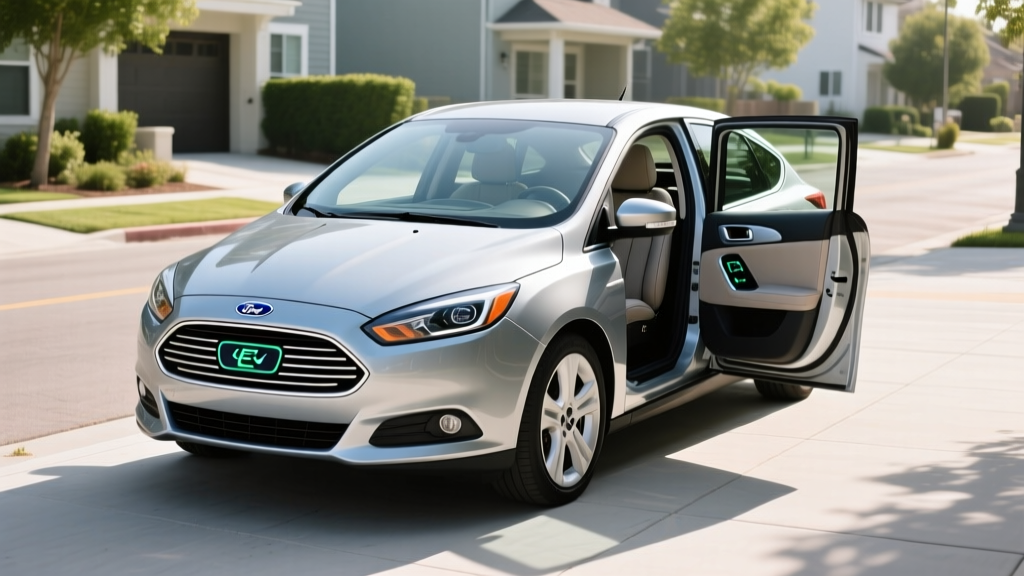
If you are considering a used 2016 Ford Focus EV as an affordable commuter car or second vehicle, here is the essential verdict: this is a short-range, city-oriented electric hatchback with an EPA-estimated 76 miles of range from a 23 kWh usable lithium-ion battery. In real-world driving, expect roughly 55–65 miles on the highway and potentially as low as 40–50 miles in freezing temperatures. It charges on CCS1 DC fast charging up to about 50 kW and Level 2 at 6.6 kW. Prices on the used market in 2026 typically range from $5,000 to $9,000 depending on mileage and battery state of health. It is not eligible for the federal §30D new-EV tax credit, and the federal used-EV credit (up to $4,000) has expired as of 2026. This car works best as a dedicated city commuter with reliable home Level 2 charging access and a second vehicle for longer trips.
Quick Verdict: 2016 Ford Focus EV
- EPA Range: 76 miles (real-world: ~55–65 mi highway, ~40–50 mi in cold)
- Battery: ~23 kWh usable, LG Chem NMC lithium-ion
- DC Fast Charge: CCS1, up to ~50 kW peak (10–80% in roughly 30–40 minutes)
- Level 2 Charge: 6.6 kW onboard charger (~4 hours from empty)
- Used Price (2026): ~$5,000–$9,000
- Best For: City commuting under 50 miles round-trip with home charging
Range, Battery, and Efficiency: What the Numbers Actually Mean
The 2016 Ford Focus Electric was built in a transitional era for EVs, before the 200+ mile range standard took hold. Its liquid-cooled 23 kWh usable battery (from a ~33.5 kWh gross pack) delivered an EPA rating of 76 miles and 105 MPGe combined (110 city / 99 highway), according to fueleconomy.gov. Efficiency is reasonable at roughly 32 kWh/100 miles.
Real-World Range Expectations
EPA Sticker: 76 miles
Warm-weather city driving: ~70–80 miles (regen braking helps in stop-and-go)
Highway at 70 mph: ~55–65 miles
Freezing weather (below 32°F): ~40–55 miles (no heat pump; resistive heater draws significant energy)
Combined realistic daily expectation: Plan for 50–60 usable miles to maintain a safe buffer.
The Focus EV lacks a heat pump, relying instead on a resistive cabin heater that can pull 3–5 kW on cold mornings. This is the single biggest range killer on this vehicle. If your commute is 30 miles each way in a cold climate, this car will be tight in winter. Preconditioning the cabin while plugged in at home mitigates some of this loss.
The battery chemistry is NMC (nickel manganese cobalt), which offers good energy density but is more susceptible to calendar degradation than LFP chemistry found in newer EVs. Expect a used 2016 example to have experienced 10–20% capacity loss after 8–10 years, depending on charging habits and climate exposure. A vehicle that was regularly DC fast-charged or left at 100% state of charge in hot climates will be on the higher end of that degradation range.
| Specification | Value |
|---|---|
| EPA Range | 76 miles |
| Battery (usable) | ~23 kWh, NMC lithium-ion |
| MPGe (combined) | 105 MPGe |
| Energy Consumption | ~32 kWh/100 mi |
| Motor Output | 107 kW (143 hp), 184 lb-ft torque |
| 0–60 mph | ~8.2 seconds |
| DC Fast Charge (peak) | ~50 kW (CCS1) |
| Level 2 Charge Rate | 6.6 kW (J1772) |
| Level 1 Charge Rate | 1.4 kW (120V) |
| Original MSRP | $29,170 (before incentives) |
| Battery Warranty (original) | 8 years / 100,000 miles |
Charging: Speeds, Connectors, and Home Setup
The 2016 Focus EV uses a CCS1 connector for DC fast charging and a standard J1772 connector for Level 1 and Level 2 AC charging. Ford equipped this model with a 6.6 kW onboard charger, which was competitive for its time and remains practical for overnight home charging.
| Charging Level | Power | Connector | Time (0–100%) | Miles Added per Hour |
|---|---|---|---|---|
| Level 1 (120V outlet) | ~1.4 kW | J1772 | ~18–20 hours | ~3–4 mi/hr |
| Level 2 (240V home/public) | 6.6 kW | J1772 | ~3.5–4 hours | ~18–20 mi/hr |
| DC Fast Charge | Up to ~50 kW | CCS1 | 10–80% in ~30–40 min | ~90–120 mi/hr (at peak) |
DC fast charging reality check: The 50 kW peak rate is modest by 2026 standards, where newer EVs routinely charge at 150–350 kW. On a 50 kW charger, the Focus EV will sustain close to peak rate up to roughly 60–70% state of charge, then taper significantly. A 10–80% session takes approximately 30–40 minutes. This is adequate for occasional road-trip top-ups but not something you would want to rely on daily.
CCS1 network access: The CCS1 connector remains widely supported at Electrify America, EVgo, and ChargePoint stations. However, the industry is transitioning toward NACS (the Tesla connector standard), and Ford's newer EVs use NACS with CCS adapters. For the 2016 Focus EV, CCS1 is your native connector, and it will remain compatible at most public chargers for the foreseeable future. Tesla Superchargers with Magic Dock adapters also support CCS1 vehicles.
Home charging recommendation: A Level 2 home charger is nearly essential for this vehicle. A 240V/30A circuit delivering 6.6 kW will fully recharge the battery overnight in about 4 hours. Professional installation of a Level 2 home charger typically costs $500–$2,000 depending on electrical panel capacity and run length from the panel to the garage. If your home has a 200-amp electrical panel with spare capacity, expect the lower end of that range. Older homes with 100-amp panels may require a panel upgrade ($1,500–$3,000) before adding a dedicated EV circuit.
EV vs. Gas Comparison: Cost and Practicality
How does a used 2016 Focus EV stack up against a comparable gas-powered compact car? The comparison below uses a 2016 Ford Focus SE (gasoline, 2.0L, automatic) as the baseline, based on EPA data.
| Metric | Focus EV | Focus Gas (2.0L Auto) |
|---|---|---|
| Fuel/Energy Cost (12,000 mi/yr) | ~$480 (at $0.13/kWh) | ~$1,440 (at $3.00/gal, 30 MPG) |
| Annual Fuel Savings (EV) | ~$960/year | |
| Oil Changes | None | 2–3 per year (~$120–$180) |
| Brake Wear | Minimal (regen braking) | Normal ($200–$400 per axle replacement) |
| Used Purchase Price (2026) | ~$5,000–$9,000 | ~$6,000–$10,000 |
| Insurance (avg. annual) | ~$1,200–$1,600 | ~$1,100–$1,500 |
| EPA Range | 76 miles | ~380 miles (12.4 gal tank) |
| Refuel/Recharge Time | 4 hrs (Level 2) / 35 min (DC) | ~5 minutes |
The bottom line on cost: Over five years of ownership at 12,000 miles per year, the Focus EV saves approximately $4,800 in fuel and $600–$900 in maintenance compared to the gas version. That is roughly $5,400–$5,700 in total savings. However, these savings assume reliable home charging and a commute within the car's range envelope. If you frequently need to DC fast charge at public stations (at $0.30–$0.50/kWh), your fuel cost advantage shrinks considerably.
Ownership Costs: The Full Financial Picture
Buying a used EV requires looking beyond the sticker price. Here is a realistic five-year cost-of-ownership breakdown for a 2016 Ford Focus EV purchased at $7,000 and driven 12,000 miles per year.
| Cost Category | Estimated 5-Year Total | Notes |
|---|---|---|
| Purchase Price | $7,000 | Mid-range used market (2026) |
| Home Charger Install | $800–$1,500 | One-time Level 2 setup |
| Electricity (charging) | $2,400 | $0.13/kWh avg, 60,000 miles total |
| Insurance | $7,000 | ~$1,400/year avg |
| Maintenance | $800–$1,200 | Tire rotation, cabin filter, wipers, brake fluid |
| Tires (1 replacement set) | $500–$800 | EVs wear tires slightly faster due to torque |
| Potential Battery Repair | $0–$3,000 | Out of warranty; module replacement if degraded |
| Depreciation (5-yr) | ~$3,000–$4,000 | Resale value ~$3,000–$4,000 after 5 more years |
| Total 5-Year Cost | $18,500–$22,000 | Excluding any major battery failure |
Battery replacement risk: The original 8-year/100,000-mile battery warranty has expired on all 2016 models. A full battery pack replacement is not economically viable for a car worth $7,000 (quotes typically range from $5,000–$8,000). However, individual module replacement or refurbishment by a specialist can cost $1,500–$3,000. Before purchasing, have the battery state of health (SoH) checked via OBD-II diagnostic tools or a Ford dealer. An SoH reading below 80% is a negotiation point or walk-away signal.
Common Misconceptions About the 2016 Focus EV
| Myth | Fact |
|---|---|
| "It can go 76 miles no matter what." | The 76-mile EPA figure assumes mixed driving at moderate temperatures. Highway driving, cold weather, and hill climbs reduce this to 40–65 miles. |
| "The battery will need replacing soon." | NMC batteries in liquid-cooled packs like this typically retain 80–90% capacity after 10 years. Check SoH before buying; most examples are still functional. |
| "I can charge it at Tesla Superchargers." | Only at Superchargers equipped with the Magic Dock CCS adapter. Native Tesla (NACS) stalls are not compatible without an adapter, which Ford does not officially provide for this model. |
| "Used EVs qualify for the $7,500 tax credit." | No. The §30D credit applies only to new EVs. The used-EV credit (up to $4,000 under §25E) expired at the end of 2025 and is not available in 2026. Check IRS.gov for current rules. |
| "Maintenance-free means zero costs." | You still need tire rotations, cabin air filters, brake fluid checks, windshield washer fluid, and eventual tire replacement. Budget $200–$300/year. |
Decision Framework: Should You Buy the 2016 Focus EV?
Choose the 2016 Ford Focus EV If:
- Your daily round-trip commute is under 50 miles, even in winter
- You have reliable home Level 2 charging (garage or driveway with 240V access)
- You own or have access to a second vehicle for road trips and long drives
- You want an affordable entry into EV ownership under $10,000
- You live in a mild or moderate climate (extreme cold significantly reduces range)
- You can verify battery SoH above 80% before purchase
Look Elsewhere If:
- Your commute exceeds 60 miles round-trip or includes significant highway driving
- You live in an apartment or lack home charging access
- You need a single vehicle that handles road trips and daily driving
- You live in a cold climate where winter range drops below 50 miles
- You want modern features like over-the-air updates, advanced ADAS, or NACS charging
- The battery SoH reads below 80% and no discount is offered
Better alternatives to consider: If the Focus EV's range is too limiting, look at used examples of the 2017–2018 Chevy Bolt EV (238 miles EPA, ~$9,000–$13,000 used) or the 2016–2018 Nissan Leaf with the 30 kWh battery (107 miles EPA, ~$7,000–$10,000 used, but note CHAdeMO connector limitations). For a plug-in hybrid that eliminates range anxiety entirely, a used Chevy Volt (53 miles electric + gas engine, ~$10,000–$14,000) may be more practical.
What to Inspect Before Buying
As with any used EV, a pre-purchase inspection focused on the high-voltage system is critical:
- Battery State of Health (SoH): Request an OBD-II battery report or visit a Ford dealer for a diagnostic. SoH above 85% is ideal; 80–85% is acceptable with price adjustment; below 80% is risky.
- Charging port and cable: Test both the J1772 and CCS1 connections. Look for corrosion, loose pins, or damage to the charge port door.
- Coolant system: The battery thermal management system uses a dedicated coolant loop. Check for leaks, proper coolant level, and service history.
- Tire condition: EVs are heavier and produce instant torque, accelerating tire wear. Budget for replacement if tread is below 4/32".
- 12V auxiliary battery: Like all EVs, the Focus EV has a conventional 12V battery that powers electronics. These typically last 3–5 years and cost ~$150–$250 to replace.
- Service records: Confirm any recall work was completed, particularly related to the battery charging system.
Frequently Asked Questions
Is the 2016 Ford Focus EV a good car in 2026?
It is a reasonable budget EV for city commuting if you have home charging and a second car. Its 76-mile EPA range is limiting by modern standards, and the expired battery warranty adds risk. For under $8,000 with a healthy battery, it offers very low running costs.
How long does the battery last on a 2016 Focus EV?
The liquid-cooled NMC battery typically retains 80–90% of original capacity after 10 years. Most 2016 examples in 2026 will show 10–20% degradation. The battery can last 150,000+ miles before needing significant service, but individual module failures can occur and are costly out of warranty.
Can I road-trip in a 2016 Ford Focus EV?
Technically yes, but it requires careful planning around CCS1 DC fast chargers spaced no more than 40–50 miles apart, and each stop takes 30–40 minutes. Most owners use it as a commuter and keep a gas car for trips.
Does the 2016 Focus EV qualify for any tax credits in 2026?
No. The federal §30D new-vehicle credit does not apply to used purchases. The §25E used-EV credit (up to $4,000) expired at the end of 2025 and is not available for 2026 purchases. Some states or local utilities may offer rebates for used EV purchases or home charger installation — check your state energy office and utility provider.
What is the top speed and acceleration?
The 107 kW (143 hp) electric motor delivers 184 lb-ft of torque, pushing the Focus EV from 0–60 mph in approximately 8.2 seconds. Top speed is electronically limited to 84 mph. Acceleration feels brisk around town due to instant torque but the car runs out of breath at highway passing speeds.
How much does it cost to charge at home?
A full charge from empty to 100% uses about 23 kWh. At the US average residential rate of $0.13/kWh, that is roughly $3.00 per full charge, or about $0.04 per mile. Compare that to a gas Focus at $0.12/mile (at $3.00/gallon and 30 MPG combined).