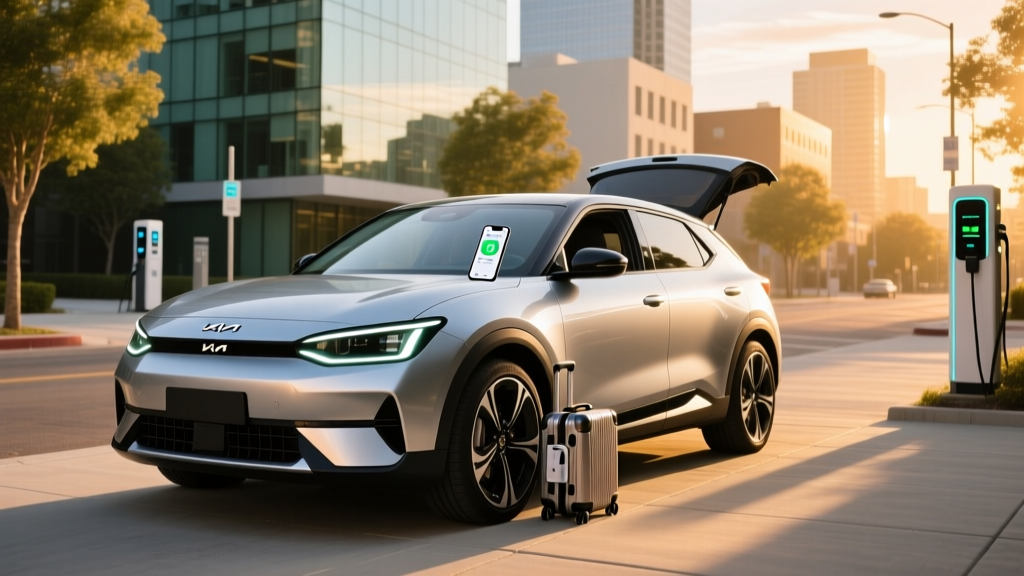
The Kia EV5 is the automaker's latest entry into the compact electric crossover segment, slotting below the EV6 and EV9 in Kia's expanding battery-electric lineup. Built on the Hyundai Motor Group's E-GMP platform, the EV5 targets buyers who want practical family space, competitive range, and Kia's strong warranty package — without stepping up to the larger, pricier EV9. After spending time with the specs, charging curves, and ownership math, here is everything you need to know before putting down a deposit.
2026 Kia EV5 at a Glance: Key Specifications
| Specification | EV5 Light (RWD) | EV5 Wind (AWD) | EV5 GT-Line (AWD) |
|---|---|---|---|
| EPA Range | 295 miles | 270 miles | 258 miles |
| Battery (usable) | 77.4 kWh, NMC lithium-ion | ||
| Horsepower | 215 hp | 320 hp | |
| 0-60 mph | 7.8 sec | 5.1 sec | |
| Drivetrain | Rear-wheel drive | Dual-motor AWD | |
| Max DC Fast Charge | ~240 kW (peak) | ||
| 10-80% DC Fast Charge | ~18 minutes (ideal conditions) | ||
| Level 2 Home Charge (10.9 kW) | ~32 miles per hour of charging | ||
| MPGe (combined) | 118 MPGe | 105 MPGe | 100 MPGe |
| Base MSRP | $41,900 | $47,500 | $52,200 |
| Battery/Powertrain Warranty | 10 years / 100,000 miles | ||
Sources: fueleconomy.gov (EPA estimates), Kia USA official specifications. Real-world results may vary.
Range and Efficiency: EPA Sticker vs. Real-World Driving
Real-World Expectation: Plan for 240-265 miles in mixed highway driving at 70-75 mph; expect a 15-25% reduction in sustained cold weather (below 30°F), bringing effective range to roughly 195-225 miles on AWD trims.
The RWD EV5 Light returns the longest EPA-rated range at 295 miles, thanks to its single-motor layout and lower curb weight. The dual-motor AWD trims sacrifice 25-37 miles of rated range to gain all-weather traction and significantly more power.
In real-world highway driving — the scenario that matters most for road-trip planning — the EV5's efficiency settles around 3.0-3.3 miles per kWh depending on trim and ambient temperature. That translates to roughly 230-255 usable highway miles before you'll want to stop at a charger. City driving with frequent regenerative braking opportunities pushes efficiency closer to the EPA combined figure, and some owners will see 280+ miles in stop-and-go commuting.
Cold weather remains the universal EV equalizer. The EV5 uses a heat pump (standard on Wind and GT-Line trims, optional on Light) to warm the cabin and precondition the battery, which mitigates but does not eliminate winter range loss. If you live in northern climates where temperatures routinely drop below freezing, budget for 200-220 miles of practical winter range on AWD models.
Charging Speed: DC Fast Charging and Home Level 2
The EV5 inherits the E-GMP platform's 800-volt electrical architecture, which enables some of the fastest DC charging available in this price bracket.
| Charging Level | Power / Rate | What You Get |
|---|---|---|
| Level 1 (120V household) | ~1.4 kW | ~4-5 miles per hour — emergency/trickle only |
| Level 2 (240V home, 48A) | 10.9 kW | ~32 miles per hour; full charge in ~8 hours |
| DC Fast Charge (peak) | ~240 kW | 10-80% in ~18 min on a 350 kW-capable station |
| DC Fast Charge (typical 150 kW station) | ~150 kW (sustained) | 10-80% in ~27 minutes |
Charging curve reality: The headline 240 kW peak is achieved between roughly 10-45% state of charge. Above 55%, the rate tapers to approximately 150 kW, and above 80% it drops further to protect battery longevity — typical of NMC chemistry. On a road trip, your most efficient strategy is to charge from 10-80% and drive on, rather than topping off to 100% at a fast charger, where the final 20% can take as long as the first 70%.
At home, the onboard 10.9 kW charger fills the 77.4 kWh battery from empty to full in about 8 hours on a properly installed 240V/48A Level 2 circuit. Most owners who plug in nightly will never need a full charge — topping up 40-50% overnight adds 120-150 miles and takes roughly 4 hours.
The EV5 ships with the NACS (North American Charging Standard) connector, giving native access to Tesla Supercharger stations (15,000+ locations) as well as Electrify America, EVgo, and other networks that have adopted NACS. This is a significant advantage over CCS-equipped competitors that require adapters for Supercharger access.
Performance and Driving Dynamics
The RWD Light trim's 215 hp and 7.8-second 0-60 time are adequate for daily commuting and merging but won't excite anyone coming from a sport sedan. Where the EV5 shines is the AWD trims: 320 hp and a 5.1-second 0-60 make the Wind and GT-Line genuinely quick off the line, with the instant torque delivery that defines electric drivetrains.
Ride quality leans toward the comfortable side, with well-tuned damping that absorbs highway expansion joints without the floatiness some competitors exhibit. The low center of gravity from the underfloor battery pack keeps body roll controlled in corners, though the steering is weighted for comfort rather than feedback. This is a family crossover, not a canyon carver, and that tuning choice is the right one for the segment.
All trims feature multiple regenerative braking modes, selectable via steering-wheel paddles, ranging from light coasting regen to full one-pedal driving that brings the EV5 to a complete stop without touching the brake pedal. The i-Pedal mode is smooth and predictable — among the better one-pedal implementations in the segment.
Interior Space, Cargo, and Technology
The EV5's interior is where it makes a compelling case against segment rivals. Passenger space is generous for a compact crossover:
- Front headroom: 40.2 inches
- Rear legroom: 38.4 inches — enough for adults on long trips
- Cargo behind rear seats: 31.5 cubic feet
- Cargo with rear seats folded: 69.8 cubic feet
- Front trunk (frunk): 1.8 cubic feet (enough for a charging cable bag or small groceries)
The dual 12.3-inch panoramic display handles infotainment and driver information, running Kia's latest Connect system with wireless Apple CarPlay and Android Auto. The center console features a sliding tray and hidden storage — a clever use of the flat EV floor. Physical climate controls are retained below the screen, a decision we strongly endorse over the touch-only panels some competitors use.
Driver assistance: The EV5 comes standard with Kia's Highway Driving Assist 2 (HDA2), a Level 2 SAE driver-assistance system that combines adaptive cruise control with lane-centering on divided highways. It handles stop-and-go traffic competently but requires hands-on-wheel engagement at all times. This is not a self-driving system — the driver remains responsible for vehicle operation. Available Remote Smart Parking Assist lets you move the EV5 in and out of tight spaces via the key fob.
Pricing, Trims, and Federal Tax Credit Eligibility
The 2026 EV5 is offered in three trims, with pricing that positions it squarely against the Hyundai Ioniq 5, Ford Mustang Mach-E, and Volkswagen ID.4:
| Trim | Base MSRP | Est. Destination | Potential §30D Credit | Effective Price (if eligible) |
|---|---|---|---|---|
| EV5 Light (RWD) | $41,900 | $1,395 | Up to $7,500 | ~$35,795 |
| EV5 Wind (AWD) | $47,500 | $1,395 | Up to $7,500 | ~$41,395 |
| EV5 GT-Line (AWD) | $52,200 | $1,395 | Up to $7,500 | ~$46,095 |
Federal tax credit (§30D) eligibility is not automatic. Under current IRS rules, the buyer must meet all of the following:
- MSRP cap: SUVs/crossovers must have an MSRP at or below $80,000 — all EV5 trims qualify.
- Buyer income cap: Modified adjusted gross income must not exceed $150,000 (single), $225,000 (head of household), or $300,000 (joint filers).
- Battery sourcing: The battery's critical minerals and components must meet phased-in domestic/free-trade sourcing thresholds. Kia has indicated the EV5's battery meets the 2026 thresholds, but verify at point of sale — sourcing rules tighten annually.
- Point-of-sale transfer: Buyers can elect to transfer the credit to the dealer at purchase, reducing the purchase price directly rather than waiting for a tax refund.
Always confirm credit eligibility with your tax professional before purchase. Rules change, and individual circumstances vary. The dealer should be able to provide a IRS seller report at the time of sale.
Pros, Cons, and the Verdict
Pros
- 800V architecture enables 240 kW peak DC fast charging — 10-80% in ~18 min
- NACS connector provides native Tesla Supercharger access
- Generous rear legroom (38.4 in) and cargo volume (31.5 cu ft)
- 10-year/100,000-mile battery and powertrain warranty
- Physical climate controls retained alongside digital displays
- Heat pump standard on Wind and GT-Line trims
- Competitive pricing with full §30D credit eligibility (if sourcing/income requirements met)
Cons
- RWD base trim feels underpowered for the price (7.8s 0-60)
- Frunk is small (1.8 cu ft) — mostly a cable-storage cubby
- Real-world highway range on AWD trims falls to ~230-240 miles
- HDA2 is competent but not class-leading among Level 2 systems
- GT-Line pricing pushes past $52K before options — overlaps with EV6 territory
How the Kia EV5 Stacks Up Against Competitors
The EV5 enters a crowded compact EV crossover segment. Here is how it compares on the metrics buyers care about most:
| Metric | 2026 Kia EV5 (AWD) | 2026 Hyundai Ioniq 5 (AWD) | 2026 Ford Mustang Mach-E (AWD) | 2026 VW ID.4 (AWD) |
|---|---|---|---|---|
| EPA Range | 270 mi | 290 mi | 275 mi | 263 mi |
| Max DC Charge | ~240 kW | ~240 kW | ~150 kW | ~175 kW |
| 10-80% Time | ~18 min | ~18 min | ~32 min | ~28 min |
| Rear Legroom | 38.4 in | 39.4 in | 38.1 in | 37.6 in |
| Cargo (rear seats up) | 31.5 cu ft | 27.2 cu ft | 29.7 cu ft | 30.3 cu ft |
| Battery Warranty | 10yr/100k mi | 10yr/100k mi | 8yr/100k mi | 8yr/100k mi |
| Starting MSRP (AWD) | $47,500 | $49,500 | $48,995 | $47,995 |
The EV5's strongest advantages are its cargo volume (best in this group), its 800V fast-charging speed, and Kia's 10-year warranty. The Ioniq 5 offers slightly more range and rear legroom on the same platform; the Mach-E has sportier driving dynamics but slower charging; the ID.4 is a value play but trails on charging speed and efficiency. For buyers prioritizing cargo space and fast road-trip charging, the EV5 makes a compelling argument.
Frequently Asked Questions
What is the real-world range of the 2026 Kia EV5?
Expect 240-265 miles in mixed highway driving on AWD trims, and up to 280 miles in city-dominant commuting on the RWD model. In sustained cold weather (below 30°F), plan for 195-225 miles on AWD trims. The EPA sticker says 270-295 miles, but real-world conditions — speed, temperature, terrain, and climate-control use — reduce that figure.
How fast does the Kia EV5 charge at home and on the road?
At home on a 240V Level 2 charger (48A), the EV5 adds roughly 32 miles of range per hour, filling from empty in about 8 hours. On a DC fast charger capable of 350 kW, the EV5 peaks at approximately 240 kW and charges from 10-80% in about 18 minutes. On more common 150 kW stations, expect 10-80% in roughly 27 minutes. The 800V architecture gives it a meaningful advantage over 400V competitors like the Mach-E and ID.4.
Does the 2026 Kia EV5 qualify for the $7,500 federal EV tax credit?
The EV5's MSRP falls well under the $80,000 SUV cap, and Kia has indicated its battery meets 2026 critical-mineral and component sourcing thresholds. However, eligibility also depends on the buyer's income (caps of $150K/$225K/$300K depending on filing status). Confirm eligibility with your tax professional and request the IRS seller report at the dealership. The credit can be transferred at point of sale to reduce your purchase price directly.
Is the Kia EV5 worth buying over the Hyundai Ioniq 5 or Tesla Model Y?
If cargo space, fast DC charging, and a long warranty top your priorities, the EV5 is a strong choice. The Ioniq 5 shares the same E-GMP platform and offers slightly more range and rear legroom but less cargo room. The Tesla Model Y offers the most range and the Supercharger network (though the EV5 now has native NACS access too) but has a firmer ride and a more minimalist interior that not everyone prefers. Test-drive all three — the decision often comes down to seating comfort and cargo needs.
What battery chemistry does the EV5 use, and how long will it last?
The EV5 uses NMC (nickel manganese cobalt) lithium-ion chemistry, which offers high energy density for strong range in a compact package. NMC batteries typically retain 85-90% of original capacity after 100,000 miles based on industry degradation data. Kia backs the battery with a 10-year/100,000-mile warranty that guarantees at least 70% capacity retention — one of the strongest warranties in the segment.
Can the Kia EV5 tow?
The AWD EV5 trims are rated for up to 2,700 pounds of towing capacity when properly equipped — sufficient for a small utility trailer or a pair of dirt bikes, but not for a boat or camper. Towing will reduce range by 30-50% depending on trailer weight and aerodynamics.
Always verify specifications, pricing, and tax-credit eligibility with Kia USA, fueleconomy.gov, and a qualified tax professional before purchasing. Specifications and incentive rules are subject to change.