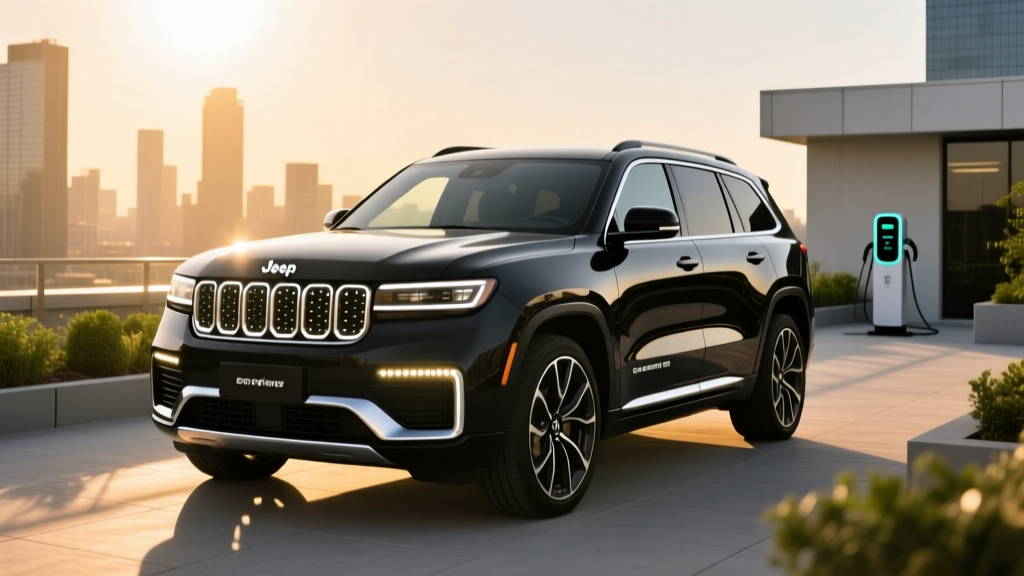
The 2026 Jeep Wagoneer S is Stellantis' flagship electric SUV built on the dedicated STLA Large platform, and it arrives with a clear mission: deliver genuine Jeep capability in a fully electric package that competes directly with the Tesla Model X, BMW iX, and Cadillac Lyriq. After spending time with the specs, analyzing its charge curve, and comparing it against the luxury electric SUV field, here is everything buyers need to know before signing a lease or purchase agreement.
The 2026 Wagoneer S carries an EPA-estimated range of 300 miles from its 100 kWh (usable) battery pack. In real-world highway driving at 70-75 mph, expect approximately 250-270 miles before needing a charge. In cold weather (below 30°F), range can drop to 210-240 miles depending on cabin heating demands and whether you precondition the battery. City driving with regenerative braking can match or slightly exceed the EPA sticker.
2026 Jeep Wagoneer S: Full Specifications at a Glance
| Specification | 2026 Wagoneer S Launch Edition |
|---|---|
| EPA Range | 300 miles |
| Battery Capacity | 100 kWh usable (NMC chemistry) |
| Drivetrain | Dual-motor AWD |
| Horsepower | 600 hp (combined) |
| Torque | 617 lb-ft |
| 0-60 mph | 3.4 seconds |
| DC Fast Charge (peak) | 150 kW (CCS1) |
| 10-80% DC Charge Time | ~23 minutes |
| Level 2 Home Charging | 11.5 kW onboard charger (~30 mi/hr) |
| MPGe (combined) | 89 MPGe |
| Efficiency | 38 kWh/100 mi |
| Cargo Volume (behind 2nd row) | 30.5 cu ft |
| Cargo Volume (max, seats folded) | 61.2 cu ft |
| Rear Legroom | 38.5 inches |
| Base MSRP | $65,200 (Launch Edition) |
| Battery/Powertrain Warranty | 8 years / 100,000 miles |
Battery, Range, and Charging: What Owners Actually Experience
The Wagoneer S uses a 100 kWh usable NMC (nickel-manganese-cobalt) battery pack mounted low in the STLA Large skateboard platform. NMC chemistry was chosen here for its higher energy density compared to LFP, which helps Jeep package a large battery without compromising interior space or ground clearance. The trade-off is that NMC batteries are generally more sensitive to sustained 100% state of charge — daily charging to 80% is recommended for longevity, which still gives you roughly 240 real-world miles for commuting.
DC Fast Charging: The Curve Matters More Than the Peak
Jeep rates the Wagoneer S at a peak 150 kW on DC fast chargers using the CCS1 connector. That peak is achievable between roughly 10-30% state of charge, after which the charge curve tapers progressively. The 10-80% time of approximately 23 minutes is competitive with the segment but falls short of 800V architectures like the Hyundai Ioniq 5 or Kia EV6, which can pull 10-80% in around 18 minutes at 240 kW or higher.
| Charging Method | Power (kW) | Miles Added per Hour | Time to Full |
|---|---|---|---|
| Level 1 (120V household) | ~1.4 kW | ~3-4 mi/hr | ~70+ hours |
| Level 2 (240V home, 48A) | 11.5 kW | ~30 mi/hr | ~9 hours (0-100%) |
| DC Fast Charge (peak) | 150 kW | ~350 mi/hr (peak) | 10-80% in ~23 min |
For home charging, the 11.5 kW onboard charger is a strong point. A full overnight charge on a Level 2 home station (requiring a 60A circuit) will replenish the entire 100 kWh pack in about 9 hours, or add roughly 200 miles of range in a typical 6-7 hour overnight window. We recommend a hardwired Level 2 station from ChargePoint, Enel X, or Tesla's Universal Wall Connector — budget $500-$800 for the unit and $800-$2,000 for professional installation depending on your electrical panel capacity. A licensed electrician should confirm whether your home's 200A panel can support a 60A dedicated circuit.
Performance and Drivetrain: 600 HP With Jeep DNA
The Launch Edition comes exclusively with a dual-motor all-wheel-drive powertrain producing a combined 600 horsepower and 617 lb-ft of torque. The 0-60 mph time of 3.4 seconds places the Wagoneer S firmly in performance SUV territory, matching or beating the BMW iX M60 and falling just behind the Tesla Model X Plaid. This is the quickest production Jeep ever built.
Beyond straight-line speed, Jeep has engineered the Wagoneer S with Selec-Terrain drive modes including Snow, Sand, and a dedicated Eco mode that optimizes regen and throttle mapping for maximum range. The AWD system can disconnect the front motor entirely during steady-state highway cruising to improve efficiency — a feature that contributes to the 300-mile EPA rating. Ground clearance of approximately 8.1 inches and Jeep's traditional approach/departure angle focus mean this EV can handle light off-road trails, though the 22-inch wheels on the Launch Edition are best kept on pavement.
Interior, Technology, and Daily Livability
The cabin is where the Wagoneer S makes its strongest case against German rivals. The dashboard features a combined 45 inches of screen real estate across the driver cluster, central infotainment touchscreen, and a dedicated front-passenger display — all running Stellantis' Uconnect 5 system with native wireless Apple CarPlay and Android Auto. A head-up display and digital rearview mirror round out the tech stack.
Passenger space accommodates five adults comfortably. The 38.5 inches of rear legroom is competitive with the BMW iX and noticeably more generous than the Tesla Model Y's second row. The flat floor (thanks to the skateboard platform) gives the middle rear passenger a real place to put their feet.
Cargo space measures 30.5 cubic feet behind the second row and 61.2 cubic feet with the rear seats folded flat. There is also a front trunk (frunk) providing additional sealed storage for charging cables or groceries — a practical advantage over the BMW iX, which has no frunk.
Driver Assistance
The Wagoneer S offers Active Driving Assist, which is an SAE Level 2 driver-assistance system. It provides adaptive cruise control and lane-centering on highways, but the driver must remain fully attentive with hands on the wheel at all times. This is not self-driving. Jeep has not announced a hands-free Level 2+ system (like GM's Super Cruise or Ford's BlueCruise) for the 2026 Wagoneer S at launch.
Pricing, Trims, and Federal Tax Credit Eligibility
The 2026 Jeep Wagoneer S launches in a single Launch Edition trim at $65,200 MSRP (including destination). Jeep has indicated that lower-priced trims will follow, potentially starting in the mid-$50,000 range, but as of the current model year, only the Launch Edition is available for order.
| Cost Factor | Amount |
|---|---|
| Base MSRP (Launch Edition) | $65,200 |
| Federal Tax Credit (max, if eligible) | Up to $7,500 |
| Effective Price After Max Credit | ~$57,700 |
| Estimated Home Level 2 Installation | $1,300 - $2,800 |
Does the Wagoneer S Qualify for the $7,500 Federal Tax Credit?
Under IRS §30D rules for the 2026 tax year, the Wagoneer S is eligible for the new clean vehicle credit, but qualification depends on several buyer- and vehicle-specific factors:
- MSRP Cap: SUVs must have an MSRP at or below $80,000. The Wagoneer S Launch Edition at $65,200 clears this threshold.
- Buyer Income Limits: Modified adjusted gross income (MAGI) must not exceed $300,000 (joint filers), $225,000 (head of household), or $150,000 (single filers).
- Battery Component Sourcing: A percentage of battery components must be manufactured or assembled in North America, and critical minerals must meet sourcing thresholds. These percentages increase each year. Check the latest fueleconomy.gov listing for the Wagoneer S's current sourcing status.
- Point-of-Sale Transfer: Eligible buyers can transfer the credit to the dealer at purchase, reducing the purchase price by up to $7,500 at the point of sale rather than waiting for a tax refund.
Critical caveat: Battery sourcing requirements tighten annually, and some EVs that qualified in prior years have lost partial or full credit eligibility. Always verify the Wagoneer S's current status on fueleconomy.gov before signing paperwork, and consult a tax professional for your specific situation.
2026 Jeep Wagoneer S vs. Key Competitors
The Wagoneer S enters a crowded luxury electric SUV segment. Here is how it stacks up against the three most common cross-shops:
| Spec | Jeep Wagoneer S | Tesla Model X LR | BMW iX xDrive50 | Cadillac Lyriq AWD |
|---|---|---|---|---|
| EPA Range | 300 mi | 335 mi | 324 mi | 307 mi |
| Battery (kWh) | 100 | ~100 | 111.5 | 102 |
| 0-60 mph | 3.4s | 3.8s | 4.4s | 4.6s |
| HP | 600 | 670 | 516 | 500 |
| Peak DC Charge | 150 kW | 250 kW | 200 kW | 190 kW |
| 10-80% Time | ~23 min | ~15 min | ~31 min | ~27 min |
| Cargo (rear seats up) | 30.5 cu ft | 37.1 cu ft | 35.5 cu ft | 28.0 cu ft |
| Starting MSRP | $65,200 | $79,990 | $87,250 | $62,990 |
The Wagoneer S's biggest competitive advantage is price-to-performance. At $65,200, it delivers 600 hp and a 3.4-second 0-60 time — figures that cost $15,000-$22,000 more from BMW and Tesla. Its biggest disadvantage is charging speed. At 150 kW peak, it is the slowest DC charger in this comparison, which matters on road trips where a 23-minute stop stretches to 30+ minutes on longer segments because of the taper curve.
Pros and Cons
✓ Pros
- Best-in-class price-to-performance ratio (600 hp at $65,200)
- 300-mile EPA range is practical for most daily and regional driving
- Spacious cabin with 45 inches of total screen real estate
- Standard dual-motor AWD with Selec-Terrain modes
- Generous 8-year/100,000-mile battery warranty
- Frunk adds practical sealed storage
- Eligible for up to $7,500 federal tax credit (verify sourcing annually)
✗ Cons
- 150 kW peak DC charging is below segment leaders
- No hands-free driving system (only Level 2 with hands-on requirement)
- Launch Edition only at launch; lower trims not yet available
- 22-inch wheels may reduce real-world range and ride comfort
- No third-row option (5-seat only)
- Efficiency at 38 kWh/100 mi is higher (worse) than lighter competitors
- Long-term reliability of STLA Large platform is unproven
Who Should Buy the 2026 Jeep Wagoneer S?
- You want 600 hp AWD performance without spending $80,000+
- Your typical driving is under 250 miles per day with overnight home charging
- You value a premium, screen-heavy interior with a front-passenger display
- You want Jeep brand identity and light off-road capability in an EV
- You qualify for the full $7,500 federal tax credit
- You road-trip frequently and need the fastest possible DC charging (consider Tesla Model X or Hyundai Ioniq 5)
- You need a third row for more than 5 passengers (consider the Kia EV9 or Rivian R1S)
- You want hands-free highway driving (consider GM Super Cruise or Ford BlueCruise vehicles)
- You need maximum cargo space for large gear hauling
Warranty and Ownership Costs
Jeep covers the Wagoneer S battery and electric powertrain for 8 years or 100,000 miles, whichever comes first. The battery warranty guarantees retention above 70% of original capacity during the coverage period — this is the industry-standard threshold also used by Tesla, Hyundai, and Ford. The bumper-to-bumper limited warranty is 3 years/36,000 miles.
On the ownership-cost side, electricity for the Wagoneer S at the national average of $0.16/kWh works out to approximately $6.08 per 100 miles driven. Compare that to a gas SUV getting 22 MPG at $3.50/gallon, which costs about $15.91 per 100 miles. Over 15,000 annual miles, that is roughly $1,475 in annual fuel savings with the EV, not accounting for reduced maintenance (no oil changes, fewer brake replacements thanks to regenerative braking).
Insurance premiums for the Wagoneer S are expected to run higher than the segment average due to the 600 hp output and $65,000+ replacement value. Get quotes before committing — performance EVs typically carry 15-25% higher premiums than equivalent gas vehicles according to industry data.
Frequently Asked Questions
What is the real-world range of the 2026 Jeep Wagoneer S?
The EPA rates the Wagoneer S at 300 miles. Real-world highway driving at 70-75 mph typically yields 250-270 miles. In cold weather below 30°F, expect 210-240 miles. City driving with regenerative braking can match or slightly exceed the EPA figure.
How fast does the Wagoneer S charge at home and on DC fast chargers?
On a Level 2 home charger (240V, 48A), the Wagoneer S charges at 11.5 kW, adding about 30 miles of range per hour and reaching a full charge in roughly 9 hours. On DC fast chargers, it peaks at 150 kW and charges from 10-80% in approximately 23 minutes, though the charge curve tapers significantly above 50% state of charge.
Does the 2026 Wagoneer S qualify for the $7,500 federal EV tax credit?
The Wagoneer S is eligible for the §30D credit, but qualification depends on your income (MAGI caps of $300K joint / $150K single), the vehicle's battery component and critical-mineral sourcing compliance (which changes annually), and the MSRP staying under $80,000 (it does at $65,200). Always verify current status on fueleconomy.gov and consult a tax professional.
Is the Wagoneer S worth buying over the Tesla Model X or BMW iX?
It depends on your priorities. The Wagoneer S offers the best performance-per-dollar at $65,200 for 600 hp. The Model X has longer range (335 mi) and much faster DC charging (250 kW) but costs $15,000 more. The BMW iX has a more luxurious cabin and longer range but starts at $87,250. If value and performance matter most, the Wagoneer S wins; if road-trip charging speed matters most, the Model X is the stronger pick.
Does the Wagoneer S have hands-free self-driving?
No. The Wagoneer S uses Active Driving Assist, which is an SAE Level 2 system requiring the driver to keep hands on the wheel at all times. It provides adaptive cruise and lane centering but is not autonomous. Jeep does not currently offer a hands-free system comparable to GM's Super Cruise or Ford's BlueCruise.
What connector does the Wagoneer S use?
The 2026 Wagoneer S uses the CCS1 connector for DC fast charging and the J1772 connector for Level 1 and Level 2 AC charging. If you plan to use Tesla Superchargers (which use the NACS connector), you will need a CCS-to-NACS adapter — check with Jeep for official adapter compatibility.