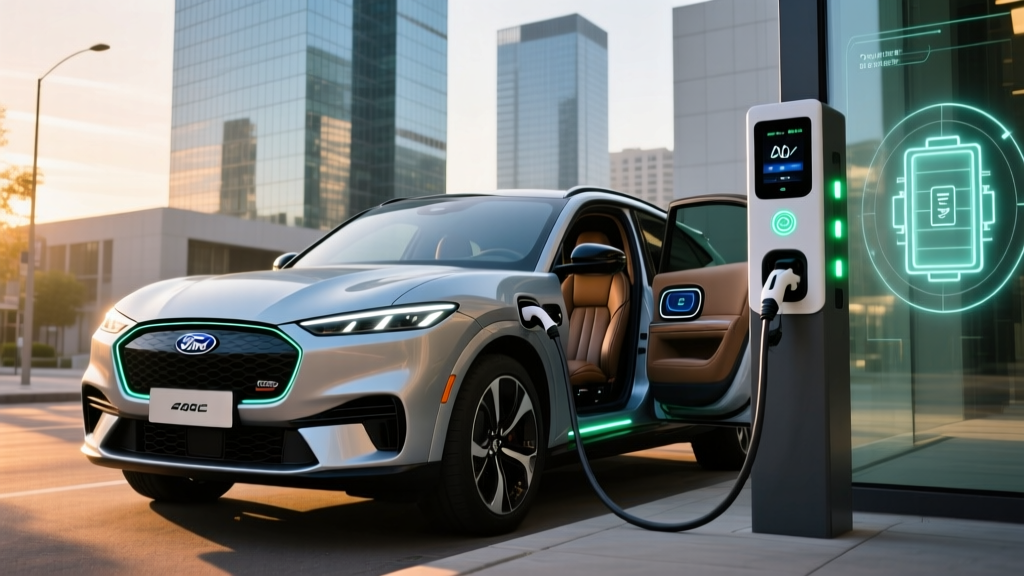
The Ford Mustang Mach-E has evolved steadily since its 2021 debut, and the 2026 model year brings incremental but meaningful refinements to Ford's electric crossover. With the NACS charge port now standard, a proven battery platform, and pricing that undercuts several rivals, the 2026 Ford Mustang Mach-E SUV occupies a specific niche: a practical, performance-credible electric family hauler that doesn't try to be a luxury statement. This review breaks down the exact numbers buyers need — range, charging curves, real-world efficiency, and after-credit pricing — to decide if it earns a spot in the driveway.
2026 Mach-E Lineup: Trims, Pricing, and Tax Credit Eligibility
Ford has streamlined the Mach-E lineup for 2026 into four trims, all available with either rear-wheel drive or all-wheel drive. Pricing starts just under $38,000 before destination, which positions the Mach-E below the Tesla Model Y and Hyundai Ioniq 5 in base form.
| Trim | Drivetrain | Battery | EPA Range | MSRP |
|---|---|---|---|---|
| Select RWD | RWD | 72 kWh (LFP) | 250 mi | $37,995 |
| Select AWD | Dual-motor AWD | 72 kWh (LFP) | 230 mi | $40,995 |
| Premium RWD | RWD | 91 kWh (NMC) | 320 mi | $44,495 |
| Premium AWD | Dual-motor AWD | 91 kWh (NMC) | 290 mi | $47,495 |
| GT | Dual-motor AWD | 91 kWh (NMC) | 280 mi | $54,995 |
| Rally | Dual-motor AWD | 91 kWh (NMC) | 265 mi | $57,995 |
Destination charge: $1,395 across all trims.
Federal §30D Tax Credit: Does the 2026 Mach-E Qualify?
- Credit amount: Up to $7,500, available as a point-of-sale transfer to the dealer (reducing your purchase price at signing).
- MSRP cap: The Mach-E qualifies as an SUV under IRS rules, so the cap is $80,000. All trims clear this threshold.
- Buyer income limits (2026 tax year): $150,000 single / $225,000 head of household / $300,000 married filing jointly (modified AGI).
- Battery sourcing: The Select trim's LFP battery uses CATL cells, which may face partial critical-mineral sourcing restrictions under current §30D rules — potentially reducing the credit to $3,750 or disqualifying this trim. The Premium and GT trims use NMC cells with more diversified sourcing and are more likely to qualify for the full $7,500.
- Action item: Confirm eligibility with your dealer and a tax professional before purchase. Rules are subject to change. See IRS §30D guidance.
| Trim | MSRP + Dest. | Est. After $7,500 Credit | Est. After $3,750 Credit |
|---|---|---|---|
| Select RWD | $39,390 | $31,890* | $35,640* |
| Premium RWD | $45,890 | $38,390 | $42,140 |
| Premium AWD | $48,890 | $41,390 | $45,140 |
| GT | $56,390 | $48,890 | $52,640 |
*Select trim credit amount depends on battery sourcing compliance — verify before purchase.
Range and Efficiency: EPA Numbers vs. Real-World Driving
The headline number for most buyers is the Premium RWD's 320-mile EPA estimate, which is competitive in the midsize electric SUV segment. But EPA range is measured under controlled conditions, and real-world results depend heavily on speed, temperature, and terrain.
Real-World Range Expectations: 2026 Mach-E Premium RWD
EPA sticker: 320 miles
Real-world highway (70-75 mph, 65°F): ~270–285 miles
Real-world mixed driving (city/suburban, moderate climate): ~295–310 miles
Cold weather (20°F, highway, cabin heat on): ~210–240 miles (30–35% reduction)
Cold weather with preconditioning + heat pump: ~245–260 miles
The Mach-E's heat pump (standard on Premium and above) is a genuine advantage in cold climates — it reduces the efficiency penalty of cabin heating by pulling ambient warmth rather than relying solely on resistive elements. Select trims use a resistive heater, which contributes to greater cold-weather range loss.
Efficiency ratings from fueleconomy.gov place the Premium RWD at approximately 101 MPGe combined (33 kWh/100 mi), while the AWD Premium drops to around 93 MPGe combined (36 kWh/100 mi). The GT's performance-oriented tuning and stickier tires reduce efficiency further to roughly 84 MPGe (40 kWh/100 mi).
Charging Speed: DC Fast Charge, Level 2, and NACS Access
The 2026 Mach-E ships with the NACS (Tesla-style) charge port as standard equipment, a significant shift from the CCS1 port on earlier models. This grants native access to Tesla's Supercharger network — the largest and most reliable DC fast-charging network in North America — without an adapter.
| Charging Level | Power | Connector | Speed / Time |
|---|---|---|---|
| Level 1 (120V household) | ~1.4 kW | NACS (mobile cord) | ~3–4 miles per hour |
| Level 2 (240V home, 48A) | 11.5 kW | NACS (wall connector) | ~27 miles per hour; 0–100% in ~9.5 hours (91 kWh battery) |
| Level 2 (240V home, 32A) | 7.7 kW | NACS (mobile cord) | ~18 miles per hour; 0–100% in ~13 hours |
| DC Fast Charge (peak) | 150 kW | NACS (Supercharger/EA) | 10–80% in ~36 minutes |
Understanding the DC charging curve: The Mach-E's 150 kW peak rate applies only at low state-of-charge (typically 10–30% SoC) and optimal battery temperature. As the battery fills, the rate tapers — by 60% SoC, expect roughly 90–100 kW, and above 80%, charging slows dramatically to protect the cells. A 10–80% session takes approximately 36 minutes at a 150+ kW Supercharger stall, but an 80–100% top-off can add another 30+ minutes. For road trips, the practical strategy is charging to 80% and moving on.
Home charging setup: The onboard charger accepts up to 11.5 kW (48 amps) on Level 2, which means a full overnight charge for even the 91 kWh extended-range battery. Ford recommends a hardwired NACS wall connector on a 60-amp circuit. Budget $500–$1,200 for the charger unit and $800–$2,500 for professional installation depending on panel proximity and local permit requirements. A 200-amp electrical panel is generally sufficient; older homes with 100-amp service may need an upgrade ($1,500–$3,000).
Performance: 0-60, Horsepower, and Drivetrain Breakdown
The Mach-E's performance profile varies significantly by trim. Ford has retained the single-motor RWD and dual-motor AWD configurations, with the GT continuing as the performance flagship.
| Trim | Horsepower | Torque (lb-ft) | 0–60 mph | Drivetrain |
|---|---|---|---|---|
| Select RWD | 266 hp | 387 | 6.3 sec | Single-motor RWD |
| Select AWD | 325 hp | 498 | 5.1 sec | Dual-motor AWD |
| Premium RWD | 290 hp | 498 | 5.8 sec | Single-motor RWD |
| Premium AWD | 365 hp | 523 | 4.8 sec | Dual-motor AWD |
| GT | 480 hp | 634 | 3.5 sec | Dual-motor AWD |
| Rally | 480 hp | 700 | 3.4 sec | Dual-motor AWD |
The dual-motor AWD models use independent front and rear motors for torque vectoring and traction management. Regenerative braking is adjustable via steering-wheel paddles or a one-pedal driving mode that brings the car to a full stop without touching the brake pedal — a feature most EV owners quickly prefer once acclimated.
Towing capacity is rated at 1,500 pounds for RWD models and 2,700 pounds for AWD models with the factory tow package. This is adequate for a small utility trailer or a pair of dirt bikes but falls well short of the Rivian R1S or even the Hyundai Ioniq 5 with its 3,500-pound rating.
Interior, Cargo, and Technology
The Mach-E's cabin prioritizes function over flash. The 15.5-inch vertically oriented touchscreen dominates the center stack, running Ford's SYNC 4A system with wireless Apple CarPlay and Android Auto, over-the-air update capability, and integrated navigation with real-time charging-station routing.
Cargo volume:
- Behind rear seats: 29.7 cu ft
- Rear seats folded: 59.7 cu ft
- Front trunk (frunk): 4.7 cu ft — drainable and washable, useful for wet gear or groceries
Passenger space:
- Front headroom: 40.4 in / legroom: 43.3 in
- Rear headroom: 38.9 in / legroom: 38.9 in
Rear legroom is adequate for adults on shorter trips but tighter than the Hyundai Ioniq 5 (39.4 in rear legroom) and noticeably less than the Tesla Model Y. The flat floor and minimal transmission tunnel help, but taller passengers will notice the seat cushion height.
Driver-assistance technology: Ford Co-Pilot360 2.0 is standard, including automatic emergency braking, blind-spot monitoring, lane-keeping assist, and adaptive cruise control. The available BlueCruise system enables hands-free driving on approximately 130,000 miles of pre-mapped divided highways.
SAE Automation Level: BlueCruise
Level 2 (partial automation). BlueCruise allows hands-off driving on approved highways, but the driver must remain attentive. An infrared camera monitors eye gaze and will issue escalating warnings — then bring the vehicle to a controlled stop — if the driver looks away or becomes unresponsive. This is not self-driving. You are responsible for the vehicle at all times.
BlueCruise requires a subscription after the initial trial period: approximately $75/month or $800/year (pricing subject to change). It works well on long highway stretches and is a genuine fatigue-reducer, but it disengages in construction zones, on unmapped roads, and in heavy precipitation.
Warranty and Long-Term Ownership Costs
Ford's warranty coverage is competitive with the segment, though not class-leading:
- Basic vehicle warranty: 3 years / 36,000 miles
- Powertrain warranty: 5 years / 60,000 miles
- High-voltage battery warranty: 8 years / 100,000 miles (covers defects and capacity loss below 70% of original capacity)
- Corrosion warranty: 5 years / unlimited miles
- Roadside assistance: 5 years / 60,000 miles
The 70% capacity retention threshold on the battery warranty is industry standard — Hyundai and Kia offer the same, while Tesla's threshold is also 70%. In practice, NMC batteries in liquid-cooled packs like the Mach-E's extended-range unit typically show 5–8% degradation after 100,000 miles based on fleet data from earlier model years. LFP batteries in the Select trim generally exhibit slower degradation but start with lower total capacity.
Estimated 5-year cost of ownership (Premium RWD, 15,000 miles/year):
| Category | Estimated 5-Year Cost |
|---|---|
| Electricity (home charging at $0.14/kWh avg) | $3,600 |
| Public DC fast charging (20% of miles) | $1,100 |
| Insurance (national EV avg) | $10,500 |
| Maintenance (tires, cabin filter, wipers, brake fluid) | $1,800 |
| Depreciation (est. 45% over 5 years) | $20,650 |
| Total (before tax credit) | ~$37,650 |
| Total (after $7,500 credit) | ~$30,150 |
For comparison, a similarly equipped gas-powered midsize SUV at 25 MPG combined with fuel at $3.50/gallon would spend approximately $10,500 on fuel over the same period — roughly $5,800 more than the Mach-E's combined electricity costs.
How It Stacks Up: Mach-E vs. Key Competitors
| Spec | 2026 Mach-E Premium RWD | 2026 Tesla Model Y LR RWD | 2026 Hyundai Ioniq 5 Limited RWD |
|---|---|---|---|
| EPA Range | 320 mi | 320 mi | 305 mi |
| Battery | 91 kWh (NMC) | ~78 kWh (NMC) | 84 kWh (NMC) |
| Peak DC Charge | 150 kW | 250 kW | 240 kW |
| 10–80% DC Time | ~36 min | ~22 min | ~18 min |
| 0–60 mph | 5.8 sec | 5.8 sec | 5.1 sec |
| Cargo (rear seats up) | 29.7 cu ft | 30.2 cu ft | 27.2 cu ft |
| Base MSRP (comparable trim) | $44,495 | $44,990 | $49,400 |
| NACS Native | Yes | Yes | Yes (2025+) |
| Hands-Free Highway Assist | BlueCruise (subscription) | Autopilot (FSD extra) | Highway Driving Assist 2 |
Choose the 2026 Mach-E If:
- You prefer a traditional dealership experience for purchase and service
- You value Ford's BlueCruise hands-free system on long commutes
- You want a drainable frunk and physical buttons alongside the touchscreen
- Premium trim pricing after the tax credit fits your budget at ~$38,000–$41,000
Look at the Model Y or Ioniq 5 If:
- DC charging speed is your top priority (both charge significantly faster)
- You need maximum rear-seat legroom for tall passengers (Model Y)
- You want 800V architecture for sustained fast-charge performance (Ioniq 5)
Pros
- Competitive 320-mile EPA range on Premium RWD
- Native NACS port — no adapter needed for Superchargers
- BlueCruise is one of the best Level 2 highway-assist systems available
- Drainable, washable frunk adds real utility
- Strong value after §30D tax credit (Premium RWD near $38K)
- Heat pump on Premium/GT reduces cold-weather range loss
Cons
- 150 kW peak DC charging lags behind Ioniq 5 (240 kW) and Model Y (250 kW)
- Rear legroom is tighter than key competitors
- BlueCruise requires an ongoing subscription after trial period
- Select trim LFP battery may face partial §30D credit restrictions
- Towing capacity limited to 2,700 lbs max (AWD)
- Infotainment can lag during heavy navigation + streaming use
Who Should Buy the 2026 Ford Mustang Mach-E?
The 2026 Mach-E is best suited for suburban families and commuters who prioritize a familiar dealership relationship, want hands-free highway driving for long commutes, and charge primarily at home overnight. The Premium RWD trim at $44,495 (potentially $38,390 after the federal credit) is the sweet spot — it delivers the longest range, the heat pump, and the extended-range NMC battery without the GT's insurance and efficiency penalties.
It's less ideal for frequent long-distance road trippers who would benefit from the Ioniq 5's faster charging, large families who need third-row seating (look at the Kia EV9), or towing-heavy users who should consider the Rivian R1S or Ford F-150 Lightning.
Frequently Asked Questions
What is the real-world range of the 2026 Mustang Mach-E?
The EPA rates the Premium RWD at 320 miles. In real-world highway driving at 70–75 mph in moderate temperatures, expect 270–285 miles. In cold weather (below 30°F), range drops to approximately 210–260 miles depending on whether you precondition the battery and use the heat pump.
How fast does the 2026 Mach-E charge at home and on the road?
At home on a 240V Level 2 charger (48A), the Mach-E adds about 27 miles of range per hour, fully charging the 91 kWh battery in roughly 9.5 hours overnight. On DC fast chargers, it peaks at 150 kW and charges from 10–80% in approximately 36 minutes. This is slower than the Hyundai Ioniq 5 (18 min) and Tesla Model Y (22 min) due to the Mach-E's 400V architecture.
How much does the 2026 Mach-E cost after the federal EV tax credit?
The Premium RWD starts at $44,495 plus $1,395 destination. If you qualify for the full $7,500 §30D credit (meeting income and battery-sourcing requirements), the effective price drops to approximately $38,390. The Select RWD may qualify for only $3,750 due to LFP battery sourcing, bringing it to roughly $35,640. Always verify with your dealer and tax professional.
Does the 2026 Mach-E qualify for the $7,500 federal EV tax credit?
It depends on the trim and your income. All trims are under the $80,000 SUV MSRP cap. The Premium, GT, and Rally trims with NMC batteries are most likely to meet the critical-mineral and battery-component sourcing requirements for the full $7,500. The Select trim with its LFP battery may face partial restrictions. Buyer income must not exceed $150K (single) / $300K (married filing jointly). The credit can be transferred to the dealer at point of sale. Check the latest IRS guidance before purchasing.
Is the Mustang Mach-E worth buying over the Tesla Model Y or Ioniq 5?
The Mach-E wins on dealership service access, BlueCruise quality, and the practical drainable frunk. The Model Y charges faster and has slightly more rear-seat space. The Ioniq 5 charges significantly faster (18 min 10–80%) thanks to its 800V architecture. If DC charging speed is your top priority, the Mach-E trails both rivals. If you value a traditional purchase experience and strong highway driver-assist, it's a compelling choice — especially after the tax credit.
What is the battery warranty on the 2026 Mach-E?
Ford covers the high-voltage battery for 8 years or 100,000 miles, whichever comes first. The warranty covers defects and capacity degradation below 70% of original capacity. Real-world data from 2021–2024 Mach-E owners suggests typical degradation of 5–8% over 100,000 miles, meaning most batteries will remain well within warranty thresholds during the coverage period.
Does the 2026 Mach-E have a NACS or CCS charging port?
The 2026 Mach-E comes standard with the NACS (Tesla-style) charge port, providing native access to Tesla Superchargers and other NACS-equipped networks like Electrify America's growing NACS rollout. No adapter is needed. If you have an older CCS-equipped home charger, Ford includes a CCS-to-NACS adapter or you can purchase one separately (~$200).