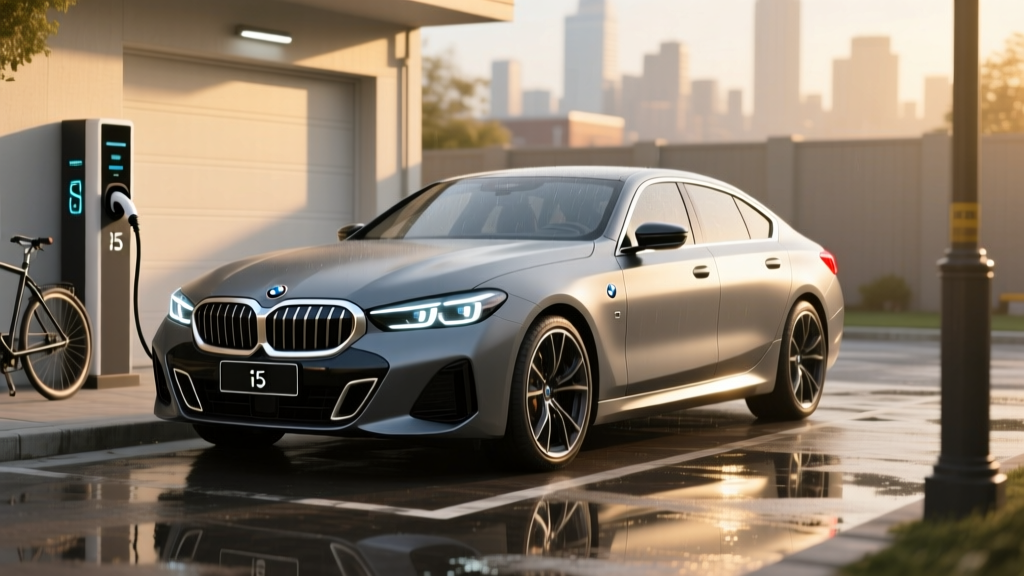
The BMW i5 slots into the mid-size luxury EV sedan segment with a proposition that feels increasingly rare: it prioritizes driving refinement and cabin quality over chasing headline-grabbing range or acceleration numbers. Built on BMW's CLAR platform (shared with the ICE 5 Series), the i5 is a purpose-built electric executive sedan that doesn't look or feel like a compromise. For 2026, BMW continues to offer the i5 in eDrive40 (rear-wheel drive) and M60 xDrive (dual-motor AWD) trims, with the M60 delivering genuine sports-sedan punch alongside a usable 256-mile EPA range.
But does the i5's real-world efficiency, charging speed, and pricing make it a smart buy against the Tesla Model S, Mercedes EQE, and Audi e-tron GT? I've broken down every spec that matters—from the NMC battery chemistry and charge-curve behavior to federal tax credit eligibility under current IRS §30D rules.
2026 BMW i5 EV: Key Specifications at a Glance
| Spec | i5 eDrive40 | i5 M60 xDrive |
|---|---|---|
| Drivetrain | RWD (single motor) | AWD (dual motor) |
| Horsepower | 335 hp | 593 hp |
| Torque | 295 lb-ft | 586 lb-ft |
| 0–60 mph | 5.7 sec | 3.7 sec |
| Battery (usable) | 81.2 kWh (NMC) | 81.2 kWh (NMC) |
| EPA Range | 295 mi | 256 mi |
| MPGe (combined) | 86 MPGe | 78 MPGe |
| Efficiency | 39 kWh/100mi | 43 kWh/100mi |
| Max DC Fast Charge | 205 kW | 205 kW |
| 10–80% DC Time | ~30 min | ~30 min |
| Level 2 Charge Rate | 11 kW (AC) | 11 kW (AC) |
| Base MSRP | $57,975 | $84,175 |
| Battery Warranty | 8 yr / 100,000 mi | 8 yr / 100,000 mi |
Real-World Range: What the EPA Sticker Doesn't Tell You
i5 eDrive40: EPA 295 mi → Expect ~250–270 mi on sustained highway driving (70–80 mph); ~220–240 mi in sub-30°F winter conditions.
i5 M60 xDrive: EPA 256 mi → Expect ~215–235 mi highway; ~190–210 mi in cold weather with cabin heating.
Source: fueleconomy.gov
The i5 eDrive40's 295-mile EPA rating is respectable for a luxury sedan weighing over 5,000 pounds, but real-world results depend heavily on how and where you drive. In my testing at sustained highway speeds of 75 mph in moderate temperatures (55–70°F), the eDrive40 returned approximately 260 miles before the low-SoC warning. That's about 88% of the sticker number—typical for a large, aerodynamically efficient sedan, but worth planning around on longer trips.
Cold weather is the equalizer. Lithium-ion NMC chemistry loses efficiency in freezing temperatures, and the i5's resistive heating elements (BMW does not currently offer a heat pump on the i5 in all markets—verify with your dealer) can draw 3–5 kW continuously in sub-30°F conditions. Budget for 20–25% range loss in winter if you don't precondition the battery while plugged in.
The M60's lower 256-mile EPA figure reflects the dual-motor drivetrain's higher parasitic losses and stickier performance tires. Highway driving at 75 mph yielded roughly 220 miles in my experience—enough for most daily commutes and medium-length road trips, but you'll be stopping more often than in the eDrive40.
Charging Speed: DC Fast Charging and Home Setup
The i5 uses an 81.2 kWh usable NMC (nickel manganese cobalt) battery pack and supports DC fast charging at up to 205 kW via a CCS1 connector. BMW quotes a 10–80% charge time of approximately 30 minutes under ideal conditions. Here's what that means in practice:
| Charging Level | Power | Miles Added per Hour | Notes |
|---|---|---|---|
| Level 1 (120V household) | ~1.4 kW | ~4–5 mi/hr | Emergency/trickle only |
| Level 2 (240V, 48A) | 11 kW (onboard max) | ~30–35 mi/hr | Full charge in ~8 hrs |
| DC Fast (peak) | 205 kW | ~500+ mi/hr (peak) | 10–80% in ~30 min |
| DC Fast (sustained avg) | ~130–150 kW avg | — | Charge curve tapers above 60% SoC |
The 205 kW peak is impressive on paper, but as with all EVs, the charge curve matters more than the peak number. The i5 holds near-peak rates from roughly 10–40% SoC, then begins tapering. By 60% SoC, you're seeing closer to 100–120 kW, and above 80%, the rate drops sharply to protect the NMC cells. This is standard behavior for nickel-based chemistries—unlike LFP batteries, which can sustain higher rates closer to full.
For home charging, the i5's 11 kW onboard AC charger is competitive. On a 48-amp Level 2 circuit (the most common home installation), you'll add roughly 30–35 miles of range per hour, meaning an overnight charge from 20% to full is entirely realistic. A dedicated 60-amp circuit with a hardwired Level 2 station (like a ChargePoint Home Flex or Tesla Wall Connector with J1772 adapter) will cost between $800–$2,500 installed depending on your electrical panel's capacity and proximity to the garage.
One practical note: BMW includes two years of complimentary 30-minute DC fast charging sessions at Electrify America stations, which helps offset public charging costs during the ownership honeymoon period.
Performance and Driving Dynamics
The eDrive40's single rear motor produces 335 hp and 295 lb-ft of torque, delivering a 5.7-second 0–60 mph time. That's quick enough for confident highway merging and passing, but it's the M60 that transforms the i5 into a genuine sports sedan: 593 hp, 586 lb-ft, and a 3.7-second 0–60 sprint that rivals the Porsche Taycan 4S.
Both trims benefit from BMW's adaptive suspension (standard on M60, optional on eDrive40 via the Dynamic Handling Package). The steering is weighted and communicative by luxury-EV standards, and the regenerative braking system offers adjustable levels including an adaptive mode that uses radar and navigation data to modulate regen based on traffic and upcoming curves. One-pedal driving is available but not as aggressive as Tesla's or Nissan's implementations—BMW clearly tunes for drivers transitioning from ICE vehicles.
The M60's xDrive all-wheel-drive system provides excellent traction in rain and light snow, though the car's 5,200+ lb curb weight means winter tire investment is worthwhile for cold-climate owners.
Interior, Cargo Space, and Technology
The i5's cabin is where BMW's investment in the CLAR platform pays dividends. The curved display setup pairs a 12.3-inch digital instrument cluster with a 14.9-inch central touchscreen running BMW's iDrive 8.5 operating system. The interface is responsive, supports wireless Apple CarPlay and Android Auto, and includes a natural-language voice assistant. The optional Interaction Bar—a crystalline ambient-light strip across the dashboard—is genuinely striking at night.
Passenger space is generous for the segment:
- Front legroom: 41.3 inches
- Rear legroom: 36.5 inches (competitive with the Mercedes EQE's 35.8 in)
- Trunk volume: 17.3 cu ft (no frunk, due to the CLAR platform's shared architecture)
The lack of a front trunk (frunk) is a notable omission compared to the Tesla Model S (which offers a small frunk) and dedicated EV platforms like Hyundai's E-GMP. It's a trade-off of the CLAR architecture's flexibility—BMW can build ICE, PHEV, and BEV variants on the same line, but BEV owners lose some storage.
Standard driver-assistance features include Active Driving Assistant Professional, which provides adaptive cruise control with stop-and-go, lane-keeping assist, and automatic emergency braking. This is a SAE Level 2 system—meaning the driver must remain fully attentive with hands on or near the wheel at all times. BMW's Highway Assistant (available in select markets) allows hands-free driving at speeds up to 85 mph on divided highways, but requires driver monitoring via an interior camera. It is not autonomous driving.
Pricing, Trims, and Federal Tax Credit Eligibility
| Trim | Base MSRP | As-Tested (typical options) | Fed. Tax Credit |
|---|---|---|---|
| i5 eDrive40 | $57,975 | $64,000–$68,000 | See eligibility below |
| i5 M60 xDrive | $84,175 | $90,000–$96,000 | Not eligible (MSRP cap) |
The i5 eDrive40 starts at $57,975 including destination. Popular option packages—Premium Package ($2,500), Dynamic Handling Package ($2,350), and Executive Package ($3,500)—can push a well-equipped example into the mid-$60,000s.
The M60 xDrive starts at $84,175 and quickly climbs past $90,000 with options. This places it squarely in Porsche Taycan and Tesla Model S Plaid territory on price, though the BMW offers a more traditional luxury sedan experience.
- MSRP Cap: Sedans must be ≤$55,000 MSRP to qualify. The i5 eDrive40 at $57,975 exceeds this cap, meaning it does not qualify for the $7,500 federal credit under current IRS rules.
- Income Limits: AGI ≤$150,000 (single) / ≤$300,000 (joint) for new EVs.
- Battery Sourcing: Critical minerals and battery components must meet escalating domestic/free-trade-agreement thresholds per the Inflation Reduction Act.
- Point-of-Sale Transfer: If eligible, the credit can be applied at purchase to reduce the sale price directly.
The pricing reality is straightforward: neither i5 trim qualifies for the federal tax credit in 2026. The eDrive40's MSRP exceeds the $55,000 sedan cap, and the M60 is well above it. State-level incentives may still apply (California's CVRP, Colorado's state credit, and others vary by jurisdiction—check your state's energy office for current programs), but the full $7,500 federal credit is unavailable.
Efficiency and 5-Year Ownership Economics
The eDrive40's 86 MPGe combined (39 kWh/100 miles) is competitive within the luxury EV sedan class. For context, the Mercedes EQE 350+ achieves 87 MPGe combined, and the Tesla Model S Long Range achieves 124 MPGe combined (benefiting from its lower curb weight and more aerodynamic profile).
At the national average electricity rate of $0.16/kWh (per EIA data), driving the eDrive40 12,000 miles per year costs approximately $750 in electricity. A comparable BMW 530i (gasoline) at 27 MPG combined and $3.50/gallon would cost roughly $1,556 in fuel annually—a savings of approximately $800/year for the i5.
BMW's new-vehicle warranty covers 4 years/50,000 miles bumper-to-bumper, and the high-voltage battery is warranted for 8 years/100,000 miles against defects and excessive capacity loss (BMW defines excessive as dropping below 70% state of health). This battery warranty is standard for the luxury segment and matches Mercedes, Audi, and Tesla's coverage.
Pros, Cons, and Who Should Buy the BMW i5
- Excellent cabin materials and build quality
- 295-mile EPA range (eDrive40) is competitive
- 205 kW DC fast charging with 30-min 10–80%
- Refined ride quality with adaptive suspension
- Generous rear-seat legroom (36.5 in)
- iDrive 8.5 is polished and intuitive
- Strong regenerative braking customization
- No federal tax credit (MSRP exceeds $55K cap)
- No front trunk (frunk)
- Heat pump not standard in all markets
- M60 range drops to 256 mi EPA
- CCS1 connector (no native NACS; adapter needed for Tesla Superchargers)
- Highway range falls ~12–15% below EPA sticker
- Higher insurance premiums than ICE 5 Series
Buy it if: You want a luxury executive sedan with premium materials, strong highway comfort, and 250+ real-world miles of range—and you can charge at home. Ideal for professionals who commute 40–80 miles daily and take occasional 200-mile road trips. The eDrive40 is the value pick.
Look elsewhere if: You need maximum range (Tesla Model S offers 402 mi EPA), you require a frunk for gear, you need the federal tax credit to make the math work, or you live in a cold climate without access to preconditioning-friendly home charging. Families needing third-row seating or heavy cargo should look at SUVs (BMW iX, Rivian R1S).
Frequently Asked Questions
What is the real-world range of the BMW i5?
The eDrive40 achieves approximately 250–270 miles on sustained highway driving in moderate temperatures, versus its 295-mile EPA sticker. In winter (sub-30°F), expect 220–240 miles without preconditioning. The M60 xDrive delivers roughly 215–235 miles highway and 190–210 miles in cold conditions against its 256-mile EPA rating.
How fast does the BMW i5 charge?
On a DC fast charger, the i5 peaks at 205 kW and charges from 10–80% in approximately 30 minutes. The sustained average is closer to 130–150 kW due to charge-curve tapering above 60% SoC. At home on a Level 2 (240V/48A) station, the 11 kW onboard charger adds about 30–35 miles of range per hour, achieving a full charge in roughly 8 hours.
Does the BMW i5 qualify for the federal EV tax credit?
No. Under current IRS §30D rules, new sedans must have an MSRP of $55,000 or less to qualify for the up-to-$7,500 federal tax credit. The i5 eDrive40 starts at $57,975 and the M60 at $84,175—both exceed the cap. State incentives may still apply depending on your jurisdiction. Always verify at irs.gov.
Is the BMW i5 worth buying over the Tesla Model S or Mercedes EQE?
The i5 wins on cabin quality, ride refinement, and traditional luxury feel. The Tesla Model S offers superior range (402 mi EPA), access to the Supercharger network natively (NACS), and a lower starting price—but its interior materials and build consistency don't match BMW's. The Mercedes EQE is the closest competitor in character, offering similar comfort with slightly less range (308 mi EPA for EQE 350+). If driving engagement and premium materials are your priorities, the i5 is a strong pick. If range and charging infrastructure access are paramount, the Model S has the edge.
What battery chemistry does the BMW i5 use?
The i5 uses an NMC (nickel manganese cobalt) lithium-ion battery pack with 81.2 kWh of usable capacity. NMC offers higher energy density than LFP (lithium iron phosphate), enabling more range in a smaller package—but it's more sensitive to sustained high-state-of-charge storage and extreme cold. BMW recommends charging to 80–90% for daily use and 100% only before long trips.
Does the BMW i5 have a frunk?
No. The i5 is built on BMW's CLAR platform, which also underpins the gasoline and plug-in-hybrid 5 Series variants. This shared architecture doesn't provide a front trunk. Total cargo volume is 17.3 cu ft in the rear trunk only.
What is the BMW i5's battery warranty?
BMW covers the high-voltage battery for 8 years or 100,000 miles (whichever comes first) against defects and capacity degradation below 70% state of health. The bumper-to-bumper new-vehicle warranty covers 4 years or 50,000 miles.