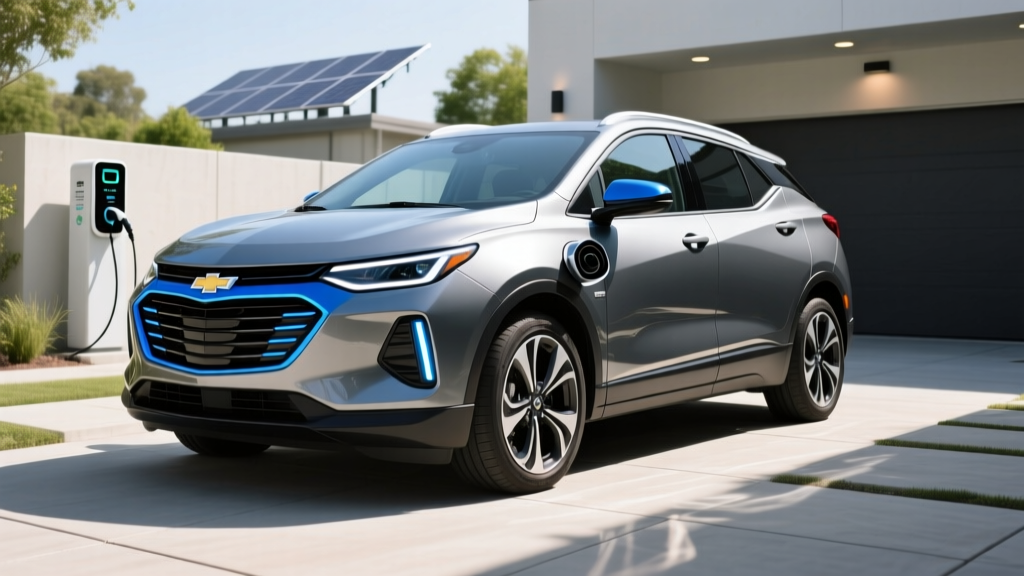
The Chevrolet Equinox EV occupies a rare sweet spot in the electric-vehicle market: a mainstream, sub-$40,000 crossover with over 300 miles of EPA-estimated range and practical daily-driver proportions. For 2026, Chevy has streamlined the lineup and expanded DC fast-charging access across more trims, making the Equinox EV one of the most spec-dense affordable electric SUVs available. Below, we break down every critical number — from real-world range expectations to charging-curve behavior and §30D tax-credit eligibility — so you can evaluate whether this EV fits your garage.
2026 Equinox EV Specs at a Glance
| Spec | 2LT (FWD) | 3LT (FWD) | RS (AWD) |
|---|---|---|---|
| EPA Range | 319 mi | 319 mi | 285 mi |
| Battery (usable) | 85 kWh (NMC) | 85 kWh (NMC) | 85 kWh (NMC) |
| Motor Output | 213 hp / 236 lb-ft | 213 hp / 236 lb-ft | 288 hp / 355 lb-ft (dual-motor) |
| 0–60 mph | ~8.1 sec | ~8.1 sec | ~5.9 sec |
| Max DC Fast Charge | 150 kW | 170 kW | 170 kW |
| 10–80% DC Time | ~34 min | ~30 min | ~30 min |
| Level 2 Home Charge | 11.5 kW (~34 mi/hr) | 11.5 kW (~34 mi/hr) | 11.5 kW (~34 mi/hr) |
| MPGe (combined) | 97 MPGe | 97 MPGe | 90 MPGe |
| Efficiency | 34 kWh/100 mi | 34 kWh/100 mi | 37 kWh/100 mi |
| Cargo (rear seats up) | 26.4 cu ft | 26.4 cu ft | 26.4 cu ft |
| Cargo (rear seats folded) | 57.2 cu ft | 57.2 cu ft | 57.2 cu ft |
| Base MSRP | $33,600 | $39,400 | $43,400 |
| Destination | +$1,395 | ||
Range and Efficiency: EPA vs. the Real World
The front-wheel-drive 2LT and 3LT trims carry an EPA-estimated 319 miles of range — a figure that places the Equinox EV ahead of the Hyundai Ioniq 5 Standard Range and competitive with the Volkswagen ID.4 Pro S. The dual-motor RS trim drops to 285 miles due to the added weight and friction of the rear axle.
EPA Sticker: 319 mi (FWD) / 285 mi (AWD RS)
Highway (70 mph, moderate temps): Expect ~265–285 mi for FWD, ~240–255 mi for AWD. The Equinox EV's boxy crossover profile creates more aerodynamic drag at speed than a sedan like the Tesla Model 3, which cuts highway range by roughly 10–15% versus the EPA combined cycle.
Cold Weather (below 32°F): Plan for a 20–30% reduction. In sub-freezing conditions without preconditioning, the FWD model may deliver 220–255 miles. Chevy's battery thermal management helps mitigate this, but LFP-equipped competitors like the Tesla Model Y Standard Range can suffer even steeper cold-weather losses.
City / Mixed Commute: Near or slightly above EPA estimates. Regenerative braking recaptures energy in stop-and-go driving, and the Equinox EV's one-pedal mode is effective enough for most urban routes.
Efficiency lands at 34 kWh per 100 miles for FWD trims (97 MPGe combined per fueleconomy.gov). That's competitive for the segment, though the Tesla Model Y Rear-Wheel-Drive still leads at roughly 30 kWh/100 mi thanks to its lighter weight and slipperier aero. On a practical level, 34 kWh/100 mi means a full 85 kWh charge costs roughly $10.20–$13.60 at the national average residential electricity rate of $0.12–$0.16/kWh — translating to about 3.2–4.3 cents per mile.
Charging Speed: DC Fast Charge and Home Level 2
Chevy equipped the 2026 Equinox EV with a CCS1 connector for DC fast charging and a J1772 inlet for Level 2 AC charging. (A NACS adapter is available for Tesla Supercharger access — Chevy includes a complimentary adapter with new vehicle purchases, though confirm availability with your dealer.)
| Charging Level | Power / Rate | Time / Miles Added |
|---|---|---|
| Level 1 (120V household) | ~1.2 kW | ~3–4 mi/hr (overnight adds ~40 mi) |
| Level 2 (240V home, 48A) | 11.5 kW | ~34 mi/hr; full charge in ~8.5 hours |
| DC Fast (2LT) | 150 kW peak | 10–80% in ~34 min; ~100 mi in 15 min |
| DC Fast (3LT / RS) | 170 kW peak | 10–80% in ~30 min; ~120 mi in 15 min |
Charging-curve reality check: The 170 kW peak rate on the 3LT and RS trims is achieved between roughly 10–30% state of charge. The curve tapers to ~120 kW by 50% SoC and drops below 60 kW past 80%. This is normal NMC behavior — the battery management system slows the charge rate to protect cell longevity. If you're road-tripping, plan stops around the 10–80% window for the fastest fills. Charging from 80–100% on DC can take an additional 25–30 minutes and is best reserved for overnight Level 2 sessions.
At home, the 11.5 kW onboard charger means you'll need a 240-volt circuit rated for at least 60 amps (to support a 48-amp continuous charge). A typical Level 2 home installation — including a hardwired Wallbox or ChargePoint unit, wiring, and permit — runs $800–$2,000 depending on your panel's proximity to the garage. Homes with older 100-amp electrical panels may need a $1,500–$3,000 panel upgrade to support simultaneous EV charging and heavy appliance use.
Performance, Powertrain, and Drivetrain
The FWD trims use a single front-mounted permanent-magnet motor producing 213 horsepower and 236 lb-ft of torque. It's adequate for merging and city driving, with a 0–60 mph time around 8.1 seconds — brisk enough for daily use but not sporty. The RS trim adds a rear induction motor for dual-motor all-wheel drive, bumping output to 288 hp and 355 lb-ft. That drops the 0–60 time to approximately 5.9 seconds, which feels meaningfully quicker in real-world passing maneuvers.
Ride quality leans toward comfort over sportiness. The Ultium platform's low center of gravity (battery pack mounted under the floor) reduces body roll, but the suspension tuning prioritizes absorbing potholes over carving canyons. Steering is light and numb — typical for the segment — and the regenerative braking offers two modes: a mild coasting mode and a strong one-pedal mode that can bring the car to a complete stop without touching the brake pedal.
Towing capacity is rated at 1,500 pounds when properly equipped — enough for a small utility trailer or a pair of dirt bikes, but not a camper. This is a limitation worth noting if you regularly haul heavier loads; the Ford Mustang Mach-E and Hyundai Ioniq 5 offer similar or slightly lower tow ratings.
Interior, Cargo, and Technology
The cabin is dominated by a 17.7-inch diagonal infotainment touchscreen running Google Built-In, which integrates Google Maps, Google Assistant, and the Play Store directly into the vehicle. A 11-inch digital driver display sits behind the steering wheel. Wireless Apple CarPlay and Android Auto are standard across all trims. The interface is responsive, and the native Google Maps navigation includes real-time charger availability and route planning with charging stops — a genuine advantage over systems that rely on phone projection for navigation.
Passenger space is generous for the segment: 41.2 inches of front legroom and 38.1 inches in the rear, enough for two adults on longer trips without complaint. Cargo volume measures 26.4 cubic feet behind the rear seats and 57.2 cubic feet with the 60/40 split rear seats folded. There is no front trunk (frunk) — the space under the hood houses HVAC and power electronics — which is a missed opportunity for weatherproof storage that competitors like the Ford Mustang Mach-E provide.
Driver-assistance technology includes Chevy's Super Cruise on higher trims (3LT and RS with the available technology package). Super Cruise is a SAE Level 2 hands-free system that operates on over 750,000 miles of mapped highways in the U.S. and Canada. It requires the driver to remain attentive — an infrared camera monitors eye gaze — and it will not navigate city streets, construction zones, or unmapped roads. This is not autonomous driving; it is a supervised cruise-and-lane-keeping system that reduces fatigue on long highway stretches.
- Operates only on pre-mapped divided highways — not surface streets or rural roads.
- Driver must keep eyes on the road; system issues escalating alerts and will stop the vehicle if the driver is unresponsive.
- Hands-free does not mean mind-free: you are legally responsible for the vehicle at all times.
- Performance degrades in heavy rain, snow, or when lane markings are obscured.
Pricing, Trims, and Federal Tax Credit Eligibility
The 2026 Equinox EV lineup starts at $33,600 for the 2LT FWD (plus $1,395 destination), making it one of the most affordable 300+ mile EVs in the U.S. market. The 3LT FWD climbs to $39,400 and adds Super Cruise eligibility, a panoramic glass roof, and upgraded interior materials. The RS AWD starts at $43,400 and includes the dual-motor powertrain, sport-tuned suspension, and unique exterior styling.
| Trim | MSRP + Dest. | Est. §30D Credit | Effective Price* |
|---|---|---|---|
| 2LT FWD | $34,995 | Up to $7,500 | ~$27,495 |
| 3LT FWD | $40,795 | Up to $7,500 | ~$33,295 |
| RS AWD | $44,795 | Up to $7,500 | ~$37,295 |
*Effective price assumes full §30D credit eligibility. Your actual credit depends on income, battery sourcing, and tax liability. Consult a tax professional.
Federal tax credit (§30D) eligibility for the Equinox EV is subject to several conditions under current IRS rules (irs.gov):
- MSRP Cap: The Equinox EV qualifies as an SUV under IRS definitions, so the MSRP cap is $80,000 — all trims clear this easily.
- Buyer Income Cap: Modified adjusted gross income must not exceed $150,000 (single), $225,000 (head of household), or $300,000 (married filing jointly).
- Battery Sourcing: The full $7,500 credit requires that both critical-mineral and battery-component sourcing requirements are met. GM has worked to qualify the Ultium battery for the full credit, but sourcing rules tighten annually. Verify the specific VIN's eligibility on the IRS clean-vehicle qualifier list before purchase.
- Point-of-Sale Transfer: You can transfer the credit to the dealer at purchase, reducing your out-of-pocket cost immediately rather than waiting for a tax refund.
- Tax Liability: The credit is non-refundable if claimed on your tax return — it can only reduce your federal tax liability to zero. The point-of-sale transfer option bypasses this limitation.
Warranty and Long-Term Ownership
Chevrolet backs the Equinox EV's battery pack and electric powertrain with an 8-year / 100,000-mile warranty, which covers defects and capacity loss below 60% of the original state of health. The limited vehicle warranty is 3 years / 36,000 miles, and corrosion coverage extends to 6 years / 100,000 miles.
The 85 kWh NMC battery is built on GM's Ultium platform, which uses a wireless battery-management system (wBMS) that reduces wiring complexity and allows over-the-air updates to charging and thermal protocols. Long-term degradation data for the Ultium platform is still accumulating — the platform launched in 2022 — but GM's 60% capacity-retention warranty threshold is on par with industry norms. For context, most NMC packs lose roughly 10–15% of capacity over the first 100,000 miles based on data from earlier GM EVs and comparable platforms from other manufacturers.
Insurance costs for the Equinox EV run roughly 10–20% higher than the gas-powered Equinox, reflecting the higher repair costs associated with EV battery packs and advanced driver-assist sensors. Average annual premiums fall in the $1,600–$2,200 range depending on your state, driving record, and coverage level.
Pros, Cons, and the Competition
- 319 miles EPA range at a sub-$35K starting price is exceptional value
- Google Built-In infotainment with native EV route planning
- Super Cruise availability on 3LT and RS trims for hands-free highway driving
- Spacious rear seat (38.1 in. legroom) and practical cargo area
- Strong federal tax credit eligibility (potential ~$27.5K effective price for 2LT)
- 11.5 kW Level 2 charging supports fast overnight fills
- No front trunk (frunk) — lost weatherproof storage opportunity
- FWD performance is adequate, not engaging (8.1 sec 0–60)
- DC fast-charge speed (150–170 kW) trails the Hyundai Ioniq 5's 240 kW capability
- 2LT trim limited to 150 kW peak DC charge rate
- Interior materials in 2LT feel budget-grade for the price
- 1,500-lb tow rating limits utility for camper or boat owners
Versus the competition: The Hyundai Ioniq 5 charges faster (up to 240 kW on 800V architecture) and offers a frunk, but its Standard Range model delivers only 220 miles EPA. The Tesla Model Y Rear-Wheel-Drive is more efficient and has a stronger Supercharger network advantage, but starts higher and its interior is sparser. The Volkswagen ID.4 Pro S offers similar range (~291 mi) and a more composed ride but charges more slowly. The Equinox EV's combination of range, price, and Google-native tech makes it the strongest value play for buyers who prioritize daily range and cabin technology over maximum charging speed.
- You want 300+ miles of range under $35,000 (after tax credit)
- You charge primarily at home and road-trip 2–4 times per year
- You value Google-native navigation with built-in charger routing
- You want hands-free highway driving (Super Cruise) without paying luxury-EV prices
- You frequently road-trip and need the fastest possible DC charging (consider Ioniq 5 or Tesla Model Y)
- You need to tow more than 1,500 lbs
- You want a frunk for gear storage
- You prioritize sporty driving dynamics over comfort (consider BMW iX or Ford Mustang Mach-E GT)
Frequently Asked Questions
What is the real-world range of the 2026 Equinox EV?
The EPA estimates 319 miles for FWD trims and 285 miles for the AWD RS. In real-world highway driving at 70 mph, expect roughly 265–285 miles (FWD) or 240–255 miles (AWD). Cold weather below freezing can reduce range by 20–30%, bringing the FWD model down to approximately 220–255 miles without preconditioning.
How fast does the Equinox EV charge at home and on the road?
At home on a 240V Level 2 charger (48A), the Equinox EV charges at 11.5 kW, adding roughly 34 miles of range per hour — a full charge takes about 8.5 hours overnight. On DC fast chargers, the 3LT and RS peak at 170 kW (10–80% in ~30 minutes), while the 2LT peaks at 150 kW (~34 minutes). Real-world charging slows above 80% SoC due to the battery's charge-curve taper.
How much does the Equinox EV cost after the federal tax credit?
The 2LT FWD starts at $34,995 with destination. If you qualify for the full $7,500 §30D federal tax credit (via point-of-sale transfer), the effective price drops to approximately $27,495. The 3LT falls to ~$33,295 and the RS AWD to ~$37,295 under the same assumption. Eligibility depends on your income, the vehicle's battery sourcing, and MSRP — always verify your specific situation with a tax professional and the IRS clean vehicle credit page.
Does the 2026 Equinox EV qualify for the full $7,500 federal tax credit?
It is expected to qualify for the full credit, but eligibility is VIN-specific and depends on meeting both critical-mineral and battery-component sourcing thresholds set by the IRS. GM has positioned the Ultium battery to meet these requirements, but rules tighten periodically. Check the official fueleconomy.gov tax credit lookup for the specific VIN before purchasing.
Is the Equinox EV worth buying over the Tesla Model Y or Hyundai Ioniq 5?
It depends on your priorities. The Equinox EV wins on upfront value (lowest effective price after tax credit) and Google-native infotainment. The Tesla Model Y wins on charging network reliability, efficiency, and cargo versatility. The Hyundai Ioniq 5 wins on DC charging speed and interior design. For a commuter who charges at home and road-trips occasionally, the Equinox EV is the strongest budget play in the segment.
What battery chemistry does the Equinox EV use?
The Equinox EV uses an NMC (nickel manganese cobalt) lithium-ion battery on GM's Ultium platform. NMC offers higher energy density than LFP (lithium iron phosphate), enabling the 319-mile range in a manageable pack size. The trade-off is that NMC batteries are more sensitive to sustained high states of charge — Chevy recommends daily charging to 80% and reserving 100% charges for road trips.
Does the Equinox EV have a frunk (front trunk)?
No. The Equinox EV does not include a front trunk. The space under the hood is occupied by power electronics and HVAC components. If enclosed front storage is a priority, the Ford Mustang Mach-E and Tesla Model Y both offer a frunk.