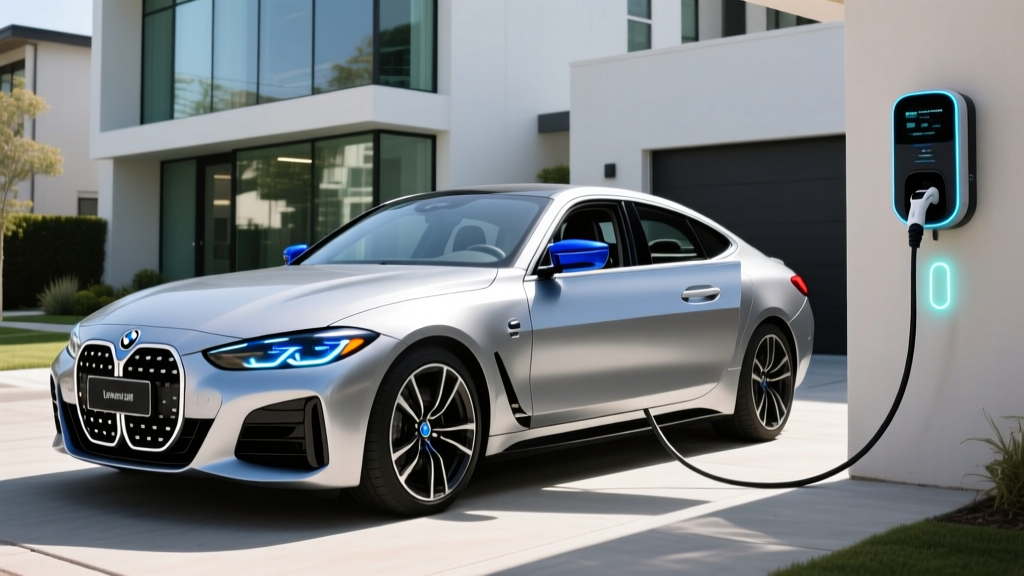
The BMW i4 occupies a specific niche in the electric-vehicle market: a premium sport sedan that happens to be electric, rather than an electric car that happens to be a sedan. Built on BMW's CLAR platform alongside the 4 Series Gran Coupe, the i4 delivers the driving dynamics BMW is known for while offering competitive range and rapid DC charging. For 2026, BMW has refined the i4 with updated infotainment, revised pricing, and expanded standard equipment. Here's everything you need to know before putting one in your driveway.
Range, Battery, and Real-World Efficiency
The 2026 BMW i4 lineup uses an 81.5 kWh usable lithium-ion battery pack (NMC chemistry — nickel manganese cobalt) across all trims. The eDrive40 and xDrive40 retain this capacity, while the M50 variant uses the same pack tuned for higher power delivery. NMC chemistry offers higher energy density than LFP, which is why the i4 maintains a relatively low roofline and sport-sedan proportions without sacrificing range.
| Trim | Drivetrain | EPA Range | MPGe (Combined) | kWh/100 mi |
|---|---|---|---|---|
| eDrive40 | RWD | 307 mi | 109 MPGe | 31 |
| xDrive40 | AWD | 287 mi | 102 MPGe | 33 |
| M50 | AWD | 269 mi | 93 MPGe | 36 |
Efficiency is a strong suit for the eDrive40. At 31 kWh/100 miles, it matches or beats most luxury electric sedans in its class. The M50 trades efficiency for performance, consuming up to 36 kWh/100 miles when driven aggressively — a meaningful difference on road trips where charging stops add up.
Charging Speed: DC Fast, Level 2, and the Charge Curve
The i4 supports up to 205 kW peak DC fast charging via its CCS1 connector (a NACS adapter is available from BMW for Tesla Supercharger access). On a compatible 350 kW charger — such as Electrify America's latest stalls — the i4 can add roughly 140 miles of range in 10 minutes under ideal conditions.
| Charging Level | Power / Voltage | Speed (mi/hr or time) | Best For |
|---|---|---|---|
| Level 1 (120V) | ~1.4 kW | ~4 mi/hr | Overnight trickle, emergencies |
| Level 2 (240V, 48A) | 11.5 kW | ~36 mi/hr / 0–100% in ~8.5 hrs | Daily home charging |
| DC Fast Charge | Up to 205 kW peak | 10–80% in ~31 min | Road trips |
The charge curve matters more than peak kW. The i4 sustains roughly 180–200 kW between 10% and 40% state of charge, then tapers progressively. From 50% to 80%, you'll see 100–130 kW. This is why the 10–80% time of approximately 31 minutes is the metric that matters — and it's competitive, though not class-leading. The Hyundai Ioniq 6 and Tesla Model 3 both charge faster in real-world conditions.
For home charging, the i4's 11.5 kW onboard charger is a practical advantage. On a properly installed 48-amp Level 2 circuit (requiring a 60-amp breaker), you'll recover a full battery overnight in about 8.5 hours. If your home electrical panel only supports a 40-amp circuit (32 amps to the car), expect roughly 7.7 kW and a full charge in about 11 hours — still workable for most daily routines.
Performance and Driving Dynamics
| Trim | Motor Config | Horsepower | Torque (lb-ft) | 0–60 mph | Top Speed |
|---|---|---|---|---|---|
| eDrive40 | Single (rear) | 335 hp | 317 | 5.5 sec | 118 mph |
| xDrive40 | Dual (AWD) | 396 hp | 443 | 4.9 sec | 118 mph |
| M50 | Dual (AWD) | 536 hp | 586 | 3.7 sec | 130 mph |
The eDrive40's 335 horsepower and rear-wheel-drive layout deliver the kind of balanced, progressive power delivery that made BMW's inline-sixes famous — just without the exhaust note. Steering is precise, body control is tight, and the low center of gravity from the underfloor battery makes the i4 feel planted through corners in a way most electric sedans don't match.
The M50 is a different animal entirely. With 536 hp and 586 lb-ft available instantly, it hits 60 mph in 3.7 seconds — territory occupied by the Tesla Model 3 Performance and Porsche Taycan 4S. But the M50's real trick is that it remains comfortable as a daily driver. Adaptive M suspension is standard, and the ride quality in Comfort mode is genuinely livable. Switch to Sport, and the dampers firm up noticeably without becoming harsh.
Regenerative braking offers three levels plus an adaptive mode that uses radar and navigation data to modulate regen based on traffic and upcoming intersections. It's not true one-pedal driving in the way a Nissan Leaf offers, but the adaptive mode is intuitive enough that most drivers will set it and forget it.
Interior, Cargo, and Technology
The i4 shares its cabin architecture with the 4 Series Gran Coupe, which means a driver-focused layout with BMW's Curved Display — a 12.3-inch instrument cluster merged with a 14.9-inch central touchscreen running BMW Operating System 8.5 (for 2026). The interface is responsive, supports wireless Apple CarPlay and Android Auto, and includes over-the-air update capability.
Interior materials are a step above mainstream EVs. Standard Sensatec synthetic leather is durable and convincing; available Vernasca leather adds genuine luxury. The front sport seats (standard on M50, optional on lower trims) offer excellent lateral support. Rear legroom measures 35.2 inches — adequate for adults on shorter trips but tight for six-footers on longer journeys. Headroom in the rear is limited by the sloping roofline at 36.6 inches.
Cargo volume is the i4's practical compromise. The liftback design provides 16.6 cubic feet behind the rear seats and 45.6 cubic feet with the 40/20/40 split rear seats folded. That's less than a Tesla Model Y (76.2 cu ft max) but comparable to a traditional sport sedan. The i4 does not have a frunk — the space under the hood houses power electronics and the climate-control compressor.
The i4 comes standard with BMW's Driving Assistant, which includes adaptive cruise control, lane-keeping assist, and blind-spot monitoring. This is an SAE Level 2 system — you must keep your hands on the wheel and remain fully engaged. The available Driving Assistant Professional adds lane-change assist and extended traffic-jam functionality, but it does not make the car autonomous.
Pricing, Trims, and Federal Tax Credit Eligibility
| Trim | Base MSRP | As-Tested (Typical Options) | Destination |
|---|---|---|---|
| eDrive40 | $52,200 | $58,000–$62,000 | $995 |
| xDrive40 | $56,200 | $62,000–$67,000 | $995 |
| M50 | $68,300 | $74,000–$80,000 | $995 |
The BMW i4 eDrive40 and xDrive40 fall under the IRS §30D federal tax credit price cap for sedans ($55,000 MSRP limit). The eDrive40 at $52,200 base qualifies on MSRP; the xDrive40 at $56,200 exceeds the sedan cap and is not eligible for the federal credit unless reclassified. The M50 at $68,300 also exceeds the cap.
-
Federal EV Tax Credit (§30D) — Eligibility Checklist for the i4 eDrive40:
- MSRP Cap: Vehicle MSRP must not exceed $55,000 (sedan classification). The eDrive40 base qualifies; adding options that push MSRP above $55,000 may disqualify it.
- Buyer Income Limits: AGI must not exceed $150,000 (single), $225,000 (head of household), or $300,000 (joint).
- Battery Sourcing: Critical minerals and battery component requirements must be met. BMW has worked to comply, but eligibility can shift based on supply-chain changes. Verify current status at fueleconomy.gov before purchasing.
- Point-of-Sale Transfer: As of 2024, the credit can be transferred to the dealer at purchase, reducing the purchase price directly rather than waiting for a tax refund.
- Assembly: Final assembly must occur in North America. The i4 is built in Munich, Germany — which means it does not meet the final-assembly requirement for §30D.
Ownership Costs and Warranty
BMW provides a 4-year/50,000-mile limited warranty and a 8-year/100,000-mile battery warranty that guarantees at least 70% capacity retention over the coverage period. This is industry-standard — matching Tesla, Hyundai, and Ford — but shorter than the 10-year coverage offered by some competitors.
| Cost Category | BMW i4 eDrive40 | Tesla Model 3 LR | Hyundai Ioniq 6 SEL |
|---|---|---|---|
| Purchase Price (base) | $52,200 | $47,740 | $42,450 |
| Federal Tax Credit | $0 (non-NA assembly) | $7,500 | $7,500 |
| Est. Electricity (5 yr / 75k mi) | $2,900 | $2,800 | $2,750 |
| Insurance (5 yr est.) | $9,500 | $8,200 | $7,400 |
| Maintenance (5 yr est.) | $1,800 | $1,200 | $1,500 |
| Est. Depreciation (5 yr) | $22,000 | $19,000 | $18,500 |
| Total 5-Year Cost | $86,400 | $70,440 | $58,600 |
The i4 costs more to own than a Model 3 or Ioniq 6 over five years, driven primarily by higher purchase price, insurance premiums typical of German luxury brands, and the lack of a federal tax credit. However, BMW's included maintenance program (3 years/36,000 miles of scheduled maintenance) and strong residual values partially offset these costs. Buyers prioritizing driving dynamics and cabin quality over pure value will find the premium justified.
How the BMW i4 Stacks Up Against Key Rivals
The i4's competitive set includes the Tesla Model 3 Long Range, Hyundai Ioniq 6, Polestar 2, and the upcoming next-generation Mercedes-Benz CLA EV. Here's how the i4 eDrive40 compares on the metrics that matter most:
| Spec | BMW i4 eDrive40 | Tesla Model 3 LR | Hyundai Ioniq 6 SEL | Polestar 2 LRSM |
|---|---|---|---|---|
| EPA Range | 307 mi | 341 mi | 361 mi | 295 mi |
| Battery (kWh usable) | 81.5 | 75.0 | 77.4 | 78.0 |
| DC Fast Charge (peak kW) | 205 kW | 250 kW | 240 kW | 205 kW |
| 10–80% DC Time | ~31 min | ~25 min | ~18 min | ~30 min |
| 0–60 mph | 5.5 sec | 4.2 sec | 5.1 sec | 4.3 sec |
| Base MSRP | $52,200 | $47,740 | $42,450 | $49,900 |
| Federal Credit Eligible | No | Yes | Yes | No |
| Cargo (max cu ft) | 45.6 | 64.9 | 40.6 | 40.5 |
The i4 wins on build quality, steering feel, and cabin refinement. The Model 3 wins on range, charging speed, and value — especially after the tax credit. The Ioniq 6 dominates on efficiency and charging speed (its 800V architecture enables that 18-minute 10–80% time) and costs significantly less. The Polestar 2 is the closest match in spirit but offers less range and a firmer ride.
- Class-leading ride and handling balance
- Premium cabin materials and quietness
- Strong real-world efficiency (31 kWh/100 mi)
- Liftback versatility with 45.6 cu ft max cargo
- BMW's proven dealer and service network
- Heat pump standard on all trims
- Not eligible for $7,500 federal tax credit (Germany assembly)
- Rear seat headroom limited by roofline
- No front trunk (frunk)
- DC charging slower than 800V rivals (Ioniq 6, Taycan)
- Options packages push price quickly above $60K
- Infotainment learning curve for non-BMW owners
Who Should Buy the BMW i4?
Choose the BMW i4 if:
- You want a sport sedan first and an EV second — driving dynamics are your top priority
- You value cabin quietness, material quality, and brand prestige over maximum range-per-dollar
- Your daily commute is under 100 miles round-trip and you have home Level 2 charging
- You want a liftback that can handle occasional cargo runs without moving to an SUV
- You prefer a traditional luxury-dealer buying and service experience
Look elsewhere if:
- You need maximum range for frequent 300+ mile road trips (Model 3 LR, Ioniq 6)
- The $7,500 federal tax credit is essential to your purchase math
- You regularly carry tall rear-seat passengers (the roofline compromises headroom)
- Fastest possible DC charging is a priority (800V rivals charge meaningfully faster)
Frequently Asked Questions
What is the real-world range of the BMW i4?
The eDrive40 achieves its EPA-rated 307 miles in mixed city driving at moderate temperatures. Highway driving at 70+ mph reduces this to roughly 255–270 miles. In sub-freezing winter conditions, expect 200–220 miles on the highway. The M50 will return approximately 10–15% less in all scenarios due to higher power consumption.
How fast does the BMW i4 charge at home and on the road?
On a 48-amp Level 2 home charger (11.5 kW), the i4 recovers about 36 miles of range per hour, charging from empty to full in roughly 8.5 hours. On a DC fast charger, it peaks at 205 kW and charges from 10% to 80% in approximately 31 minutes. Actual charging speed depends on battery temperature, state of charge, and the charger's maximum output.
Does the BMW i4 qualify for the $7,500 federal EV tax credit?
No. The BMW i4 is assembled in Munich, Germany, and current IRS §30D rules require North American final assembly for new-vehicle credit eligibility. However, leasing an i4 may allow the leasing company to claim the commercial clean-vehicle credit and pass savings to you as a lower lease payment. State incentives may also apply — check fueleconomy.gov and your state's energy office for current programs.
Is the BMW i4 worth buying over a Tesla Model 3?
It depends on your priorities. The Model 3 Long Range offers more range (341 mi vs. 307 mi), faster charging (250 kW vs. 205 kW), eligibility for the $7,500 federal credit, and a lower base price. The i4 counters with superior build quality, a quieter cabin, better steering feel, and a traditional luxury ownership experience. If driving engagement and interior refinement matter more than spec-sheet numbers, the i4 earns its premium. If value and efficiency are paramount, the Model 3 wins.
What is the battery warranty on the BMW i4?
BMW covers the i4's high-voltage battery for 8 years or 100,000 miles (whichever comes first), guaranteeing at least 70% of original capacity retention over that period. If the battery degrades below 70% within the warranty window, BMW will repair or replace it to restore capacity above the threshold. This matches the industry standard set by most automakers.
Can I charge a BMW i4 at Tesla Superchargers?
Yes, with BMW's CCS-to-NACS adapter (available through BMW dealers). The i4 uses a native CCS1 charge port, and the adapter enables access to Tesla's Supercharger network, which remains the most reliable and widespread DC fast-charging network in the US. Charging speed through the adapter is limited by the i4's peak 205 kW acceptance rate, not the adapter itself.