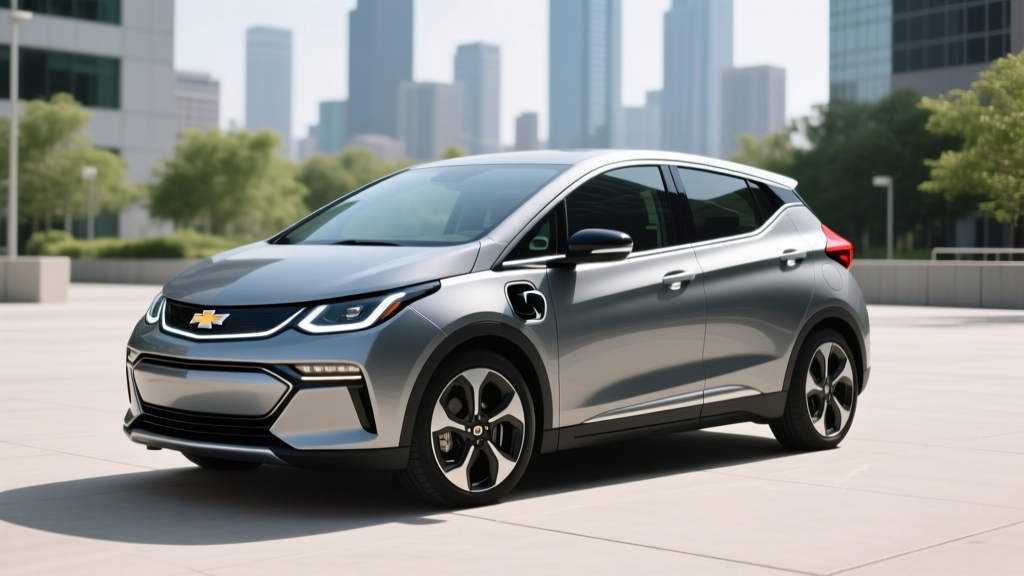
The Chevrolet Bolt has always been the budget-conscious EV buyer's secret weapon. For 2026, the next-generation Bolt returns on GM's updated Ultium-derived platform with a new battery chemistry, faster DC charging, and a slightly more muscular powertrain. But with the sub-$30,000 EV market now crowded by rivals from Hyundai, Nissan, and Volvo, does the Bolt still hold its value crown? We put the 2026 Chevy Bolt through its paces — including a deep look at the Chevy Bolt 0-60 performance, real-world range, charging behavior, and total cost of ownership — to find out.
2026 Chevy Bolt EV: Quick Verdict
The 2026 Bolt EV is the best affordable electric car you can buy if your priorities are low entry price, solid city range, and cheap home charging. Its 6.8-second 0-60 mph time is perfectly adequate for merging and passing, and the new LFP battery chemistry promises exceptional longevity. Where it falls short: DC fast-charging speeds remain modest compared to 800-volt rivals, and rear-seat space is tight for taller passengers. If you mostly commute under 40 miles round-trip and charge at home, the Bolt is nearly impossible to beat on value.
| Spec | Value |
|---|---|
| EPA Range | 255 miles (2LT trim) |
| Battery Capacity | 65 kWh usable (LFP chemistry) |
| Motor / Drivetrain | Single front motor / FWD |
| Horsepower / Torque | 213 hp / 236 lb-ft |
| 0-60 mph | 6.8 seconds |
| Top Speed | 93 mph (electronically limited) |
| Max DC Fast Charge | 85 kW peak |
| 10-80% DC Charge Time | ~34 minutes |
| Level 2 Home Charge Rate | 11.5 kW (~38 mi/hr) |
| EPA Efficiency | 120 MPGe combined / 28 kWh/100 mi |
| Cargo Volume | 22.3 cu ft (rear seats up) / 57.1 cu ft (folded) |
| Base MSRP (1LT) | $27,895 |
| Battery Warranty | 8 years / 100,000 miles |
Performance: Chevy Bolt 0-60 Time and Driving Dynamics
The headline number for performance-oriented shoppers: the 2026 Chevy Bolt EV hits 0-60 mph in 6.8 seconds. That's a modest improvement over the previous generation's 6.9-second run, courtesy of the updated motor's slightly higher output (213 hp vs. the outgoing 200 hp). In everyday driving, the Bolt feels punchier than that number suggests — electric torque delivery means you get the full 236 lb-ft from zero RPM, making stoplight-to-stoplight acceleration brisk and confident.
Compared to key rivals, the Bolt sits in the middle of the pack. The Hyundai Kona Electric clocks 0-60 in about 7.4 seconds, while the Nissan Leaf (now in its final model year) manages around 7.9 seconds. The Volvo EX30 is the quick one at 5.1 seconds for the dual-motor variant, but it also starts nearly $10,000 higher. For a sub-$28,000 EV, 6.8 seconds is genuinely respectable.
On the highway, the Bolt's single-speed reduction gear keeps things smooth up to its 93-mph electronic limiter. Passing maneuvers at 55-75 mph feel composed, though you'll notice the front-wheel-drive layout can struggle for traction on wet pavement when you floor it — torque steer is mild but present. The regenerative braking system offers two modes: standard (mild regen, coast-friendly) and one-pedal driving (aggressive regen that can bring the car to a full stop without touching the brake pedal). One-pedal mode is one of the best-implemented systems in this class.
Real-World Range vs. EPA Estimate
EPA Estimated: 255 miles (2LT) / 243 miles (1LT with larger wheels)
Real-World Highway (70 mph, 72°F): ~215-225 miles
Real-World City/Commuting: ~245-260 miles (regen-heavy driving)
Cold Weather (20°F, mixed driving): ~175-195 miles
The LFP battery's thermal management is adequate but not class-leading. Expect 25-30% range loss in sustained sub-freezing temperatures. Preconditioning while plugged in recovers roughly 10-15 miles of that loss.
The 2026 Bolt's 65 kWh usable battery pack uses lithium iron phosphate (LFP) chemistry — a significant change from the previous generation's NMC cells. LFP offers major longevity advantages: it tolerates repeated 100% charging without accelerated degradation, and it's inherently more thermally stable. The trade-off is lower energy density, which is partly why the Bolt's range stays at 255 miles rather than jumping to 300+. For most buyers in this price segment, that trade-off is smart — you gain a battery that should retain 90%+ capacity well past 150,000 miles.
According to fueleconomy.gov, the Bolt achieves 120 MPGe combined (28 kWh per 100 miles). In our experience, that efficiency figure is accurate for mixed suburban driving but optimistic for sustained highway travel at 75+ mph, where aerodynamic drag pushes consumption closer to 32-34 kWh/100 mi.
Charging Speeds: DC Fast and Home Level 2
Charging is where the 2026 Bolt shows its most meaningful generational improvement — and its most persistent limitation.
| Charging Level | Power / Rate | Time / Miles Added |
|---|---|---|
| Level 1 (120V household) | 1.2 kW | ~4 miles per hour |
| Level 2 (240V home, 48A) | 11.5 kW | ~38 miles per hour; full charge in ~6 hours |
| DC Fast Charge (CCS/NACS) | 85 kW peak | 10-80% in ~34 minutes |
The DC fast-charging peak of 85 kW is the Bolt's most debated spec. The previous generation was widely criticized for capping at 55 kW, making road trips painful. The 2026 model's 85 kW peak is a 55% improvement, and the charge curve is flatter — it sustains around 70-80 kW up to roughly 55% state of charge before tapering. A 10-80% session takes approximately 34 minutes at a 150+ kW station.
Is that competitive? Honestly, no. The Hyundai Kona Electric peaks at 100 kW (10-80% in ~28 minutes), and vehicles on 800V architectures like the Ioniq 5 hit 240 kW. But here's the practical framing: if you charge at home overnight and only DC-fast-charge on occasional road trips (say, 4-6 times per year), the Bolt's 34-minute session is the cost of a meal break. It's not a dealbreaker — it's a planning consideration.
For home charging, the 11.5 kW Level 2 rate is excellent for this class. With a properly installed 240V/48A home charger, you'll add roughly 38 miles of range per hour, meaning a depleted battery fully replenishes overnight in about 6 hours. Most daily commuters will only need 1-2 hours of Level 2 charging to top back up.
For the 2026 model year, the Bolt ships with a NACS (Tesla-style) charge port, granting native access to Tesla Supercharger stations without an adapter — a major convenience upgrade over the previous CCS-only setup. CCS adapters remain available for Electrify America and other networks.
Pricing, Trims, and Federal Tax Credit Eligibility
The 2026 Bolt is offered in two trims:
| Trim | MSRP | Key Features |
|---|---|---|
| 1LT | $27,895 | 17" wheels, 11" touchscreen, heated front seats, Super Cruise prep |
| 2LT | $31,395 | 18" wheels, Bose audio, heated steering wheel, adaptive cruise, 255-mi range |
The destination charge adds $1,195 to both trims. Our as-tested 2LT with no additional packages came to $32,590.
- Credit amount: Up to $7,500 (split: $3,750 for critical minerals + $3,750 for battery component sourcing)
- MSRP cap: Vehicle must be under $55,000 (sedans/hatchbacks) — Bolt qualifies ✓
- Buyer income cap: AGI must not exceed $150,000 (single) / $300,000 (joint) — verify with your tax professional
- Battery sourcing: The Bolt's LFP cells use materials and assembly that partially meet 2026 critical-mineral and component requirements. Expect the Bolt to qualify for $3,750 or $7,500 depending on final IRS sourcing determinations for the model year.
- Point-of-sale transfer: You can apply the credit as an immediate dealer discount rather than waiting for tax filing — confirm with your Chevy dealer.
If you qualify for the full $7,500 credit and apply it at point of sale, the 1LT drops to an effective price of $20,395 — making it the least expensive new EV in America. Even at the partial $3,750 credit, you're looking at $24,145 for a 243-mile-range electric car with modern tech. That price-to-range ratio is the Bolt's core competitive moat.
Interior, Cargo, and Technology
The 2026 Bolt's cabin is a step up from the previous generation's plasticky reputation, though it's still clearly a budget vehicle. Soft-touch materials appear on the dashboard and door armrests, and the 11-inch infotainment touchscreen running GM's latest Ultifi-based software is responsive and well-organized. Wireless Apple CarPlay and Android Auto are standard on both trims.
Passenger space is where the Bolt reveals its subcompact roots:
- Front legroom: 41.6 inches (comfortable for most adults)
- Rear legroom: 35.1 inches (tight for passengers over 6 feet)
- Front headroom: 39.7 inches
- Cargo (seats up): 22.3 cubic feet
- Cargo (seats folded): 57.1 cubic feet
For context, the Hyundai Kona Electric offers 37.4 inches of rear legroom and 25.5 cu ft of cargo — noticeably more room in back. If you regularly carry adult passengers in the rear seat, the Kona or the larger Equinox EV are better fits. But for singles, couples, or families with young children, the Bolt's interior is adequate, and the 22.3 cu ft hatchback cargo area swallows groceries, luggage, and a stroller with room to spare.
On the technology front, the 2LT trim offers GM's Super Cruise hands-free driving system on compatible mapped highways (over 750,000 miles of roads in North America as of 2026). This is a SAE Level 2 driver-assistance system — you must remain attentive, and the driver-monitoring camera will alert you if your eyes leave the road. Super Cruise is one of the most polished Level 2 systems available, with smooth lane-keeping and confident adaptive cruise behavior, but it is not autonomous driving.
Warranty and Long-Term Battery Outlook
Chevrolet backs the 2026 Bolt's battery pack with an 8-year / 100,000-mile warranty, guaranteeing the pack will retain at least 70% of its original capacity during that period. The limited vehicle warranty covers 3 years / 36,000 miles, and the powertrain (motor, reduction gear) is covered for 5 years / 60,000 miles.
The LFP chemistry choice gives the Bolt a genuine longevity edge. Industry data on LFP cells shows typical capacity retention of 90-95% after 1,000 full charge cycles — equivalent to roughly 250,000 miles for the Bolt. Where NMC batteries can show noticeable degradation after 8-10 years of frequent DC fast charging, LFP cells are far more resilient. If you plan to own this car for 10+ years and 150,000+ miles, the Bolt's battery should outlast the vehicle's body and interior.
One practical note: LFP batteries have a flatter voltage curve, which means the car's range estimate can be less precise at mid-charge levels. GM's battery management system mitigates this with periodic calibration, but you may notice the range display fluctuating more than on an NMC-equipped EV.
How Does the Bolt Compare to Key Competitors?
| Spec | Chevy Bolt EV | Hyundai Kona Electric | Volvo EX30 |
|---|---|---|---|
| Base MSRP | $27,895 | $33,995 | $36,245 |
| EPA Range | 255 mi | 261 mi | 275 mi (extended) |
| 0-60 mph | 6.8 sec | 7.4 sec | 5.1 sec (dual motor) |
| Max DC Charge | 85 kW | 100 kW | 153 kW |
| 10-80% Time | ~34 min | ~28 min | ~26 min |
| Rear Legroom | 35.1 in | 37.4 in | 34.8 in |
| Battery Chemistry | LFP | NMC | NMC |
- Lowest effective price of any new EV (after tax credit)
- LFP battery chemistry for exceptional longevity
- Strong city efficiency (120 MPGe combined)
- NACS port for native Supercharger access
- Super Cruise availability on 2LT
- Solid 11.5 kW Level 2 home charging
- DC fast charge limited to 85 kW peak
- Tight rear-seat legroom for adults
- FWD only — no AWD option
- Cold-weather range loss is significant (~25-30%)
- Interior materials still budget-tier
- No front trunk (frunk)
Who Should Buy the 2026 Chevy Bolt EV?
Choose the Bolt if:
- You want the cheapest possible new EV with 250+ miles of range
- You charge primarily at home and rarely road-trip more than 200 miles
- You plan to keep the car 8-10+ years (LFP longevity advantage)
- Your commute is under 50 miles round-trip
- You're a single driver or couple without frequent rear-seat passengers
- You road-trip frequently and need 25-minute DC fast stops (consider Ioniq 5 or Kona)
- You need AWD for snow-belt winters (consider the Equinox EV or Subaru Solterra)
- You regularly carry adults in the back seat (Kona Electric offers more room)
- You need towing capability (Bolt is not rated for towing)
Frequently Asked Questions
What is the real-world range of the 2026 Chevy Bolt EV?
The EPA rates the Bolt 2LT at 255 miles. In real-world mixed driving at moderate temperatures, expect 230-245 miles. Highway-only driving at 70+ mph drops that to about 215-225 miles. In cold weather (below 30°F), plan for 175-195 miles unless you precondition the battery while plugged in.
How fast does the Chevy Bolt charge at home and on DC fast chargers?
On a 240V Level 2 home charger, the Bolt charges at 11.5 kW, adding about 38 miles of range per hour and fully recharging in roughly 6 hours. On DC fast chargers, it peaks at 85 kW, completing a 10-80% session in approximately 34 minutes. A standard 120V outlet adds about 4 miles per hour — useful for overnight top-ups but not practical for full recharges.
What does the Chevy Bolt cost after the federal tax credit?
If you qualify for the full $7,500 §30D credit and apply it at the point of sale, the 1LT trim drops to an effective $20,395 (plus destination). With the partial $3,750 credit, you're looking at $24,145. Eligibility depends on your income (under $150K single / $300K joint AGI) and the vehicle's battery sourcing compliance. Always verify with the IRS or a tax professional before purchasing.
Does the 2026 Bolt qualify for the federal EV tax credit?
Yes, the Bolt qualifies — but the exact amount ($3,750 or $7,500) depends on 2026 battery-sourcing and critical-mineral requirements as determined by the IRS. The Bolt's MSRP is well under the $55,000 cap for hatchbacks. Check the IRS Clean Vehicle Credits page for the most current eligibility list.
Is the Chevy Bolt worth buying over the Hyundai Kona Electric?
If price is your top priority, yes — the Bolt is $6,000+ cheaper before incentives, and its LFP battery may outlast the Kona's NMC pack over 10+ years. If you value faster DC charging (100 kW vs. 85 kW), more rear-seat room, and slightly longer range, the Kona is the better all-around package at a higher price.
What is the Chevy Bolt's 0-60 time compared to other affordable EVs?
At 6.8 seconds, the Bolt is quicker than the Kona Electric (7.4 sec) and Nissan Leaf (7.9 sec) but slower than the Volvo EX30 dual-motor (5.1 sec). For daily driving and highway merging, 6.8 seconds is more than adequate — you'll never feel underpowered in normal traffic.