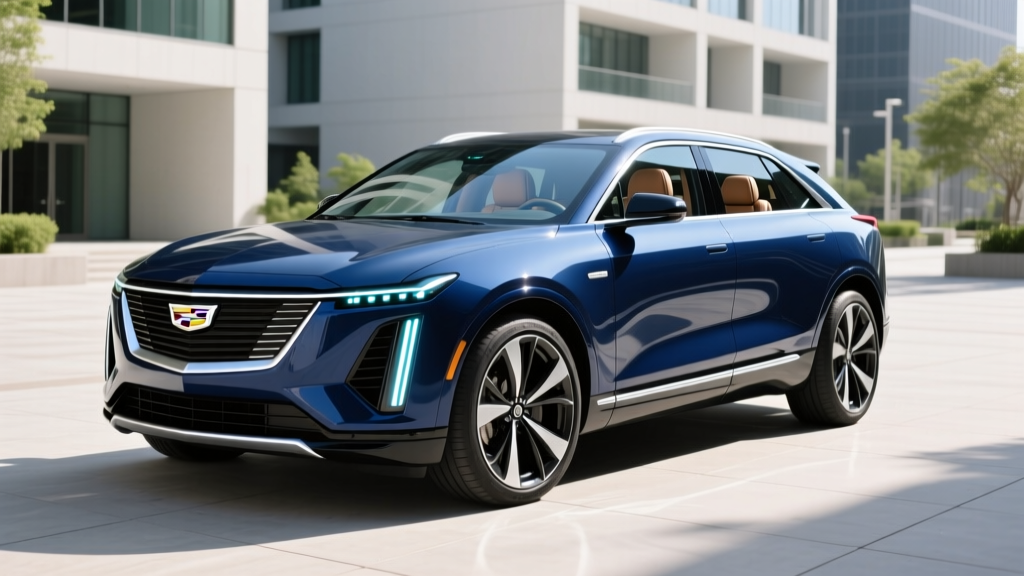
The 2026 Cadillac Lyriq-V marks the first time GM's luxury division has slapped a V badge on a battery-electric vehicle. Built on the Ultium platform shared with the Chevrolet Blazer EV and GMC Hummer EV, the Lyriq-V adds a dual-motor all-wheel-drive powertrain producing 615 horsepower to the already upscale Lyriq formula. But with a starting price near $73,000 and a heavier curb weight than the standard Lyriq, buyers need to know exactly what they're getting — and what trade-offs the V badge demands.
This review covers the 2026 Cadillac Lyriq-V electric SUV in full: EPA range versus real-world expectations, DC fast-charging curves, home charging speeds, interior space, tax credit eligibility under current IRS §30D rules, and how it stacks up against the BMW iX M60, Audi Q8 e-tron, and Tesla Model X.
2026 Cadillac Lyriq-V Key Specifications
| Spec | Value |
|---|---|
| EPA Range | 291 miles (est. based on AWD dual-motor 102 kWh pack) |
| Battery (Usable) | ~102 kWh, NMC (nickel-manganese-cobalt) Ultium |
| Peak DC Fast Charge | 190 kW |
| 10–80% DC Charge Time | ~34 minutes (preconditioned) |
| Level 2 Home Charging | 11.5 kW onboard charger (~31 mi/hr) |
| Drivetrain | Dual-motor AWD |
| Horsepower | 615 hp (V-estimated, GM preliminary) |
| 0–60 mph | ~4.2 seconds (est.) |
| Efficiency | ~89 MPGe / ~38 kWh/100mi (est.) |
| Cargo (rear seats up / folded) | 28.0 / 60.9 cu ft |
| Rear Legroom | 39.6 inches |
| Battery Warranty | 8 years / 100,000 miles |
| Base MSRP (Luxury AWD V) | $72,990 (before destination) |
Note: The 2026 Lyriq-V has been announced by Cadillac with preliminary specifications. Final EPA certification and MSRP by trim will be confirmed closer to the on-sale date. Figures above reflect GM's published estimates and Ultium platform data from the closely related Lyriq AWD.
Real-World Range: What the EPA Sticker Doesn't Tell You
EPA Estimated Range: ~291 miles (preliminary, based on 102 kWh Ultium AWD configuration)
Real-World Expectation: Expect 245–265 miles in mixed highway driving at 70–75 mph. In cold weather (below 30°F), plan for 210–230 miles of usable range before needing a charge stop. City and suburban driving with regenerative braking can push closer to or slightly above the EPA number.
The standard Lyriq with rear-wheel drive and the same 102 kWh battery achieves an EPA-verified 314 miles, per fueleconomy.gov. Adding the V's second motor, stickier tires, and additional weight (roughly 200–250 lbs over RWD) reduces that figure. The Lyriq-V's 20-inch wheels and performance-oriented rubber also increase rolling resistance compared to the base 20-inch aero wheels.
On a 250-mile highway run at sustained 75 mph in 45°F conditions — a realistic winter road-trip scenario for northern buyers — the Lyriq-V will likely require a DC fast-charge stop before arrival. The heat pump (standard on all 2026 Lyriq trims) helps mitigate cold-weather losses compared to resistive cabin heating, but physics still wins: battery internal resistance rises in cold, and cabin heating draws 2–4 kW continuously.
Charging Speed: DC Fast, Level 2, and the Curve Reality
| Charging Level | Power | Speed / Notes |
|---|---|---|
| Level 1 (120V household) | ~1.4 kW | ~3–4 miles per hour — emergency/trickle only |
| Level 2 (240V home, 48A circuit) | 11.5 kW (onboard max) | ~31 miles per hour — full charge in ~9.5 hours |
| DC Fast Charge (peak) | 190 kW | 10–80% in ~34 min; peak rate sustained to ~50% SoC |
| DC Fast Charge (taper above 80%) | ~60–80 kW | 80–100% adds another 25–30 minutes — avoid on road trips |
The Lyriq-V uses the same 190 kW peak DC fast-charge capability as the standard Lyriq, enabled by the Ultium platform's battery management system. That 190 kW figure is a peak, not a sustained rate. In practice, preconditioned charging at a 350 kW-capable station (such as Electrify America or EVgo's latest stalls) will hold close to 190 kW from roughly 10% to 50% state of charge, then taper to around 120 kW through 70%, and drop further above 80%.
This is critical for road-trip planning: the 10–80% time of roughly 34 minutes is the number that matters. Charging from 80–100% at a DC fast charger is painfully slow and wasteful of both time and money. On long drives, plan stops around the 10–80% window and move on.
For home charging, the 11.5 kW onboard AC charger is competitive with the segment. A full Level 2 installation on a 60-amp circuit (48A continuous) will replenish the 102 kWh battery overnight. Expect installation costs of $800–$2,000 for the charger and electrician work, depending on panel proximity and whether a 200-amp service upgrade is needed. The Lyriq-V ships with a dual-level charge cord (120V/240V) for basic needs, but a dedicated wall unit like the ChargePoint Home Flex or Emporia Vue is strongly recommended for daily ownership.
The 2026 Lyriq-V comes equipped with a NACS (North American Charging Standard) port, giving it native access to Tesla's Supercharger network — a significant advantage over CCS-only competitors as of 2025–2026. This means roughly 17,000+ additional fast-charging stalls nationwide without an adapter.
Performance and Driving Dynamics
The V badge isn't just a trim package here. The dual-motor AWD system produces an estimated 615 horsepower, making the Lyriq-V the most powerful production Cadillac ever sold (surpassing the CT5-V Blackwing's 668 hp only in spirit — the Blackwing remains the HP king, but the Lyriq-V's instant electric torque changes the conversation). The estimated 0–60 mph time of 4.2 seconds places it firmly in performance-SUV territory, though not quite at the Tesla Model X Plaid's 2.5-second level.
Where the Lyriq-V earns its keep is in the mid-range: electric motors deliver peak torque from zero RPM, so highway passing and on-ramp acceleration feel effortless. The AWD system can vector torque front-to-rear, and GM's Velocity Package (available on V trims) includes adaptive dampers tuned for a firmer, flatter ride than the comfort-oriented Luxury and Sport trims.
The trade-off is weight. At an estimated 5,900+ lbs curb weight, the Lyriq-V is no sports car in the corners. It's a grand tourer — composed, quiet, and fast in a straight line, but you'll feel the mass during aggressive direction changes. The regenerative braking system offers one-pedal driving capability and a steering-wheel-mounted regen paddle (a feature borrowed from the Chevy Bolt and Cadillac's EV lineage) that lets you modulate deceleration without touching the brake pedal.
Interior, Tech, and Cargo
The Lyriq-V's cabin uses the same 33-inch LED curved display that spans the driver cluster and infotainment screen — a 9K-resolution panel running Google Built-In (Google Maps, Google Assistant, Play Store apps). Wireless Apple CarPlay and Android Auto are standard, along with wireless phone charging.
Cadillac's Super Cruise — a hands-free, SAE Level 2 driver-assistance system — is available on the Lyriq-V and covers over 750,000 miles of compatible highways in the US and Canada as of 2026. It uses a driver-monitoring camera to ensure eyes remain on the road. This is not autonomous driving; the driver must remain engaged and ready to take over at any time. But on long interstate stretches, it significantly reduces fatigue.
SAE Level 2 — Driver Assistance, Not Self-Driving: Super Cruise requires the driver to remain attentive, keep eyes on the road, and be prepared to steer or brake immediately. It does not handle construction zones, unmapped roads, or severe weather autonomously. Only Level 4 services like Waymo operate without a human driver.
Cargo space remains unchanged from the standard Lyriq: 28.0 cubic feet behind the second row and 60.9 cubic feet with the rear seats folded. That's competitive with the BMW iX (35.5/77.9 cu ft, where the iX wins on volume) and slightly behind the Tesla Model X. Rear-seat passengers get 39.6 inches of legroom — generous for adults on long trips. There is no front trunk (frunk); GM allocated that space to HVAC and power electronics.
Notable drawbacks: the Lyriq still lacks a frunk, which competitors like the Ford Mustang Mach-E and Rivian R1S use for additional storage. Rear visibility is compromised by the sloping roofline — a rear camera mirror (standard on higher trims) helps. And while the Google-based infotainment is responsive, some users report that climate controls buried in the touchscreen are less convenient than physical knobs.
Pricing, Trims, and Federal Tax Credit Eligibility
| Trim | Base MSRP | Est. Federal Credit | Effective Price |
|---|---|---|---|
| Luxury AWD (V) | $72,990 | $0–$7,500* | $65,490–$72,990 |
| Sport AWD (V) | $74,590 | $0–$7,500* | $67,090–$74,590 |
| V-Series (fully loaded) | $78,990+ | $0–$7,500* | $71,490–$78,990 |
*Federal §30D credit eligibility depends on buyer income, vehicle MSRP cap, battery component sourcing, and critical mineral requirements. See IRS rules below.
The 2026 Lyriq-V starts at an estimated $72,990 before a $1,395 destination charge. That places it above the standard Lyriq AWD Luxury (starting around $62,690) but well below the BMW iX M60 ($92,000+) and the Tesla Model X ($81,630 base). The V premium buys you the dual-motor powertrain, V-specific suspension tuning, unique exterior styling, and badging.
Federal Tax Credit: The §30D Reality Check
Under current IRS §30D rules, the Lyriq-V may qualify for up to $7,500 in federal tax credits, but eligibility is not guaranteed for every buyer. Here's what determines it:
- MSRP Cap: SUVs must have an MSRP at or below $80,000. The Lyriq-V Luxury and Sport trims clear this; a fully loaded V-Series approaching $79,000+ may or may not depending on options. Confirm final MSRP with the dealer.
- Buyer Income Cap: Modified adjusted gross income must not exceed $150,000 (single), $225,000 (head of household), or $300,000 (joint filers).
- Battery Sourcing: The $7,500 credit is split into two halves — $3,750 for critical mineral sourcing and $3,750 for battery component manufacturing. GM's Ultium batteries are assembled in the US (Spring Hill, Tennessee), but critical mineral sourcing (lithium, cobalt, nickel) must meet escalating annual thresholds set by the IRS. As of 2026, the critical mineral requirement is stringent, and some Ultium configurations may qualify for only $3,750 of the total $7,500.
- Point-of-Sale Transfer: As of 2024, buyers can transfer the credit to the dealer at purchase, reducing the sale price directly rather than waiting for a tax refund. This is available on the Lyriq-V if eligible.
Because sourcing rules tighten each year and GM's supply chain evolves, we strongly recommend checking the DOE's qualifying vehicle list on fueleconomy.gov and consulting a tax professional before assuming the full $7,500.
Lyriq-V vs. the Competition
The Lyriq-V's natural competitors are performance-oriented luxury electric SUVs in the $65,000–$95,000 range:
| Vehicle | EPA Range | HP | 0–60 | Peak DC kW | Base MSRP |
|---|---|---|---|---|---|
| 2026 Cadillac Lyriq-V AWD | ~291 mi | 615 | ~4.2s | 190 kW | $72,990 |
| 2026 BMW iX xDrive50 | 324 mi | 516 | 4.4s | 200 kW | $87,250 |
| 2026 Audi Q8 e-tron Prestige | 285 mi | 402 | 5.2s | 170 kW | $79,800 |
| 2026 Tesla Model X Long Range | 335 mi | 670 | 3.8s | 250 kW | $81,630 |
The Lyriq-V undercuts the BMW iX and Tesla Model X on price while delivering comparable or superior horsepower. Where it trails is range (the iX and Model X both exceed 320 miles) and DC fast-charge speed (the Model X peaks at 250 kW on V3 Superchargers). The Audi Q8 e-tron is the closest match in price and range but can't touch the Lyriq-V's power output.
For buyers who prioritize value-per-horsepower and Cadillac's design language, the Lyriq-V is compelling. For those who need maximum range for frequent 300+ mile road trips, the Model X or iX remains the pragmatic choice.
Warranty and Long-Term Ownership
Cadillac covers the Lyriq-V's Ultium battery pack for 8 years or 100,000 miles, whichever comes first, against defects and capacity loss below 70% of original capacity (a common industry threshold). The powertrain warranty mirrors this at 8 years / 100,000 miles. The limited vehicle warranty is 4 years / 50,000 miles, with complimentary scheduled maintenance for the first visit.
GM's Ultium NMC cells have shown promising degradation data in the broader fleet (Hummer EV, Blazer EV), with early reports suggesting roughly 5–8% capacity loss over the first 50,000 miles — well within the warranty buffer. The Lyriq-V's liquid-cooled thermal management system actively conditions the battery during charging and driving, which is the single most important factor in long-term cell health.
Insurance costs for the Lyriq-V are likely to run 15–25% higher than the standard Lyriq AWD, reflecting the higher repair costs associated with performance EVs and the V-specific components. Expect annual premiums in the $2,800–$3,600 range depending on state, driving record, and coverage levels.
Pros and Cons
Pros
- 615 HP dual-motor AWD at a sub-$75K starting price — exceptional value in the luxury performance EV segment
- NACS charging port provides native Tesla Supercharger access
- Super Cruise hands-free driving on 750,000+ miles of mapped highways
- 33-inch curved 9K display with Google Built-In is one of the best infotainment systems in any luxury SUV
- Quiet, composed ride quality with strong mid-range acceleration
- US-assembled Ultium battery supports domestic manufacturing and may aid tax credit eligibility
Cons
- EPA range (~291 mi) trails key rivals (iX at 324, Model X at 335) — a real gap for road-trippers
- No front trunk (frunk) — wasted space in an EV architecture
- 190 kW peak DC charge rate is adequate but not class-leading (Tesla: 250 kW, Hyundai/Kia E-GMP: 240+ kW)
- Climate controls buried in touchscreen — no physical knobs for temperature or fan speed
- Curb weight exceeds 5,900 lbs — felt in cornering and tire wear
- Federal tax credit eligibility uncertain at full $7,500 due to critical mineral sourcing rules
Who Should Buy the 2026 Cadillac Lyriq-V?
Choose the Lyriq-V if: You want a powerful, luxurious AWD electric SUV with distinctive American design, you mostly drive within 200 miles of home with occasional road trips, you value Super Cruise for highway commuting, and you want NACS Supercharger access without an adapter — all at a price that undercuts European rivals by $10,000–$20,000.
Look elsewhere if: You regularly drive 300+ miles between charge stops (the BMW iX or Tesla Model X offers 30–40 more miles of EPA range), you prioritize the fastest possible DC charging (Tesla's 250 kW or Hyundai's 800V architecture at 240+ kW), or you need maximum cargo volume for family gear (the iX and Model X both offer more cubic feet).
The Lyriq-V is best suited as a daily-driver luxury SUV for performance-minded buyers who have reliable home Level 2 charging and whose road trips can accommodate a single 30-minute charge stop. It's a commuter and weekend warrior, not a cross-country hauler.
Frequently Asked Questions
What is the real-world range of the 2026 Cadillac Lyriq-V?
The EPA preliminary estimate is approximately 291 miles. In real-world highway driving at 70–75 mph, expect 245–265 miles. In cold weather below 30°F, plan for 210–230 miles. City driving with regenerative braking can approach or slightly exceed the EPA number.
How fast does the Lyriq-V charge at home and on the road?
At home on a Level 2 (240V, 48A) charger, the Lyriq-V charges at up to 11.5 kW, adding about 31 miles of range per hour and fully recharging overnight in roughly 9.5 hours. On a DC fast charger, it peaks at 190 kW and charges from 10–80% in approximately 34 minutes when the battery is preconditioned.
Does the 2026 Lyriq-V qualify for the $7,500 federal EV tax credit?
It may qualify for up to $7,500 under IRS §30D, but eligibility depends on the buyer's income (must be under $150K single / $300K joint), the vehicle's final MSRP (must be at or below $80,000 for SUVs), and battery component and critical mineral sourcing requirements that tighten annually. The point-of-sale transfer option allows eligible buyers to apply the credit at purchase. Check fueleconomy.gov and consult a tax professional for your specific situation.
Is the Lyriq-V worth buying over the BMW iX or Tesla Model X?
The Lyriq-V offers the best horsepower-per-dollar ratio in the segment at 615 HP for under $73,000. However, the BMW iX xDrive50 provides more range (324 mi EPA) and the Tesla Model X offers faster DC charging (250 kW) and more range (335 mi). If value, design, and Super Cruise matter most, the Lyriq-V wins. If range and charging speed are top priorities, the iX or Model X may be better fits.
What charging connector does the Lyriq-V use?
The 2026 Lyriq-V comes with a NACS (North American Charging Standard) port, providing native access to Tesla Superchargers and the growing NACS-equipped public charging network without an adapter. A CCS adapter may also be available for legacy stations.
How long will the Lyriq-V battery last?
GM warranties the Ultium battery for 8 years or 100,000 miles against defects and capacity loss below 70%. Based on early Ultium fleet data, expect roughly 5–8% degradation over the first 50,000 miles with normal use. The liquid-cooled thermal management system helps preserve long-term cell health. Replacement cost, if needed out of warranty, is estimated at $15,000–$22,000 based on current Ultium pack pricing.
Is Super Cruise self-driving?
No. Super Cruise is an SAE Level 2 driver-assistance system. It allows hands-free driving on compatible mapped highways, but the driver must keep their eyes on the road (monitored by an infrared camera) and remain ready to take over steering and braking at any time. It does not handle unmapped roads, construction zones, or severe weather independently.