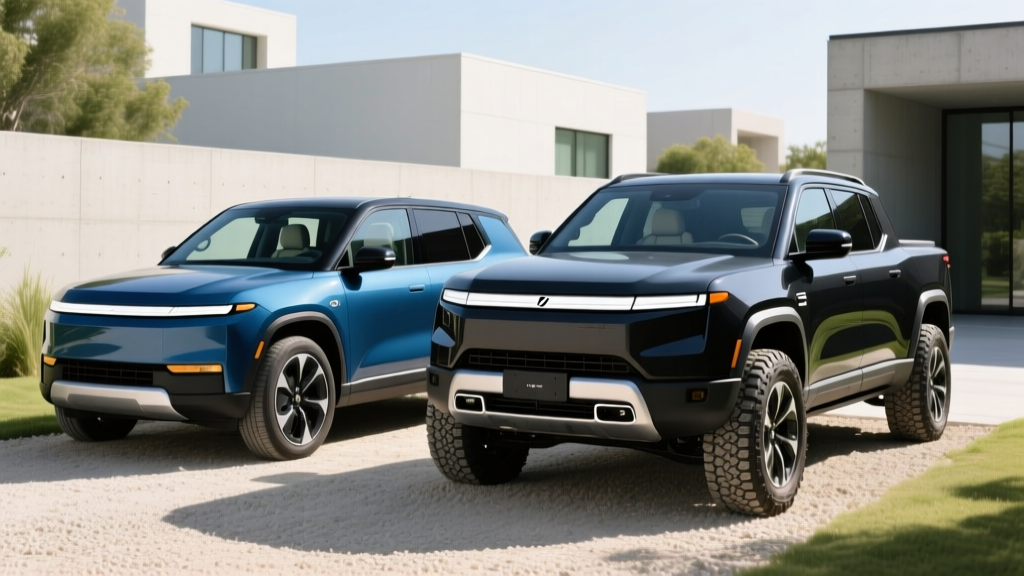
If you've seen a Rivian R1S SUV or R1T truck on the road and wondered how employees score such steep deals, you're not alone. The Rivian employee discount has become one of the most discussed perks in the EV space — but for the general public, the real question is what these vehicles actually cost, deliver, and compare to once incentives, range, and ownership realities are factored in. This review covers the 2026 Rivian R1S and R1T lineup with the exact numbers buyers need.
Rivian R1S and R1T: 2026 Lineup Overview
Rivian refreshed both the R1S (three-row SUV) and R1T (crew-cab pickup) for the 2025 model year, and those updates carry into 2026 with minor software and packaging tweaks. Both vehicles now sit on Rivian's second-generation "Gen 2" platform featuring a new Enduro drive unit, upgraded thermal management, and a zonal electrical architecture that reduces wiring harness weight by over 100 pounds. The result is better efficiency, faster charging, and more power across the board.
Available in Dual-Motor, Performance Dual-Motor, and Tri-Motor configurations, both models offer a choice between a Standard battery pack and a Max battery pack. Rivian also introduced a new LFP (lithium iron phosphate) Standard pack option on the Dual-Motor trims — a chemistry trade-off that prioritizes longevity and lower cost over maximum energy density.
| Spec | R1S Dual-Motor (Standard) | R1S Tri-Motor (Max) | R1T Dual-Motor (Standard) | R1T Tri-Motor (Max) |
|---|---|---|---|---|
| EPA Range | 270 mi | 410 mi | 270 mi | 420 mi |
| Battery (usable) | 92 kWh (LFP) | 141 kWh (NMC) | 92 kWh (LFP) | 141 kWh (NMC) |
| Horsepower | 533 hp | 850 hp | 533 hp | 850 hp |
| 0-60 mph | 4.5 sec | 2.9 sec | 4.5 sec | 2.9 sec |
| Drivetrain | AWD (Dual-Motor) | AWD (Tri-Motor) | AWD (Dual-Motor) | AWD (Tri-Motor) |
| Max DC Fast Charge | 200 kW | 220 kW | 200 kW | 220 kW |
| 10-80% DCFC Time | ~28 min | ~34 min | ~28 min | ~34 min |
| Level 2 Home Rate | 11.5 kW (~25 mi/hr) | 11.5 kW (~25 mi/hr) | 11.5 kW (~25 mi/hr) | 11.5 kW (~25 mi/hr) |
| MPGe (combined) | 73 MPGe | 70 MPGe | 74 MPGe | 71 MPGe |
| kWh/100 mi | 46 | 48 | 45 | 47 |
| Towing Capacity | 7,700 lb | 7,700 lb | 11,000 lb | 11,000 lb |
| Base MSRP | $75,900 | $99,900 | $69,900 | $93,900 |
Real-World Range: What the EPA Sticker Doesn't Tell You
Rivian's large, heavy vehicles (the R1S Tri-Motor Max tips the scales at over 7,100 pounds) pay an efficiency penalty at highway speeds. Around town, regenerative braking and lower aero drag help the vehicles meet or even slightly exceed their EPA ratings. But if your commute is mostly 75-mph interstate, the real-world gap matters.
The LFP Standard pack deserves special mention. While it offers less total range, LFP chemistry tolerates repeated 100% charging without the degradation concerns of NMC cells. For daily commuters who can charge at home every night, the Standard LFP pack may deliver more practical value over five years than the range advantage of the Max pack suggests on paper.
Charging Speed: DC Fast and Home Level 2
Rivian's Gen 2 platform brought meaningful charging improvements. Both models support the NACS (North American Charging Standard) connector natively, granting access to Tesla's Supercharger network — a major practical advantage over CCS-only rivals now that the NACS transition is largely complete.
| Charging Level | Power | Speed (approx.) | Notes |
|---|---|---|---|
| Level 1 (120V) | 1.4 kW | ~3 mi/hr | Emergency/trickle only |
| Level 2 (240V, 48A) | 11.5 kW | ~25 mi/hr | Full charge overnight (~10-14 hrs for Max) |
| DC Fast (Standard pack) | Peak 200 kW | 10-80% in ~28 min | Sustains ~150 kW to 60%, tapers above 80% |
| DC Fast (Max pack) | Peak 220 kW | 10-80% in ~34 min | Larger battery = longer session despite higher peak |
On a road trip, the Max pack's 34-minute 10-80% session is acceptable given the 410-mile range between stops — you'll typically stop every 280-320 real miles and add 200+ miles in 20 minutes. The Standard pack charges faster in absolute time but requires more frequent stops on long hauls.
At home, Rivian's Wall Charger delivers up to 11.5 kW on a 60-amp circuit (48 amps continuous). For the 92 kWh Standard pack, a full charge takes roughly 8-9 hours. The 141 kWh Max pack requires 12-14 hours from near-empty — still feasible overnight, but tight if you arrive home depleted and need a full pack by morning. Installation costs for a 60-amp Level 2 circuit typically run $800-$2,000 depending on panel proximity and local permit fees, per Rivian's home charging guide.
Performance and Driving Dynamics
The Tri-Motor R1S and R1T deliver supercar-rivaling acceleration — the 2.9-second 0-60 mph time in the 7,100-pound R1S Tri-Motor is genuinely startling. The Dual-Motor's 4.5 seconds is plenty quick for daily driving and merging.
Both models feature Rivian's quad-motor air suspension (Tri-Motor) or dual-motor air suspension (Dual-Motor) with adjustable ride height. Ground clearance ranges from 7.9 inches in Standard mode to 14.9 inches in Max Off-Road mode, giving the R1T legitimate trail capability and the R1S genuine overlanding chops. The electro-hydraulic roll control system eliminates traditional anti-roll bars, providing a surprisingly flat cornering experience for a vehicle this tall.
The R1T's unique gear tunnel — a full-width pass-through storage compartment between the cab and bed — remains one of the most clever utility features in any pickup. Combined with the bed's powered tonneau and integrated camp kitchen option, the R1T is purpose-built for adventure use cases that no competitor directly matches.
Pricing, Rivian Employee Discount, and Federal Tax Credit
Let's address the keyword directly: the Rivian employee discount is an internal company benefit available to Rivian staff, not the general public. Employee pricing is confidential and varies, but industry reports suggest savings of roughly $5,000-$10,000 off MSRP depending on model and configuration. This is consistent with typical OEM employee pricing programs.
For public buyers, here's what the 2026 pricing and federal tax credit landscape looks like:
| Model / Trim | Base MSRP | §30D Credit Eligible? | Est. Net Price (w/ max credit) |
|---|---|---|---|
| R1T Dual-Motor Standard | $69,900 | Yes (if under MSRP + income caps) | ~$62,400 |
| R1T Dual-Motor Performance | $79,900 | No (exceeds $80K truck cap) | $79,900 |
| R1T Tri-Motor Max | $93,900 | No (exceeds $80K truck cap) | $93,900 |
| R1S Dual-Motor Standard | $75,900 | Yes (if under MSRP + income caps) | ~$68,400 |
| R1S Dual-Motor Performance | $85,900 | No (exceeds $80K SUV cap) | $85,900 |
| R1S Tri-Motor Max | $99,900 | No (exceeds $80K SUV cap) | $99,900 |
Critical §30D rules for 2026 (per the IRS): The federal tax credit offers up to $7,500, but eligibility hinges on three hurdles:
- MSRP cap: Vans, SUVs, and trucks must not exceed $80,000 MSRP. This limits the credit to the R1T Dual-Motor Standard and the R1S Dual-Motor Standard trims only.
- Buyer income cap: Modified AGI must not exceed $150,000 (single), $225,000 (head of household), or $300,000 (joint).
- Battery sourcing: Critical minerals and battery components must meet phased-in domestic-content thresholds. Rivian has worked to qualify its LFP and NMC packs, but sourcing rules tighten annually — verify current eligibility on the IRS qualified vehicle list before purchasing.
The credit can now be transferred to the dealer at point of sale, reducing your purchase price directly rather than waiting for a tax refund. This makes the R1T Dual-Motor Standard at roughly $62,400 after credit one of the most capable electric trucks available at that price point.
Cargo, Passenger Space, and Interior
The R1S offers seating for up to seven across three rows, though the third row is best suited for children or short trips. Cargo volume behind the third row is approximately 10.4 cu ft, expanding to 46.7 cu ft behind the second row and 91.6 cu ft with both rear rows folded. A front trunk (frunk) adds 11.1 cu ft of sealed, drainable storage.
The R1T provides seating for five with generous rear legroom (approximately 38.2 inches). The 4.5-foot bed is shorter than a full-size truck, but the gear tunnel adds 11.7 cu ft of lockable, weather-sealed storage that effectively extends usable cargo length. The frunk offers 11.1 cu ft.
Interior materials are premium without reaching luxury-brand levels. Rivian uses vegan leather standard, with available Nappa leather on upper trims. The 15.6-inch center touchscreen runs Rivian's proprietary software — responsive and well-designed, but lacking Apple CarPlay and Android Auto. Wireless phone mirroring and native app integrations (Spotify, TuneIn) partially compensate, but smartphone projection remains a notable omission.
Driver Assistance and Technology
Rivian Driver+ works well on divided highways, offering smooth lane-keeping and predictable adaptive cruise behavior. It does not currently offer hands-free operation like GM's Super Cruise or Ford's BlueCruise, though Rivian has indicated hands-free capability is in development via future over-the-air updates. The system includes automatic emergency braking, blind-spot monitoring, rear cross-traffic alert, and a comprehensive surround-view camera system.
Other standout tech includes Rivian's Camp Mode (maintains climate and battery conditioning while parked), Pet Mode (keeps cabin climate controlled for animals), and the Gear Guard system — integrated cable locks and cameras that monitor your stored gear and send alerts if tampering is detected.
Pros, Cons, and Verdict
Pros
- Class-leading off-road capability with air suspension and 14.9" ground clearance
- NACS native — full Supercharger network access without adapters
- Tri-Motor performance is extraordinary (2.9 sec 0-60)
- R1T gear tunnel is a genuinely unique utility feature
- LFP Standard pack option offers long cycle life and daily 100% charging
- Over-the-air updates continuously add features
Cons
- No Apple CarPlay or Android Auto
- Highway efficiency suffers — real-world range gap is significant at 75 mph
- Most trims exceed the $80K MSRP cap, eliminating the $7,500 federal credit
- Max pack charging sessions are long (~34 min 10-80%)
- Rear visibility in the R1S is compromised by thick D-pillars
- Insurance premiums run 15-25% above comparable ICE vehicles
Who Should Buy the Rivian R1S or R1T?
Choose the R1T if: You need a truck that can tow up to 11,000 lb, handle genuine off-road trails, and serve as an adventure platform — and you're willing to accept a shorter bed than a full-size F-150 or Silverado.
Choose the R1S if: You want a three-row electric SUV with real off-road ability and 410 miles of EPA range on the Max pack, and you find the Tesla Model X too polarizing or the Cadillac Escalade IQ too expensive.
Look elsewhere if: Your priority is maximum highway efficiency, lowest possible cost per mile, or full smartphone integration. The Hyundai Ioniq 9, Tesla Model X, or upcoming competitors may better serve those use cases.
Rivian vs. Key Competitors
The R1T competes most directly with the Ford F-150 Lightning (starting ~$55,000, up to 320 mi EPA, 10,000 lb towing) and the Chevrolet Silverado EV (starting ~$55,000, up to 440 mi EPA on Max range trims). The R1T's advantage lies in off-road capability, the gear tunnel, and build quality; its disadvantage is price — you'll pay $10,000-$15,000 more for equivalent range and features.
The R1S competes with the Tesla Model X (starting ~$80,000, 335 mi EPA), Kia EV9 (starting ~$55,000, 304 mi EPA), and the Cadillac Escalade IQ (starting ~$130,000, 450 mi EPA). The R1S occupies a unique middle ground: more rugged and adventure-focused than the Model X, more premium and longer-ranged than the EV9, and significantly less expensive than the Escalade IQ.
Battery Warranty and Longevity
Rivian covers the battery pack and drive units with an 8-year/175,000-mile warranty — one of the more generous mileage limits in the industry (most competitors offer 8yr/100,000 mi). The warranty guarantees the battery will retain at least 70% of its original capacity over that period. Rivian's bumper-to-bumper warranty runs 5 years/60,000 miles.
For the LFP Standard pack, real-world degradation data is still accumulating, but LFP chemistry historically shows slower capacity loss than NMC, often retaining 90%+ capacity after 1,000 full charge cycles. The NMC Max pack follows more typical degradation curves — expect 5-8% loss over the first 50,000 miles, stabilizing afterward.
Frequently Asked Questions
Can the public access the Rivian employee discount?
No. The Rivian employee discount is an internal benefit reserved for Rivian employees and, in some cases, immediate family members. Public buyers should instead focus on the federal §30D tax credit (up to $7,500 on qualifying trims), state-level incentives, and any publicly advertised promotional offers.
Does the 2026 Rivian R1T qualify for the $7,500 federal tax credit?
Only the R1T Dual-Motor Standard at $69,900 MSRP qualifies, provided the buyer meets income caps ($150K single / $300K joint) and the battery meets current-year critical mineral and component sourcing requirements. Higher trims exceed the $80,000 MSRP cap for trucks and are ineligible. Always verify on the fueleconomy.gov qualified vehicle list before purchasing.
What is the real-world range of the Rivian R1S Tri-Motor Max?
The EPA rates it at 410 miles. In real-world highway driving at 70-75 mph, expect 340-360 miles. In cold weather below 30°F, plan for 280-310 miles. These figures assume no towing; towing a 5,000 lb trailer can cut range by 40-50%.
How fast does the Rivian R1 charge at home?
On a Level 2 home charger at 11.5 kW (48 amps), the R1 adds approximately 25 miles of range per hour. A full charge of the Standard pack takes ~8-9 hours; the Max pack takes ~12-14 hours. You'll need a 60-amp dedicated circuit installed by a licensed electrician.
Is the Rivian R1T worth it over the Ford F-150 Lightning?
If you prioritize off-road capability, premium build quality, the gear tunnel, and NACS Supercharger access — yes, the R1T justifies its premium. If your priority is lowest cost, maximum bed length, or fleet/commercial use, the F-150 Lightning is the more practical and affordable choice. The R1T is an adventure-lifestyle truck; the Lightning is a work truck that happens to be electric.
Does Rivian offer Apple CarPlay or Android Auto?
No. Rivian uses its proprietary infotainment system with native app integrations. This is one of the most commonly cited drawbacks among prospective buyers who prefer smartphone projection.