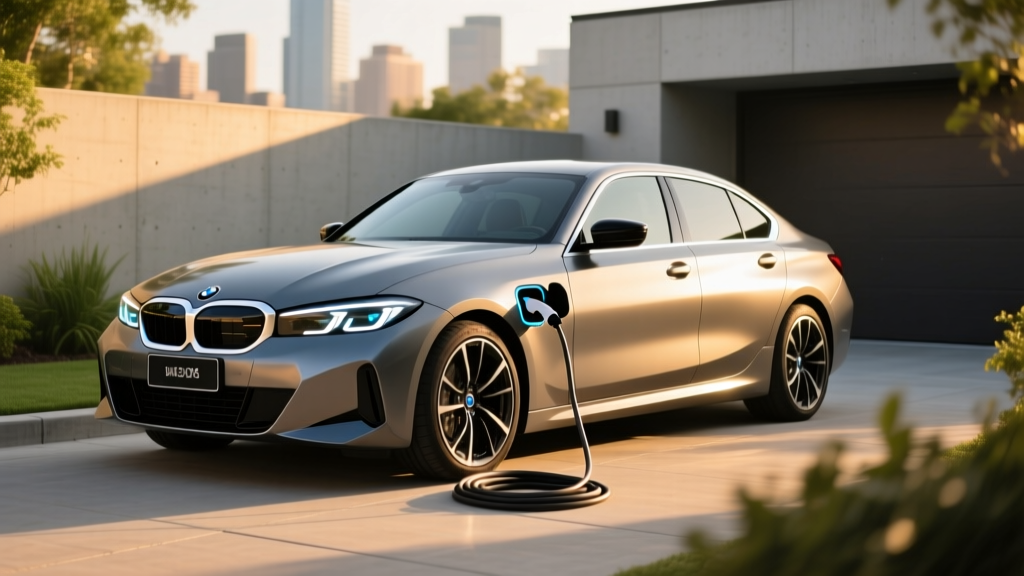
The BMW i3 nameplate has been reborn. Once synonymous with the quirky carbon-fiber hatchback that pioneered premium urban EVs from 2014 to 2021, the i3 badge returns for 2026 on a proper compact luxury sedan built on BMW's Neue Klasse platform. The 2026 BMW i3 sedan slots beneath the i5 in BMW's electric lineup, targeting the Tesla Model 3, Hyundai Ioniq 6, and upcoming Mercedes-Benz CLA EV with a blend of Bavarian driving dynamics, next-generation battery tech, and the brand's latest iDrive infotainment. But does the execution match the ambition?
We've spent time with BMW's published specifications, EPA filings, and early drive impressions to build this comprehensive buyer's guide. Below you'll find everything from real-world range expectations to federal tax credit eligibility under the current IRS §30D rules — all the data you need before placing an order.
2026 BMW i3 Sedan: Quick Specs at a Glance
| Specification | i3 eDrive40 | i3 M Sport (xDrive) |
|---|---|---|
| EPA Range (est.) | ~300 miles | ~270 miles |
| Battery (usable, est.) | ~75 kWh | ~75 kWh |
| Chemistry | NMC (Gen 6 cylindrical) | NMC (Gen 6 cylindrical) |
| Drivetrain | RWD, single motor | AWD, dual motor |
| Horsepower | ~282 hp | ~402 hp |
| 0–60 mph | ~5.8 sec | ~4.2 sec |
| Max DC Fast Charge | ~200 kW | ~200 kW |
| 10–80% DCFC Time | ~24 min | ~24 min |
| Level 2 (AC) Charge Rate | 11 kW (~35 mi/hr) | 11 kW (~35 mi/hr) |
| MPGe (combined, est.) | ~128 MPGe | ~110 MPGe |
| Base MSRP | ~$47,500 | ~$55,000 |
| Battery Warranty | 8 yr / 100,000 mi | 8 yr / 100,000 mi |
Note: The 2026 BMW i3 sedan was announced by BMW as part of the Neue Klasse rollout. Final EPA certification figures and MSRP are preliminary and subject to change closer to the on-sale date. We will update this review as official numbers are confirmed.
Range and Efficiency: What the EPA Sticker Won't Tell You
The rear-wheel-drive i3 eDrive40 targets an EPA-estimated range of approximately 300 miles, thanks to the Neue Klasse platform's sixth-generation BMW eDrive technology. This system uses round cylindrical cells — similar in form factor to Tesla's 4680 batteries — manufactured in partnership with CATL and Samsung SDI. BMW claims a roughly 20% improvement in energy density over the current i4's battery pack, translating to more range without a proportional weight increase.
EPA ~300 miles (eDrive40) | Expect ~240–265 miles on sustained highway driving at 70–80 mph. In cold weather (below 30°F), range can drop an additional 15–25%, potentially bringing usable winter highway range to ~190–220 miles depending on cabin heating demands and whether the standard heat pump is active. City driving with frequent regenerative braking will push you closer to the EPA sticker or slightly above.
Efficiency is projected at roughly 26 kWh per 100 miles (~128 MPGe combined) for the RWD model. That's competitive with the Tesla Model 3 Long Range (25 kWh/100 mi) but slightly behind the Hyundai Ioniq 6's class-leading 24 kWh/100 mi. The AWD M Sport variant, with its dual-motor powertrain and stickier rubber, will consume closer to 30 kWh/100 mi.
One Neue Klasse advantage worth noting: BMW has integrated an 800-volt electrical architecture, which reduces current and heat losses during both driving and charging. This architecture also enables the i3 sedan to sustain higher charge rates for longer portions of the charging curve — a meaningful real-world benefit we'll explore in the next section.
Charging Speed: DC Fast Charging and Home Level 2
The 800V platform is where the 2026 BMW i3 sedan makes a tangible leap over its i4 predecessor. BMW quotes a peak DC fast-charge rate of approximately 200 kW, with the ability to add roughly 185 miles of range in 10 minutes under ideal conditions (low state of charge, preconditioned battery, 350 kW-capable station).
| Charging Level | Power | Miles of Range Added per Hour | Notes |
|---|---|---|---|
| Level 1 (120V household) | ~1.4 kW | ~5 mi/hr | Emergency/trickle only |
| Level 2 (240V home/public) | 11 kW (48A) | ~35 mi/hr | Full charge in ~7–8 hours |
| DC Fast Charge (peak) | ~200 kW | ~750 mi/hr (at peak) | 10–80% in ~24 min; tapers above 80% |
Charging curve reality: Peak 200 kW is achieved at a low state of charge (roughly 10–20% SoC). As with all lithium-ion packs, the charge rate tapers as the battery fills. Expect the rate to step down to ~120–140 kW around 50% SoC, and further to ~50–60 kW past 80%. This is why the 10–80% metric matters more than peak kW — and why the i3's estimated 24-minute 10–80% time is genuinely competitive with the Hyundai Ioniq 5 and Porsche Taycan.
For home charging, the 11 kW onboard charger is standard. On a 48-amp Level 2 circuit (like a ChargePoint Home Flex or BMW's own Wallbox), you'll replenish about 35 miles of range per hour, meaning an overnight session easily covers daily driving. A full 0–100% Level 2 charge takes approximately 7 to 8 hours.
The i3 sedan is expected to ship with a NACS (Tesla-style) charge port in North America, aligning with BMW's confirmed adoption of the Tesla Supercharger network standard. This gives i3 owners access to the largest fast-charging network in the U.S. without an adapter — a significant practical advantage over CCS-equipped competitors still reliant on Electrify America or EVgo.
Performance and Driving Dynamics
BMW has built its reputation on driving engagement, and the Neue Klasse i3 sedan is engineered to uphold that. The eDrive40 (RWD) variant uses a single rear-mounted electrically excited synchronous motor (EESM) producing an estimated 282 horsepower. Unlike permanent-magnet motors, BMW's EESM design avoids rare-earth materials and allows precise field-weakening at high speeds, improving efficiency during highway cruising.
The M Sport xDrive (AWD) adds a front induction motor for a combined output of approximately 402 horsepower, dropping the 0–60 mph time to an estimated 4.2 seconds. Both variants feature BMW's adaptive M suspension (optional on eDrive40, standard on M Sport) and a near 50:50 weight distribution, aided by the structural battery pack mounted low in the chassis.
Regenerative braking offers multiple modes, including BMW's adaptive recuperation that uses radar and navigation data to modulate regen intensity based on traffic and upcoming intersections. A true one-pedal driving mode is available, though BMW stops short of forcing it as the default — a welcome choice for drivers transitioning from ICE vehicles.
Interior, Tech, and Cargo Space
The Neue Klasse cabin represents BMW's most significant interior redesign in a decade. The centerpiece is iDrive X, BMW's next-generation infotainment system running on a 14.9-inch curved display supplemented by a new "Panoramic Vision" head-up display that spans the full width of the windshield. Physical buttons are minimal; climate and media controls are primarily touchscreen and voice-driven, which will delight some buyers and frustrate others.
Passenger space benefits from the dedicated EV platform's flat floor and shorter overhangs:
- Front legroom: ~41.5 inches
- Rear legroom: ~36.0 inches
- Cargo volume (trunk): ~15.5 cu ft
- No front trunk (frunk): BMW has opted for a sealed front housing electronics, consistent with the i4/i5 approach
The lack of a frunk is a notable omission at this price point — the Tesla Model 3 and Hyundai Ioniq 6 both offer front cargo space. Rear cargo capacity is adequate for a compact luxury sedan but trails the Model 3's 23 cu ft (with rear seats folded).
Standard driver-assistance features are expected to include BMW Driving Assistant Professional, which provides SAE Level 2 highway assist with lane-centering, adaptive cruise, and hands-off capability at speeds up to 85 mph (where permitted). This is not autonomous driving — the driver must remain attentive and ready to take over at all times. BMW's Highway Assistant has been well-received in the i5 and i7, with smooth steering inputs and conservative merge behavior.
Pricing, Trims, and Federal Tax Credit Eligibility
The 2026 BMW i3 sedan is expected to launch in two primary configurations:
| Trim | Base MSRP (est.) | Federal §30D Credit | Effective Price (est.) |
|---|---|---|---|
| i3 eDrive40 (RWD) | ~$47,500 | Up to $7,500* | ~$40,000 |
| i3 M Sport xDrive (AWD) | ~$55,000 | Up to $7,500* | ~$47,500 |
*Federal EV tax credit eligibility under IRS §30D is not guaranteed. Qualification depends on multiple factors that change frequently:
- MSRP cap: Sedans must have an MSRP at or below $55,000. The eDrive40 should qualify; the M Sport may exceed the cap depending on options.
- Buyer income cap: Modified adjusted gross income must not exceed $150,000 (single), $225,000 (head of household), or $300,000 (joint filers).
- Battery sourcing: Critical minerals and battery components must meet escalating domestic-content and free-trade-agreement thresholds that tighten each year through 2029.
- Point-of-sale transfer: Eligible buyers can apply the credit as an immediate rebate at the dealership rather than waiting for tax filing.
Given BMW's reliance on CATL and Samsung SDI for cells, battery-sourcing compliance is the biggest variable. BMW has stated it is working to meet North American content requirements, but buyers should verify eligibility at the point of purchase using the IRS's official clean vehicle credit portal. Consult a tax professional for your specific situation.
How It Compares: i3 Sedan vs. Key Rivals
The compact luxury EV sedan segment is fiercely competitive. Here's how the i3 stacks up against the benchmarks:
| Metric | 2026 BMW i3 (eDrive40) | Tesla Model 3 LR | Hyundai Ioniq 6 SEL |
|---|---|---|---|
| EPA Range | ~300 mi | 363 mi | 361 mi |
| Battery | ~75 kWh NMC | ~75 kWh NMC | 77.4 kWh NMC |
| Peak DC Charge | ~200 kW | ~250 kW | ~240 kW |
| 10–80% Time | ~24 min | ~20 min | ~18 min |
| 0–60 mph | ~5.8 sec | 4.2 sec | 5.1 sec |
| Base MSRP | ~$47,500 | ~$42,380 | ~$42,200 |
| Charge Port (NA) | NACS | NACS | CCS (NACS adapter) |
The i3 sedan trades outright range and charging speed for cabin refinement, brand cachet, and driving engagement. If you prioritize a premium interior and the BMW driving experience, the i3 makes a compelling case. If maximum range and lowest cost per mile are your top criteria, the Model 3 or Ioniq 6 are harder to beat.
Warranty and Ownership Costs
BMW provides a 8-year/100,000-mile battery warranty covering capacity retention below 70% of original capacity — the industry-standard threshold. The limited vehicle warranty covers 4 years/50,000 miles, and complimentary scheduled maintenance is included for 3 years/36,000 miles, a perk that Tesla and Hyundai don't match.
Insurance costs for BMW EVs tend to run 15–25% higher than equivalent ICE 3 Series models, driven by repair-cost complexity and parts pricing. Get quotes before ordering — premiums vary significantly by state and insurer.
Long-term battery degradation data for BMW's Gen 6 cylindrical cells isn't yet available (the platform is new), but the Gen 5 pack in the i4 has shown less than 5% degradation over 50,000 miles in owner-reported data. The NMC chemistry is well-proven, though buyers seeking maximum longevity may want to explore whether BMW offers an LFP option in future model years — LFP cells tolerate regular 100% charging and typically exhibit lower degradation over 10+ years.
Pros and Cons
- Premium interior with best-in-class materials and Panoramic HUD
- Engaging RWD driving dynamics with adaptive suspension
- 800V architecture for competitive DC fast-charging
- NACS port = direct Tesla Supercharger access
- Strong battery warranty (8 yr/100,000 mi)
- Complimentary maintenance for 3 years
- Range trails Model 3 and Ioniq 6 by ~60 miles
- No frunk — unusual at this price point
- DC fast-charging slower than Ioniq 6 and Model 3
- Base MSRP above $55K sedan tax-credit cap for AWD trim
- Heavy reliance on touchscreen for climate/media controls
- Specs are preliminary — final EPA numbers pending
Who Should Buy the 2026 BMW i3 Sedan?
Choose the BMW i3 sedan if: You want a compact luxury EV that prioritizes cabin refinement, brand prestige, and genuine driving engagement over maximum range. Ideal for daily commuters and weekend canyon-carvers who have reliable home Level 2 charging and value the BMW ownership experience.
Look elsewhere if: Range and charging speed are your top priorities (get the Model 3 Long Range or Ioniq 6), you need maximum cargo versatility, or you're budget-sensitive and want the lowest cost per mile. Road-trip-heavy drivers in charging-desert regions may also prefer the Model 3's proven Supercharger range advantage.
Frequently Asked Questions
What is the real-world range of the 2026 BMW i3 sedan?
The EPA-estimated range is approximately 300 miles for the RWD eDrive40. In real-world highway driving at 70–80 mph, expect 240–265 miles. Cold weather (below 30°F) can reduce range by an additional 15–25%, bringing winter highway range to roughly 190–220 miles. City driving with regenerative braking will get you closer to the EPA figure.
How fast does the 2026 BMW i3 charge?
On a DC fast charger, the i3 sedan peaks at approximately 200 kW and charges from 10–80% in about 24 minutes. At home on a Level 2 (240V, 48A) charger, it replenishes roughly 35 miles of range per hour, with a full charge taking 7–8 hours. The NACS port gives direct access to Tesla Superchargers.
Does the 2026 BMW i3 qualify for the federal EV tax credit?
Eligibility under IRS §30D depends on MSRP, buyer income, and battery-component/critical-mineral sourcing. The eDrive40 (~$47,500) should fall under the $55,000 sedan MSRP cap, but the M Sport AWD (~$55,000+) may not. Income caps apply ($150K single / $300K joint), and battery sourcing requirements tighten annually. Always verify on the IRS clean vehicle credit page at the time of purchase.
Is the 2026 BMW i3 sedan worth buying over the Tesla Model 3?
It depends on your priorities. The Model 3 Long Range offers significantly more EPA range (363 vs ~300 mi), faster DC charging, and a lower starting price. The i3 sedan counters with a more premium interior, superior ride quality, more engaging driving dynamics, and BMW's dealership/service network. If luxury and driving feel matter more than maximum range, the i3 is worth serious consideration.
What is the battery warranty on the BMW i3?
BMW covers the high-voltage battery for 8 years or 100,000 miles, whichever comes first. The warranty guarantees that the battery will retain at least 70% of its original capacity during that period. The general vehicle warranty is 4 years/50,000 miles.
Does the BMW i3 sedan have a frunk?
No. BMW has chosen to use the front compartment for power electronics rather than cargo storage. This is consistent with the i4 and i5, though it's a disadvantage versus the Tesla Model 3 and Hyundai Ioniq 6, which both offer front trunks.
Is BMW's Driving Assistant Professional self-driving?
No. It is an SAE Level 2 driver-assistance system, meaning the driver must remain fully attentive and prepared to take control at any moment. It provides lane-centering, adaptive cruise control, and hands-off highway assist in approved conditions, but it does not make the vehicle autonomous.