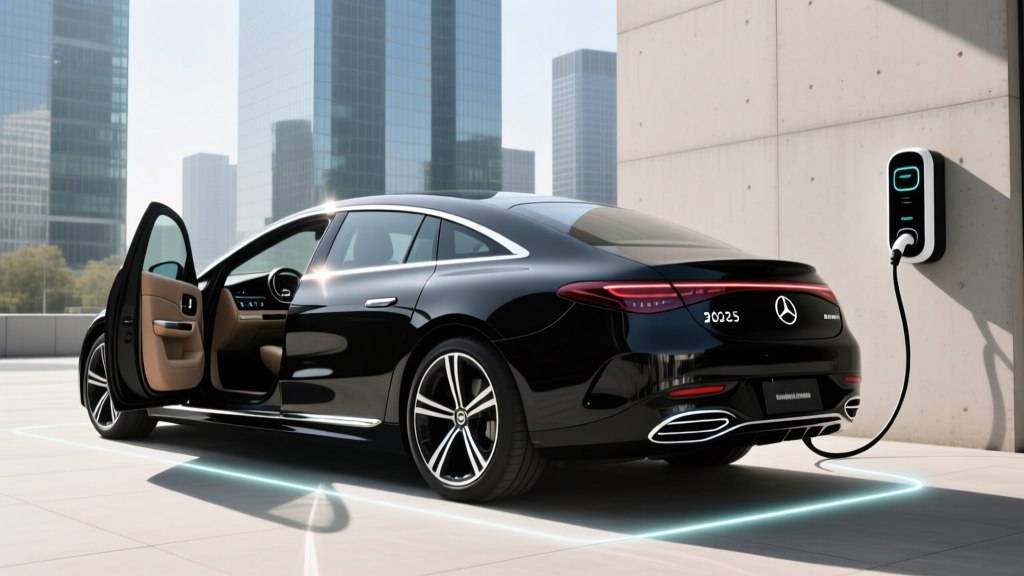
The 2025 Mercedes-Benz EQS sedan remains the benchmark for electric luxury — a 3,500-pound statement that range, refinement, and technology can coexist in a single package. But benchmark status comes with a benchmark price, and the luxury EV landscape has shifted dramatically since the EQS first launched. With rivals like the BMW i7, Lucid Air, and Tesla Model S pressing hard on efficiency, charging speed, and value, the EQS must earn its six-figure sticker every single mile.
This review cuts through the marketing gloss with exact figures: EPA range versus what you'll actually see on a highway road trip, the real charging curve at a DC fast charger, total cost after federal tax credit rules, and whether the EQS's standout tech justifies its position at the top of Mercedes' EV lineup.
Range, Battery, and Real-World Efficiency
The 2025 EQS 450+ (rear-wheel drive) carries a 118 kWh usable battery pack using NMC (nickel manganese cobalt) chemistry — the high-energy-density choice Mercedes favors for maximum range over the LFP chemistry found in some base-trim competitors. The EPA rates the EQS 450+ at 390 miles of combined range, placing it among the longest-range luxury EVs sold in the United States.
EPA estimate: 390 miles (EQS 450+), 371 miles (EQS 450 4MATIC), 330 miles (EQS 580 4MATIC)
Real-world expectation: Plan for 300–330 miles on sustained highway driving at 70–80 mph. In cold weather (below 32°F), expect a 15–25% reduction, dropping effective range to roughly 250–280 miles for the 450+. City driving with regenerative braking recovers more energy and can approach or slightly exceed the EPA combined figure.
Efficiency for the EQS 450+ lands at 97 MPGe combined (35 kWh/100 mi), according to fueleconomy.gov. That's respectable for a 5,600-pound sedan, though the lighter Lucid Air Grand Touring achieves 131 MPGe with similar range. The EQS prioritizes isolation and ride comfort over lightweighting — and you feel that trade-off at the charger.
| Spec | EQS 450+ | EQS 450 4MATIC | EQS 580 4MATIC |
|---|---|---|---|
| EPA Range | 390 mi | 371 mi | 330 mi |
| Battery (usable) | 118 kWh NMC | 118 kWh NMC | 118 kWh NMC |
| Horsepower | 355 hp | 355 hp | 536 hp |
| 0–60 mph | 5.9 sec | 5.3 sec | 4.1 sec |
| Drivetrain | RWD | AWD (dual-motor) | AWD (dual-motor) |
| MPGe (combined) | 97 MPGe | 93 MPGe | 87 MPGe |
| Efficiency | 35 kWh/100 mi | 36 kWh/100 mi | 39 kWh/100 mi |
Charging Speed: DC Fast, Level 2, and the Curve Reality
Mercedes rates the EQS for a peak DC fast-charge rate of 200 kW on a CCS1 connector. In controlled testing, the EQS sustains close to that peak between roughly 10% and 40% state of charge, then tapers progressively. A 10–80% charge takes approximately 31 minutes at a capable 200+ kW station — competitive with the BMW i7 but noticeably behind the Lucid Air's 300+ kW architecture and the Porsche Taycan's 270 kW peak.
One ownership note: the EQS supports NACS (Tesla Supercharger) access via adapter, and Mercedes has committed to native NACS ports on future model years. For now, CCS remains the native port, and the adapter adds a minor friction point at Tesla stalls.
| Charge Level | Power / Rate | Time / Miles Added |
|---|---|---|
| Level 1 (120V household) | ~1.4 kW | ~3–4 miles per hour |
| Level 2 (240V home, 48A) | 11.5 kW | ~28 miles per hour; full charge ~11 hrs |
| DC Fast Charge (CCS) | Peak 200 kW | 10–80% in ~31 min; ~180 mi in 15 min at peak |
For home Level 2 charging, the 11.5 kW onboard charger means a full 0–100% session takes about 11 hours — adequate for overnight replenishment. Most EQS owners will rarely charge past 80% daily, preserving long-term battery health and cutting that session to roughly 8 hours. A dedicated 60-amp circuit with a hardwired Level 2 EVSE (such as a ChargePoint Home Flex or Tesla Wall Connector with J1772 adapter) is the recommended home setup; budget $800–$2,500 for professional installation depending on panel proximity and local permit requirements.
The EQS includes preconditioning for DC fast charging — the battery thermally prepares itself when you navigate to a charger in the MBUX system, reducing taper and ensuring you hit that 200 kW peak even in cooler weather. Always use this feature; skipping preconditioning in cold conditions can cut peak charge rates by 30–50%.
Performance, Ride, and Drivetrain
The EQS lineup spans three powertrains. The base EQS 450+ uses a single rear-mounted motor producing 355 hp and 419 lb-ft of torque, reaching 60 mph in 5.9 seconds — adequate for highway merging but not thrilling for a six-figure sedan. The EQS 450 4MATIC adds a front motor for all-wheel drive (same 355 hp, but improved traction drops the 0–60 to 5.3 seconds). The EQS 580 4MATIC is the performance flagship: 536 hp, 633 lb-ft, and a 4.1-second sprint to 60.
All trims share Mercedes' sophisticated air suspension with adaptive damping, rear-axle steering (up to 10 degrees, shrinking the turning circle to a remarkably compact 35.8 feet), and a low center of gravity from the under-floor battery pack. The ride quality is genuinely exceptional — the EQS absorbs highway imperfections with a composure that few EVs, and few cars at any price, can match. Wind noise at 80 mph is nearly absent, aided by acoustic glass and aero-optimized bodywork (a drag coefficient of 0.20 — among the lowest of any production car).
Regenerative braking offers multiple modes: steering-wheel paddle selectors let you choose from strong one-pedal-style regen to a coasting "glide" mode that maximizes efficiency on highways. The EQS does not offer true one-pedal driving to a complete stop in all modes — a small frustration for drivers accustomed to the Chevrolet Bolt or Tesla behavior.
Interior, Tech, and Cargo Practicality
The EQS cabin is dominated by the available MBUX Hyperscreen — a 56-inch curved glass panel spanning the entire dashboard, combining a 12.3-inch instrument cluster, 17.7-inch central OLED touchscreen, and 12.3-inch passenger display. The system runs Mercedes' latest MBUX generation with over-the-air updates, augmented-reality navigation, and natural-language voice control ("Hey Mercedes"). It's visually stunning, though the glossy surface attracts fingerprints and the touch-only climate controls require more attention than physical buttons.
Driver assistance comes via Mercedes' Driver Assistance Package, which includes adaptive cruise control with stop-and-go, active lane-keeping, automated lane changes, and evasive steering assist. This is a SAE Level 2 system — the driver must remain engaged with hands on the wheel and eyes on the road. It is not self-driving. Mercedes also offers Drive Pilot, a certified Level 3 system capable of hands-off, eyes-off driving at speeds up to 40 mph in heavy traffic on approved highways — currently available only in Nevada and California with strict operational constraints.
The EQS's standard driver-assist suite requires continuous driver supervision. Drive Pilot (Level 3) allows conditional hands-off operation at low speeds on mapped divided highways — but only in approved states, in daylight, in good weather, and below 40 mph. The driver must be ready to resume control within seconds when prompted.
Passenger space is generous: 41.7 inches of front legroom and 41.0 inches of rear legroom — limousine-grade room that outpaces the Tesla Model S and matches the BMW i7. The rear seats recline, and available executive rear packages add heated, ventilated, and massaging outboard seats with a center console tablet.
Cargo volume is the EQS's most notable practicality weakness. The trunk offers 22 cubic feet — decent on paper, but the opening is narrow and the lift-over height is high due to the rear-axle motor and suspension hardware. There is no front trunk (frunk), as Mercedes uses that space for HVAC and electronics. Compare this to the Lucid Air's 32 cu ft combined (trunk + frunk) or the Tesla Model S's 28 cu ft with a usable frunk, and the EQS falls short for airport runs or bulky cargo.
Pricing, Trims, and Federal Tax Credit Eligibility
The 2025 EQS sedan starts at $104,400 (including destination) for the EQS 450+ and climbs to $127,350 for the EQS 580 4MATIC in base form. Options — AMG Line styling, the Hyperscreen, Executive rear seating, Burmester 4D sound, and Advanced Driver Assistance packages — can push a well-equipped 580 past $145,000.
| Trim | Base MSRP | §30D Federal Credit | Effective Price |
|---|---|---|---|
| EQS 450+ | $104,400 | $0 (exceeds MSRP cap) | $104,400 |
| EQS 450 4MATIC | $107,400 | $0 (exceeds MSRP cap) | $107,400 |
| EQS 580 4MATIC | $127,350 | $0 (exceeds MSRP cap) | $127,350 |
Federal tax credit reality: Under current IRS §30D rules, the EQS sedan does not qualify for the $7,500 federal EV tax credit. The credit imposes an MSRP cap of $55,000 for sedans (per irs.gov), and every EQS trim far exceeds that threshold. Additionally, the credit requires buyer income limits ($150,000 single / $300,000 joint modified AGI) and critical-mineral/battery-component sourcing requirements. Even if the MSRP cap didn't disqualify it, battery sourcing rules could further limit eligibility.
- MSRP cap (sedans): $55,000 — EQS starts at $104,400 ❌
- Buyer income cap: $150K single / $225K head of household / $300K joint
- Critical minerals requirement: Must meet annual threshold (increasing yearly)
- Battery components requirement: Must meet annual threshold; no foreign entity of concern (FEOC) content
- Point-of-sale transfer: Available for qualifying vehicles — but moot here
Some buyers may offset cost through state-level incentives (California's CVRP, Colorado's state credit, New York's Drive Clean rebate, among others), employer EV benefits, or favorable lease structures. Mercedes has occasionally offered lease credits that effectively pass through the commercial clean vehicle credit (§45W) — a loophole available to luxury EVs above the MSRP cap when leased rather than purchased. Consult a tax professional and your local dealer for current lease incentive details.
Warranty, Ownership Costs, and Long-Term Battery Outlook
Mercedes covers the EQS with a 4-year/50,000-mile limited warranty and an 8-year/100,000-mile high-voltage battery warranty — the industry standard for battery coverage. The battery warranty guarantees the pack will retain a minimum capacity threshold (typically 70% state of health) over that period. If degradation exceeds the threshold, Mercedes will repair or replace modules to bring the pack back within spec.
NMC chemistry in the EQS has demonstrated modest degradation in early model-year data. Owners reporting on long-term tracking platforms show approximately 5–8% capacity loss over the first 50,000 miles — in line with industry norms for liquid-cooled NMC packs. Mercedes' thermal management system is robust, with active liquid cooling and heating to keep cells in the optimal 20–40°C window during driving and charging.
Insurance is a real ownership factor: expect annual premiums of $2,800–$4,200 depending on state, driving record, and coverage level — roughly 30–50% higher than a comparable E-Class gasoline sedan. Get quotes before purchasing.
Maintenance costs are lower than gasoline equivalents (no oil changes, fewer brake replacements thanks to regen), but Mercedes' service labor rates and parts pricing keep scheduled maintenance at $400–$800 per visit. Tire replacement is a significant line item: the EQS wears through its 255/40R21 or 265/35R22 rubber every 20,000–30,000 miles under normal driving, and EV-rated tires with low rolling resistance and noise foam run $300–$450 per corner.
How the EQS Compares to Key Rivals
The luxury EV sedan segment gives buyers four serious alternatives, each with distinct strengths:
- Ride comfort and cabin silence are your top priorities
- You want 390-mile EPA range with proven Mercedes build quality
- Executive rear-seat comfort matters (chauffeur or carpool use)
- You value the Hyperscreen and MBUX ecosystem
- Lucid Air Grand Touring: 516-mile range, 131 MPGe, faster 300 kW charging, more cargo space — at a similar or lower price
- BMW i7 xDrive60: Comparable luxury, 318-mile range, more traditional styling, slightly lower starting price
- Tesla Model S: 402-mile range, 250 kW Supercharger network access, more cargo (frunk + trunk), significantly lower price from ~$75K
- Porsche Taycan: Superior driving dynamics, 270 kW charging, sportier character — but less range (246–283 mi)
The EQS wins on comfort and technology presentation. It loses on charging speed (200 kW vs. Lucid's 300+ kW), cargo practicality (no frunk, narrow trunk), and efficiency (97 MPGe vs. Lucid's 131). For buyers who measure luxury in isolation and presence, the EQS is unmatched. For buyers who measure it in engineering efficiency and practicality, the Lucid Air makes a compelling counter-argument.
Pros, Cons, and the Verdict
- Class-leading 390-mile EPA range (450+)
- Exceptionally quiet, composed ride with rear-axle steering
- Hyperscreen is visually impressive and functionally capable
- Spacious rear seat with 41.0 inches of legroom
- Available Level 3 Drive Pilot (limited markets)
- Strong dealer/service network vs. startup competitors
- 200 kW peak DC charging trails Lucid (300+ kW) and Porsche (270 kW)
- No frunk; trunk opening is narrow and high
- No federal tax credit eligibility (MSRP cap)
- Touch-only climate controls frustrate at speed
- Heavy: 5,600+ lbs impacts tire wear and handling agility
- High insurance premiums relative to gasoline equivalents
The 2025 Mercedes-Benz EQS sedan is the luxury EV for buyers who prioritize serenity over sportiness, presence over efficiency, and brand heritage over spec-sheet supremacy. It delivers on every comfort metric — and it asks you to accept compromises in charging speed, cargo flexibility, and value that its newer competitors have addressed. If your definition of luxury is arriving relaxed after a 350-mile drive in near-silence, the EQS is still the car. If your definition includes charging in 18 minutes and hauling four suitcases, look to Lucid.
Frequently Asked Questions
What is the real-world range of the 2025 Mercedes-Benz EQS?
The EPA rates the EQS 450+ at 390 miles combined. In real-world highway driving at 70–80 mph, expect 300–330 miles. In cold weather below freezing, plan for 250–280 miles. City driving with regenerative braking can match or slightly exceed the EPA figure.
How fast does the EQS charge at home and on the road?
At a DC fast charger, the EQS peaks at 200 kW and charges from 10–80% in about 31 minutes. At home on a Level 2 (240V, 48A) charger, it adds roughly 28 miles per hour and fully charges overnight in about 11 hours.
Does the 2025 EQS qualify for the federal EV tax credit?
No. The IRS §30D credit imposes a $55,000 MSRP cap on sedans, and the EQS starts at $104,400. It does not qualify regardless of buyer income or battery sourcing. Some buyers may benefit from state incentives or lease structures that access the commercial clean vehicle credit.
How much does the EQS cost to own over five years?
Between purchase price, insurance ($3,000–$4,000/year), electricity (roughly $1,200–$1,800/year at national average rates), and maintenance, a five-year ownership cost for an EQS 450+ lands in the $125,000–$140,000 range including depreciation. This is competitive with a similarly priced BMW 7 Series or S-Class when factoring fuel savings versus premium gasoline.
Is the EQS worth buying over the Lucid Air or BMW i7?
The EQS wins on ride comfort, cabin silence, and Mercedes dealer infrastructure. The Lucid Air wins on range (516 mi), efficiency (131 MPGe), charging speed, and cargo space. The BMW i7 offers a more traditional luxury sedan aesthetic with comparable features but less range (318 mi). Test-drive all three — the decision comes down to which compromises matter least to you.
What is the battery warranty on the EQS?
Mercedes provides an 8-year/100,000-mile high-voltage battery warranty, guaranteeing a minimum state of health (typically 70% capacity retention). The standard vehicle warranty is 4 years/50,000 miles.