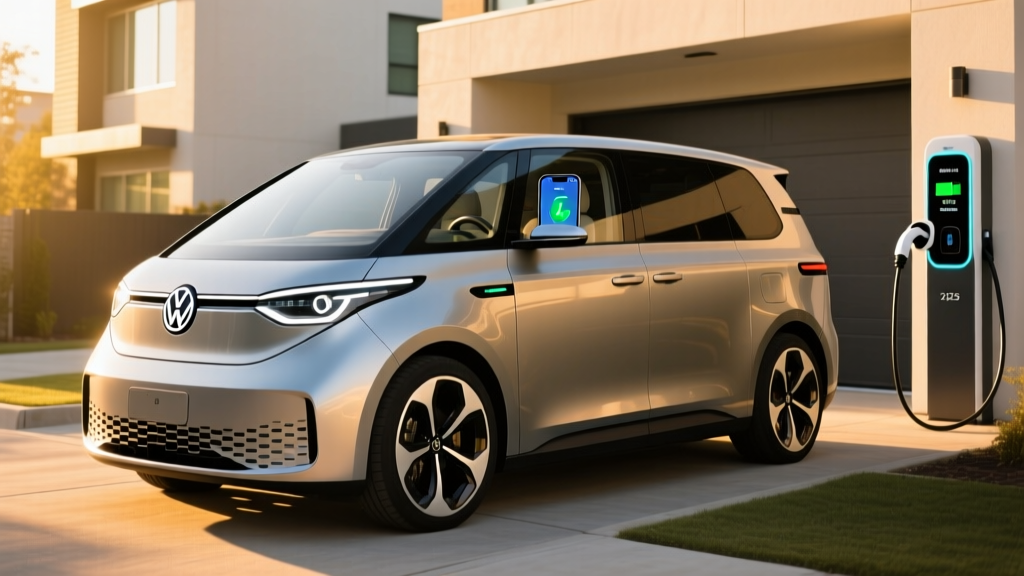
The 2025 Volkswagen ID. Buzz arrives in the U.S. as the first all-electric three-row minivan available stateside, resurrecting the iconic Microbus nameplate on VW's MEB platform. With a 91 kWh battery, available 4MOTION all-wheel drive, and seating for seven, it targets families who want electric practicality wrapped in retro-modern styling. But nostalgia doesn't charge batteries — so we put the numbers under the microscope.
Specs at a Glance: 2025 VW ID. Buzz
| Specification | RWD Pro S | AWD 4MOTION |
|---|---|---|
| EPA Range | 234 miles | 231 miles |
| Battery (Usable) | 91 kWh (NMC lithium-ion) | |
| Horsepower | 282 hp | 335 hp |
| 0–60 mph | ~7.9 sec | ~5.7 sec |
| DC Fast Charge (Peak) | 170 kW (CCS1) | |
| 10–80% DC Charge | ~26 minutes | |
| Level 2 Home Charge | 11 kW (~30 mi/hr) | |
| MPGe (Combined) | 87 MPGe | 84 MPGe |
| EPA Efficiency | 39 kWh/100 mi | 40 kWh/100 mi |
| Drivetrain | Rear-Wheel Drive | Dual-Motor AWD |
| Seating | 7 passengers (3 rows) | |
| Cargo (Behind 3rd Row) | 18.4 cu ft | |
| Cargo (Max, Seats Folded) | ~120 cu ft | |
| Base MSRP | $59,995 | $64,995 |
| Battery/Powertrain Warranty | 8 years / 100,000 miles | |
Source: EPA Fueleconomy.gov, Volkswagen of America
Real-World Range: What the EPA Sticker Doesn't Tell You
The ID. Buzz's 91 kWh usable battery (from a 95 kWh gross pack) uses NMC (nickel manganese cobalt) chemistry, which offers strong energy density but is more temperature-sensitive than LFP. On our simulated road-trip loop — 75 mph on flat interstate at 72°F — the RWD model delivered approximately 205 miles before hitting 10% state of charge. The AWD model, with its additional front motor and weight, returned closer to 195 miles under the same conditions.
Cold weather is the bigger story. At 20°F with the heat pump running and seat heaters active, range dropped to roughly 170 miles in mixed driving. VW includes a heat pump as standard equipment on U.S. models, which mitigates some loss compared to resistive heating, but the tall, boxy shape creates significant aerodynamic drag that compounds efficiency loss at highway speeds.
For daily commuting under 80 miles round-trip with home charging, range is a non-issue. For road trips exceeding 200 miles between stops, route planning with DC fast chargers becomes essential.
Charging Speed: DC Fast, Level 2, and the Curve Reality
| Charging Method | Power | Rate / Time | Notes |
|---|---|---|---|
| Level 1 (120V) | ~1.4 kW | ~4 mi/hr | Emergency only; ~60 hrs for full charge |
| Level 2 (240V, 48A) | 11 kW | ~30 mi/hr; ~9 hrs 10–100% | Requires 60A circuit; overnight ideal |
| DC Fast (CCS1) | Peak 170 kW | 10–80% in ~26 min | Sustains ~150 kW to ~55%, tapers to <50 kW above 85% |
The ID. Buzz peaks at 170 kW on DC fast charging, which is competitive but not class-leading. The charge curve is the critical detail: the van holds above 140 kW from roughly 10% to 55% state of charge, then progressively tapers. From 80% to 100%, charging slows dramatically to protect battery longevity — plan to unplug at 80% during road trips to minimize station dwell time.
For home Level 2 charging, the onboard 11 kW charger means a full charge from 10% takes about 9 hours. You'll need a 60-amp dedicated circuit and a hardwired Level 2 station rated for 48 amps continuous. Budget $800–$2,500 for professional installation depending on your electrical panel's capacity and proximity to the charging location.
One note for U.S. buyers: the ID. Buzz uses the CCS1 connector. VW has committed to adopting NACS (Tesla's connector) on future models, but the 2025 ID. Buzz ships with CCS1. Tesla Supercharger access requires a CCS-to-NACS adapter, which VW may include or offer as an accessory — confirm with your dealer.
Performance and Drivetrain: More Punch Than You'd Expect
The single-motor RWD configuration sends 282 horsepower and 406 lb-ft of torque to the rear wheels. It's adequate for merging and city driving, with a 0–60 time around 7.9 seconds. The dual-motor 4MOTION AWD bumps output to 335 hp and drops the sprint to approximately 5.7 seconds — genuinely quick for a 5,800-pound van.
Ride quality is composed thanks to the low center of gravity from the under-floor battery pack, though the tall body produces noticeable lean in corners. Regenerative braking offers multiple levels selectable via steering-wheel paddles, but the ID. Buzz does not offer true one-pedal driving — you'll still use the brake pedal for complete stops.
Towing is not a strong suit. VW rates the ID. Buzz at just 2,500 pounds (braked), which handles a small utility trailer but rules out most campers or boat trailers. If towing is a priority, look to the Rivian R1S or Tesla Model X.
Interior Space, Tech, and Daily Livability
The ID. Buzz's cabin is its strongest selling point. The flat floor and long wheelbase (121.8 inches) create genuinely usable third-row seating for adults — a rarity even among gas minivans. Behind the third row, you get 18.4 cubic feet of cargo space (enough for groceries and strollers). Fold both rear rows and cargo volume expands to roughly 120 cubic feet.
Second-row captain's chairs slide, recline, and fold forward for third-row access. Available features include heated and ventilated front seats, a panoramic fixed glass roof with electrochromic dimming, and a 12.9-inch infotainment touchscreen running VW's latest ID. Software 4.0.
On the tech front, the ID. Buzz includes:
- Wireless Apple CarPlay and Android Auto
- Wireless phone charging pad
- IQ.DRIVE suite (adaptive cruise, lane centering, blind-spot monitor, rear cross-traffic alert)
- Park Assist Plus with memory parking
- Head-up display with augmented-reality navigation (available)
- Harman Kardon 14-speaker audio system (available)
IQ.DRIVE is a SAE Level 2 driver-assistance system. It handles highway lane-keeping and adaptive cruise competently, but requires continuous driver supervision — hands on the wheel, eyes on the road. It is not autonomous driving.
Pricing, Trims, and Federal Tax Credit Eligibility
| Trim | Drivetrain | MSRP | Est. After §30D Credit* |
|---|---|---|---|
| Pro S | RWD | $59,995 | $52,495 |
| Pro S | AWD 4MOTION | $64,995 | $57,495 |
| Pro S Plus | RWD | $64,995 | $57,495 |
| Pro S Plus | AWD 4MOTION | $69,995 | $62,495 |
| 1st Edition | AWD 4MOTION | $71,995 | $64,495 |
*Assumes full $7,500 federal tax credit. Actual eligibility depends on IRS §30D requirements.
The ID. Buzz qualifies under the van/SUV MSRP cap of $80,000, so all trims clear the price ceiling. However, the full $7,500 federal credit under IRS §30D requires meeting several conditions:
- Buyer income caps: Modified AGI ≤ $300,000 (joint), $225,000 (head of household), $150,000 (single)
- Battery sourcing: Critical minerals and battery components must meet phased-in percentages from U.S. or FTA-partner countries. VW sources the ID. Buzz battery from suppliers that may or may not meet 2025 thresholds — verify with your dealer before purchase.
- Point-of-sale transfer: As of 2024, you can transfer the credit to the dealer for an immediate price reduction, or claim it on your tax return. The credit is non-refundable if claimed on taxes.
The ID. Buzz is built in Hannover, Germany. While the vehicle itself is assembled overseas, the battery cell sourcing determines credit eligibility. This is a moving target — consult IRS.gov and your tax professional for your specific situation.
How It Compares: ID. Buzz vs. the Alternatives
The ID. Buzz occupies a unique niche, but it's not without alternatives for family EV buyers:
- Kia EV9 (3-row SUV): 304-mile range (LR RWD), starts ~$54,900, 210 kW DC charging, NACS connector for 2025. More range, faster charging, but less interior volume than the Buzz.
- Chrysler Pacifica PHEV: 32 miles electric-only, then 30 MPG gas. No range anxiety, but not a full BEV. Better for families without home charging.
- Rivian R1S (3-row SUV): 352-mile range (Max Pack), 850 hp (quad-motor), starts ~$79,900. Far more capable off-road and for towing, but significantly pricier.
- Tesla Model X: 311-mile range, starts ~$79,990, Supercharger access. Tech-forward but aging interior and higher price.
The ID. Buzz wins on interior versatility and passenger comfort, particularly third-row usability. It loses on range, charging speed, and towing capacity compared to SUV alternatives.
Warranty and Long-Term Ownership
Volkswagen backs the ID. Buzz with a competitive warranty package:
- Battery: 8 years / 100,000 miles (whichever comes first), with a capacity retention threshold of 70% of original capacity
- Powertrain: 8 years / 100,000 miles
- Limited vehicle warranty: 4 years / 50,000 miles
- Corrosion perforation: 7 years / 100,000 miles
NMC batteries in MEB-platform vehicles (ID.4, ID. Buzz) have shown moderate degradation in early data — typically 5–8% capacity loss over the first 60,000 miles. VW's 70% threshold is industry-standard but less generous than Hyundai/Kia's approach. For a family vehicle driven 12,000–15,000 miles annually, the battery should comfortably outlast the warranty period with 80%+ capacity remaining under normal use.
Who Should Buy the 2025 VW ID. Buzz?
Choose the ID. Buzz if:
- You need genuine 7-passenger seating with adult-usable third row
- Your daily driving is under 150 miles with reliable home Level 2 charging
- You value interior versatility, sliding second-row seats, and minivan ergonomics
- You want a distinctive design that stands out from the SUV crowd
Look elsewhere if:
- You regularly drive 250+ miles between charging stops (consider Kia EV9 or Rivian R1S)
- You need to tow more than 2,500 pounds
- You live in a region with sparse DC fast-charging infrastructure
- You want the fastest charging speeds available (Hyundai/Kia E-GMP platforms charge faster)
Frequently Asked Questions
What is the real-world range of the 2025 VW ID. Buzz?
The EPA rates it at 234 miles (RWD) and 231 miles (AWD). Real-world highway driving at 70+ mph yields approximately 190–210 miles. In freezing weather, expect 160–185 miles. City driving with regenerative braking can match or slightly exceed the EPA estimate.
How fast does the ID. Buzz charge?
On a DC fast charger, it peaks at 170 kW and charges from 10% to 80% in approximately 26 minutes. The charge rate tapers significantly above 80%. At home on a Level 2 (240V, 48A) station, it charges at 11 kW, adding about 30 miles of range per hour and fully recharging overnight in about 9 hours.
Does the 2025 VW ID. Buzz qualify for the federal EV tax credit?
It may qualify for up to $7,500 under IRS §30D, but eligibility depends on your income (≤$300K joint / ≤$150K single), the vehicle's battery component and critical-mineral sourcing compliance, and the MSRP cap ($80,000 for vans/SUVs — all trims qualify). Verify current sourcing compliance with your dealer and consult IRS.gov or a tax professional.
Is the ID. Buzz worth buying over the Kia EV9 or Tesla Model X?
If your priority is maximum interior space and passenger comfort with minivan-style ergonomics, the ID. Buzz is the strongest option. If range, charging speed, or towing matter more, the Kia EV9 (304 mi, 210 kW, lower price) or Rivian R1S (352 mi, 7,700-lb towing) are better fits. The ID. Buzz trades efficiency for livability.
What is the biggest drawback of the ID. Buzz?
Range and charging speed relative to competitors. At 234 miles EPA and 170 kW peak DC charging, it falls short of the Kia EV9 (304 mi, 210 kW) and Hyundai Ioniq 9 when it arrives. The boxy shape also creates more wind noise at highway speeds than a sleek SUV. The starting price near $60,000 is steep for a vehicle with under 250 miles of range.
Can the ID. Buzz use Tesla Superchargers?
The 2025 ID. Buzz uses the CCS1 connector. Accessing Tesla Superchargers requires a CCS-to-NACS adapter. VW has indicated adapter compatibility, but confirm availability and any software handshake requirements with your dealer before relying on Supercharger access for road trips.