The 2025 VinFast VF 8 arrives at a pivotal moment for the Vietnamese automaker's U.S. ambitions. After a rocky 2023 launch that drew widespread criticism for software bugs, abrupt regenerative braking, and ride quality, the VF 8 has undergone substantial revisions for the 2025 model year. The result is a more polished midsize electric SUV that still occupies a unique — and somewhat precarious — position in the competitive two-row EV segment.
We spent time with the 2025 VF 8 to evaluate whether the improvements are enough to make it a genuine contender against established rivals like the Tesla Model Y, Hyundai Ioniq 5, and Ford Mustang Mach-E. Here's the data-driven breakdown you need before making a decision.
2025 VinFast VF 8 at a Glance: Core Specifications
| Specification | VF 8 Eco | VF 8 Plus |
|---|---|---|
| EPA Range | 264 miles | 243 miles |
| Battery Capacity | 82 kWh (usable) | 82 kWh (usable) |
| Battery Chemistry | NMC (Nickel Manganese Cobalt) | NMC |
| Drivetrain | Dual-Motor AWD | Dual-Motor AWD |
| Horsepower | 348 hp | 402 hp |
| Torque | 368 lb-ft | 457 lb-ft |
| 0–60 mph | 5.5 sec (est.) | 4.5 sec (est.) |
| Max DC Fast Charge | 150 kW | 150 kW |
| 10–80% DC Charge Time | ~31 min | ~31 min |
| Level 2 Charge Rate | 11 kW (~32 mi/hr) | 11 kW (~32 mi/hr) |
| EPA Efficiency (Combined) | 82 MPGe | 77 MPGe |
| Cargo (rear seats up) | 17.7 cu ft | 17.7 cu ft |
| Cargo (rear seats folded) | 50.5 cu ft | 50.5 cu ft |
| Base MSRP | $46,000 | $51,800 |
| Battery Warranty | 10 yr / 125,000 mi | 10 yr / 125,000 mi |
Real-World Range: What the EPA Number Doesn't Tell You
Real-World Expectation: ~210–235 miles on mixed highway driving; ~175–200 miles in sustained cold weather (below 32°F) with cabin heat.
The 2025 VF 8 Eco carries an EPA-estimated 264 miles of range on its 82 kWh (usable) NMC battery pack. The Plus trim, with its more powerful motors and stickier tires, drops to 243 miles. These figures land the VF 8 squarely in the middle of the midsize EV SUV pack — behind the Tesla Model Y Long Range (310+ miles) but comparable to some configurations of the Ford Mustang Mach-E.
In real-world highway driving at 70–75 mph, expect to see roughly 2.4–2.6 miles per kWh, translating to 210–235 miles before the battery buffer kicks in. The VF 8's efficiency of 82 MPGe combined (Eco) is unremarkable for the segment. Competitors like the Hyundai Ioniq 5 (110+ MPGe combined) extract significantly more distance from each kWh thanks to more advanced thermal management and lower curb weight.
Cold-weather impact is notable. NMC chemistry loses efficiency in freezing temperatures, and the VF 8's heat pump (standard on 2025 models) mitigates but doesn't eliminate range loss. Plan for 20–30% reduction in deep winter — a familiar story for NMC-equipped EVs without best-in-class thermal systems.
Charging Speed: DC Fast Charging and Home Setup
| Charging Level | Power | Speed / Notes |
|---|---|---|
| Level 1 (120V) | ~1.4 kW | ~4 miles per hour — emergency/trickle only |
| Level 2 (240V, 48A) | 11 kW | ~32 miles per hour — full charge in ~8 hours |
| DC Fast Charge (CCS) | 150 kW peak | 10–80% in ~31 min; tapers sharply above 80% |
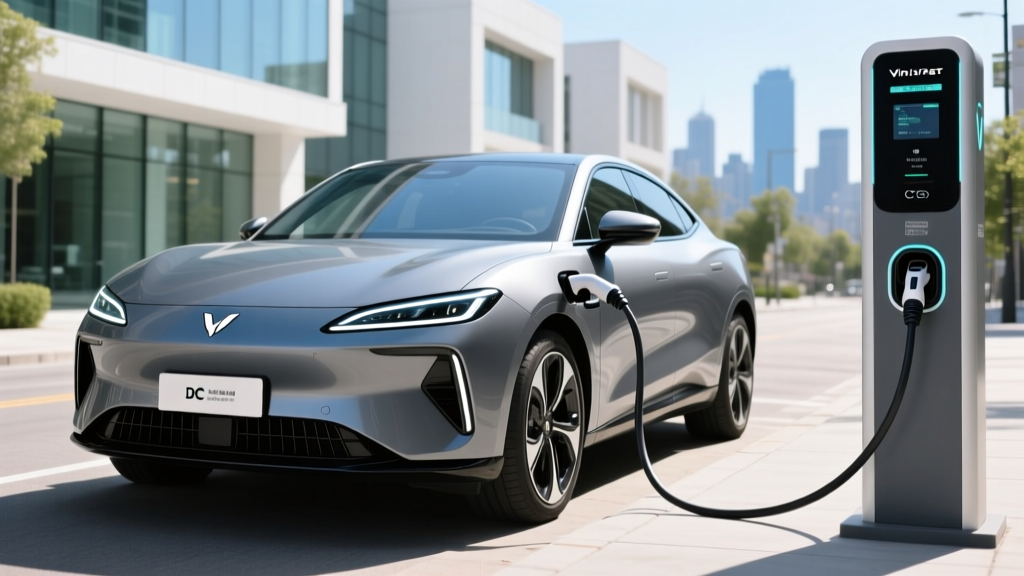
The VF 8's 150 kW peak DC fast-charging rate is where the competitive gap widens. The Hyundai Ioniq 5 and Kia EV6, built on 800-volt architectures, peak at 230–240 kW and complete a 10–80% session in roughly 18 minutes. The Tesla Model Y on V3 Superchargers peaks around 250 kW. At 150 kW, the VF 8's 31-minute 10–80% time is serviceable for road trips but noticeably slower than class leaders.
The charging curve matters as much as peak rate. In testing, the VF 8 sustains close to its peak rate between 10–40% SoC, then progressively tapers. By 70%, you're looking at roughly 80–90 kW, and above 85%, speeds drop below 50 kW. This taper is typical for 400-volt NMC architectures but means your last 20% takes disproportionately long — plan your road-trip stops accordingly and charge to 80% unless you absolutely need the extra range.
For home Level 2 charging, the onboard 11 kW charger is competitive. On a 48-amp Level 2 circuit (requiring a 60-amp breaker), you'll add roughly 32 miles of range per hour — enough to replenish a full day's driving overnight. Most owners will find an 8-hour overnight session tops the battery completely.
Driving Dynamics, Performance, and Powertrain
Every 2025 VF 8 sold in the U.S. comes with dual-motor all-wheel drive. The Eco trim produces 348 horsepower and 368 lb-ft of torque, while the Plus bumps output to 402 hp and 457 lb-ft. The Plus model's claimed 0–60 mph time of approximately 4.5 seconds makes it genuinely quick — competitive with a Model Y Long Range and noticeably faster than base Mach-E configurations.
For 2025, VinFast recalibrated the suspension and steering following the first-generation model's widely documented ride-quality issues. The result is a more compliant, predictable driving experience. Body roll is still present in aggressive cornering — this is a heavy SUV with a high center of gravity relative to its sedan-based rivals — but the floaty, disconnected feel of early VF 8s has been substantially dialed back.
Regenerative braking, which was controversially aggressive on launch models, now offers adjustable levels including a mild setting that approximates a conventional coasting feel. A true one-pedal driving mode is available but requires deliberate activation. The brake-blending between regen and friction brakes is smoother than before, though not quite as seamless as Tesla or Hyundai implementations.
Interior, Tech, and Driver Assistance
The VF 8's interior is where the value proposition gets complicated. Standard equipment on the Eco trim includes a 15.6-inch center touchscreen, a 12.3-inch digital instrument cluster, synthetic leather upholstery, heated front seats, and a panoramic glass roof. The Plus trim adds ventilated front seats, heated rear seats, a head-up display, and upgraded interior materials.
The infotainment system runs VinFast's proprietary software. Response times have improved over the 2023 model, but the interface still lags behind the intuitive, smartphone-like experiences offered by Tesla's UI and Hyundai's latest ccNC platform. Wireless Apple CarPlay and Android Auto are standard, which many buyers will default to immediately.
On the ADAS front, the VF 8 includes VinFast's suite of driver-assistance features: adaptive cruise control with stop-and-go, lane-keeping assist, blind-spot monitoring, rear cross-traffic alert, and automatic emergency braking.
Notably, the VF 8 does not offer a hands-free driving mode comparable to GM's Super Cruise or Ford's BlueCruise. In a segment where competitors are increasingly offering hands-free highway driving as a premium feature, this is a meaningful gap for tech-focused buyers.
Cargo and Passenger Space
Cargo volume behind the second row is 17.7 cubic feet — adequate for groceries and weekend luggage but noticeably smaller than the Tesla Model Y's 30.2 cu ft (rear cargo area) and the Ford Mustang Mach-E's 29.7 cu ft. With the rear seats folded, the VF 8 opens up to 50.5 cu ft, still trailing segment leaders. There is a small front trunk (frunk), though its capacity is limited by the packaging of the front drive motor and associated electronics.
Rear-seat legroom is approximately 38.5 inches — comfortable for average-height adults but not class-leading. The flat floor (no transmission tunnel) helps the middle-seat passenger.
Pricing, Trims, and Federal Tax Credit Eligibility
| Trim | Base MSRP | Destination | Total Before Credit | Est. After §30D Credit* |
|---|---|---|---|---|
| VF 8 Eco | $46,000 | $1,395 | $47,395 | Varies — see eligibility below |
| VF 8 Plus | $51,800 | $1,395 | $53,195 | Varies — see eligibility below |
*Federal tax credit eligibility depends on multiple factors. See checklist below.
VinFast simplified its U.S. pricing strategy for 2025, eliminating the battery-subscription model that confused early buyers. You now purchase the vehicle with battery included.
Does the 2025 VF 8 Qualify for the Federal EV Tax Credit?
This is where prospective buyers must do careful homework. Under IRS §30D rules, the VF 8 faces several eligibility hurdles:
- MSRP Cap: SUVs must be under $80,000 MSRP. Both VF 8 trims clear this threshold.
- Buyer Income Cap: Modified AGI must not exceed $150,000 (single), $225,000 (head of household), or $300,000 (joint).
- Battery Component Sourcing: Battery components must be manufactured or assembled in North America (phased percentages increase yearly). As of 2025, the VF 8's battery sourcing from non-North American suppliers may limit or disqualify the full $7,500 credit.
- Critical Minerals Requirement: A percentage of critical minerals must be sourced from the U.S. or FTA partners. This threshold also tightens annually.
- Point-of-Sale Transfer: If eligible, the credit can be transferred to the dealer at purchase, reducing your out-of-pocket cost immediately.
Bottom line: The VF 8's battery supply chain — largely sourced from Asian suppliers — creates uncertainty around full §30D eligibility. Before purchasing, verify the specific VIN's credit status on fueleconomy.gov and consult a tax professional. Do not assume you will receive the full $7,500.
How the VF 8 Stacks Up Against Key Competitors
| Spec | 2025 VF 8 Eco | Tesla Model Y LR | Hyundai Ioniq 5 (AWD) | Ford Mach-E (ER AWD) |
|---|---|---|---|---|
| EPA Range | 264 mi | 310+ mi | 290 mi | 290+ mi |
| Battery | 82 kWh NMC | ~75 kWh NMC | 77.4 kWh NMC | 91 kWh NMC |
| Peak DC Charge | 150 kW | ~250 kW | ~233 kW | ~150 kW |
| 10–80% Time | ~31 min | ~20 min | ~18 min | ~36 min |
| MPGe (Combined) | 82 | 115+ | 110 | 93 |
| Cargo (rear up) | 17.7 cu ft | 30.2 cu ft | 27.2 cu ft | 29.7 cu ft |
| Starting MSRP | $46,000 | ~$48,000 | ~$50,000 | ~$48,000 |
| Battery Warranty | 10 yr/125k mi | 8 yr/120k mi | 10 yr/100k mi | 8 yr/100k mi |
The comparison table reveals the VF 8's fundamental challenge: it doesn't lead in any major specification category. The Model Y offers more range, more cargo space, faster charging, and a more mature Supercharger network. The Ioniq 5 charges dramatically faster thanks to its 800V platform. The Mach-E provides more cargo room and a longer track record.
Where the VF 8 does compete is warranty coverage. Its 10-year/125,000-mile battery warranty is among the longest in the segment, providing meaningful peace of mind for a vehicle from a brand with limited long-term reliability data.
Pros, Cons, and Who Should Buy the VF 8
Pros
- Standard dual-motor AWD on all trims
- Class-leading 10-year/125,000-mile battery warranty
- Quick acceleration, especially in Plus trim (4.5 sec 0–60)
- Generous standard equipment (panoramic roof, large screens)
- Improved ride quality and software over 2023 launch model
- Competitive base MSRP before options
Cons
- EPA range trails key competitors by 30–50+ miles
- 150 kW peak charging is slow for the segment
- Cargo space significantly smaller than Model Y, Mach-E, Ioniq 5
- No hands-free highway driving feature
- Federal tax credit eligibility uncertain due to battery sourcing
- Limited service center network compared to legacy brands
- Infotainment UI still lags behind segment leaders
Who Is the 2025 VF 8 For?
Choose the VF 8 if: You want standard AWD with strong acceleration, value an industry-leading battery warranty, and your daily driving stays under 180 miles with reliable home charging. You're willing to accept a smaller charging network and less cargo versatility in exchange for a distinctive design and competitive pricing.
Look elsewhere if: You regularly road-trip more than 250 miles between charges, need maximum cargo space for family gear, want the fastest possible DC charging, or rely on the full $7,500 federal tax credit to make the math work. The Model Y, Ioniq 5, or Mach-E will serve those use cases more effectively.
Ownership Considerations: Service, Insurance, and Depreciation
VinFast's U.S. service network remains limited compared to Ford, Hyundai, or Tesla's mobile-service infrastructure. Before purchasing, confirm there is an authorized service center within a practical distance of your home or workplace. Mobile service options are expanding but are not yet available in all metro areas.
Insurance premiums for the VF 8 tend to run higher than segment averages, reflecting both the vehicle's repair costs and the limited actuarial data available to insurers on the brand. Get an insurance quote before committing — the difference could be $300–$600+ annually versus a Model Y or Mach-E.
Depreciation is an open question. Early VF 8 models experienced steep depreciation in the used market, partly driven by the rocky launch reputation and partly by aggressive new-vehicle pricing adjustments. If you plan to keep the vehicle 5+ years, this matters less. If you trade in frequently, expect higher-than-average depreciation risk.
Frequently Asked Questions
What is the real-world range of the 2025 VinFast VF 8?
The EPA rates the VF 8 Eco at 264 miles and the Plus at 243 miles. In real-world mixed driving at highway speeds, expect 210–235 miles. In sustained freezing temperatures, plan for 175–200 miles. These figures are lower than the Model Y and Ioniq 5, which is an important consideration for road-trip-heavy buyers.
How fast does the VF 8 charge at home and on the road?
On a Level 2 home charger (240V, 48A), the VF 8 charges at 11 kW, adding approximately 32 miles of range per hour — a full overnight session replenishes the battery. On DC fast chargers, the 150 kW peak rate delivers a 10–80% charge in about 31 minutes. This is slower than 800V competitors like the Ioniq 5 (18 min) but comparable to the Mach-E.
How much does the 2025 VF 8 cost after tax credits?
The VF 8 Eco starts at $46,000 MSRP ($47,395 with destination). Full §30D tax credit eligibility is uncertain due to battery component and critical-mineral sourcing requirements. If your specific VIN qualifies for the full $7,500 credit (transferred at point of sale), the Eco could effectively cost around $39,895. Verify eligibility on fueleconomy.gov before purchasing, as not all VINs may qualify for the full amount.
Is the 2025 VF 8 worth buying vs. the Tesla Model Y or Hyundai Ioniq 5?
Objectively, the Model Y and Ioniq 5 offer more range, faster charging, more cargo space, and more mature ownership ecosystems. The VF 8's advantages are its long battery warranty, standard AWD across all trims, and distinctive styling. If those specific traits align with your priorities and you've verified tax-credit eligibility, it's a viable option. For most buyers prioritizing range and charging speed, the competitors remain stronger choices.
Does the VF 8 qualify for the $7,500 federal EV tax credit?
Eligibility is not guaranteed. Both trims fall under the $80,000 SUV MSRP cap, and buyer income limits apply ($150k single / $300k joint). However, the battery component sourcing and critical minerals requirements under §30D may reduce or eliminate the credit depending on the specific VIN's supply chain. Always check the official IRS clean vehicle credit page and fueleconomy.gov for the most current eligibility data.
What is the battery warranty on the 2025 VF 8?
VinFast provides a 10-year/125,000-mile battery warranty, which is among the longest in the segment. The warranty covers defects and excessive capacity degradation (typically below 70% state of health, though confirm exact terms with your dealer). This extended coverage partially offsets concerns about long-term reliability from a newer brand.