Quick Verdict: Can the Cybertruck Handle Snow and Ice?
If you've seen viral videos of a Cybertruck stuck in snow and wondered whether Tesla's angular electric pickup is actually viable in winter, you're not alone. The stainless-steel exoskeleton and single- or dual-motor setups look rugged, but winter performance depends on far more than ground clearance. After analyzing Tesla's official specs, EPA data, and real-world owner reports from northern climates, the answer is nuanced: the dual-motor AWD Cybertruck delivers confident snow traction, but cold temperatures significantly cut its range, and the truck's substantial weight (nearly 6,700 lbs) works against it on unplowed or icy surfaces.
This review covers the 2025–2026 Tesla Cybertruck lineup — the Long Range AWD and Cyberbeast trims — with a focus on winter drivability, real-world cold-weather range loss, charging behavior in freezing temperatures, and whether this truck earns its place in a snowy driveway.
Range and Efficiency: What Happens When Temperatures Drop
The Cybertruck Long Range AWD carries an EPA-estimated range of 340 miles, while the tri-motor Cyberbeast is rated at 320 miles. On paper, those are competitive numbers for an electric pickup. But the EPA test cycle assumes moderate temperatures and mixed driving — conditions that rarely match a January morning in Minnesota or a mountain pass in Colorado.
- EPA Sticker (Long Range AWD): 340 miles
- Real-world highway (70°F): ~280–300 miles (high speeds and wind resistance reduce efficiency)
- Cold-weather (20°F, highway): ~210–240 miles — expect a 25–35% reduction due to battery resistance, cabin heating, and snow/ice road drag
- Extreme cold (0°F, city + highway mix): ~190–220 miles
The Cybertruck's boxy aerodynamics (drag coefficient ~0.34) amplify cold-weather losses at highway speed compared to sleeker EVs. Plan charging stops accordingly.
Tesla equips the Cybertruck with a heat pump for cabin and battery thermal management, which is more efficient than resistive heating. Even so, the battery's internal resistance rises in cold weather, limiting regenerative braking and reducing the energy available for propulsion. Owners in sub-freezing climates report that preconditioning the battery (via the Tesla app or scheduled departure) recovers 5–10% of lost range and restores regen functionality.
Battery, Chemistry, and Under-the-Hood Specs
The Cybertruck uses a structural battery pack with an estimated usable capacity of approximately 123 kWh (total pack ~130 kWh). Tesla has not officially published cell chemistry for the Cybertruck, but industry analysis and supply-chain reporting point to a high-nickel NMC (nickel manganese cobalt) configuration — consistent with Tesla's performance-oriented vehicles. NMC cells offer higher energy density than LFP (lithium iron phosphate), which is critical given the truck's weight, but they degrade slightly faster over thousands of cycles and are more sensitive to sustained high states of charge.
| Specification | Long Range AWD | Cyberbeast (Tri-Motor) |
|---|---|---|
| EPA Range | 340 miles | 320 miles |
| Battery (usable) | ~123 kWh (NMC) | ~123 kWh (NMC) |
| Drivetrain | Dual-motor AWD | Tri-motor AWD |
| Horsepower | 600 hp | 845 hp |
| 0–60 mph | 3.9 seconds | 2.6 seconds |
| Top Speed | 112 mph | 130 mph |
| MPGe (combined) | 66 MPGe | 61 MPGe |
| Efficiency | 51 kWh/100 mi | 55 kWh/100 mi |
| Towing Capacity | 11,000 lbs | 11,000 lbs |
| Payload | 2,500 lbs | 2,500 lbs |
| Cargo Bed Length | 6 ft (72 in) | 6 ft (72 in) |
| Ground Clearance | Up to 16 in (adaptive air suspension) | Up to 16 in (adaptive air suspension) |
| Base MSRP | $79,990 | $99,990 |
For efficiency context, the Cybertruck Long Range at 51 kWh/100 miles is less efficient than a Tesla Model Y (~28 kWh/100 mi) but on par with the Ford F-150 Lightning and Rivian R1T. That high energy consumption is the direct cost of moving 6,600+ pounds of stainless steel and battery.
Charging in Cold Weather: Speeds, Curves, and Preconditioning
Cold temperatures don't just reduce range — they also slow charging speeds. Lithium-ion cells cannot safely accept high charge rates when cold, so the Cybertruck's battery management system throttles DC fast charging until the pack warms up. Tesla's navigation-based preconditioning helps: if you route to a Supercharger, the truck begins heating the battery en route, often arriving at an optimal temperature for peak charge rates.
| Charging Level | Power / Rate | Time or Miles Added |
|---|---|---|
| DC Fast Charge (Supercharger V4) | Peak 250 kW | 10–80% in ~30 minutes (preconditioned) |
| DC Fast Charge (cold battery, no precondition) | Limited to ~80–120 kW initially | 10–80% can take 45–60+ minutes |
| Level 2 Home (48A / 11.5 kW) | 11.5 kW | ~30 miles of range per hour; full charge ~12 hours |
| Level 2 Home (32A / 7.7 kW) | 7.7 kW | ~20 miles of range per hour; full charge ~17 hours |
| Level 1 (120V / 12A) | 1.4 kW | ~3–4 miles per hour (emergency/trickle only) |
The Cybertruck's charge curve peaks around 250 kW at low states of charge (10–30%) and tapers progressively. By 60% SoC, expect rates around 120–150 kW; above 80%, charging slows dramatically to protect the battery, often dropping below 40 kW. This taper is more pronounced in cold weather without preconditioning.
For home charging, Tesla's Wall Connector at 48 amps (11.5 kW) is the practical minimum for daily use with a pack this large. A 200-amp electrical panel can usually support this, but older homes may require a panel upgrade ($1,500–$3,000) — factor that into your budget.
Snow Traction, AWD System, and Why Weight Matters
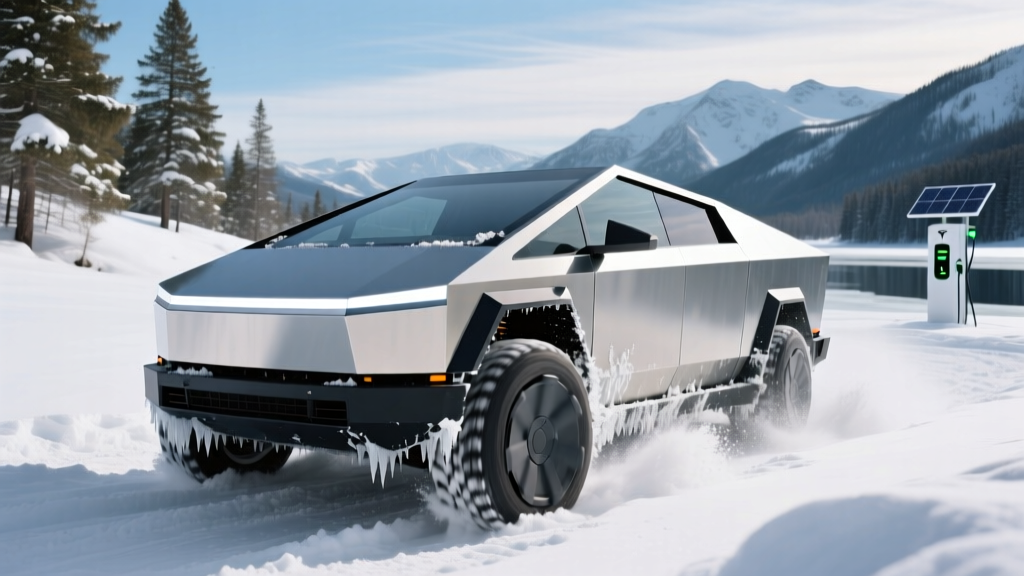
The dual-motor AWD system in the Cybertruck Long Range provides independent torque control to front and rear axles, with traction management handled through Tesla's software-defined stability control. In moderate snow (2–4 inches on plowed roads), the AWD system delivers confident acceleration and hill-climbing ability. The adaptive air suspension can raise ground clearance to 16 inches in Off-Road mode, helping the truck clear deeper accumulations.
However, the Cybertruck's curb weight — approximately 6,600 to 6,700 lbs depending on trim — is a double-edged sword. Heavy vehicles carry more momentum, which means longer stopping distances on ice and a greater tendency to push forward (understeer) in low-grip corners. This is the physics behind many viral clips of the Cybertruck stuck in snow: once a heavy EV loses traction on an unplowed incline or icy patch, the mass that helps it push through shallow snow becomes a liability.
Tire choice is the single most impactful upgrade for winter driving. The Cybertruck ships with all-season or all-terrain tires depending on configuration, but dedicated winter tires (3PMSF-rated) dramatically improve braking and cornering grip on snow and ice. Tesla's 20-inch wheel fitment limits some winter tire options, but brands like Nokian Hakkapeliitta and Bridgestone Blizzak offer compatible sizes.
- Heavy curb weight increases stopping distance on ice — allow extra following distance.
- Regenerative braking can cause rear-end instability on slick surfaces; set regen to "Low" in snow.
- Stainless steel body panels do not dent easily but are difficult and expensive to repair if damaged in a winter collision.
- Washer fluid nozzles and door handles can freeze in extreme cold — keep de-icer on hand.
- Autopilot and FSD (Supervised) are SAE Level 2 driver-assist systems — they do NOT handle heavy snow, obscured lane markings, or whiteout conditions. The driver must remain fully engaged.
Pricing, Tax Credit Eligibility, and Total Cost
The Cybertruck's pricing has shifted since its initial announcement, and as of the 2025–2026 model year, it sits firmly in the premium truck segment. Here's the breakdown:
| Trim | Base MSRP | Federal §30D Credit | Effective Price (if eligible) |
|---|---|---|---|
| Long Range AWD | $79,990 | $0 (exceeds MSRP cap) | $79,990 |
| Cyberbeast | $99,990 | $0 (exceeds MSRP cap) | $99,990 |
Federal tax credit reality: Under current IRS §30D rules, the Cybertruck does not qualify for the $7,500 federal EV tax credit. The credit's MSRP cap for vans, SUVs, and pickup trucks is $80,000, and while the Long Range AWD's base price sits just under that threshold, the addition of any options, destination fees, or packages pushes the vehicle above the cap. The Cyberbeast at $99,990 exceeds it outright. Additionally, §30D imposes buyer income limits ($150,000 single / $300,000 married filing jointly) and battery critical-mineral sourcing requirements. Always verify eligibility with a tax professional and consult the IRS clean vehicle credits page for the latest rules.
Some buyers may qualify for state-level EV incentives (California, Colorado, and others offer rebates or tax credits), but these vary by jurisdiction — check your state's energy office or DMV for current programs.
Interior, Cargo, Technology, and Daily Livability
The Cybertruck's cabin follows Tesla's minimalist philosophy: a single 18.5-inch front touchscreen handles navigation, media, climate, and vehicle settings, with a 9.4-inch rear screen for passengers. There are no physical buttons for climate or audio — everything is screen-driven, which some owners find distracting in winter when gloves and fogged windows add friction.
Cargo and passenger dimensions:
- Bed volume: ~67 cu ft (6-foot bed with motorized tonneau cover)
- Front trunk (frunk): ~7 cu ft — useful for charging cables or groceries
- Front legroom: 41.3 inches
- Rear legroom: 38.5 inches (adequate for adults, tighter than an F-150 SuperCrew)
- Seating: 5-passenger (bench-style front with fold-down center armrest)
The motorized stainless-steel tonneau cover is a standout feature — it locks automatically, supports up to 300 lbs of distributed weight, and integrates with the bed's built-in ramp. However, the cover's motorized mechanism can struggle in heavy ice accumulation, a known issue in northern-climate ownership reports.
Driver assistance: The Cybertruck includes Tesla Autopilot (adaptive cruise + lane centering) as standard, with Full Self-Driving (Supervised) available as a $8,000 add-on or $99/month subscription. FSD (Supervised) is an SAE Level 2 system — it can handle highway interchanges and city streets under ideal conditions but requires continuous driver attention and does not function reliably in snow, fog, or when lane markings are obscured. Tesla's camera-only vision system (no LiDAR or radar) is particularly challenged by heavy precipitation and road-salt spray.
Warranty, Battery Longevity, and Ownership Costs
Tesla covers the Cybertruck with the following warranty:
- Basic Vehicle: 4 years / 50,000 miles
- Battery and Drive Unit: 8 years / 120,000 miles (whichever comes first), with a minimum 70% capacity retention guarantee over the warranty period
The NMC battery pack should retain usable capacity well beyond the warranty period under normal use. Tesla's thermal management system actively heats and cools the pack, mitigating the degradation that plagues passively cooled EVs. However, consistently charging to 100% (rather than the recommended 80–90% daily limit) and frequent DC fast charging will accelerate wear. Battery replacement out of warranty is estimated at $15,000–$22,000 based on current Tesla service pricing for large packs, though costs are expected to decline as cell manufacturing scales.
Insurance is a significant ownership cost for the Cybertruck. Average annual premiums range from $3,500 to $5,500 depending on state, driving record, and coverage level — substantially higher than a Ford F-150 Lightning (~$2,200–$3,000) due to the Tesla's repair complexity, stainless steel panel costs, and high performance.
- Dual-motor AWD delivers strong traction in moderate snow with torque vectoring
- Adaptive air suspension raises to 16 inches of ground clearance for deep snow
- Stainless steel body resists dents, dings, and road-salt corrosion
- 250 kW DC fast charging (preconditioned) enables viable road-trip charging
- 11,000-lb towing capacity competitive with gas half-ton trucks
- Heat pump improves cold-weather cabin efficiency
- Heavy curb weight (~6,700 lbs) increases stopping distance and understeer risk on ice
- Cold-weather range loss of 25–35% makes winter road trips require careful planning
- No federal §30D tax credit due to MSRP cap — full price out of pocket
- Camera-only Autopilot/FSD struggles in snow, fog, and salt spray
- High insurance premiums ($3,500–$5,500/year)
- Rear legroom tighter than competing full-size trucks
- 20-inch wheel size limits winter tire selection
Is the Cybertruck Worth It for Snow-Belt Buyers?
The Cybertruck is a capable winter vehicle if you understand its limitations. The AWD system and air suspension handle moderate snow well, the heat pump keeps cabin heating efficient, and the stainless steel body is impervious to the road salt that destroys conventional truck bodies over time. But it is not an unstoppable winter machine. The weight, cold-weather range loss, and camera-dependent driver assists mean you need to drive defensively, plan charging stops conservatively, and invest in quality winter tires.
- You want an electric truck with strong AWD traction and 11,000-lb towing
- You have reliable home Level 2 charging and can precondition daily
- You value corrosion resistance against road salt
- You accept the premium price without a federal tax credit
- You need a lower purchase price and potential tax credit eligibility (Lightning qualifies in some trims)
- You prioritize rear-seat passenger space
- You want a more conventional truck experience with physical controls
- You need proven cold-weather track records from longer-market vehicles
Frequently Asked Questions
Why do videos show the Cybertruck stuck in snow?
Most viral clips involve the Cybertruck on unplowed, steep inclines or deep, unpacked snow where its 6,700-lb weight works against it. Any heavy vehicle — EV or gas — can get stuck in these conditions without proper tires or momentum. The AWD system is capable, but it cannot overcome physics when all four wheels lose grip simultaneously on ice or when the truck's mass causes it to sink into soft, deep snow.
What is the real-world range of the Cybertruck in winter?
Expect 210–240 miles of highway range at 20°F for the Long Range AWD (down from the EPA's 340 miles). In extreme cold near 0°F, plan for 190–220 miles. Preconditioning the battery and using seat heaters instead of cranking cabin heat can recover 10–15 miles.
How fast does the Cybertruck charge at home and on the road?
At a Supercharger (250 kW peak), a preconditioned Cybertruck charges from 10–80% in approximately 30 minutes. In cold weather without preconditioning, that time can stretch to 45–60 minutes. At home on a 48-amp Level 2 charger (11.5 kW), expect roughly 30 miles of range per hour, or a full charge in about 12 hours.
Does the Cybertruck qualify for the $7,500 federal EV tax credit?
No. Under IRS §30D rules, the Cybertruck exceeds the $80,000 MSRP cap for pickup trucks once options and destination charges are included, and the Cyberbeast exceeds it at base price. Buyer income limits and battery sourcing requirements add further restrictions. Consult the IRS website and a tax professional for your specific situation.
Should I buy winter tires for the Cybertruck?
Absolutely. The stock all-season or all-terrain tires are adequate for light snow, but dedicated 3PMSF-rated winter tires dramatically improve braking distances and cornering grip on ice and packed snow. Given the Cybertruck's weight, this is one of the most impactful safety upgrades you can make. Check for 285/65R20 or 275/60R20 sizing from Nokian, Bridgestone, or Michelin.
Is Autopilot safe to use in snow?
Tesla's Autopilot and FSD (Supervised) are SAE Level 2 driver-assist systems that rely on cameras. In heavy snow, fog, or when lane markings are covered by snow or salt spray, the system can lose lane-detection capability and disengage unexpectedly. Always remain fully attentive, and disable Autopilot in poor winter visibility conditions. You are the driver — the system assists but does not replace you.
How does the Cybertruck compare to the F-150 Lightning in snow?
Both trucks offer capable AWD systems, but the F-150 Lightning is lighter (~6,200 lbs), has a longer wheelbase for better stability, and qualifies for the federal tax credit in some trims. The Cybertruck has higher ground clearance (16 in vs. ~10 in for the Lightning) and superior corrosion resistance from its stainless steel body. Range in cold weather is comparable between the two, with both losing 25–35% in sub-freezing conditions. See fueleconomy.gov for official EPA comparisons.