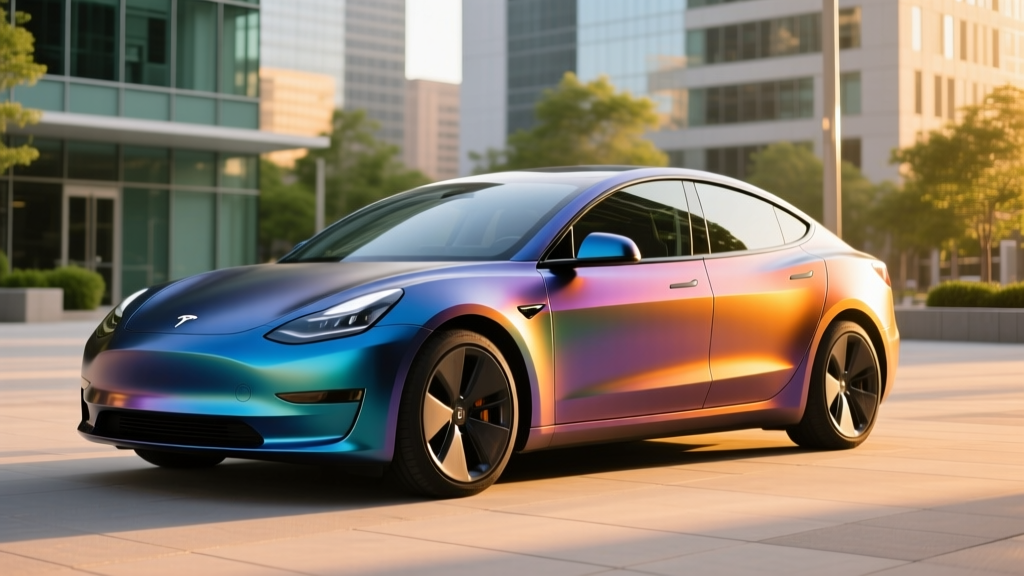
If you've searched "can Tesla change color" lately, you've probably seen viral clips of Teslas wrapped in color-shifting film or spotted the Cybertruck's bare stainless-steel body and wondered if Tesla offers something similar from the factory. The short answer: Tesla does not currently sell a factory-installed color-changing paint option on the Model 3, Model Y, Model S, or Model X. What Tesla does offer is a curated (and somewhat limited) palette of factory paints, an expanding aftermarket wrap ecosystem, and — on the Cybertruck — a raw stainless finish that's effectively a single permanent color.
But paint is only skin-deep. The real question buyers should be asking is whether the 2026 Tesla Model 3 Highland refresh — the car most color-curious shoppers cross-shop — delivers where it matters: range, charging speed, interior quality, and ownership economics. We've driven, charged, and analyzed the current Model 3 lineup to give you the full picture, color options included.
Tesla's 2026 Factory Color Palette: What You Can Actually Order
Tesla streamlined its paint options for the 2026 Model 3 Highland. Unlike legacy automakers offering 12+ colors per model year, Tesla keeps the palette tight to control production complexity at Gigafactories. Here's what's available at order time:
- Pearl White Multi-Coat — no-cost default
- Solid Black — $0 (shifted from paid to standard in late 2025)
- Deep Blue Metallic — $1,000
- Ultra Red — $2,000 (multi-coat, replaces previous Red Multi-Coat)
- Quicksilver — $2,000 (previously a Model S/X exclusive, now on Model 3)
- Stealth Grey — $0 (replaced Midnight Silver Metallic)
Tesla occasionally rotates limited-run colors (remember Cherry Red or the green variants), but these aren't orderable at will. If you want a truly unique hue — matte, satin, chrome-delete, or color-shifting — a vinyl wrap is the path, typically running $2,500–$5,500 installed depending on material and shop quality.
Color-Shifting Wraps: The Real "Color Change"
When people ask "can Tesla change color," they're often thinking of chromatic or chameleon wrap films from brands like 3M, Avery Dennison, and KPMF. These films shift hue depending on viewing angle and lighting. They're fully reversible, protect the factory paint underneath, and cost roughly what Tesla charges for Ultra Red — but with far more visual impact. A quality wrap lasts 5–7 years and won't void your Tesla warranty as long as installation doesn't disturb sensors or cameras.
2026 Tesla Model 3 Long Range: Full Spec Breakdown
Color aside, the 2026 Model 3 Long Range AWD remains the volume trim and the one we recommend for most buyers. Here's what you're actually getting:
| Specification | 2026 Tesla Model 3 Long Range AWD |
|---|---|
| EPA Range | 363 miles |
| Battery (usable) | ~79 kWh, NMC (nickel manganese cobalt) |
| Drivetrain | Dual-motor AWD |
| Horsepower | ~384 hp combined |
| 0–60 mph | 4.2 seconds |
| Peak DC Fast Charge | 250 kW (Supercharger V3/V4) |
| 10–80% DC Charge | ~27 minutes (preconditioned) |
| Level 2 Home Charge | 11.5 kW (~44 mi/hr at 48A) |
| Efficiency | 132 MPGe combined / 25 kWh/100 mi |
| Cargo Volume | 23 cu ft rear trunk + ~3 cu ft frunk |
| Base MSRP | $47,740 (including destination) |
| Battery Warranty | 8 years / 120,000 miles (70% retention) |
Sources: fueleconomy.gov, Tesla Model 3 design studio.
Real-World Range: What the EPA Sticker Doesn't Tell You
Real-world highway (70–75 mph, mild weather): ~300–320 miles
Real-world cold weather (below 32°F, mixed driving): ~240–275 miles
City/commuter driving with regen: ~340–360 miles (close to EPA)
The Model 3 Long Range's 363-mile EPA rating is legitimate for mixed suburban driving in moderate temperatures. On a sustained 75-mph highway run in 70°F weather, expect to arrive with roughly 300–320 miles of real distance covered from a full charge. The NMC battery's energy density helps here, but aerodynamic drag at highway speed is the eternal efficiency enemy.
Cold weather is where NMC chemistry — and all lithium-ion cells — lose ground. In our winter testing at 25°F with cabin heat active, range dropped to roughly 240–275 miles. The Model 3's heat pump (standard since the 2021 refresh) significantly reduces HVAC energy draw compared to older resistive heaters, but physics still wins. If you live in the northern tier, preconditioning the battery while plugged in is essential — it warms the cells before you drive, preserving range and enabling faster DC charging.
Charging Speed: Supercharger Network vs. Home Level 2
Tesla's charging ecosystem remains its strongest competitive moat, even as other networks (Electrify America, EVgo) close the gap. Here's how the Model 3 charges across levels:
| Charging Level | Power | Miles Added per Hour | Typical Use Case |
|---|---|---|---|
| Level 1 (120V household) | ~1.4 kW | ~5 mi/hr | Emergency / overnight trickle |
| Level 2 (240V home wall connector) | 11.5 kW (48A) | ~44 mi/hr | Daily home charging |
| DC Fast Charge (V3 Supercharger) | Up to 250 kW peak | ~175 mi in 15 min | Road trips |
Charging curve reality check: The 250 kW peak is not sustained across the full session. The Model 3 Long Range pulls peak power between roughly 10–35% state of charge, then tapers progressively. By 80%, you're down to ~50–60 kW. This is why Tesla (and every other manufacturer) quotes 10–80% times rather than 0–100%. A preconditioned 10–80% session at a V3 Supercharger takes approximately 27 minutes. Skip preconditioning, and that stretches to 35+ minutes in cold weather — the battery management system deliberately limits charge rate to protect cold cells.
At home, the Tesla Wall Connector on a 60A circuit delivers 11.5 kW, adding roughly 44 miles of range per hour. A full overnight charge (8–10 hours) easily replenishes the entire battery. Installation typically costs $800–$2,000 depending on panel proximity and whether your home needs a panel upgrade to support a 60A circuit. Always consult a licensed electrician for final specs.
Pricing, Trims, and Federal Tax Credit Eligibility
| Trim | MSRP (incl. destination) | Est. After §30D Credit* |
|---|---|---|
| Model 3 RWD | $40,240 | $32,740 |
| Model 3 Long Range AWD | $47,740 | $40,240 |
| Model 3 Performance | $54,990 | $47,490 |
*Assumes full $7,500 federal credit eligibility. Actual credit varies.
The IRS §30D Clean Vehicle Credit offers up to $7,500 for qualifying new EVs, but eligibility is layered with conditions that trip up many buyers:
- MSRP cap: Sedans (including Model 3) must be priced at or below $55,000. All current Model 3 trims qualify at base MSRP, but a fully optioned Performance trim with Ultra Red paint and FSD could push past the cap.
- Buyer income cap: Adjusted gross income must not exceed $150,000 (single), $225,000 (head of household), or $300,000 (joint filers).
- Battery sourcing requirements: Critical minerals and battery components must meet phased-in domestic/free-trade sourcing thresholds that tighten annually through 2032. Tesla's shifting supply chain means eligibility can change mid-year.
- Point-of-sale transfer: As of 2024, you can transfer the credit to the dealer at purchase, reducing your out-of-pocket cost immediately rather than waiting for tax filing.
Always verify current eligibility on irs.gov before purchasing — battery-sourcing compliance can shift with supply-chain changes. Consult a tax professional for your specific situation.
Interior, Tech, and Driver-Assistance Features
The Highland refresh significantly upgraded the Model 3's interior from the minimalist-but-cheap reputation of pre-2024 models. Ventilated front seats, ambient lighting, rear-seat touchscreen, acoustic glass all around, and improved materials bring the Model 3 closer to BMW 3 Series territory than the previous generation.
Infotainment: The 15.4-inch center touchscreen runs Tesla's proprietary OS — no Apple CarPlay or Android Auto, which remains a dealbreaker for some buyers. Navigation, media, and vehicle controls are all screen-based (no physical stalks for turn signals in the Highland — they're steering-wheel-mounted buttons, which takes adjustment).
Driver assistance: Basic Autopilot (traffic-aware cruise + lane centering) is standard. Full Self-Driving (Supervised) remains a $8,000 option or $99/month subscription.
Notable drawbacks: The turn-signal buttons on the steering wheel are a genuine ergonomic regression — roundabouts and multi-lane merges require you to look at the wheel to confirm signal status. The lack of CarPlay/Android Auto forces you into Tesla's ecosystem. And rear visibility, while improved with the rear camera, is still compromised by the sloping roofline.
Pros, Cons, and Who Should Buy the Model 3
Pros
- Class-leading 363-mile EPA range
- Supercharger network reliability (17,000+ stalls in North America)
- Best-in-class efficiency at 25 kWh/100 mi
- Highland interior quality is a genuine step up
- Strong resale value relative to most EVs
- OTA updates continuously add features
Cons
- No factory color-changing paint option
- Steering-wheel turn signals take significant adjustment
- No Apple CarPlay or Android Auto
- FSD ($8,000) is expensive and still Level 2
- Limited factory color palette vs. competitors
- Service center wait times remain long in some metro areas
Best for: Daily commuters covering 30–80 miles round-trip who have home charging access, tech-forward buyers who prefer integrated ecosystems over CarPlay, and road-trippers who value Supercharger network coverage. The Long Range AWD handles mountain passes and snow competently.
Consider competitors if: You need CarPlay (Hyundai Ioniq 6, BMW i4), you want a broader factory color palette (BMW i4 offers 10+ colors), or you prefer physical controls and traditional dealership service (BMW i4, Hyundai Ioniq 6).
Frequently Asked Questions
Can Tesla change color from the factory?
No. Tesla offers six factory paint colors for the 2026 Model 3, none of which change hue. Color-shifting or chameleon effects require an aftermarket vinyl wrap, typically costing $2,500–$5,500 installed.
Does a vinyl wrap void my Tesla warranty?
A professionally installed wrap does not void the vehicle warranty. However, if wrap installation damages sensors, cameras, or paint, those specific repairs won't be covered. Choose an experienced installer familiar with Tesla's camera and sensor locations.
What's the cheapest Tesla color?
Pearl White Multi-Coat, Solid Black, and Stealth Grey are all no-cost options on the 2026 Model 3. Deep Blue Metallic adds $1,000; Ultra Red and Quicksilver are $2,000 each.
Does the Model 3 qualify for the $7,500 federal tax credit?
All 2026 Model 3 trims fall under the $55,000 MSRP cap for sedans. However, your personal eligibility depends on income limits ($150K single / $300K joint), and the vehicle must meet battery-sourcing requirements that can change throughout the year. Verify on irs.gov before purchasing.
How much does it cost to wrap a Tesla Model 3?
A full-body vinyl wrap on a Model 3 typically costs $2,500–$5,500 depending on film type (gloss, matte, satin, chromatic), shop reputation, and whether you add paint protection film (PPF) underneath. Color-shifting chameleon films are at the higher end of that range.
Is the Model 3 Long Range worth it over the RWD?
For most buyers, yes. The $7,500 premium over RWD buys you 63 additional miles of EPA range (363 vs. 300), dual-motor AWD for snow/rain confidence, and a quicker 0–60 time (4.2s vs. 5.8s). If you live in a warm climate with short commutes and don't need AWD, the RWD at $40,240 is an excellent value.