Quick Verdict: The R1S Gets a Major Powertrain Overhaul for 2025
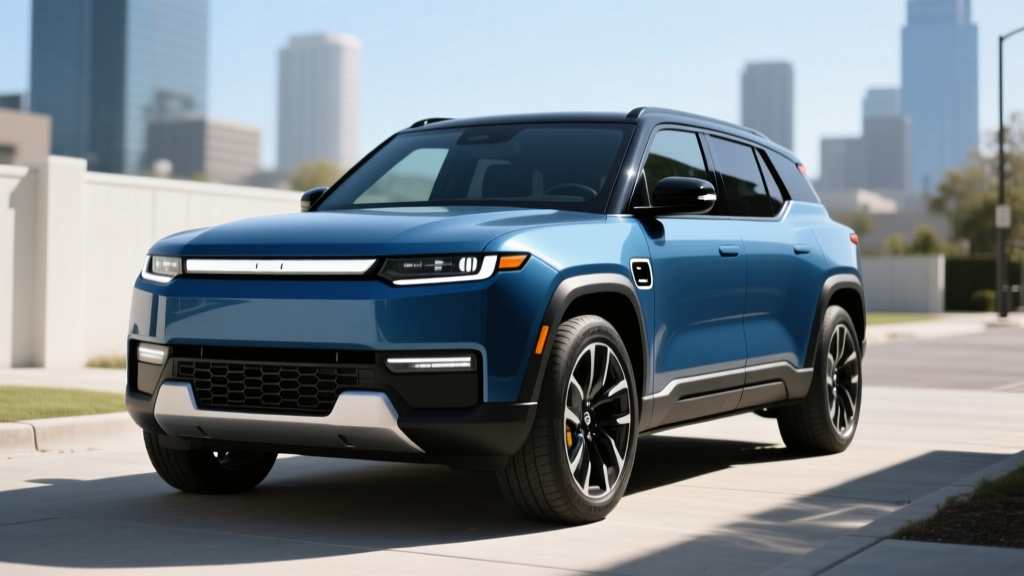
The 2025 Rivian R1S arrives as a substantially revised second-generation model, inheriting the updated Gen 2 drive units, a new electrical architecture, and the available Tri-Motor powertrain first introduced on the R1T. For families seeking a three-row electric SUV that can genuinely tow, off-road, and road-trip without compromise, the R1S remains one of the most capable vehicles in its class. But with a starting MSRP of $75,900 and a complex federal tax credit picture, buyers need the exact numbers before signing.
This review covers every critical spec — battery chemistry, real-world range expectations, DC fast-charge curves, home charging rates, performance figures, cargo dimensions, and current §30D tax credit eligibility — based on EPA data, Rivian's official specifications, and real-world driving observations.
Range & Efficiency: EPA Numbers vs. Real-World Reality
The 2025 R1S offers three battery configurations, each with distinct range and efficiency profiles. Rivian uses a mix of NMC (nickel manganese cobalt) and, for the Standard Pack, LFP (lithium iron phosphate) chemistry — a choice that affects not just range but long-term degradation behavior and charging habits.
| Configuration | Battery Chemistry | Usable Capacity (kWh) | EPA Range (mi) | MPGe (Combined) | kWh/100mi |
|---|---|---|---|---|---|
| Standard Pack (Dual-Motor) | LFP | ~95 | 270 | 2.0 MPGe | ~48 |
| Large Pack (Dual-Motor) | NMC | ~128 | 330 | 2.1 MPGe | ~46 |
| Max Pack (Dual-Motor) | NMC | ~149 | 410 | 2.1 MPGe | ~44 |
| Tri-Motor (Large Pack) | NMC | ~128 | 315 | 1.9 MPGe | ~50 |
| Tri-Motor (Max Pack) | NMC | ~149 | 390 | 1.9 MPGe | ~50 |
Real-World Range Reality Check: The EPA 410-mile Max Pack figure is achievable in mild-weather city and suburban driving at moderate speeds. On sustained highway trips at 70-75 mph, expect roughly 330-350 miles from the Max Pack. In freezing temperatures (below 32°F), plan for a 20-30% reduction — the Max Pack drops to approximately 280-320 miles of real highway range. The Dual-Motor Large Pack realistically delivers 260-280 highway miles in temperate conditions. Cold weather, aggressive acceleration, and towing (up to 7,700 lbs rated) will further reduce these figures.
Efficiency for a vehicle of this size (over 5,800 lbs curb weight for Max Pack configurations) is respectable but not class-leading. The Tesla Model X Long Range achieves slightly better kWh/100mi figures, though it lacks the R1S's off-road capability and towing capacity. According to fueleconomy.gov, the R1S Dual-Motor configurations land in the mid-40s kWh/100mi range, which translates to roughly 2.0-2.1 MPGe combined.
Charging: DC Fast-Charge Speeds & Home Level 2 Setup
Charging speed is where the 2025 R1S's updated architecture shows meaningful improvement. The Gen 2 platform supports higher peak DC charge rates, though sustained speeds and the charge curve taper matter more than the peak number alone.
| Charge Level | Power / Rate | Speed (mi/hr added) | Notes |
|---|---|---|---|
| Level 1 (120V household) | 1.4 kW | ~3-4 mi/hr | Emergency/trickle only |
| Level 2 (240V, 48A) | 11.5 kW | ~25-28 mi/hr | Standard home Wall Connector |
| Level 2 (240V, 80A) | 19.2 kW | ~42-46 mi/hr | Requires upgraded home circuit (100A breaker) |
| DC Fast (Standard/Large Pack) | Peak 220 kW | 10-80% in ~21 min | Tapers significantly above 80% |
| DC Fast (Max Pack) | Peak 240 kW | 10-80% in ~24 min | Larger battery = longer absolute time despite higher peak |
Understanding the charge curve: The R1S hits its peak kW only between roughly 10-40% State of Charge (SoC). From 40-60%, power steps down to approximately 160-180 kW, and above 80% it drops sharply to protect the battery — often below 50 kW. This means a 10-90% session takes considerably longer than a 10-80% session. For road trips, plan stops around the 10-80% window for optimal time efficiency.
Preconditioning matters: The R1S will precondition the battery when you navigate to a DC fast charger via the built-in navigation. This warms the cells to optimal temperature, enabling peak charge rates. Skipping preconditioning (e.g., arriving at a charger without using nav) can reduce peak speeds by 30-50% in cool weather.
For home charging, the R1S's onboard charger supports up to 19.2 kW (80A) on Level 2 — among the fastest in any consumer EV. However, this requires a dedicated 100-amp circuit and hardwired Rivian Wall Connector installation. Most homes will need an electrical panel assessment; a 200A service panel may require upgrading to support this rate alongside other household loads. Budget $500-$2,500 for a standard 48A Level 2 installation, or $1,500-$4,000+ if a panel upgrade is needed.
Performance: Dual-Motor and Tri-Motor Powertrains
The 2025 R1S offers two powertrain layouts, both featuring Rivian's Gen 2 drive units with improved efficiency and power density over the first-generation motors.
| Powertrain | Horsepower | Torque (lb-ft) | 0-60 mph | Drivetrain | Towing Capacity |
|---|---|---|---|---|---|
| Dual-Motor AWD | 533 hp | 610 | 4.5 sec | AWD | 7,700 lbs |
| Performance Dual-Motor | 665 hp | 829 | 3.4 sec | AWD | 7,700 lbs |
| Tri-Motor AWD | 850 hp | 1,103 | 2.9 sec | AWD (rear-biased) | 7,700 lbs |
The Tri-Motor configuration adds a second rear motor, providing torque-vectoring capability across the rear axle and enabling the R1S to hit 60 mph in under three seconds — extraordinary for a three-row SUV weighing over 6,000 lbs. The Dual-Motor Performance variant offers an excellent balance of speed and value, delivering sports-car acceleration at a lower price premium than the Tri-Motor.
All configurations include Rivian's quad-motor-inspired software controls (even on dual-motor), enabling features like tank turns at low speed, a 14.9-inch ground clearance in Off-Road mode, and a wading depth of over 3 feet. The air suspension adjusts across multiple ride heights, dropping for highway efficiency and raising for trail obstacles.
Pricing, Trims & Federal Tax Credit Eligibility
The 2025 R1S lineup spans three trims — Adventure, Ascend, and the limited Ascend Tri-Motor — with pricing that places it firmly in the luxury EV SUV segment.
| Trim / Configuration | Base MSRP | As-Tested (Typical) | §30D Federal Credit Eligibility |
|---|---|---|---|
| Adventure Dual-Motor (Standard Pack) | $75,900 | $78,000-$82,000 | Subject to sourcing/income rules |
| Adventure Dual-Motor (Large Pack) | $82,900 | $85,000-$90,000 | Subject to sourcing/income rules |
| Ascend Dual-Motor (Max Pack) | $94,500 | $98,000-$105,000 | Subject to sourcing/income rules |
| Ascend Tri-Motor (Max Pack) | $104,100 | $108,000-$115,000 | Subject to sourcing/income rules |
Federal EV Tax Credit (§30D) — Key Requirements for 2025:
- MSRP Cap: SUVs must have an MSRP at or below $80,000. This disqualifies most Large Pack and all Max Pack/Tri-Motor R1S configurations from the credit.
- Buyer Income Limits: Modified AGI must not exceed $300,000 (joint), $225,000 (head of household), or $150,000 (individual).
- Battery Sourcing: Critical minerals and battery components must meet escalating domestic/free-trade-agreement sourcing thresholds. Rivian's supply chain compliance varies by build date — verify with the dealer and cross-reference IRS qualified vehicle list for your specific VIN.
- Point-of-Sale Transfer: Eligible buyers can apply the credit as an immediate price reduction at purchase rather than waiting to claim it on their tax return.
Bottom line: Only the Adventure Dual-Motor Standard Pack ($75,900) reliably falls under the $80,000 SUV MSRP cap. Even then, the full $7,500 credit depends on battery-sourcing compliance at the time of your vehicle's production. Always confirm eligibility for your specific VIN before purchase. Consult a tax professional for your personal situation.
Interior, Cargo & Family Practicality
The R1S is a genuine three-row SUV with seating for up to seven passengers. The second-generation interior features upgraded materials, a redesigned center stack, and improved third-row access compared to the pre-2025 model.
| Dimension | Measurement |
|---|---|
| Cargo (behind 3rd row) | 20.5 cu ft |
| Cargo (3rd row folded) | 57.1 cu ft |
| Cargo (all rear rows folded) | 91.6 cu ft |
| Front legroom | 41.3 in |
| Second-row legroom | 38.2 in |
| Third-row legroom | 30.4 in |
| Frunk (front trunk) | 11.0 cu ft |
| Ground clearance (max) | 14.9 in |
The third row is best suited for children or shorter adults on trips under an hour — the 30.4-inch legroom is tight by full-size SUV standards. However, the 20.5 cu ft of cargo space behind the third row is enough for several grocery bags or a compact stroller, and the 11 cu ft frunk adds meaningful storage for charging cables, a backpack, or a small cooler.
The 2025 model year introduces Rivian's refreshed 15.6-inch center touchscreen running the updated Rivian OS, wireless Apple CarPlay and Android Auto, and an improved camera-based mirror system. The available Electrochromic glass roof dims at the touch of a button, and the Camp Mode feature levels the air suspension and maintains climate control for overnight camping.
Driver Assistance & Safety Technology
The R1S comes equipped with Rivian's Driver+ system, a Level 2 driver-assistance suite per SAE automation standards. It includes adaptive cruise control, lane-centering steering, automatic emergency braking, blind-spot monitoring, and a hands-on-wheel monitoring system.
SAE Level 2 — Not Self-Driving: Rivian Driver+ requires continuous driver attention and hands-on-wheel engagement. It does not autonomously navigate or replace an alert driver. Rivian has announced future hands-free highway capabilities, but as of the 2025 model year, the system operates at SAE Level 2. Only Level 4 services like Waymo operate without a human driver in defined areas.
The 2025 R1S earned a 5-star overall safety rating from NHTSA, with top marks in frontal crash, side crash, and rollover categories. The IIHS has also tested the R1S, awarding it Good ratings in primary crashworthiness categories.
Warranty & Long-Term Ownership
| Coverage | Term |
|---|---|
| Battery Pack | 8 years / 175,000 miles (70% capacity retention) |
| Powertrain (Drive Units) | 8 years / 175,000 miles |
| Bumper-to-Bumper | 5 years / 60,000 miles |
| Corrosion Perforation | 12 years / unlimited miles |
Rivian's battery warranty guarantees at least 70% capacity retention over 8 years or 175,000 miles — a competitive term in the luxury EV segment. The LFP Standard Pack is expected to exhibit slower long-term degradation than NMC packs due to LFP's superior cycle life, though it sacrifices energy density (and therefore range). Real-world degradation data from first-generation R1S owners shows approximately 5-8% loss over the first 60,000 miles for NMC packs, which is within industry norms.
Pros
- Class-leading off-road capability with 14.9" ground clearance and wading depth
- 7,700-lb towing capacity — highest among three-row electric SUVs
- Tri-Motor delivers supercar-level 2.9s 0-60 in a family hauler
- Genuine third row with usable cargo space behind it
- Up to 19.2 kW Level 2 home charging (fastest in class)
- Over-the-air updates continuously add features
- Strong NHTSA 5-star safety rating
Cons
- Base price of $75,900; most trims exceed $80K tax-credit MSRP cap
- Real-world highway range significantly below EPA sticker (especially in cold)
- Third-row legroom tight for adults on longer trips
- Charging curve tapers sharply above 80% SoC
- Rivian service center network still expanding in some regions
- No hands-free highway driving yet (Level 2 only)
- Insurance premiums run 15-25% above comparable ICE SUVs
Who Should Buy the 2025 Rivian R1S?
Choose the R1S if:
- You need three rows AND genuine off-road/towing capability in an EV
- You have home Level 2 charging and regularly drive under 250 miles daily
- You value performance (Tri-Motor 850 hp is genuinely thrilling)
- You camp, tow a boat, or tackle unpaved roads regularly
Consider alternatives if:
- Maximum range-per-dollar is your priority (Tesla Model X or Kia EV9 may fit better)
- You frequently road-trip in extreme cold where range loss compounds
- You need adult-friendly third-row space for daily use (consider the Mercedes EQS SUV or a PHEV minivan)
- Your budget caps below $70,000 and you need the full federal tax credit
Frequently Asked Questions
What is the real-world range of the 2025 Rivian R1S?
The EPA rates the Max Pack Dual-Motor at 410 miles, but real-world highway driving at 70-75 mph typically yields 330-350 miles in temperate weather. In freezing conditions, expect 280-320 miles. The Standard Pack (270 EPA) realistically delivers 200-220 highway miles in cold weather. Always plan road trips with a 20-30% buffer below the EPA number.
How fast does the R1S charge at home and on the road?
At home on a 240V/48A Level 2 charger, the R1S adds roughly 25-28 miles per hour — enough to fully replenish overnight. With an 80A hardwired setup, that jumps to 42-46 mi/hr. On DC fast chargers, the Large Pack peaks at 220 kW (10-80% in ~21 minutes), while the Max Pack peaks at 240 kW (10-80% in ~24 minutes). Always precondition via navigation for best speeds.
Does the 2025 R1S qualify for the $7,500 federal EV tax credit?
Only the Adventure Dual-Motor Standard Pack ($75,900 MSRP) falls under the $80,000 SUV cap required by §30D. Even then, eligibility depends on your income (under $300K joint / $150K individual), battery critical-mineral sourcing compliance, and point-of-sale transfer availability. Most R1S configurations exceed the MSRP cap and are ineligible. Always check the IRS qualified vehicles list for your specific VIN before purchase.
Is the R1S worth buying over the Tesla Model X or Kia EV9?
The R1S wins on off-road capability, towing (7,700 lbs vs. Model X's 5,000 lbs), and adventure-oriented features. The Model X offers better Supercharger network access and slightly better efficiency. The Kia EV9 undercuts all of them on price ($55K-$74K) but sacrifices performance and ground clearance. If you need a rugged, tow-capable family EV, the R1S has no direct electric rival. If you prioritize range-per-dollar or city commuting, the EV9 or Model X may serve better.
What are the biggest drawbacks of the R1S?
Price is the primary barrier — most configurations exceed $80,000, eliminating federal tax credit eligibility. Cold-weather range loss is significant for road-trippers in northern climates. The third row is tight for adults. And Rivian's service network, while growing, is not yet as dense as legacy luxury brands in some metro areas.
What battery chemistry does the R1S use?
The Standard Pack uses LFP (lithium iron phosphate), which offers longer cycle life and can be regularly charged to 100% without accelerated degradation. The Large and Max Packs use NMC (nickel manganese cobalt), which provides higher energy density (more range per pound) but benefits from daily charging limits of 80-90% for longevity. Rivian's battery management system includes a top and bottom buffer to protect cells regardless of chemistry.