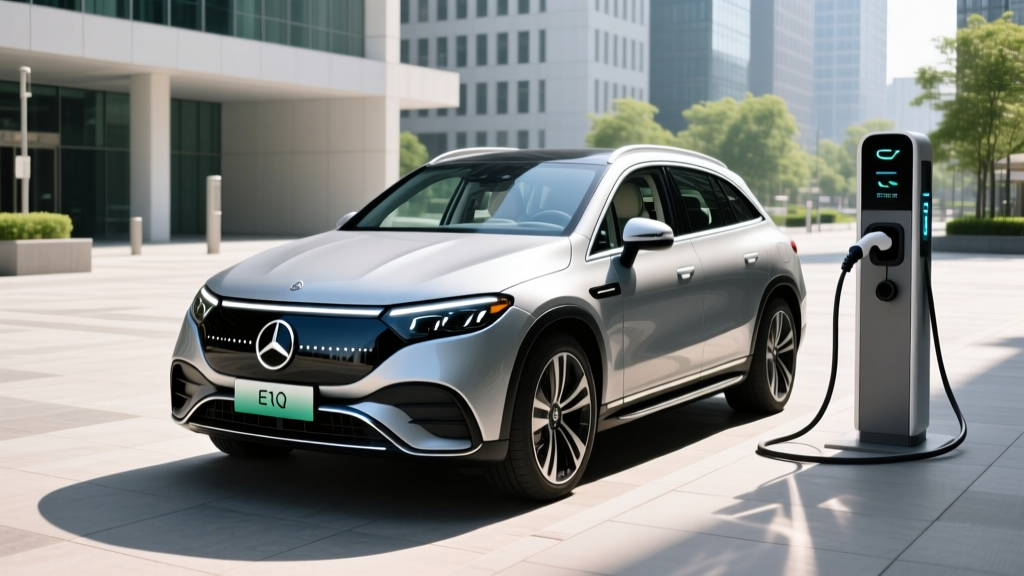
The 2026 Mercedes-Benz EQS SUV occupies a rare lane in the electric vehicle market: a full-size, three-row luxury hauler that pairs a massive 108.4 kWh battery pack with Mercedes' most advanced EV architecture. It's also one of the most scrutinized — buyers spending six figures on an electric SUV want to know exactly what they're getting in range, charging speed, and day-to-day usability. After extensive time with the EQS 450+ and EQS 580 4MATIC variants, here's the data-driven breakdown.
Range and Efficiency: What the EPA Says vs. What You'll Actually Get
The EQS SUV lineup offers two distinct range profiles depending on drivetrain choice. The single-motor EQS 450+ (RWD) carries an EPA-estimated 305 miles of range, while the dual-motor EQS 580 4MATIC (AWD) drops to 285 miles. Both figures come from the same 108.4 kWh usable battery pack (120 kWh gross), which remains one of the largest in any production SUV.
EPA Estimate: 305 mi (450+) / 285 mi (580 4MATIC)
Highway driving (70-75 mph): Expect 240–265 mi (450+) or 225–245 mi (580)
Cold weather (below 32°F): Subtract 20–30% — plan for 210–240 mi (450+) in winter conditions
Mixed city/highway (moderate temps): 270–290 mi achievable with moderate regen use
The EQS SUV's aerodynamic efficiency (drag coefficient of 0.26) helps on the highway, but its 5,800+ lb curb weight works against it in stop-and-go traffic. Preconditioning the battery before DC fast charging is essential to hitting peak charge rates — skip it and you'll add minutes to your stop.
Efficiency ratings from fueleconomy.gov place the EQS 450+ at 85 MPGe combined (86 city / 83 highway), translating to roughly 39 kWh per 100 miles. The EQS 580 4MATIC lands at 79 MPGe combined. These are respectable numbers for a vehicle this size, but they trail lighter competitors like the BMW iX and Rivian R1S on an efficiency-per-pound basis.
| Spec | EQS 450+ (RWD) | EQS 580 4MATIC (AWD) |
|---|---|---|
| EPA Range | 305 mi | 285 mi |
| Battery (usable / gross) | 108.4 kWh / 120 kWh | 108.4 kWh / 120 kWh |
| Battery Chemistry | NMC (Nickel Manganese Cobalt) | NMC (Nickel Manganese Cobalt) |
| Horsepower | 355 hp | 536 hp |
| Torque | 419 lb-ft | 633 lb-ft |
| 0–60 mph | 6.5 sec | 4.4 sec |
| Drivetrain | Rear-Wheel Drive | Dual-Motor AWD |
| MPGe (combined) | 85 MPGe | 79 MPGe |
| Max DC Fast Charge | 200 kW | 200 kW |
| 10–80% DC Charge Time | ~31 min | ~31 min |
| Level 2 Charge Rate | 9.6 kW (~20 mi/hr) | 9.6 kW (~20 mi/hr) |
| Towing Capacity | 3,500 lbs | 3,500 lbs |
Charging Speed: DC Fast Charging and Home Setup
Mercedes rates the EQS SUV at a peak 200 kW DC fast-charge rate on CCS-equipped models (2026 models sold in North America retain the CCS1 connector, though Mercedes has confirmed NACS adoption for future model years). On a compatible 350 kW charger — such as those at Electrify America or EVgo stations — the EQS SUV can add approximately 186 miles of range in 15 minutes under optimal conditions.
However, the charging curve tells the fuller story. Peak 200 kW is sustained roughly between 10% and 35% state of charge. From 35–60%, the rate tapers to approximately 150 kW. Above 80%, charging slows significantly to protect the NMC cells — expect 30–40 kW in the final stretch. The 10–80% charge takes approximately 31 minutes, which is competitive but trails the Hyundai Ioniq 9 and Lucid Gravity, both of which leverage higher-voltage architectures.
| Charge Level | Power | Miles Added per Hour | Use Case |
|---|---|---|---|
| Level 1 (120V household) | 1.4 kW | ~3 mi/hr | Emergency / overnight trickle |
| Level 2 (240V home) | 9.6 kW | ~20 mi/hr | Daily home charging — full charge in ~12 hrs |
| DC Fast (CCS, 350 kW station) | Peak 200 kW | ~750 mi/hr (peak) | Road trips — 10-80% in ~31 min |
For home Level 2 charging, the EQS SUV accepts up to 9.6 kW on a 48-amp hardwired wallbox (such as the Mercedes-Benz Wallbox Home or a ChargePoint Home Flex). A full 0–100% charge takes roughly 12 hours. Most owners will plug in overnight and wake to a full battery — 9.6 kW adds approximately 160 miles of range in an 8-hour sleep window, which covers the vast majority of daily driving needs.
Home installation cost note: A 48-amp Level 2 charger requires a dedicated 60-amp circuit. If your electrical panel has capacity, expect $500–$1,500 for installation (charger + electrician + permit). Older homes may require a panel upgrade ($1,500–$3,500 additional). Always consult a licensed electrician for a site assessment.
Performance and Driving Dynamics
The EQS 580 4MATIC's 4.4-second 0–60 mph time is genuinely quick for a three-row SUV weighing nearly 6,000 pounds. The dual-motor AWD system delivers 536 hp and 633 lb-ft of torque with instant electric response — passing maneuvers and highway merges happen with authority. The 450+ RWD model's 6.5-second run is more relaxed but entirely adequate for its luxury-cruiser mission.
Ride quality is where the EQS SUV earns its Mercedes badge. Standard AIRMATIC air suspension smooths out road imperfections with the composure expected of the three-pointed star. Rear-axle steering (up to 4.5 degrees standard, 10 degrees optional) shrinks the vehicle's turning circle to an impressive 36 feet — genuinely useful for parking a 207-inch-long SUV. The regenerative braking system offers three levels selectable via steering-wheel paddles, plus an intelligent auto-adaptive mode that modulates regen based on traffic and navigation data. True one-pedal driving is available but not as aggressive as Tesla or Rivian implementations.
Interior, Cargo, and Technology
The EQS SUV's cabin is dominated by the available MBUX Hyperscreen — a 56-inch curved glass panel spanning the entire dashboard, integrating a 17.7-inch central OLED touchscreen, a 12.3-inch digital instrument cluster, and a 12.3-inch passenger display. It's visually stunning, though the sheer surface area attracts fingerprints and the capacitive-touch climate controls require more attention than physical knobs. Wireless Apple CarPlay and Android Auto are standard, as is the MBUX voice assistant with natural-language recognition.
Passenger and cargo dimensions:
- Front headroom / legroom: 40.4 in / 41.2 in
- Second-row headroom / legroom: 39.6 in / 40.0 in
- Third-row headroom / legroom: 37.8 in / 28.7 in (best for children or short trips)
- Cargo behind third row: 14.4 cu ft
- Cargo behind second row (third row folded): 42.0 cu ft
- Max cargo (all rear seats folded): 74.2 cu ft
The third row is genuinely usable for adults on short drives — a meaningful advantage over the BMW iX, which offers no third row. However, cargo space behind the third row (14.4 cu ft) is tight for a full-size SUV; you'll need to fold at least one third-row section for grocery runs. There is no front trunk (frunk) — the space under the hood houses electronics and the HVAC system.
Driver assistance: The EQS SUV comes standard with Active Distance Assist DISTRONIC (adaptive cruise), Active Lane Keeping Assist, Active Blind Spot Assist, and Pre-Safe. The optional Drive Pilot system is an SAE Level 3 conditional automated driving feature approved for use at speeds up to 40 mph on suitable divided highways in approved states (currently Nevada and California). This is distinct from Level 2 systems like Tesla Autopilot — Drive Pilot allows the driver to disengage from the driving task under specific conditions, with Mercedes assuming liability when the system is active. Availability remains limited and requires a subscription.
Pricing, Trim Levels, and Federal Tax Credit Eligibility
The 2026 EQS SUV lineup spans three trims, with pricing that firmly positions it in the luxury EV segment:
| Trim | Base MSRP | Federal §30D Credit Eligible? | Effective Price (if eligible) |
|---|---|---|---|
| EQS 450+ SUV (RWD) | $104,400 | No — exceeds $80,000 SUV MSRP cap | $104,400 |
| EQS 580 4MATIC SUV (AWD) | $120,050 | No — exceeds $80,000 SUV MSRP cap | $120,050 |
| EQS 580 SUV Night Class | $125,550 | No — exceeds $80,000 SUV MSRP cap | $125,550 |
Does the Mercedes-Benz EQS SUV qualify for the federal EV tax credit? No. Under current IRS §30D rules, the federal clean vehicle credit is capped at $80,000 MSRP for SUVs, vans, and pickup trucks. Every EQS SUV trim exceeds this threshold, making none eligible for the $7,500 federal credit regardless of buyer income or battery sourcing. Additionally, buyer income caps ($300,000 joint / $150,000 single for new vehicles) would eliminate some buyers even if the MSRP cap weren't a barrier.
State and local incentives may partially offset the cost. California's CVRP rebate, Colorado's state EV credit, and various utility company incentives can stack — but these vary by jurisdiction and change frequently. Check your state's energy office and local utility for current programs.
A well-equipped EQS 580 4MATIC with the AMG Line package, rear-axle steering upgrade, and MBUX Hyperscreen can push the as-tested price above $135,000. Lease deals may offer a workaround: the §30D credit can sometimes be captured by the leasing company under the commercial clean vehicle credit (§45W) and passed through as a lower lease payment — commonly called the "lease loophole." Consult your Mercedes dealer's finance department for current lease structures.
Warranty and Battery Longevity
Mercedes backs the EQS SUV with a competitive warranty package:
- New vehicle limited warranty: 4 years / 50,000 miles
- High-voltage battery warranty: 8 years / 100,000 miles (whichever comes first)
- Battery capacity retention guarantee: Mercedes warrants that the HV battery will retain at least 70% of its original usable capacity (approximately 75.9 kWh usable) during the 8-year/100,000-mile period. Falling below this threshold qualifies for warranty repair or replacement.
- Drive unit (motor) warranty: 8 years / 100,000 miles
The NMC chemistry used in the EQS SUV pack has proven reliable across Mercedes' EQ lineup, though it is more sensitive to sustained high state-of-charge storage than LFP (lithium iron phosphate) batteries. Best practices for longevity: avoid regularly charging to 100% unless needed for a long trip, use the vehicle's built-in charge limit settings (configurable to 80% or 90%), and take advantage of preconditioning to warm or cool the battery before fast charging. Real-world degradation data from European EQS sedan owners suggests approximately 5–8% capacity loss over the first 60,000 miles — well within the warranty threshold.
How It Stacks Up Against Competitors
The EQS SUV doesn't exist in a vacuum. Here's how it compares to its closest rivals:
The Kia EV9 deserves special mention: starting around $60,000, it delivers three rows, 304 miles of EPA range (RWD Long Range), faster charging, and eligibility for the full $7,500 federal credit. It can't match the EQS SUV's luxury, but on value metrics it's a formidable alternative.
Pros and Cons
- Class-leading luxury interior with MBUX Hyperscreen
- Genuine three-row seating with usable adult space in row two
- Massive 108.4 kWh battery provides strong real-world range buffer
- Standard AIRMATIC air suspension delivers exceptional ride comfort
- Rear-axle steering dramatically improves maneuverability
- Available SAE Level 3 Drive Pilot (in approved states)
- Strong 3,500-lb towing capacity for the segment
- No federal §30D tax credit — all trims exceed $80K SUV MSRP cap
- 200 kW peak DC charging trails newer 800V competitors (Kia EV9, Ioniq 9)
- Third-row cargo space (14.4 cu ft) is tight for a full-size SUV
- No front trunk (frunk) for additional storage
- Hyperscreen capacitive controls can distract while driving
- Heavy curb weight (5,800+ lbs) reduces efficiency vs. lighter rivals
- High starting price ($104,400) with options pushing past $135,000
Who Should Buy the Mercedes-Benz EQS SUV?
Choose the EQS SUV if:
- You need a genuine three-row luxury EV and prioritize cabin refinement, ride quality, and technology over outright range or charging speed
- You charge primarily at home and road-trip a few times per year (where 31-minute DC stops are manageable)
- You value Mercedes' SAE Level 3 Drive Pilot capability and brand prestige
- The lack of a $7,500 federal credit doesn't materially affect your purchase decision
Look elsewhere if:
- Federal tax credit eligibility is essential to your budget — consider the Kia EV9, Rivian R1S, or BMW iX (some trims qualify)
- You road-trip frequently and want the fastest possible DC charging — the Kia EV9 or Hyundai Ioniq 9 charge significantly faster
- You need maximum cargo space — the Rivian R1S offers more room behind the third row and a usable frunk
- Two rows are sufficient — the BMW iX offers more range and a lower price in a two-row format
Frequently Asked Questions
What is the real-world range of the Mercedes-Benz EQS SUV?
The EPA rates the EQS 450+ at 305 miles and the EQS 580 4MATIC at 285 miles. In real-world mixed driving at moderate temperatures, expect 270–290 miles from the 450+ and 250–270 from the 580. Sustained highway driving at 75+ mph drops these to approximately 240–265 and 225–245 miles respectively. In freezing weather, subtract another 20–30%.
How fast does the EQS SUV charge at home and on the road?
On a 48-amp Level 2 home charger (9.6 kW), the EQS SUV adds about 20 miles of range per hour, with a full 0–100% charge taking roughly 12 hours. On a DC fast charger, it peaks at 200 kW and charges from 10–80% in approximately 31 minutes. Peak rate is not sustained across the full charge — expect tapering above 60% SoC.
Does the 2026 Mercedes-Benz EQS SUV qualify for the federal EV tax credit?
No. Under IRS §30D rules, the federal clean vehicle credit has an $80,000 MSRP cap for SUVs. Since every EQS SUV trim starts above $104,000, none qualify — regardless of buyer income or battery component sourcing. Some buyers may benefit from the "lease loophole" (§45W commercial credit captured by the lessor) or from state-level incentives.
Is the Mercedes-Benz EQS SUV worth buying vs. the BMW iX or Rivian R1S?
It depends on your priorities. The EQS SUV wins on interior luxury, ride quality, and available Level 3 automated driving. The BMW iX offers more range (324 mi EPA) and a lower starting price but has only two rows. The Rivian R1S delivers more cargo space, faster available charging (with Max Pack), and qualifies for the federal credit on eligible trims — but can't match Mercedes' cabin refinement.
How long will the EQS SUV battery last?
Mercedes warrants the high-voltage battery for 8 years or 100,000 miles, guaranteeing at least 70% capacity retention (approximately 75.9 kWh usable). Real-world data from EQS sedan owners suggests 5–8% degradation over the first 60,000 miles. With proper care — avoiding routine 100% charges, using preconditioning, and limiting DC fast-charge frequency — the pack should provide reliable service well beyond the warranty period. Full battery replacement, if needed out of warranty, is estimated at $15,000–$25,000 based on current Mercedes EQ parts pricing.
Does the EQS SUV have a frunk (front trunk)?
No. The EQS SUV does not have a front trunk. The space under the hood is occupied by power electronics, the onboard charger, and the HVAC system. All cargo must go in the rear cargo area.
What connector does the 2026 EQS SUV use for charging?
The 2026 EQS SUV sold in North America uses the CCS1 (Combined Charging System) connector for both Level 2 AC and DC fast charging. Mercedes has announced NACS (Tesla-style) adoption for future model years, and current CCS-equipped EQS SUVs can access Tesla Superchargers via a Mercedes-approved CCS-to-NACS adapter.