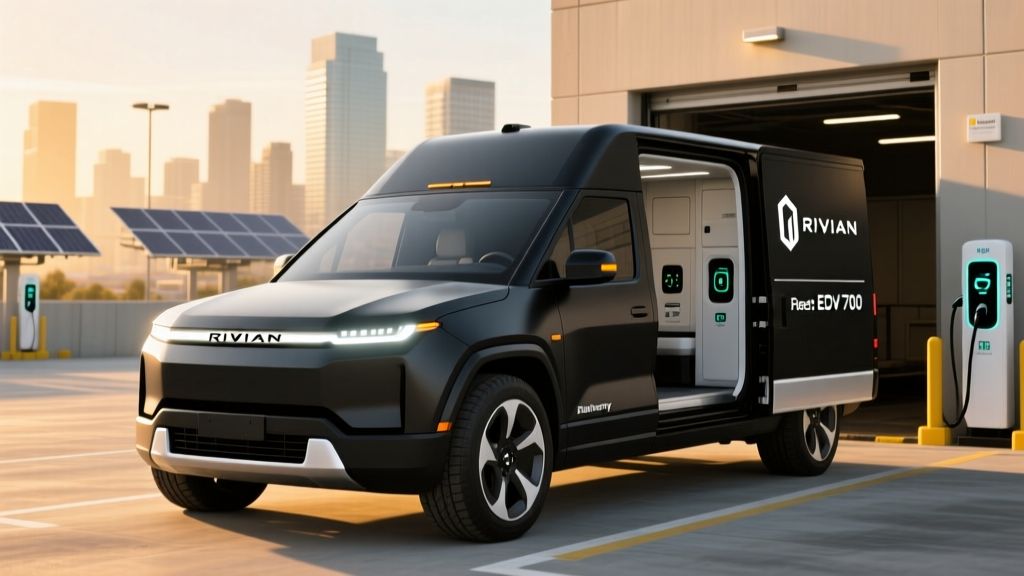
The 2025 Rivian EDV 700 (Electric Delivery Van, 700 cubic feet of cargo volume) occupies a unique space in the commercial EV landscape. Born from an exclusive partnership with Amazon and now gradually expanding to broader fleet availability, the EDV 700 is the largest of Rivian's three commercial delivery van configurations. Unlike consumer EVs reviewed against comfort and performance benchmarks, the EDV 700 lives or dies by uptime, route efficiency, and total cost per mile. This review breaks down the real-world range, charging infrastructure requirements, and ownership economics fleet operators need before committing to deployment.
Spec Overview: 2025 Rivian EDV 700 at a Glance
| Specification | Value |
|---|---|
| EPA Estimated Range | 161 miles (loaded) |
| Battery Capacity | ~149 kWh usable (NMC lithium-ion) |
| Max DC Fast Charge | ~150 kW peak |
| 10–80% DC Charge Time | ~45 minutes (est.) |
| Level 2 AC Charge Rate | ~19.2 kW (estimated ~25 mi/hr) |
| Drivetrain | Single-motor FWD |
| Horsepower | ~275 hp |
| 0–60 mph | N/A (commercial, speed-limited) |
| Cargo Volume | ~660 cu ft (EDV 700 configuration) |
| Payload Capacity | ~2,500 lbs |
| Efficiency | ~2.0–2.3 kWh/mile (route-dependent) |
| Battery/Powertrain Warranty | 8 years / 100,000 miles |
| Base MSRP | Fleet-only (not consumer retail) |
Range and Efficiency: What the EPA Number Doesn't Tell You
Real-World Expectation: 120–145 miles on dense urban delivery routes with frequent stops, HVAC use, and full payload. Highway-speed repositioning between depots drops efficiency further. Cold-weather operations (below 32°F) can reduce usable range by 20–30%, bringing effective range to ~100–115 miles without depot preconditioning.
The 161-mile EPA figure for the EDV 700 is measured under specific commercial-cycle testing that accounts for stop-and-go delivery patterns. However, fleet operators should plan routes against a more conservative 120–130 mile working range to preserve battery longevity and account for seasonal variation. Rivian's thermal management system includes active liquid cooling and heating, but the sheer mass of the 149 kWh pack means cold-soak recovery takes significant energy.
Efficiency in practice runs approximately 2.0 to 2.3 kWh per mile depending on route density. A van completing 150 stops across 80 miles in moderate weather will consume roughly 170–185 kWh — manageable within the usable pack capacity. Routes with extended highway segments between distribution hubs will see efficiency degrade toward 2.5 kWh/mile due to the EDV 700's aerodynamic profile and weight.
Charging: Depot Infrastructure Requirements
| Charging Level | Power (kW) | Rate | Use Case |
|---|---|---|---|
| Level 1 (120V) | ~1.4 kW | ~2 mi/hr | Not practical for fleet ops |
| Level 2 (240V AC) | ~19.2 kW | ~25 mi/hr | Overnight depot charging (primary method) |
| DC Fast Charge | ~150 kW peak | ~10–80% in ~45 min | Mid-day top-ups, opportunity charging |
For fleet deployment, overnight Level 2 depot charging is the backbone. At 19.2 kW, a fully depleted EDV 700 battery requires approximately 7.5–8 hours to reach full charge — aligning well with overnight dwell time. Fleet depots will need commercial-grade Level 2 stations (typically ChargePoint or BTC Power units rated for continuous fleet use) with dedicated 100-amp circuits per stall.
DC fast charging at 150 kW peak is available via CCS1 connector, but the charge curve tapers significantly above 80% state of charge. Expect the 10–80% window in roughly 45 minutes under optimal thermal conditions, but the 80–100% top-off can add another 30+ minutes. For most delivery operations, opportunity charging during driver lunch breaks or route midpoints can recover 60–80 miles of range in 20–25 minutes — enough to extend route coverage without requiring full depot return.
Depot operators should budget for panel upgrades. A 10-stall Level 2 depot installation at 19.2 kW per stall requires approximately 192 kW of continuous draw, which typically demands a dedicated commercial transformer or significant switchgear upgrade. According to the U.S. Department of Energy's Alternative Fuels Data Center, commercial depot charging installations average $30,000–$60,000 per stall when accounting for trenching, conduit, and utility coordination.
Battery Chemistry and Longevity
The EDV 700 uses an NMC (nickel-manganese-cobalt) lithium-ion battery pack with approximately 149 kWh of usable capacity. NMC chemistry offers higher energy density than LFP (lithium iron phosphate), which matters for a vehicle this size — an LFP pack of equivalent capacity would add substantial weight. The trade-off is that NMC cells degrade slightly faster under high-temperature and high-cycle conditions, though Rivian's thermal management system actively mitigates this.
Rivian warrants the battery pack and electric powertrain for 8 years or 100,000 miles, whichever comes first, with a capacity retention threshold typically set at 70% of original capacity. For a delivery van averaging 25,000–30,000 miles annually, the warranty covers roughly 3–4 years of heavy use before the mileage cap is reached. Fleet operators running high-mileage routes should model battery replacement or refurbishment costs into their 7–10 year total cost of ownership projections.
Performance and Drivetrain
The EDV 700 is configured as a single-motor front-wheel-drive vehicle producing approximately 275 horsepower. Unlike Rivian's consumer R1T and R1S platforms with their quad-motor AWD systems, the delivery van prioritizes simplicity, efficiency, and cost-effectiveness over performance. The FWD layout reduces mechanical complexity and weight — critical for maximizing payload capacity and minimizing maintenance intervals.
Acceleration is adequate for urban merging but not brisk; the van is speed-limited for fleet safety compliance and is not designed for highway passing performance. Regenerative braking is aggressively tuned for delivery routes, allowing significant one-pedal driving in stop-and-go traffic and recapturing energy on frequent deceleration events. This regen tuning is one of the EDV 700's strongest efficiency contributors in dense urban environments.
Cargo Space and Practical Design
The EDV 700 designation refers to the largest cargo configuration in Rivian's delivery van lineup, offering approximately 660 cubic feet of cargo volume. (Rivian's EDV lineup includes the smaller EDV 500 and EDV 900 variants, with the numbers loosely correlating to relative cargo capacity tiers.) The EDV 700's load floor is low and flat, optimized for pallet-jack access and hand-truck maneuverability.
Notable design features include:
- Curbside sliding door: Wide opening for rapid package access, with an integrated step for driver entry
- Driver cockpit: Purpose-built with a pass-through to the cargo area, eliminating the need to exit the vehicle between cab and cargo
- Shelving integration: Factory-compatible mounting points for aftermarket racking systems (typically Upfit by Morgan or similar)
- 360-degree camera system: Critical for tight urban loading docks and alley deliveries
- Integrated navigation: Route-optimized for delivery density, with battery state-of-charge-aware routing
Pricing, Availability, and Tax Credit Eligibility
The 2025 Rivian EDV 700 is not available through consumer retail channels. It is sold exclusively through Rivian's commercial fleet program, with Amazon holding priority allocation under their multi-year agreement. Broader fleet availability has been gradually expanding, but exact pricing is negotiated per fleet contract and is not published as a consumer MSRP.
Industry estimates place the EDV 700's per-unit cost in the $100,000–$130,000 range before incentives, though Rivian has not confirmed public pricing. For comparison, the Ford E-Transit — the EDV 700's closest public-market competitor — starts around $55,000–$65,000 depending on body configuration, though it offers significantly less range and cargo volume.
| Cost Factor | Estimated Value |
|---|---|
| Estimated Unit Price (fleet negotiated) | $100,000–$130,000 |
| Federal Commercial Clean Vehicle Credit (§45W) | Up to $40,000 (30% of cost basis, for vehicles over 14,000 lbs GVWR) |
| Estimated Post-Credit Cost | $60,000–$90,000 per unit |
| Depot Charging Install (per stall) | $30,000–$60,000 |
Driver Technology and Safety Systems
The EDV 700 includes Rivian's driver-assistance suite tuned specifically for commercial delivery use:
- Adaptive cruise control with stop-and-go for highway repositioning
- Automatic emergency braking with pedestrian and cyclist detection
- Blind-spot monitoring calibrated for the van's extended body length
- Rear cross-traffic alert with trailer-hitch awareness
- Driver monitoring camera for fatigue and distraction detection (fleet-configurable)
These systems operate at SAE Level 2 — the driver must remain fully engaged at all times. There is no hands-off or eyes-off capability. The driver monitoring system is configurable by fleet managers to set alert thresholds and reporting, but it does not replace active driver supervision.
Pros, Cons, and Competitive Position
Pros
- Class-leading 161-mile EPA range for a large delivery van
- 149 kWh battery provides genuine all-day route coverage for most urban last-mile operations
- Purpose-built delivery ergonomics (pass-through cab, low load floor, curbside access)
- Aggressive regen braking tuned for stop-and-go efficiency recovery
- Integrated route planning with SoC-aware navigation
- Strong §45W commercial credit eligibility (up to $40,000)
Cons
- Not available to individual consumers or small operators outside fleet programs
- Amazon priority allocation limits broader market access
- 150 kW DC fast-charge peak is modest vs. newer passenger EV platforms (limits mid-day turnaround speed)
- NMC chemistry may require earlier capacity refurbishment vs. LFP under high-cycle fleet use
- Cold-weather range loss of 20–30% requires route derating or depot preconditioning investment
- No AWD option — limits deployment in regions with heavy snow/ice without winter tire mandates
Who Should Consider the 2025 Rivian EDV 700?
Choose the EDV 700 if: You operate high-volume urban or suburban last-mile delivery routes under 120 miles daily, have depot charging infrastructure (or budget to install it), and can access Rivian's commercial fleet allocation. The 161-mile range and large cargo volume make it ideal for parcel delivery, grocery fulfillment, and service-route operations.
Look at competitors (Ford E-Transit, BrightDrop Zevo 600) if: You need immediate retail availability, operate shorter routes under 80 miles, require AWD capability, or are a small operator unable to meet fleet-program minimums. The Ford E-Transit offers lower upfront cost and broader dealer support, though with roughly 126 miles of EPA range and less cargo volume.
Frequently Asked Questions
What is the real-world range of the 2025 Rivian EDV 700?
The EPA rates the EDV 700 at 161 miles. In real-world delivery operations with full payload, HVAC use, and frequent stops, expect 120–145 miles in moderate weather. Cold-weather operations below freezing can reduce this to approximately 100–115 miles without preconditioning.
How fast does the EDV 700 charge at home and on DC fast chargers?
At Level 2 (19.2 kW AC), the EDV 700 gains roughly 25 miles of range per hour, requiring about 7.5–8 hours for a full charge — suitable for overnight depot charging. On DC fast chargers, it peaks at approximately 150 kW, reaching 10–80% in roughly 45 minutes. The charge curve tapers above 80%, so plan for 75+ minutes for a full charge on DC.
Does the EDV 700 qualify for the federal EV tax credit?
Not the consumer §30D credit — it qualifies for the IRS §45W Commercial Clean Vehicle Credit, which provides up to 30% of the cost basis (capped at $40,000 for vehicles over 14,000 lbs GVWR). Battery sourcing and domestic content requirements apply. Tax-exempt entities may use direct-pay provisions.
Is the Rivian EDV 700 worth buying vs. the Ford E-Transit?
The EDV 700 offers significantly more range (161 vs. ~126 miles EPA) and cargo volume, making it superior for longer or higher-volume routes. However, the E-Transit costs roughly half as much, is available through standard Ford commercial dealers, and offers AWD. The EDV 700 is the better route-efficiency play; the E-Transit is the more accessible, lower-cost entry point.
Can individual consumers buy a 2025 Rivian EDV 700?
No. The EDV 700 is sold exclusively through Rivian's commercial fleet program. Amazon holds priority allocation, and broader fleet access is expanding gradually but requires commercial fleet credentials and negotiated contracts.
What is the battery warranty on the EDV 700?
Rivian covers the battery pack and electric powertrain for 8 years or 100,000 miles, whichever comes first, with a minimum capacity retention threshold (typically 70%). For high-mileage fleet operations averaging 25,000+ miles annually, the mileage limit will likely be reached before the time limit.