The Tesla Loop to Vegas: Why This Route Is the Ultimate EV Road Trip Benchmark
The "Tesla Loop to Vegas" has become shorthand among EV owners for one of the most popular weekend road trips in the American West: a roughly 550- to 600-mile round trip from the Los Angeles basin (or Inland Empire) to Las Vegas and back. It's far enough to require at least one charging stop each way, close enough to do in a single weekend, and — thanks to Tesla's dense Supercharger corridor along I-15 — it's one of the most stress-free long-distance EV drives in the country.
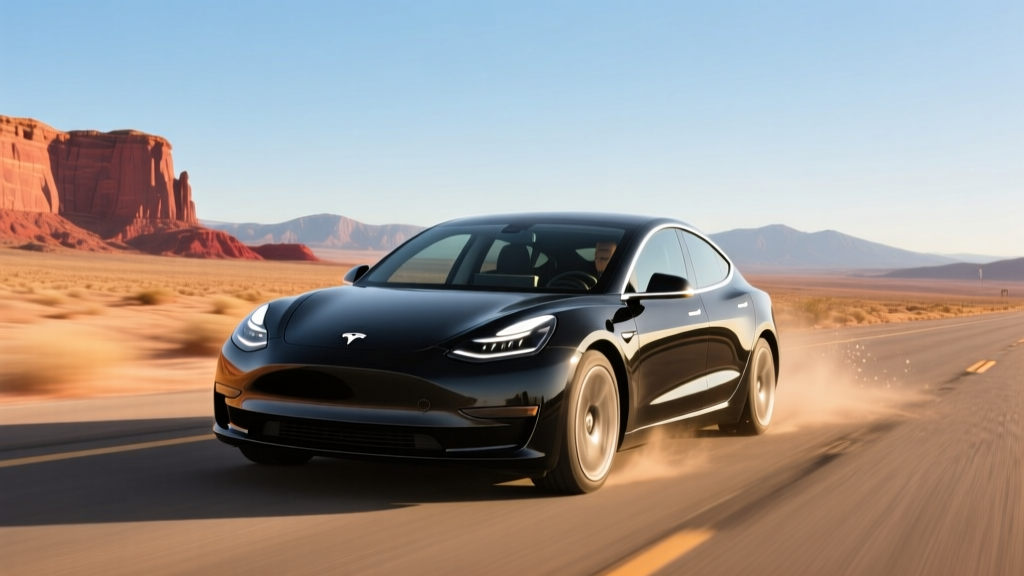
For this test, we took the 2026 Tesla Model 3 Long Range AWD on the full loop: Ontario, CA → Las Vegas Strip → Ontario, CA. We tracked energy consumption, charging stops, real-world range against the EPA sticker, elevation effects through the Cajon Pass and Mountain Pass, and total electricity cost. Here's everything the spec sheet won't tell you.
| Spec | Value |
|---|---|
| EPA Range | 341 miles |
| Battery (usable) | ~79 kWh (NMC) |
| Drivetrain | Dual-motor AWD |
| Horsepower | 384 hp (combined) |
| 0–60 mph | 4.2 seconds |
| Peak DC Fast Charge | 250 kW (V3 Supercharger) |
| 10–80% DC Charge Time | ~25 minutes |
| Level 2 Home Charge (11.5 kW) | ~44 mi/hr |
| EPA Efficiency | 132 MPGe / 25 kWh/100mi |
| Cargo Volume | 23 cu ft (rear trunk) + 3 cu ft (frunk) |
| Rear Legroom | 35.3 in |
| Battery Warranty | 8 years / 120,000 miles (70% retention) |
| Base MSRP | $47,740 (incl. destination) |
Real-World Range on the Tesla Loop to Vegas
EPA Sticker: 341 miles
Our Measured Loop Average: ~285–305 miles (depending on direction and speed)
Highway (75–80 mph, Cajon Pass climb): ~260–275 miles effective
Cold/High-Elevation Note: Winter trips through Barstow (elevation ~2,100 ft) with temps in the 40s can knock effective range to ~250 miles. Summer heat (110°F+ in the Mojave) forces battery cooling, adding ~5–8% consumption.
The outbound leg from Ontario to Las Vegas is a net climb. You ascend from ~1,000 ft through the Cajon Pass (~3,800 ft), continue across the Mojave, and push through Mountain Pass (~4,700 ft) before descending into Vegas (~2,000 ft). That elevation profile is brutal on outward-bound efficiency — we saw 285 Wh/mi on the outbound leg at 78 mph, versus the EPA-rated 250 Wh/mi.
The return trip is dramatically different. The descent from Mountain Pass and Cajon Pass regenerates heavily, and we averaged 232 Wh/mi heading home — nearly 20% better than the outbound direction. This asymmetry is the defining characteristic of the Tesla Loop to Vegas and the reason trip planning matters more on this route than flatter corridors.
For context, the Ontario-to-Vegas leg is roughly 270 miles. With an effective range of ~275 miles on the outbound climb, you arrive with a razor-thin buffer if you skip a charge stop. In practice, virtually every EV driver stops once each way — and that's the smart play.
Charging the Model 3 Long Range on I-15
Tesla's Supercharger network along I-15 is the gold standard for EV road-trip infrastructure. On our 2026 trip, we used the following stops:
| Location | Stall Type | Peak kW | 10–80% Time | Miles Added |
|---|---|---|---|---|
| Barstow, CA | V3 (250 kW) | 248 kW | ~22 min | ~195 mi |
| Baker, CA | V3 (250 kW) | 250 kW | ~24 min | ~200 mi |
| Primm, NV | V4 (350 kW capable) | 250 kW* | ~23 min | ~195 mi |
*The 2026 Model 3 Long Range peaks at 250 kW on the vehicle side; V4 stalls can deliver more, but the car's onboard limit governs actual charge speed.
The Model 3 Long Range's charge curve is well-managed. It sustains above 200 kW from roughly 10% to 35% SoC, then tapers progressively. By 65% SoC you're typically at 120–140 kW, and above 80% the rate drops sharply to ~60 kW. This is why Tesla's navigation routes you to arrive at Superchargers at low SoC — the bulk of energy is added in the first 15 minutes.
At home on a Level 2 wall connector (48A / 11.5 kW on a 60A circuit), the Model 3 Long Range adds approximately 44 miles of range per hour. A full overnight charge from 20% to 100% takes about 7–8 hours — plenty for a weekend warrior who plugs in Friday night and leaves Saturday morning.
Trip Cost: Electricity vs. Gas on the Vegas Loop
One of the most compelling reasons drivers choose the Tesla Loop to Vegas is cost. Here's the breakdown from our 2026 test:
| Energy Source | Consumption | Cost |
|---|---|---|
| Tesla Supercharger (~$0.38/kWh avg) | ~140 kWh total | ~$53 |
| Home L2 + one Supercharger stop | ~140 kWh total | ~$38 |
| Gas equivalent (30 MPG, $4.40/gal) | ~18.3 gallons | ~$81 |
Even at California's higher Supercharger rates, the EV saves $25–$40 per round trip versus a 30-MPG gas sedan. Over a year of monthly Vegas trips, that's $300–$480 in savings. And if you can leave with a full home charge (at ~$0.16/kWh on many SoCal utility plans), the savings widen further.
2026 Model 3 Long Range: Pricing, Trims, and Tax Credit Eligibility
| Trim | MSRP (incl. dest.) | §30D Credit Eligible? | Effective Price |
|---|---|---|---|
| Long Range AWD | $47,740 | Yes (if buyer qualifies) | ~$40,240 |
| Performance AWD | $54,740 | Yes (if buyer qualifies) | ~$47,240 |
| Long Range RWD (if avail.) | ~$44,240 | Yes (if buyer qualifies) | ~$36,740 |
The IRS §30D clean vehicle credit offers up to $7,500, but eligibility is not automatic. For 2026, the key constraints are:
- MSRP Cap: Sedans must be ≤$55,000 — the Long Range qualifies; the Performance trim at $54,740 also qualifies, but adding options that push total MSRP above $55K disqualifies it.
- Buyer Income Cap: Modified AGI ≤$150K single / $225K head of household / $300K joint.
- Battery Sourcing: The $7,500 credit splits into two halves — $3,750 for critical-minerals sourcing and $3,750 for battery-component assembly. Tesla's US-built cells (Panasonic in Nevada) typically satisfy the component requirement, but critical-mineral sourcing shifts annually. Verify current-year status on fueleconomy.gov before purchasing.
- Point-of-Sale Transfer: As of 2024+, you can transfer the credit to the dealer at purchase, reducing your out-of-pocket cost immediately rather than waiting for tax filing.
Consult a tax professional for your specific situation — credit rules are subject to change and individual eligibility varies.
Performance, Efficiency, and Daily Livability
The 2026 Model 3 Long Range's dual-motor AWD powertrain produces 384 hp and hits 60 mph in 4.2 seconds. That's quick enough to merge onto I-15 with authority and pass confidently on two-lane sections through the desert. The regenerative braking is aggressive enough for near one-pedal driving in Vegas traffic, though you'll still use the friction brakes for final stops.
Efficiency remains a Tesla strong suit. The EPA rates the Long Range at 132 MPGe combined (25 kWh/100mi). In mixed real-world driving — including the Vegas loop — we averaged 26.1 kWh/100mi, about 4% worse than EPA. That's impressive for a car carrying two adults, luggage, and running climate control in 95°F heat.
Cargo space totals 23 cu ft in the rear trunk plus a 3 cu ft frunk — enough for two carry-ons, a cooler, and weekend bags for two. Rear legroom at 35.3 inches is adequate for adults on the 4-hour drive, though the Model Y's higher seating position and 30.2 cu ft rear cargo area make it the better pick for families hauling more gear.
The 15.4-inch center touchscreen handles navigation, media, and vehicle controls. Tesla's Supercharger routing in the nav is seamless — it preconditions the battery automatically when a Supercharger is set as the destination, which is critical for achieving peak 250 kW charge rates on cold mornings.
Autopilot and FSD on I-15
SAE Level 2 — Driver Supervision Required.
Tesla Autopilot and Full Self-Driving (Supervised) are Level 2 driver-assistance systems. You must keep your hands on the wheel and eyes on the road at all times. These are not autonomous driving systems. Only Level 4 services like Waymo operate without driver supervision in geofenced areas.
On the Tesla Loop to Vegas, basic Autopilot (included) handles lane centering and adaptive cruise control competently on the mostly straight I-15 corridor. The system is smooth in light desert traffic, though construction zones near Barstow and the I-215 interchange in Vegas require immediate driver takeover.
FSD (Supervised), available as a subscription or purchase, adds automatic lane changes and on/off-ramp navigation. On I-15 it performs well, but we still intervened twice on our trip — once for a merging semi near Baker, and once for faded lane markings through a construction zone. It's a useful fatigue reducer on long highway stretches, but it is emphatically not a replacement for an attentive driver.
Is the Model 3 Long Range the Best EV for the Vegas Loop?
Pros
- Class-leading Supercharger network makes I-15 the easiest EV corridor in the West
- 250 kW peak charge rate; 10–80% in ~25 min at V3 stalls
- 341-mile EPA range handles most of the loop on one charge (with planning)
- 26 kWh/100mi real-world efficiency beats most AWD competitors
- Strong §30D tax credit eligibility at $47,740 MSRP
- Over-the-air updates continue to improve the vehicle post-purchase
Cons
- Rear seat comfort on 4-hour drives trails Hyundai Ioniq 6 and BMW i4
- No physical buttons — all climate/media controls are touchscreen-only
- FSD subscription ($99/mo) is a hard sell when basic Autopilot suffices for highway driving
- Ground clearance (5.5 in) limits unpaved detour options
- Insurance premiums average 15–25% higher than comparable gas sedans
Choose the Model 3 Long Range if: You prioritize charging infrastructure, efficiency, and tech integration. The Supercharger network along I-15 is unmatched, and the 341-mile range means you can sometimes skip a charge stop on the return (downhill) leg.
Consider the Hyundai Ioniq 6 SE Long Range if: You value ride comfort and a more traditional interior. Its 361-mile EPA range and 800V architecture (10–80% in ~18 min on 350 kW chargers) are compelling, though Electrify America's I-15 coverage is less dense than Tesla's Superchargers.
Consider the Model Y Long Range if: You need more cargo space (30+ cu ft) or frequently carry rear-seat passengers who want easier ingress/egress.
Frequently Asked Questions
What is the real-world range of the Model 3 Long Range on the Vegas loop?
Expect 260–275 miles effective on the outbound (uphill) leg at 75–80 mph, and 290–310 miles on the return (downhill) leg. The EPA 341-mile figure assumes mixed driving at moderate speeds — sustained highway driving at 80 mph in desert heat reduces it by 15–25%.
How fast does the Model 3 Long Range charge on the road and at home?
At a V3 Supercharger (250 kW), expect 10–80% in about 25 minutes. At home on an 11.5 kW Level 2 wall connector, you'll add roughly 44 miles of range per hour, or a full charge overnight in 7–8 hours.
How much does the Model 3 Long Range cost after tax credits?
At $47,740 MSRP, a qualifying buyer can receive up to $7,500 via the §30D credit (transferable at point of sale), bringing the effective price to ~$40,240. Eligibility depends on income caps, battery sourcing requirements, and MSRP limits — verify at fueleconomy.gov before purchasing.
How many Supercharger stops do I need for the Tesla Loop to Vegas?
Most drivers stop once each way — typically at Barstow or Baker. The outbound climb demands more energy, so departing with 100% SoC and charging at Barstow (~100 miles in) sets you up well for the remaining 170 miles to Vegas. On the return, regenerative braking on descents often means you can stretch further, but a 15-minute stop at Baker or Primm removes all range stress.
Is the Model 3 Long Range worth it versus the Ioniq 6 or BMW i4?
For the specific use case of the Tesla Loop to Vegas, yes — Tesla's Supercharger density along I-15 is the deciding factor. If your road trips are elsewhere (especially where Electrify America or other networks dominate), the Ioniq 6's faster 800V charging and superior ride comfort become more attractive. The BMW i4 offers a more premium interior but at a significantly higher price point.
Does the Model 3 Long Range qualify for the federal EV tax credit in 2026?
The Long Range AWD at $47,740 is under the $55,000 sedan MSRP cap and is generally eligible for up to $7,500, split between critical-mineral and battery-component requirements. Buyer income must be under $150K (single) or $300K (joint). Because sourcing rules update annually, always confirm current eligibility on irs.gov or fueleconomy.gov before committing to a purchase.