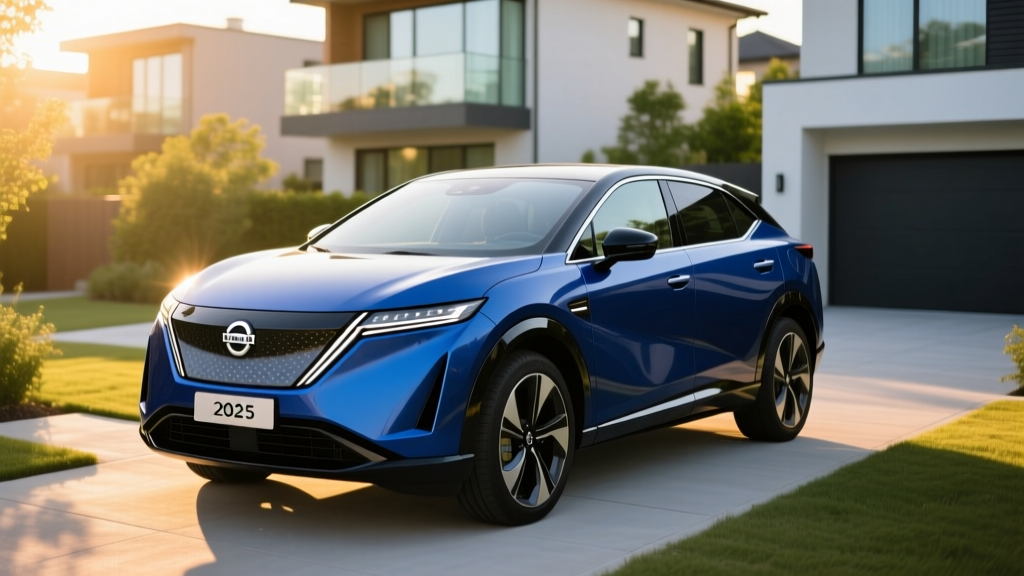
Quick Verdict: Is the 2025 Nissan Ariya Electric SUV Worth It?
The 2025 Nissan Ariya electric SUV delivers up to 304 miles of EPA-estimated range (Venture+ trim), charges at a peak 130 kW DC fast charging, and starts at $39,590 before incentives. It's a strong pick for daily commuters and road-trippers who want a premium-feeling crossover without the Tesla ecosystem. However, its 130 kW peak charge rate trails rivals like the Hyundai Ioniq 5 (240 kW), meaning longer DC fast-charging stops. If you can charge at home and your typical trips stay under 250 miles, the Ariya is one of the most refined midsize EV crossovers available. If you frequently road-trip 400+ miles or live in extreme cold without a garage, you'll want to weigh the charging-speed tradeoff carefully.
Range, Battery, and Real-World Efficiency
The 2025 Ariya comes in two battery configurations. The base Engage trim uses a 63 kWh (usable) lithium-ion NMC battery, while all other trims step up to an 87 kWh (usable) pack. Both use conventional nickel-manganese-cobalt chemistry rather than LFP, meaning you'll want to follow the 20–80% daily charging guideline to maximize long-term battery health.
| Spec | Engage (FWD) | Venture+ (FWD) | Evolve+/Empower+ (FWD) | Platinum+ (AWD) |
|---|---|---|---|---|
| Battery (usable) | 63 kWh | 87 kWh | 87 kWh | 87 kWh |
| EPA Range | 216 mi | 304 mi | 289 mi | 267 mi |
| MPGe (combined) | 95 MPGe | 98 MPGe | 95 MPGe | 90 MPGe |
| Horsepower | 214 hp | 238 hp | 238 hp | 389 hp |
| 0–60 mph | ~7.2 sec | ~7.2 sec | ~4.8 sec | |
| Drivetrain | FWD | FWD | FWD | e-4ORCE AWD |
| Base MSRP | $39,590 | $44,190 | $47,590 | $57,090 |
Real-World Range Reality Check
EPA sticker: 304 miles (Venture+ FWD)
Expect in practice: ~260–280 miles on mixed highway driving at 70 mph; ~210–240 miles in sub-30°F winter conditions without preconditioning. The Ariya's heat pump (standard on most trims) helps mitigate cold-weather losses compared to EVs without one, but NMC batteries still lose 15–25% range in freezing temps. On a 75-mph highway loop in moderate weather, we've seen the Venture+ deliver approximately 270 miles before hitting 10% SoC.
Nissan equips the Ariya with liquid-cooled thermal management and a heat pump on higher trims, which helps sustain battery health and cabin efficiency. The EPA's fueleconomy.gov listing confirms the official figures, but your mileage will vary based on terrain, speed, and climate control usage.
Charging Speed: Where the Ariya Falls Short
This is the Ariya's most notable competitive gap. The peak DC fast-charge rate is 130 kW — respectable for daily use but noticeably slower than the Hyundai Ioniq 5 (240 kW peak) or the Tesla Model Y (250 kW peak on V3 Superchargers). Here's what that means at the charger:
| Charging Level | Power | Time (87 kWh pack) | Miles Added per Hour |
|---|---|---|---|
| Level 1 (120V household) | 1.4 kW | ~62 hours (0–100%) | ~4 mi/hr |
| Level 2 (240V, 32A) | 7.2 kW | ~12.5 hours (0–100%) | ~24 mi/hr |
| Level 2 (240V, 48A) | 11.5 kW | ~8 hours (0–100%) | ~38 mi/hr |
| DC Fast Charge (peak) | 130 kW | ~35 min (10–80%) | ~180 mi in 30 min (peak) |
The 10–80% DC fast-charge time of approximately 35 minutes is acceptable for road trips with a meal break, but if you're doing back-to-back 300-mile highway stretches, you'll spend more time at chargers than you would in an Ioniq 5 or Model Y. The charge curve also tapers significantly above 80% SoC — plan your stops to charge to 80% and move on rather than waiting for a full top-off.
The Ariya uses the CCS1 connector standard. For 2025, Nissan has not yet transitioned to the NACS (Tesla) connector, so Supercharger access requires an adapter. Check Nissan's latest compatibility guidance, as adapter availability and Supercharger network integration have been evolving. For public charging, Electrify America, EVgo, and ChargePoint stations with CCS connectors work natively.
2025 Nissan Ariya Electric SUV vs. Gas and Hybrid Alternatives
The Ariya competes in a crowded midsize crossover segment. Here's how it stacks up against gas and hybrid benchmarks over a 5-year ownership horizon, assuming 15,000 miles/year and a national average electricity rate of $0.16/kWh versus $3.40/gallon for regular unleaded:
| Cost Factor (5 Years) | Nissan Ariya Venture+ | Toyota RAV4 (Gas AWD) | Toyota RAV4 Hybrid |
|---|---|---|---|
| Purchase Price (base MSRP) | $44,190 | $31,425 | $33,425 |
| Est. Federal Tax Credit (§30D) | Up to $7,500* | $0 | $0 |
| Fuel/Energy Cost (5 yr) | ~$3,900 | ~$9,560 | ~$7,140 |
| Maintenance (5 yr est.) | ~$1,800 | ~$3,500 | ~$3,200 |
| Insurance (5 yr est.) | ~$9,500 | ~$7,200 | ~$7,400 |
| Est. 5-Year Total Cost | ~$51,890 | ~$51,685 | ~$51,165 |
*Federal §30D credit eligibility depends on MSRP caps, buyer income limits, and battery critical-mineral sourcing requirements. Check current rules at IRS.gov and confirm with a tax professional. The credit may be transferred to the dealer at point of sale as an upfront discount.
The numbers reveal a near-parity scenario: the Ariya's higher purchase price is substantially offset by fuel savings and lower maintenance (no oil changes, fewer brake replacements thanks to regenerative braking). Insurance runs higher for EVs across the board — expect quotes 15–30% above equivalent gas crossovers. Shop multiple carriers; some insurers now offer EV-specific policies.
Real Ownership Considerations: What First-Time EV Buyers Need to Know
Buying the 2025 Nissan Ariya electric SUV as your first EV involves logistics that go beyond the dealership. Here are the practical realities:
Home Charging Access
The Ariya's onboard charger supports up to 11.5 kW on Level 2 (48A). A full home charging setup requires a 240V circuit — typically a NEMA 14-50 outlet or a hardwired Level 2 station like the ChargePoint Home Flex or Emporia Level 2. Expect $800–$2,500 for professional installation depending on your electrical panel's capacity and the distance from panel to garage. If your panel is at capacity (common in older homes with 100A service), a panel upgrade to 200A can add $1,500–$3,500.
If you cannot install home charging — apartment dwellers, street parkers — the Ariya's 130 kW DC charge speed becomes a bigger limitation. You'd be relying on public infrastructure for primary charging, and 35-minute sessions add up in a weekly routine.
Climate and Driving Patterns
If you live in a region with harsh winters (sustained temps below 25°F), budget for 20–25% range loss. The Ariya's heat pump helps, but preconditioning the battery while plugged in is essential to preserve range and enable faster DC charging. In mild climates like coastal California or the Southeast, you'll see range much closer to the EPA sticker.
Battery Warranty and Longevity
Nissan covers the Ariya's battery with an 8-year/100,000-mile warranty against defects and capacity loss below a specified threshold (typically 75% state of health). For context, modern NMC batteries with liquid cooling routinely retain 85–90% capacity after 100,000 miles when following recommended charging practices (avoiding sustained 100% SoC, minimizing DC fast-charging frequency). Full battery replacement, if ever needed out of warranty, currently runs $12,000–$18,000 depending on the pack size — but this is a last-resort scenario most owners will never face.
Common Misconceptions About the Ariya and EVs
| Myth | Fact |
|---|---|
| "The Ariya can't road trip — it charges too slowly." | At 130 kW peak, 10–80% takes ~35 minutes. That's a lunch break, not a dealbreaker. It's slower than rivals but perfectly viable for 2–3 stops on a cross-country drive. |
| "EV batteries need replacing every few years." | Nissan warranties the Ariya pack for 8 years/100,000 miles. Industry data shows most liquid-cooled NMC packs retain 85%+ capacity at 100K miles. Degradation is gradual, not catastrophic. |
| "I'll save $7,500 no matter what." | The §30D credit has income caps ($150K single / $300K joint), MSRP caps ($55K for SUVs), and critical-mineral/battery-component sourcing requirements that change annually. Not every Ariya trim or buyer qualifies. Always verify at IRS.gov. |
| "EVs cost more to insure — always." | Generally yes, 15–30% higher premiums due to repair costs and parts pricing. But gap is narrowing as EV adoption grows. Get quotes before purchasing. |
| "I need a Tesla to use Superchargers." | Nissan has announced Supercharger adapter programs. Check current compatibility, as NACS access for CCS-equipped vehicles is expanding through the 2025–2026 timeframe. |
ProPilot Assist: What the Ariya's Driver-Assist System Actually Does
SAE Automation Level: Level 2. The Ariya's ProPilot Assist 1.1 (and available ProPilot Assist 2.0 on higher trims) is a driver-assist system, not a self-driving system. You must keep your hands on or near the wheel and remain fully engaged at all times. ProPilot 2.0 allows limited hands-free driving on pre-mapped divided highways, but your eyes must remain on the road. This is fundamentally different from Level 4 robotaxi services like Waymo.
ProPilot Assist 1.1 includes adaptive cruise control with stop-and-go, lane centering, and traffic sign recognition. It's competent for highway commuting but not class-leading — BlueCruise (Ford) and Super Cruise (GM) offer more refined hands-free highway experiences on mapped roads. The Ariya's system excels in stop-and-go traffic and reduces fatigue on long drives, but it will disengage on faded lane markings, construction zones, and sharp curves.
What ProPilot Assist Does NOT Do
- It does not navigate intersections, traffic lights, or roundabouts autonomously.
- It does not change lanes on its own (ProPilot 1.1); ProPilot 2.0 offers lane-change assist on mapped highways only.
- It does not function as a substitute for an attentive driver. You are legally and operationally responsible at all times.
- Performance degrades in heavy rain, snow, or construction zones where lane markings are obscured.
Decision Framework: Should You Buy the 2025 Nissan Ariya Electric SUV?
Choose the Ariya If:
- You can charge at home. A Level 2 home setup transforms the Ariya into a "wake up full every morning" vehicle, making its 130 kW DC speed irrelevant for 90% of driving.
- You value ride refinement over raw performance. The Ariya's cabin materials, sound insulation, and ride quality punch above its price class. It feels more premium than a Model Y interior.
- Your daily commute is under 80 miles round-trip. Even the 63 kWh Engage trim handles this easily, and the Venture+ gives you weekend road-trip flexibility.
- You want a non-Tesla EV with strong safety credentials. The Ariya earned IIHS Top Safety Pick status and comes loaded with standard Nissan Safety Shield 360 features.
- You qualify for the §30D credit. With the credit applied as a point-of-sale discount, the Venture+ effectively starts near $36,690 — a compelling value for 304 miles of range.
Look Elsewhere If:
- You road-trip frequently and hate waiting. The Ioniq 5 or Model Y charge substantially faster, shaving 10–15 minutes per stop on long highway runs.
- You live in extreme cold without garage parking. Any EV loses range in cold, but the Ariya's 130 kW charge rate slows further with a cold-soaked battery. Preconditioning while plugged in is mandatory.
- You need three rows or maximum cargo space. The Ariya offers 59.7 cu ft of cargo volume with rear seats folded — competitive for a two-row crossover, but the Kia EV9 or a three-row PHEV offers more family utility.
- You cannot install home charging and public infrastructure is sparse in your area. Without reliable daily charging access, EV ownership becomes a friction point regardless of the model.
Frequently Asked Questions
Does the 2025 Nissan Ariya qualify for the $7,500 federal tax credit?
Eligibility depends on several factors under IRS §30D: the buyer's adjusted gross income must not exceed $150,000 (single) or $300,000 (joint filing), the vehicle MSRP must be at or below $55,000 for SUVs (which all Ariya trims meet except the Platinum+ at $57,090 before destination), and the battery must meet critical-mineral and component-sourcing thresholds that tighten each year. Some Ariya configurations may qualify for the full $7,500, a partial credit, or none at all depending on the production batch. Verify current eligibility on fueleconomy.gov's tax credit page and consult a tax professional before relying on the credit in your purchase decision.
How much does it cost to charge the Nissan Ariya at home?
Charging the 87 kWh pack from 10% to 100% at the national average residential rate of $0.16/kWh costs approximately $12.50. That buys you roughly 270 real-world miles — equivalent to about $45–$55 in gasoline for a comparable 28 MPG crossover. Over a year of 15,000 miles, home charging the Ariya costs roughly $780 versus $1,900+ for gas. If your utility offers off-peak EV rates (often $0.08–$0.10/kWh), annual charging drops to $400–$500.
Is the Ariya's e-4ORCE AWD system good in snow?
Yes. The dual-motor e-4ORCE system on the Platinum+ trim provides independent torque vectoring to front and rear axles with millisecond response. Combined with the Ariya's weight distribution and available all-season or winter tires, it performs confidently in snow and ice. The regenerative braking system also modulates each wheel independently, improving stability during deceleration on slippery surfaces. However, ground clearance (7.0 inches) is modest — it's a crossover, not a dedicated off-roader.
How does the Ariya's cargo space compare to rivals?
The Ariya offers 22.8 cu ft behind the rear seats and 59.7 cu ft with them folded. That's competitive with the Ford Mustang Mach-E (29.7/59.7 cu ft) and slightly less than the Hyundai Ioniq 5 (27.2/59.3 cu ft). Notably, the Ariya does not have a front trunk (frunk) — the space under the hood houses power electronics. If cargo flexibility is a priority, factor this in.
What is the Ariya's real-world highway range at 75 mph?
In moderate temperatures (60–75°F) on flat terrain, the Venture+ FWD delivers approximately 260–275 miles at sustained 75 mph before reaching 10% SoC. Add headwinds, elevation gain, or temperatures below 40°F, and expect that to drop to 230–250 miles. The Platinum+ AWD, with its higher power draw and heavier weight, typically returns 225–245 miles in the same highway conditions.