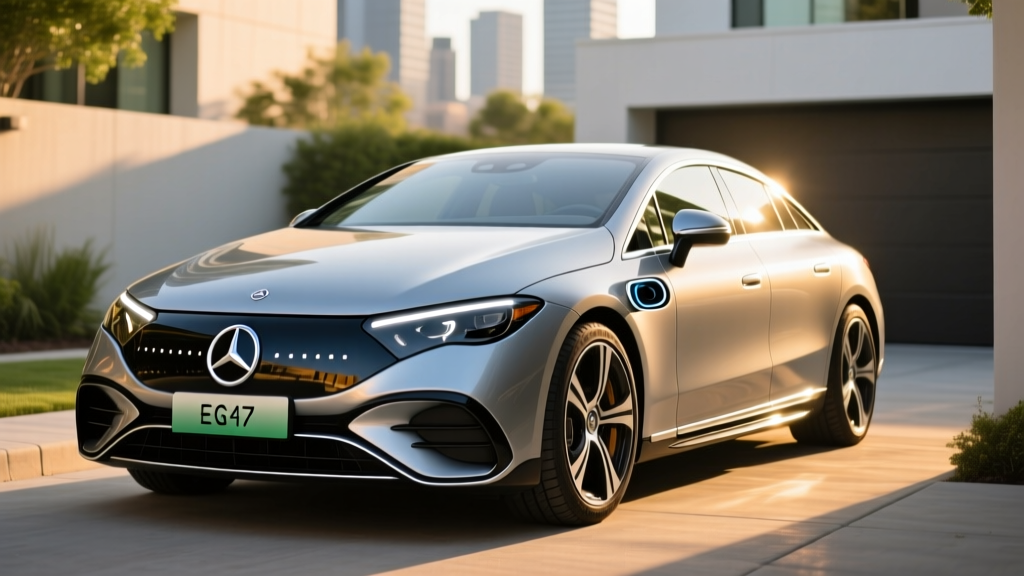
Quick Verdict: A Luxury EV Sedan That Prioritizes Refinement Over Flash
The 2025 Mercedes-Benz EQE sedan occupies a specific niche: it's the executive express for buyers who want German luxury electrified without stepping up to the flagship EQS. With EPA-estimated range reaching 305 miles in the EQE 350+ rear-wheel-drive configuration, a 90.6 kWh usable battery, and Mercedes' signature cabin isolation, the EQE delivers on its core promise — serene, silent, long-distance cruising. But in a segment now crowded with the BMW i5, Audi e-tron GT, Tesla Model S, and Lucid Air, the EQE's value proposition requires careful scrutiny. This review breaks down every number that matters.
2025 Mercedes-Benz EQE Key Specifications
| Specification | EQE 350+ | EQE 350 4MATIC | EQE 500 4MATIC | AMG EQE |
|---|---|---|---|---|
| EPA Range | 305 mi | 277 mi | 270 mi | 230 mi |
| Battery (Usable) | 90.6 kWh NMC | 90.6 kWh NMC | 90.6 kWh NMC | 90.6 kWh NMC |
| Horsepower | 288 hp | 288 hp | 402 hp | 617 hp (677 w/boost) |
| 0–60 mph | 6.2 sec | 6.0 sec | 4.5 sec | 3.3 sec |
| Drivetrain | RWD | AWD Dual-Motor | AWD Dual-Motor | AWD Dual-Motor |
| DC Fast Charge Peak | 170 kW | 170 kW | 170 kW | 170 kW |
| 10–80% DC Time | ~32 min | ~32 min | ~32 min | ~32 min |
| Level 2 Rate | 9.6 kW | 9.6 kW | 9.6 kW | 9.6 kW |
| EPA Efficiency | 94 MPGe | 87 MPGe | 85 MPGe | 74 MPGe |
| Base MSRP | $76,050 | $79,050 | $89,050 | $108,550 |
Range and Efficiency: What the EPA Sticker Doesn't Tell You
The headline number — 305 miles EPA for the EQE 350+ — is competitive with the BMW i5 eDrive40 (295 mi) and trails the Lucid Air Pure (419 mi) but comfortably exceeds daily and most road-trip needs. However, EPA estimates assume mixed driving at moderate temperatures. Real-world results diverge meaningfully.
Real-World Range Expectations
EPA Sticker: 305 mi (EQE 350+)
Highway (70–80 mph, 75°F): Expect 250–275 mi. The EQE's aerodynamic drag coefficient of 0.22 helps, but sustained high speeds consume energy faster than the EPA city-heavy cycle.
Cold Weather (20–30°F): Expect 200–230 mi. The EQE uses a heat pump (standard on 2025 models) to mitigate cabin-heating losses, but lithium-ion chemistry inherently loses efficiency in cold. Preconditioning the battery while plugged in recovers some of this deficit.
City/Commuting: 290–310 mi. Regenerative braking and low-speed efficiency align closely with or slightly exceed EPA estimates.
Efficiency for the EQE 350+ is rated at 94 MPGe combined, which translates to roughly 36 kWh per 100 miles. That's less efficient than the BMW i5 eDrive40 (100 MPGe combined) and notably behind the Lucid Air Pure's class-leading efficiency. The EQE's ~5,400-pound curb weight works against it in stop-and-go and higher-speed driving alike. The 350 4MATIC drops to 87 MPGe; the 500 4MATIC falls to 85 MPGe; and the AMG EQE lands at 74 MPGe — a steep penalty for 617 horsepower.
Charging Speed: 170 kW Peak, but Watch the Curve
All 2025 EQE variants share the same charging hardware: a 170 kW maximum DC fast-charge rate on CCS1 connectors (NACS adapter available for Tesla Supercharger access). On paper, 170 kW is mid-pack — the Hyundai Ioniq 5 peaks at 240 kW, and the Lucid Air at over 250 kW — but sustained rate matters more than peak.
2025 EQE Charging Breakdown
| Charging Level | Power / Rate | Time / Range Added |
|---|---|---|
| Level 1 (120V household) | ~1.4 kW | ~3–4 mi/hr (50+ hrs for full charge) |
| Level 2 (240V home, 40A) | 9.6 kW | ~25–28 mi/hr (~10 hrs 10–100%) |
| DC Fast Charge (peak) | 170 kW | 10–80% in ~32 min |
| DC Fast Charge (sustained avg) | ~110–120 kW | 10–80% real-world avg |
The charge curve reality: The EQE hits 170 kW briefly between roughly 10–25% state of charge (SoC) on a compatible 350 kW charger. From 25–60%, it sustains approximately 120–140 kW. Above 80%, the rate tapers sharply to protect battery longevity — dropping below 50 kW. This is normal for NMC chemistry but means charging from 80–100% at a DC station is painfully slow. For road trips, plan stops at 15–20% SoC and charge to 80%, then move on.
For home charging, the onboard 9.6 kW Level 2 charger means a full charge from empty takes roughly 10 hours on a hardwired 48-amp Level 2 station (like a ChargePoint Home Flex or Wallbox Pulsar Plus). Most owners charging overnight from 20–30% remaining will wake to a full battery in 7–8 hours. A dedicated 240V/60A circuit is recommended; budget $800–$2,000 for professional installation depending on panel proximity, per typical DOE home charging estimates.
Performance: Quiet Thrust, Not Track-Day Drama
The EQE 350+ uses a single rear-mounted permanent-magnet synchronous motor producing 288 hp and 391 lb-ft of torque. The 0–60 mph time of 6.2 seconds is adequate for merging and passing but won't thrill anyone cross-shopping a Tesla Model S Plaid (1.99 sec) or even the EQE 500 4MATIC (4.5 sec).
The dual-motor 350 4MATIC adds a front motor for all-wheel drive without increasing horsepower (still 288 hp combined) — the benefit is traction in rain and snow, not acceleration. The 500 4MATIC bumps output to 402 hp and 633 lb-ft, dropping the 0–60 to 4.5 seconds. At the top, the AMG EQE delivers 617 hp (677 with Race Start boost) and a 3.3-second 0–60 — genuine supercar territory, at the cost of 75 miles of range versus the 350+.
Ride quality is where the EQE justifies its price. The standard steel suspension with adaptive damping absorbs road imperfections with the composure expected from Mercedes. Optional AIRMATIC air suspension (included on 500 and AMG) adds a plush, floating quality at highway speeds and adjusts ride height for aerodynamics or clearance. Steering is light and numb by sporty standards — this is a grand tourer, not a sports sedan.
Interior, Cargo, and Technology
The EQE cabin is a study in material quality and digital ambition. The standard 12.8-inch central touchscreen runs Mercedes' MBUX infotainment system with wireless Apple CarPlay and Android Auto, voice control ("Hey Mercedes"), and over-the-air update capability. The optional Hyperscreen — a 56-inch curved glass panel spanning the full dashboard width with a dedicated passenger display — is a $8,500 upgrade on the 350+ and visually stunning, though the additional screen real estate doesn't add much practical function.
Passenger space: The EQE seats five, with 42.5 inches of front legroom and 37.2 inches rear. Rear headroom (38.1 inches) is generous for a sedan, though the sloping roofline cuts into space for taller passengers. Rear seat comfort is a clear advantage over the lower-slung Audi e-tron GT.
Cargo volume: 15.0 cubic feet in the trunk. There is no front trunk (frunk) — the space under the hood houses HVAC components and the 12V battery. The 15.0 cu ft figure is competitive with the BMW i5 (17.4 cu ft is slightly larger) but significantly less than the Tesla Model S (28.0 cu ft including frunk). For families needing hatchback utility, the EQE SUV variant offers more practicality.
Driver assistance: The EQE includes Mercedes' Driver Assistance Package standard: Active Distance Assist (adaptive cruise), Active Steering Assist (lane centering), Active Lane Change Assist, and Active Emergency Stop Assist. This is SAE Level 2 automation — the driver must remain attentive with hands on or near the wheel at all times. Mercedes' DRIVE PILOT system (Level 3, allowing hands-off/eyes-off under 40 mph on approved highways) is available in limited markets (California and Nevada) as of 2025, but availability is restricted to specific highway segments and conditions.
Pricing, Trims, and Federal Tax Credit Eligibility
The 2025 EQE lineup starts at $76,050 (including destination) for the 350+ and climbs to $108,550 for the AMG EQE. Most buyers targeting value within the luxury EV sedan segment will focus on the 350+ or 350 4MATIC.
2025 EQE Pricing and Tax Credit Analysis
| Trim | Base MSRP | As-Tested (Typical Options) | §30D Federal Credit | Effective Price |
|---|---|---|---|---|
| EQE 350+ | $76,050 | $82,000–$88,000 | $0–$3,750* | $72,300–$88,000 |
| EQE 350 4MATIC | $79,050 | $85,000–$92,000 | $0–$3,750* | $75,300–$92,000 |
| EQE 500 4MATIC | $89,050 | $96,000–$105,000 | $0–$3,750* | $85,300–$105,000 |
| AMG EQE | $108,550 | $115,000–$125,000 | $0 | $108,550–$125,000 |
§30D Federal Tax Credit Rules (2025)
- MSRP Cap: Sedans must have an MSRP at or below $55,000 to qualify. The EQE exceeds this cap in every trim — it does NOT qualify for the full $7,500 new-vehicle credit.
- Partial Credit Possibility: Some buyers may qualify for up to $3,750 if the vehicle meets critical-mineral sourcing requirements but not battery-component requirements (or vice versa), but the $55,000 sedan MSRP cap disqualifies the EQE entirely from the new-vehicle §30D credit.
- Lease Loophole (§45W): If you lease the EQE through Mercedes-Benz Financial, the lessor may receive a $7,500 commercial clean vehicle credit and pass some or all of the savings to you as a lease incentive. Mercedes has historically offered lease credits on EQE models — check current dealer offers.
- Income Limits: Even if the EQE qualified, §30D caps buyer AGI at $150,000 (single), $225,000 (head of household), or $300,000 (joint). These apply regardless of MSRP.
- Point-of-Sale Transfer: For qualifying vehicles, the credit can be applied at purchase to reduce the sale price. Since the EQE doesn't qualify for §30D, this doesn't apply — but lease incentives work differently.
Source: IRS §30D Clean Vehicle Credit guidelines. Consult a tax professional for your specific situation. Rules are subject to change.
Warranty and Long-Term Battery Outlook
Mercedes covers the EQE with a 4-year/50,000-mile limited warranty and a 10-year/155,000-mile high-voltage battery warranty — one of the longest battery warranties in the luxury segment. The battery warranty guarantees the 90.6 kWh NMC pack will retain at least 70% of its original capacity during the coverage period. If degradation exceeds 30%, Mercedes will repair or replace the battery at no cost.
For context, BMW matches with 8 years/100,000 miles on the i5, and Tesla offers 8 years/120,000 miles on the Model S. Mercedes' 10-year/155,000-mile coverage provides meaningful peace of mind for second owners and high-mileage commuters alike.
NMC (nickel manganese cobalt) chemistry in the EQE offers high energy density but is more sensitive to repeated 100% charging and extreme heat than LFP chemistry. Best practice: set your daily charge limit to 80% and reserve 100% for road-trip days. Mercedes' MBUX system allows scheduled charging and preconditioning to optimize battery temperature before departure.
How the EQE Compares: BMW i5, Lucid Air, Tesla Model S
Competitive Comparison
| Spec | 2025 MB EQE 350+ | 2025 BMW i5 eDrive40 | 2025 Lucid Air Pure | 2025 Tesla Model S LR |
|---|---|---|---|---|
| EPA Range | 305 mi | 295 mi | 419 mi | 402 mi |
| Battery | 90.6 kWh NMC | 84.3 kWh NMC | 88 kWh NMC | 100 kWh NMC |
| Peak DC Charge | 170 kW | 205 kW | 250+ kW | 250 kW |
| 0–60 mph | 6.2 sec | 5.7 sec | 5.0 sec | 3.1 sec |
| Base MSRP | $76,050 | $71,200 | $71,090 | $76,630 |
| Cargo | 15.0 cu ft | 17.4 cu ft | 32.0 cu ft | 28.0 cu ft |
| Battery Warranty | 10 yr/155k mi | 8 yr/100k mi | 8 yr/100k mi | 8 yr/120k mi |
Who Should Buy the 2025 EQE?
Choose the EQE 350+ if: You prioritize ride comfort, cabin quietness, and brand prestige over outright performance or maximum range. You want a sedan with a long battery warranty and don't need hatchback cargo space. You commute 40–80 miles daily and take occasional 200-mile road trips.
Choose the BMW i5 if: You want a more engaging driving experience, slightly lower starting price ($71,200), and faster DC charging (205 kW). The i5 sacrifices 10 miles of range and some ride plushness.
Choose the Lucid Air Pure if: Range is your top priority. 419 miles EPA is unmatched, and at $71,090, it undercuts the EQE by over $5,000. The trade-off is a less established service network and a sparser interior.
Choose the Tesla Model S if: You need Supercharger network reliability, hatchback versatility, and sub-3.5-second acceleration. The Model S interior and build quality remain a step behind Mercedes in material finish.
Pros, Cons, and Final Assessment
Pros
- Class-leading 10-year/155,000-mile battery warranty
- Exceptional cabin quietness and ride quality
- 305-mile EPA range (350+) covers most use cases
- MBUX infotainment with robust voice control and OTA updates
- Strong resale brand equity
- Optional DRIVE PILOT Level 3 system (limited markets)
Cons
- Does not qualify for §30D federal tax credit (MSRP above $55K sedan cap)
- 170 kW DC fast-charge rate trails competitors (i5: 205 kW, Lucid: 250+ kW)
- No front trunk (frunk) — lost cargo opportunity
- Heavy at ~5,400 lbs; efficiency (94 MPGe) lags class
- 350+ acceleration (6.2 sec 0–60) feels modest for the price
- Hyperscreen adds cost without proportional function
The 2025 Mercedes-Benz EQE is a compelling luxury EV sedan for buyers who measure value in refinement rather than spec-sheet dominance. Its 305-mile range, 10-year battery warranty, and unmatched ride quality make it an excellent daily driver and grand tourer. But its charging speed, tax-credit ineligibility, and weight-driven efficiency are real compromises. If those trade-offs align with your priorities — and you can negotiate a lease with §45W incentive passthrough — the EQE rewards with a driving experience few competitors can match.
Frequently Asked Questions
What is the real-world range of the 2025 Mercedes-Benz EQE?
The EPA rates the EQE 350+ at 305 miles. In real-world highway driving at 75 mph, expect 250–275 miles. In cold weather (20–30°F), expect 200–230 miles even with the standard heat pump. City driving can match or slightly exceed the EPA figure thanks to regenerative braking.
How fast does the EQE charge at home and on DC fast chargers?
On a 170 kW DC fast charger, the EQE charges from 10–80% in approximately 32 minutes, though peak rate is only sustained briefly. On a Level 2 home charger (9.6 kW), a full charge from empty takes about 10 hours. Most overnight top-ups from 30% take 7–8 hours.
Does the 2025 EQE qualify for the $7,500 federal EV tax credit?
No. Under IRS §30D rules, new sedans must have an MSRP at or below $55,000 to qualify. Every EQE trim exceeds this cap. However, leasing may unlock a $7,500 commercial credit (§45W) that the lessor can pass through as a lease incentive — check current Mercedes-Benz dealer offers.
Is the EQE worth buying over the BMW i5 or Lucid Air?
It depends on your priorities. The EQE wins on ride comfort, cabin materials, and battery warranty length (10 years). The BMW i5 offers a lower price, faster charging, and sportier handling. The Lucid Air Pure delivers far more range (419 mi) at a lower price but with a smaller service network. Test-drive all three before deciding.
What battery chemistry does the EQE use, and how should I care for it?
The EQE uses an NMC (nickel manganese cobalt) lithium-ion battery with 90.6 kWh usable capacity. To maximize longevity, charge to 80% for daily use, use 100% only for long trips, avoid frequent DC fast charging when Level 2 is available, and precondition the battery in cold weather. Mercedes' 10-year/155,000-mile battery warranty covers degradation below 70% capacity.
Can the EQE use Tesla Superchargers?
Yes. The 2025 EQE comes with a CCS1 inlet, and Mercedes offers a NACS adapter that enables access to Tesla's V3 and V4 Supercharger network (150–250 kW stalls). The EQE will charge at its 170 kW maximum even on higher-capacity Supercharger stalls. Tesla's open Supercharger network now supports CCS vehicles via adapter at many locations — verify availability in your area via the Mercedes me app or Tesla's non-Tesla Supercharger page.
How much cargo space does the EQE have?
The EQE sedan offers 15.0 cubic feet of trunk space. There is no front trunk (frunk). For comparison, the Tesla Model S provides 28.0 cu ft (including frunk), and the Lucid Air offers 32.0 cu ft. If cargo versatility is essential, consider the EQE SUV variant or a hatchback competitor.