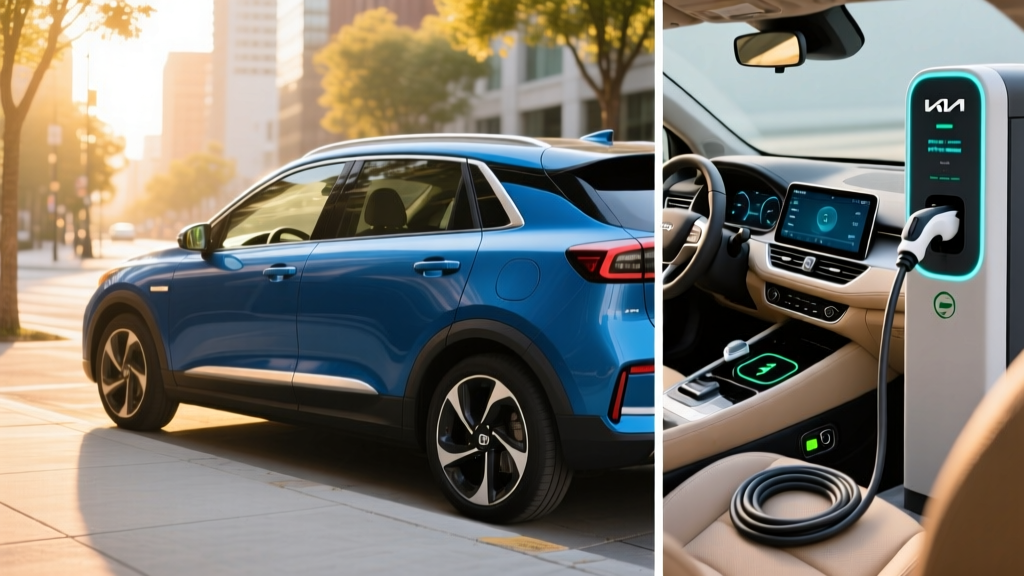
If you're researching the 2025 Niro EV, the short answer is this: it's one of the most affordable, practical compact electric crossovers on the market for buyers who can charge at home and don't regularly drive more than 200 miles in a single day. With an EPA-estimated 239 miles of range, a starting MSRP around $39,600, and a 64.8 kWh battery, it undercuts rivals like the Hyundai Ioniq 5 and Volkswagen ID.4 on price while offering strong cargo utility. However, its 85 kW peak DC fast-charging rate means road trips require more patience than in faster-charging competitors, and federal tax credit eligibility under IRS §30D rules is limited by battery-sourcing requirements. Below, we break down every number you need to decide if the 2025 Niro EV fits your driving life — or if the Niro Hybrid is the smarter buy.
Quick Verdict: 2025 Kia Niro EV
Buy it if: You want an affordable, efficient electric crossover for daily commuting and have reliable home Level 2 charging.
Skip it if: You take frequent 300+ mile road trips, lack home charging, or need the fastest DC charging available.
Key numbers: 239 mi EPA range | 64.8 kWh battery | 85 kW peak DC charge | ~$39,600 starting MSRP
Range, Battery, and Real-World Efficiency
The 2025 Kia Niro EV carries a 64.8 kWh usable lithium-ion battery pack using NMC (nickel-manganese-cobalt) chemistry. The EPA rates it at 239 miles of combined range, with an efficiency rating of 113 MPGe combined (29 kWh/100 miles). That efficiency figure is genuinely excellent for a crossover — it means the Niro EV extracts more miles per kilowatt-hour than most competitors in its class.
EPA Sticker vs. Real-World Range
EPA estimate: 239 miles
Real-world highway (70-75 mph, moderate weather): ~200–215 miles
Cold weather (below 32°F, highway): ~165–185 miles
Mild weather, city/suburban driving: 230–245 miles (regen-heavy routes can exceed EPA)
The Niro EV's heat pump (standard on all trims) helps mitigate cold-weather range loss compared to EVs without one, but expect a 20–30% reduction in freezing conditions at highway speeds. Source: fueleconomy.gov.
The 201-horsepower front-mounted motor delivers adequate acceleration — Kia quotes a 0–60 mph time of approximately 7.8 seconds. It's not a performance EV, but it merges confidently onto highways and handles city driving with the instant torque characteristic of all battery-electric vehicles.
| Spec | Value |
|---|---|
| EPA Range | 239 miles |
| Battery Capacity (usable) | 64.8 kWh (NMC) |
| Efficiency | 113 MPGe / 29 kWh/100 mi |
| Motor Output | 201 hp / 188 lb-ft torque |
| 0–60 mph | ~7.8 seconds |
| Peak DC Fast Charge Rate | 85 kW |
| 10–80% DC Charge Time | ~43 minutes |
| Level 2 (AC) Charge Rate | 11 kW |
| Level 2 0–100% Time | ~6 hours 20 minutes |
| Connector | CCS1 (NACS adapter available) |
| Starting MSRP (Wind trim) | $39,600 |
| Battery/Powertrain Warranty | 10 years / 100,000 miles |
Charging Speed: The Niro EV's Main Limitation
Here's where the 2025 Niro EV reveals its most significant compromise. Its peak DC fast-charging rate of 85 kW trails competitors substantially. The Hyundai Ioniq 5 peaks at 240 kW (on 350 kW chargers), and even the Chevrolet Equinox EV hits around 150 kW. On a long road trip, that difference matters: while an Ioniq 5 adds 200 miles in roughly 18 minutes, the Niro EV needs about 43 minutes to go from 10% to 80% state of charge.
| Charging Level | Power (kW) | Miles Added per Hour | Typical Use Case |
|---|---|---|---|
| Level 1 (120V outlet) | ~1.4 kW | ~5 mi/hr | Emergency / overnight top-off |
| Level 2 (240V home) | 11 kW | ~38 mi/hr | Daily home charging |
| DC Fast Charge | 85 kW peak | ~230 mi/hr (at peak) | Road trips (10–80% in ~43 min) |
kW vs. kWh reminder: kW (kilowatts) measures the rate of charging — like water flow from a hose. kWh (kilowatt-hours) measures the battery's capacity — like the size of the bucket. The Niro EV charges at up to 85 kW into a 64.8 kWh battery.
For home charging on a Level 2 wallbox, the 11 kW onboard charger is competitive. A full 0–100% charge takes about 6 hours and 20 minutes, meaning you'll wake up to a full battery every morning if you plug in when you get home. This is the ownership experience that makes EVs work: if you have home charging, daily range anxiety essentially disappears.
Kia equips the 2025 Niro EV with a CCS1 connector natively. A NACS adapter is available for access to Tesla Supercharger stations, though charge speeds on Superchargers will still be limited by the vehicle's 85 kW peak — you won't see the 250 kW that Tesla-native vehicles can pull.
2025 Niro EV vs. Niro Hybrid: Which Saves You More?
The Niro lineup also includes a conventional hybrid (HEV) and a plug-in hybrid (PHEV). For most buyers cross-shopping the Niro EV, the standard Niro Hybrid is the most common comparison. Here's how the numbers stack up:
| Metric | Niro EV (Wind) | Niro Hybrid (LX) |
|---|---|---|
| Starting MSRP | $39,600 | $26,940 |
| EPA Efficiency | 113 MPGe (29 kWh/100 mi) | 53 MPG combined |
| Annual Fuel/Energy Cost* | ~$600 | ~$1,100 |
| 5-Year Fuel/Energy Cost | ~$3,000 | ~$5,500 |
| Estimated Maintenance (5 yr) | ~$1,200 | ~$2,800 |
| 5-Year Total Energy + Maint. | ~$4,200 | ~$8,300 |
| 5-Year Savings (EV vs. Hybrid) | ~$4,100 in fuel + maintenance | |
| Price Premium for EV | $12,660 (before incentives) | |
*Based on 15,000 miles/year, $0.14/kWh national average electricity rate, and $3.30/gallon regular unleaded. Your actual costs depend on local rates and driving patterns. Source: fueleconomy.gov comparison tool.
The math is clear: the Niro EV saves roughly $4,100 over five years in fuel and maintenance compared to the hybrid, but costs $12,660 more upfront. Even with a potential federal tax credit (see below), the hybrid wins on pure purchase economics for most buyers. The EV makes financial sense if:
- You qualify for the full or partial §30D federal tax credit
- Your state offers additional EV rebates (check afdc.energy.gov for state incentives)
- You plan to keep the vehicle 7+ years, allowing operating savings to close the gap
- Your electricity rate is below the national average
Federal Tax Credit and Incentive Reality
The 2025 Niro EV's eligibility for the $7,500 federal EV tax credit under IRS §30D is complicated and subject to change. The credit has multiple requirements that must all be met simultaneously:
§30D Credit Requirements (2025 Tax Year)
- MSRP cap: Vehicle must have an MSRP at or below $80,000 for SUVs/crossovers — the Niro EV qualifies.
- Buyer income cap: Modified AGI must not exceed $150,000 (single) / $300,000 (joint).
- Battery sourcing: A percentage of critical minerals and battery components must be sourced from the US or free-trade-agreement countries. These thresholds increase annually and may restrict the Niro EV's credit amount.
- Point-of-sale transfer: Eligible buyers can transfer the credit to the dealer at purchase, reducing the purchase price directly.
- Final assembly: Vehicle must undergo final assembly in North America. The Niro EV is assembled in South Korea, which disqualifies it from the new-vehicle §30D credit.
Critical detail: Because the 2025 Niro EV is manufactured in Hwaseong, South Korea, it does not meet the North American final-assembly requirement for the new-vehicle §30D credit. This is a significant disadvantage versus US- or Canada-assembled competitors. Some buyers may be able to benefit from leasing the vehicle, as leased EVs can qualify for a commercial clean vehicle credit (§45W) that the leasing company may pass along as a reduced lease payment — but this is not guaranteed and varies by dealer and lessor. Always consult a tax professional and verify current rules at irs.gov.
Real-World Ownership: What First-Time EV Buyers Should Know
If the 2025 Niro EV is your first electric vehicle, here's what the ownership experience actually looks like day to day:
Home Charging Is the Foundation
Roughly 80–90% of EV charging happens at home. You'll want a Level 2 (240V) wallbox installed in your garage or driveway. Expect to pay $500–$800 for the charger (Kia doesn't include one) and $800–$2,000 for professional installation depending on whether your electrical panel needs an upgrade. If you live in an apartment or lack off-street parking, public-only charging is possible but more expensive and less convenient — factor that into your decision honestly.
Cold Weather Cuts Range — Plan for It
If you live in a region with sustained freezing temperatures, expect the Niro EV's range to drop to roughly 165–185 miles on highway drives. The standard heat pump helps, but battery chemistry inherently loses efficiency in the cold. Preconditioning the battery while plugged in (using the Kia Connect app) recovers some range and improves charging speed.
Maintenance Is Genuinely Minimal
The Niro EV has no engine oil, no spark plugs, no transmission fluid, and no exhaust system. Routine maintenance is limited to tire rotations, cabin air filter replacement, brake fluid checks, and windshield washer fluid. Regenerative braking significantly extends brake pad life — many EV owners go 80,000+ miles before needing new pads. Kia's 10-year/100,000-mile battery and powertrain warranty is among the best in the industry, covering capacity loss below 70% of original capacity.
Insurance Costs More
EV insurance premiums run 15–25% higher than equivalent gas vehicles on average, driven by higher repair costs for battery and structural damage. Get quotes from your insurer before purchasing to avoid surprises.
| Cost Category | Niro EV | Niro Hybrid |
|---|---|---|
| Purchase Price (MSRP) | $39,600 | $26,940 |
| Federal Tax Credit | $0 (assembly in S. Korea) | N/A |
| Home Charger Install | $1,500 | $0 |
| Energy/Fuel (5 years) | $3,000 | $5,500 |
| Maintenance (5 years) | $1,200 | $2,800 |
| Insurance (5 years, est.) | $9,500 | $7,800 |
| Estimated Depreciation | $18,000 | $11,500 |
| 5-Year Total (approx.) | $72,800 | $54,540 |
Depreciation estimates are approximate and vary by market conditions. Insurance estimates assume a clean-record driver in a suburban area. Actual costs will differ.
Common Misconceptions — Fact-Checked
| Myth | Fact |
|---|---|
| "The battery will need replacing in 5 years and cost $15,000." | NMC batteries in modern EVs typically retain 85–90% capacity after 100,000 miles. Kia's warranty covers you for 10 years/100,000 miles if capacity drops below 70%. Full replacements are rare and covered if within warranty. |
| "239 miles of range isn't enough." | The average American drives 37 miles per day (FHWA data). You'd need to charge roughly every 5–6 days on home charging. Range only matters for your longest regular trip. |
| "I can use any fast charger and get full speed." | The Niro EV peaks at 85 kW regardless of the charger's maximum output. A 350 kW Electrify America station won't charge it any faster than a 150 kW station. |
| "EVs are worse for the environment because of battery mining." | Lifecycle analyses consistently show EVs produce fewer total emissions than gas cars over their lifetime, even accounting for battery production — especially as grids decarbonize. The break-even point is typically 1–2 years of driving. |
| "I'll save $7,500 on taxes if I buy it." | The Niro EV's South Korean assembly disqualifies it from the new-vehicle §30D credit. Leasing may unlock a commercial credit passed through as lease savings — confirm with the dealer. |
Decision Framework: Is the 2025 Niro EV Right for You?
Choose the 2025 Niro EV if:
- You have (or can install) Level 2 home charging
- Your daily round-trip commute is under 100 miles
- You rarely drive more than 200 miles in a single day without stopping
- You want the lowest per-mile energy cost and minimal maintenance
- You value Kia's 10-year/100,000-mile powertrain warranty
- Your state offers additional EV purchase incentives that offset the price premium
Choose the 2025 Niro Hybrid instead if:
- You lack reliable home charging access (apartment, street parking)
- You regularly drive 300+ miles in a day (road trips, rural routes)
- You live in an extreme-cold climate where range loss compounds frequently
- The $12,660 price premium is a barrier and you don't qualify for offsetting incentives
- You want a simpler ownership experience with no charging logistics
Consider a faster-charging EV (Ioniq 5, Tesla Model Y) if:
- You take frequent road trips and want 10–80% charging in under 20 minutes
- You need access to the Tesla Supercharger network natively (NACS connector)
- The Niro EV's 85 kW charge rate would frustrate your travel patterns
Frequently Asked Questions
Does the 2025 Kia Niro EV qualify for the $7,500 federal tax credit?
No. The Niro EV is assembled in South Korea and does not meet the North American final-assembly requirement under IRS §30D. However, leasing may allow the lessor to claim a commercial clean vehicle credit (§45W), potentially reducing your monthly lease payment. Confirm specifics with your dealer and a tax professional. Check current rules at irs.gov.
How long does it take to charge the Niro EV at home?
On a Level 2 (240V) home charger at 11 kW, a full 0–100% charge takes approximately 6 hours and 20 minutes. Most owners plug in when they get home and wake up to a full battery. On a standard 120V outlet (Level 1), expect roughly 5 miles of range per hour of charging — usable for overnight top-offs but not practical as a primary charging method.
What is the real-world range of the Niro EV in winter?
In sustained freezing temperatures with highway driving, expect approximately 165–185 miles — a 20–30% reduction from the 239-mile EPA estimate. City driving with regenerative braking and preconditioning while plugged in helps recover some of this loss. The standard heat pump reduces cabin-heating energy draw compared to resistive heaters.
How does the Niro EV compare to the Hyundai Ioniq 5?
The Ioniq 5 offers more range (up to 303 miles EPA), dramatically faster DC charging (up to 240 kW, 10–80% in ~18 minutes), and a more spacious interior — but starts around $42,600, roughly $3,000 more. The Ioniq 5 also qualifies for the §30D tax credit (US-assembled), which can make it cheaper after incentives. If road-trip charging speed and range matter, the Ioniq 5 is the stronger EV. If budget is the priority, the Niro EV wins.
What happens if the Niro EV's battery degrades?
Kia warrants the high-voltage battery for 10 years or 100,000 miles against capacity loss below 70% of original capacity. Industry data suggests modern NMC batteries typically retain 85–92% capacity at 100,000 miles under normal use. If your battery does fall below the warranty threshold, Kia will repair or replace it at no cost. Out-of-warranty full battery replacement costs are estimated at $8,000–$14,000, though this is rarely needed within the vehicle's practical lifespan.
Can I tow with the 2025 Niro EV?
The Niro EV is not rated for towing in the US market. If you need towing capability, look at the Hyundai Ioniq 5 (up to 2,300 lbs with trailer brakes) or the Ford Mustang Mach-E.