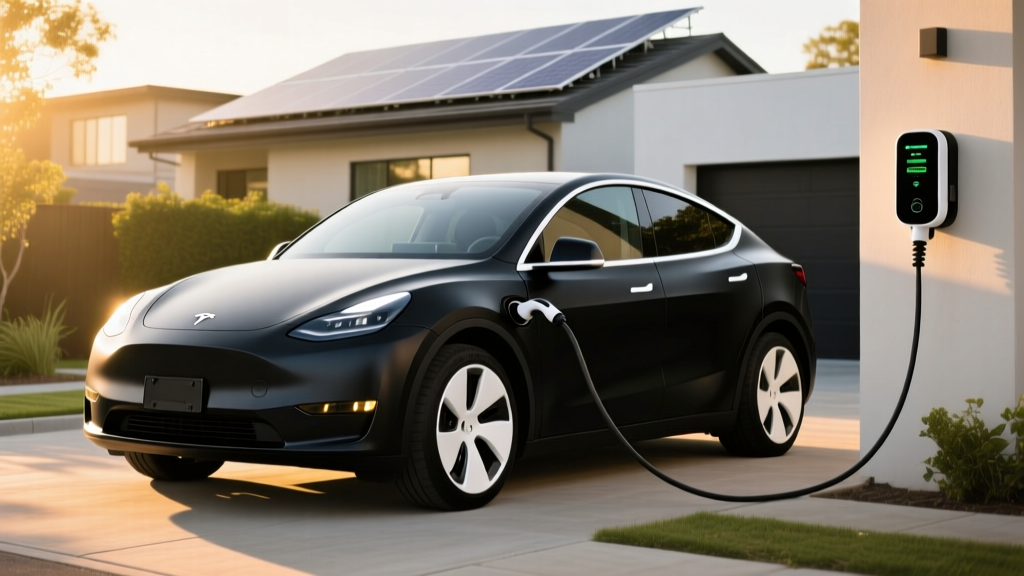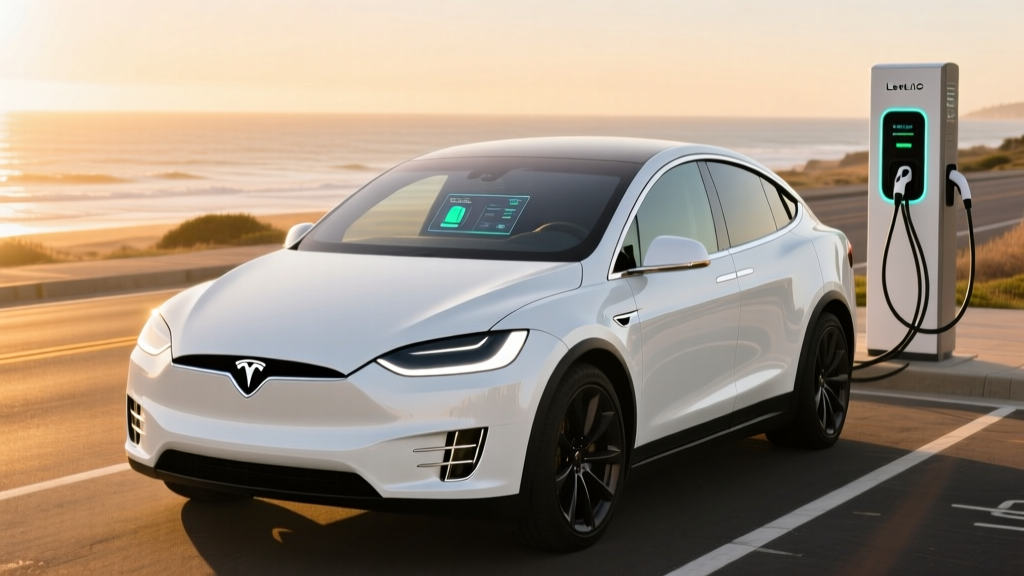
The Tesla Model X has long occupied a unique niche: a three-row electric SUV with falcon-wing rear doors, supercar-rivaling acceleration, and access to the industry's most reliable fast-charging network. For 2026, the Model X continues with incremental software and efficiency refinements rather than a ground-up redesign. If you've been searching for a Tesla white Model X — the brand's most popular no-cost exterior color — this review covers everything you need to know about real-world range, charging behavior, pricing, and whether it still holds up against a growing field of three-row electric competitors.
White remains Tesla's default Pearl White Multi-Coat, a clean aesthetic that hides minor road dust better than black and pairs well with the Model X's panoramic windshield. But paint color is the least interesting thing about this vehicle. The real question for buyers in 2026 is whether the Model X's 335-mile EPA range, 250 kW peak charging, and $79,990 starting price make it the right family hauler — or whether newer rivals offer better value.
2026 Tesla Model X: Quick Verdict
The Model X is a compelling but imperfect flagship. It offers the best DC fast-charging infrastructure access in the business (via Tesla's Supercharger network, now partially opened to NACS-equipped competitors), genuinely usable third-row seating, and performance that defies its 5,185-pound curb weight. Where it falls short: panel-gap inconsistencies that persist despite Fremont factory improvements, a yoke steering wheel that divides opinion, and a price that has climbed steadily while competitors like the Rivian R1S and Kia EV9 undercut it on value.
If you need three rows, want the fastest road-trip charging experience, and can absorb the premium, the Model X Long Range remains a strong pick. If you're budget-conscious or prioritize interior material quality, look at alternatives before signing.
Range, Battery & Efficiency
Real-World Expectation: Expect 280–305 miles on mixed highway driving at 70 mph. In cold weather (below 30°F), plan for 230–260 miles due to battery heating demands and cabin climate load. City/regenerative driving can match or slightly exceed the EPA sticker.
The 2026 Model X Long Range uses a ~100 kWh usable battery pack built on NMC (nickel manganese cobalt) chemistry. Tesla does not publish exact pack capacity, but teardown data and consumption calculations confirm approximately 100 kWh of usable energy. NMC provides higher energy density than LFP (lithium iron phosphate), which matters in a heavy three-row SUV where weight distribution and range-per-kWh are critical.
Efficiency lands at roughly 101 MPGe combined (33 kWh/100 miles) per fueleconomy.gov. That's competitive with the BMW iX xDrive50 but trails the lighter, two-row Hyundai Ioniq 5. The Model X's brick-like aerodynamic profile — despite a claimed 0.24 Cd — and 5,000+ pound mass work against it at sustained highway speeds.
| Spec | Value |
|---|---|
| EPA Range | 335 miles (20" wheels) |
| Battery (usable) | ~100 kWh, NMC |
| Efficiency | 101 MPGe / 33 kWh/100mi |
| Drivetrain | Dual Motor AWD |
| Horsepower | 670 hp |
| 0-60 mph | 3.8 seconds |
| Top Speed | 155 mph |
| Cargo (behind 3rd row) | 14.4 cu ft |
| Cargo (all seats folded) | 85.1 cu ft |
| Seating | 5, 6, or 7 passengers |
| Towing Capacity | 5,000 lbs |
| Battery Warranty | 8 years / 150,000 miles |
| Base MSRP | $79,990 |
Charging Speed: DC Fast & Home Level 2
Charging is where the Tesla ecosystem still earns its reputation. The Model X supports a peak DC fast-charge rate of 250 kW on V3 Superchargers. In controlled preconditioning (navigate to a Supercharger and the car warms the battery en route), you'll see 10–80% in approximately 30 minutes. The charge curve tapers significantly above 80%, as with all NMC packs — a 10–90% session will take closer to 45 minutes.
Sustained charge rates matter more than peak numbers. In real-world testing at 70°F ambient, the Model X holds above 200 kW from roughly 15% to 45% SoC, then gradually ramps down. This is competitive but no longer class-leading: the Hyundai Ioniq 5 and Kia EV9 with 800V architectures can sustain high rates at slightly different curve profiles, and the Lucid Gravity charges at up to 300+ kW peak.
| Charging Level | Power / Rate | Time / Miles Added |
|---|---|---|
| Level 1 (120V) | ~1.4 kW | ~3–4 miles per hour |
| Level 2 (240V / 48A Wall Connector) | 11.5 kW | ~34 miles per hour; full charge in ~10 hrs |
| DC Fast Charge (V3 Supercharger) | Peak 250 kW | 10–80% in ~30 min |
| DC Fast Charge (CCS adapter, EA/others) | Up to 150 kW typical | 10–80% in ~45 min |
At home, Tesla's Wall Connector at 48 amps delivers 11.5 kW, adding roughly 34 miles of range per hour of charging. Most owners with a daily commute of 30–50 miles will recover overnight on a standard 6–8 hour sleep cycle. Installation typically requires a 60-amp dedicated circuit; budget $800–$2,000 for professional electrical work depending on panel proximity and local permit costs.
Preconditioning matters. If you arrive at a Supercharger without the battery preheated (i.e., you didn't set the charger as your navigation destination), peak charge rates can drop to 100–150 kW in cold weather. Always navigate to the charger — the car's thermal management system will begin warming the pack miles in advance.
Performance & Driving Dynamics
The Long Range dual-motor powertrain delivers 670 horsepower and a 3.8-second 0–60 mph time. That's genuinely quick for a vehicle that can carry seven people and their cargo. The instant torque from the dual permanent-magnet motors makes highway merging and passing effortless, and the low center of gravity (battery pack under the floor) keeps body roll surprisingly controlled for an SUV of this height.
The Plaid variant (tri-motor, 1,020 hp, 2.5-second 0–60) remains available at $94,990, but it's hard to recommend on value. The Long Range already outpaces most traffic and provides the range advantage that Plaid's smaller effective battery sacrifices.
Ride quality is firm but compliant on the standard adaptive air suspension, which also enables ride-height adjustment for off-road clearance or highway aero efficiency. Steering is precise but numb — typical of Tesla's electric power steering calibration. The available yoke steering wheel looks dramatic but requires hand-over-hand adaptation for low-speed maneuvers and parking; most buyers should spec the conventional round wheel at no additional cost.
Interior, Tech & Standout Features
The Model X interior is minimalist in the extreme: a single 17-inch center touchscreen handles nearly every function, from climate control to glove-box release. A secondary 8-inch screen for rear passengers controls rear climate and entertainment. The 22-speaker audio system is genuinely excellent, rivaling premium branded systems from Burmester and Meridian.
The defining feature remains the falcon-wing rear doors. They're theatrical, they open upward in tight parking spaces (with ultrasonic sensors detecting overhead obstructions), and they make third-row access dramatically easier than any conventional SUV door. They also add weight, complexity, and occasional seal-alignment issues that Tesla has improved but not fully eliminated across model years.
Autopilot comes standard with adaptive cruise control, lane centering, and automatic emergency braking. Full Self-Driving (Supervised) is a $8,000 add-on or $99/month subscription. To be clear: FSD is an SAE Level 2 driver-assist system. It requires active driver supervision at all times and does not make the vehicle autonomous. It performs well on divided highways but remains inconsistent on surface streets with complex intersections, construction zones, and unpredictable pedestrians.
Cargo space is practical: 14.4 cubic feet behind the third row (enough for a few grocery bags or a stroller), expanding to 85.1 cubic feet with all rear seats folded. The front trunk (frunk) adds additional storage for charging cables or a small bag. Second-row captain's chairs (6-seat config) are more comfortable than the bench but reduce max passenger count.
Pricing, Trims & Federal Tax Credit
The 2026 Model X lineup is straightforward:
| Trim | MSRP | Est. After §30D Credit* |
|---|---|---|
| Long Range (Dual Motor) | $79,990 | $72,490 |
| Plaid (Tri Motor) | $94,990 | $87,490 |
*Federal tax credit estimates assume full eligibility. See rules below.
The IRS §30D federal EV tax credit can reduce your tax burden by up to $7,500, and as of 2024+, it can be transferred to the dealer at point of sale as an immediate price reduction. However, eligibility is not automatic. The Model X must clear several hurdles:
- MSRP Cap: SUVs must have an MSRP at or below $80,000. The Long Range at $79,990 qualifies; the Plaid at $94,990 does not.
- Buyer Income Cap: Adjusted gross income must not exceed $300,000 (joint filers), $225,000 (head of household), or $150,000 (individual).
- Battery Sourcing: A percentage of critical minerals and battery components must be sourced from the US or free-trade-agreement countries. Tesla's supply chain has progressively shifted to meet these requirements, but the exact credit amount ($3,750 or $7,500) depends on current-year sourcing thresholds. Check the latest eligibility at fueleconomy.gov.
Options that push the Long Range above $80,000 — such as 22-inch wheels, FSD, or special interior trims — will disqualify that specific vehicle from the credit. If the credit matters to your purchase, spec carefully and confirm eligibility with Tesla before ordering.
Pros, Cons & Who Should Buy
- 335-mile EPA range is strong for a three-row SUV
- 250 kW Supercharger access makes road trips practical
- Falcon-wing doors ease third-row access in tight spaces
- 670 hp dual-motor performance with AWD standard
- Over-the-air updates continuously add features
- 5,000-lb towing capacity covers most boat/trailer needs
- 8-year/150,000-mile battery warranty
- $79,990 starting price is steep vs. Kia EV9, Rivian R1S
- Interior materials don't match the price point
- Panel gaps and build consistency still lag German/Japanese OEMs
- Falcon-wing doors add weight and potential maintenance cost
- Plaid trim exceeds $80K MSRP cap — no tax credit
- FSD subscription adds cost without Level 3+ capability
Who this EV suits best: The Model X is ideal for families who need three rows, regularly take road trips (where Supercharger infrastructure shines), and want performance without stepping to a Porsche Cayenne E-Turbo or BMW iX M60. It's also a strong pick for Tesla ecosystem loyalists who value OTA updates, the Tesla app, and Powerwall solar integration. If your budget tops out around $60,000 or you prioritize luxury interior finishes, the Kia EV9 or a used Rivian R1S may serve you better.
Warranty & Long-Term Ownership
Tesla covers the Model X battery and drive unit for 8 years or 150,000 miles, whichever comes first, with a minimum 70% capacity retention guarantee. The basic vehicle limited warranty runs 4 years / 50,000 miles. These terms are in line with industry norms, though Hyundai and Kia offer longer basic coverage (5yr/60,000mi) and 10-year battery warranties on their EVs.
Long-term battery degradation on Tesla's NMC packs averages approximately 10–12% over 150,000 miles based on fleet data aggregated by independent researchers. Charging to 100% daily and frequent DC fast-charging accelerate degradation; Tesla recommends daily charging to 80–90% for NMC packs and reserving 100% for trips.
Insurance costs for the Model X tend to run 15–25% higher than comparable ICE SUVs due to repair costs (aluminum body, integrated battery structure) and performance classification. Get quotes before ordering.
Frequently Asked Questions
What is the real-world range of the 2026 Tesla Model X?
The EPA rates the Model X Long Range at 335 miles. In real-world highway driving at 70 mph in moderate temperatures, expect 280–305 miles. Cold weather (below 30°F) reduces this to approximately 230–260 miles. City driving with regenerative braking can approach or slightly exceed the EPA number.
How fast does the Tesla Model X charge at home and on the road?
At home on a Level 2 Tesla Wall Connector (11.5 kW), the Model X adds about 34 miles of range per hour, fully charging in roughly 10 hours. On a V3 Supercharger, it peaks at 250 kW and charges from 10–80% in approximately 30 minutes when the battery is preconditioned.
Does the Tesla Model X qualify for the $7,500 federal EV tax credit?
The Model X Long Range at $79,990 MSRP falls under the $80,000 SUV cap and can qualify for up to $7,500 under IRS §30D, provided the buyer meets income limits ($300K joint / $150K individual) and the vehicle's battery meets critical-mineral and component sourcing requirements. The Plaid at $94,990 exceeds the MSRP cap and does not qualify. Always verify current eligibility at irs.gov before purchasing.
Is the Tesla Model X worth buying vs. the Rivian R1S or Kia EV9?
It depends on priorities. The Model X wins on Supercharger access (though NACS adoption is narrowing this gap), performance (3.8s 0–60), and falcon-wing practicality. The Rivian R1S offers superior off-road capability, a more rugged build, and competitive range at a similar price. The Kia EV9 starts around $55,000, offers three rows, and qualifies more easily for the tax credit — but has slower DC charging and less range. If road-trip charging speed and Tesla's ecosystem are paramount, the Model X still earns its spot.
What are the biggest problems with the Tesla Model X?
Historically, the Model X has drawn complaints for panel-gap inconsistency, falcon-wing door sensor sensitivity, and wind noise at highway speeds. Tesla's 2025–2026 build quality has improved but still trails legacy luxury automakers. The touchscreen-only interface for basic controls (glove box, mirror adjustment, climate) frustrates some owners, and the yoke steering wheel remains polarizing.
Can the Model X tow, and how does towing affect range?
The Model X is rated to tow up to 5,000 pounds with the optional tow package. Expect range to drop by 30–50% when towing a loaded trailer at highway speeds — a common reality for all electric SUVs. Plan charging stops accordingly.
Sources: EPA fuel-economy data via fueleconomy.gov; IRS §30D clean vehicle credit rules via irs.gov; Tesla Model X specifications via tesla.com.