Quick Verdict: The Subcompact EV the US Is Still Waiting For
The 2025 Kia EV3 launched in Europe and South Korea in mid-2024 as a front-wheel-drive subcompact crossover built on a stretched version of Hyundai Motor Group's EV3 platform. It targets urban commuters who want a ~370-mile WLTP range, a practical cabin, and a sub-$40,000 price point — a combination that has made it one of the best-selling EVs on the continent. For US shoppers searching for the 2025 Kia EV3, the situation is more complicated: Kia America has not officially confirmed a US launch for the EV3, and as of early 2026, the model is not listed on Kia's US configurator or available at American dealerships.
This profile compiles everything we know from confirmed international specs, Kia's global press materials, and regulatory filings — clearly separating verified data from US-market estimates. If and when Kia America greenlights the EV3 domestically, expect trim adjustments, NACS charge-port adoption, and potential battery-sourcing changes that directly affect federal tax credit eligibility.
Range, Battery & Efficiency
The EV3 is offered globally with two battery packs. The Standard Range uses a 58.3 kWh (usable) nickel-manganese-cobalt (NMC) pack, while the Long Range steps up to an 81.4 kWh NMC battery. Both use a liquid-cooled thermal management system with a heat pump as standard on higher trims — a critical efficiency advantage in cold climates where resistive cabin heating can cut range by 25-35%.
International WLTP ratings put the Long Range EV3 at approximately 373 miles (600 km). US EPA estimates typically run 10-15% lower than WLTP. Based on the EV3's efficiency profile and comparable Hyundai Motor Group vehicles (Kona Electric, Niro EV), we project:
- Standard Range (58.3 kWh): ~230-245 miles EPA est. | Real-world highway: ~200-215 mi | Cold-weather (below 32°F): ~170-190 mi
- Long Range (81.4 kWh): ~305-325 miles EPA est. | Real-world highway: ~260-280 mi | Cold-weather (below 32°F): ~220-245 mi
Highway driving at 70+ mph and winter temperatures are the biggest range killers. Preconditioning the battery before DC fast charging — which the EV3 supports via the Kia Connect app — recovers significant charging speed and helps mitigate cold-weather range loss.
| Spec | Standard Range | Long Range |
|---|---|---|
| Battery (usable) | 58.3 kWh (NMC) | 81.4 kWh (NMC) |
| WLTP Range | ~267 mi (430 km) | ~373 mi (600 km) |
| Est. EPA Range | ~230-245 mi | ~305-325 mi |
| Motor | Single FWD | Single FWD |
| Horsepower | 201 hp (150 kW) | 201 hp (150 kW) |
| Torque | 209 lb-ft | 209 lb-ft |
| 0-62 mph (0-100 km/h) | ~7.5 sec | ~7.7 sec |
| Est. MPGe (combined) | ~120-128 MPGe | ~118-125 MPGe |
| Est. Efficiency | ~28-30 kWh/100 mi | ~27-29 kWh/100 mi |
Efficiency figures are projected from WLTP consumption data converted to US metrics. The Long Range model's slightly lower MPGe despite its larger battery reflects the added mass (~260 lbs heavier). For context, the 2025 Hyundai Kona Electric achieves 129 MPGe combined per fueleconomy.gov, and the EV3 should land in the same neighborhood.
Charging Speed: DC Fast & Home Level 2
Charging performance is where the EV3's platform maturity shows. Kia quotes a 10-80% DC fast-charge time of approximately 31 minutes for the Long Range model under optimal conditions, with a peak charge rate around 150 kW. The Standard Range pack peaks closer to 120 kW. These figures assume battery preconditioning is active and ambient temperatures are moderate (above 50°F).
| Charging Level | Power / Rate | Est. Time / Miles Added |
|---|---|---|
| Level 1 (120V household) | ~1.4 kW | ~4-5 mi/hr | Full charge: 40-60+ hrs |
| Level 2 (240V home/public) | ~11 kW (onboard charger) | ~30-38 mi/hr | 10-100%: ~8-9 hrs (Long Range) |
| DC Fast Charge (CCS/NACS) | Peak ~150 kW (Long Range) | 10-80%: ~31 min | ~140 mi in 15 min |
| DC Fast Charge (Standard Range) | Peak ~120 kW | 10-80%: ~29 min | ~110 mi in 15 min |
Charging curve reality check: Peak kW is not sustained kW. The EV3 will hit its maximum charge rate only in the 10-40% state-of-charge window, then progressively taper. Expect average charging power of roughly 95-110 kW across the full 10-80% session on the Long Range model. This is typical for 400-volt architecture — vehicles on 800V platforms (Hyundai Ioniq 5, Kia EV6) sustain higher rates longer and achieve faster overall charge times.
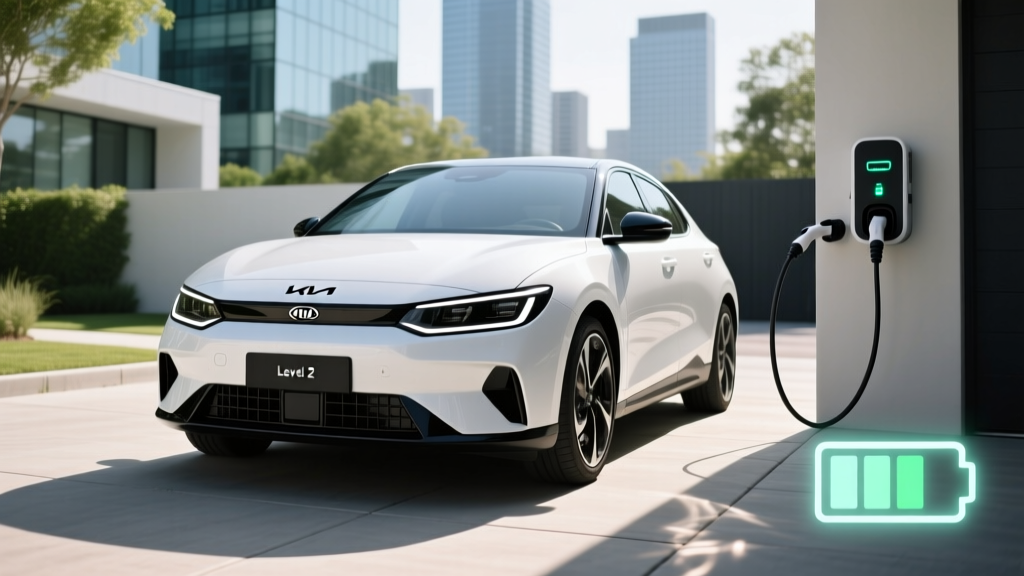
For US models, Kia will almost certainly adopt the NACS (Tesla) charge port as the standard connector, in line with Hyundai Motor Group's commitment to transition to NACS across all new models. CCS1 adapters will be available for legacy Electrify America and other CCS-equipped stations. Home Level 2 charging on a 48-amp circuit (hardwired, requiring a 60-amp breaker) will replenish the Long Range battery overnight — a practical setup for most owners.
Performance, Drivetrain & Ride
The EV3 is strictly a front-wheel-drive, single-motor vehicle. There is no dual-motor AWD variant — a deliberate choice to maximize efficiency and keep the price down. The 201 hp (150 kW) permanent-magnet synchronous motor delivers adequate acceleration for a subcompact crossover: 0-62 mph in roughly 7.5 seconds, which translates to a 0-60 mph time of approximately 7.2-7.4 seconds. That's competitive with the Chevrolet Equinox EV FWD (~7.3 sec) but trails the Hyundai Kona Electric (~6.8 sec in its latest generation).
Top speed is electronically limited to approximately 106 mph (170 km/h). Regenerative braking offers multiple levels selectable via steering-wheel paddles, including a full one-pedal driving mode (i-PEDAL) that brings the EV3 to a complete stop without touching the brake pedal. The suspension tuning favors comfort over sportiness — expect a compliant ride on rough urban roads with moderate body lean in corners, consistent with the EV3's commuter-oriented positioning.
Pricing, Trims & Federal Tax Credit Eligibility
In Europe, the EV3 Long Range starts around €43,000 (~$46,500 USD), with incentives bringing effective prices significantly lower. Kia America has not published US pricing, but based on Kia's historical US-market pricing strategy and competitive positioning against the Chevrolet Equinox EV (~$33,600 base), Hyundai Kona Electric (~$32,975), and Volvo EX30 (~$36,245), a reasonable estimate places the US-spec EV3 between $32,000 and $42,000 depending on battery and trim.
| Trim (Projected) | Est. MSRP | Est. After §30D Credit* |
|---|---|---|
| Light (Standard Range) | ~$32,000-$34,000 | ~$24,500-$26,500 |
| Wind (Long Range) | ~$37,000-$39,000 | ~$29,500-$31,500 |
| GT-Line (Long Range) | ~$40,000-$42,000 | ~$32,500-$34,500 |
*Federal tax credit (§30D) caveats: The $7,500 credit is not guaranteed for the EV3. Per IRS guidelines, eligibility depends on three factors that are especially uncertain for a model not yet confirmed for the US market:
- MSRP cap: SUVs/crossovers must be priced at or below $80,000. The EV3 easily clears this hurdle.
- Buyer income cap: Modified AGI must not exceed $150,000 (single), $225,000 (head of household), or $300,000 (joint). Buyers above these thresholds are ineligible regardless of the vehicle.
- Battery sourcing & critical minerals: A percentage of battery components must be manufactured or assembled in North America, and critical minerals must be sourced from the US or free-trade-agreement countries. These thresholds increase annually. If Kia sources EV3 battery cells from South Korean or Chinese suppliers that don't meet the evolving thresholds, the credit could be reduced to $3,750 (minerals only or components only) or eliminated entirely.
The point-of-sale transfer option allows eligible buyers to apply the credit as an instant dealer discount rather than waiting for a tax refund. Always verify current-year eligibility on the IRS Clean Vehicle Credit page and consult a tax professional before making a purchase decision based on credit assumptions.
Interior, Cargo & Technology
The EV3's cabin punches above its subcompact weight class. Rear-seat legroom measures approximately 38.2 inches — genuinely comfortable for adults on longer trips and competitive with the Nissan Ariya. Cargo volume behind the rear seats is estimated at 17.7 cubic feet, expanding to roughly 48-50 cubic feet with the 60/40 rear seats folded. A modest front trunk (frunk) adds approximately 1.0-1.5 cubic feet for charging cables or small items.
The dashboard features a widescreen dual-display layout: a 12.3-inch digital instrument cluster and a 12.3-inch touchscreen infotainment system running Kia's latest Connect interface with wireless Apple CarPlay and Android Auto. A separate 5.3-inch climate-control touch panel sits below the main screen. Higher trims include a head-up display with augmented-reality navigation overlays, a Harman Kardon premium audio system, and vehicle-to-load (V2L) capability that can power external devices at up to 3.6 kW through an interior outlet or exterior adapter — useful for camping or emergency backup power.
Driver-assistance technology includes Kia's Highway Driving Assist 2 (HDA2), which combines adaptive cruise control with lane-centering steering on divided highways. This is a SAE Level 2 system: the driver must remain engaged, hands on or near the wheel, and eyes on the road at all times. It is not autonomous driving. Additional ADAS features include forward collision-avoidance assist, blind-spot collision-avoidance assist, rear cross-traffic collision-avoidance assist, and intelligent speed-limit assist. Remote Smart Parking Assist on GT-Line trims allows the EV3 to park and unpark itself via key fob in tight spaces — a genuinely useful feature in urban environments.
- Projected 300+ mile EPA range (Long Range) at a sub-$40K price point
- Spacious rear seat and cargo area for the subcompact segment
- Heat pump standard on upper trims — preserves winter range
- V2L capability for external power (camping, emergencies)
- Comprehensive ADAS suite (HDA2) included, not paywalled
- One-pedal driving with multiple regen levels
- Not yet confirmed for US sale — availability uncertain
- FWD only — no AWD option for snow-belt buyers
- 400V architecture limits peak DC fast-charge speed vs 800V rivals
- Federal tax credit eligibility uncertain due to battery-sourcing rules
- ~7.5-sec 0-60 mph is adequate, not quick
- European-spec features may change for US homologation
Warranty & Ownership Costs
Kia's US warranty coverage is among the best in the industry, and the EV3 should carry the same structure as other Kia EVs:
- Limited vehicle warranty: 5 years / 60,000 miles
- Powertrain warranty: 10 years / 100,000 miles
- EV battery warranty: 10 years / 100,000 miles (covers capacity loss below 70% state of health)
- Roadside assistance: 5 years / 60,000 miles
The 70% capacity-retention threshold is standard across Hyundai Motor Group. Real-world degradation data from Kia EV6 and Niro EV owners suggests NMC packs in this family lose roughly 5-8% capacity over the first 100,000 miles under normal use — well within the warranty floor. Insurance premiums for subcompact EVs tend to run 10-20% higher than equivalent ICE vehicles due to repair-cost structures; expect annual premiums in the $1,400-$2,000 range depending on state and driving record.
Who the 2025 Kia EV3 Is For — And Who Should Look Elsewhere
Choose the EV3 (if it reaches the US) if:
- You're an urban or suburban commuter who needs 250-320 miles of real range at an affordable price
- You want a compact crossover with genuine rear-seat usability, not just a hatchback
- You charge primarily at home (Level 2 overnight) and take occasional road trips under 300 miles
- You value Kia's 10-year battery/powertrain warranty as long-term peace of mind
Look elsewhere if:
- You need AWD for heavy snow or mountain driving (consider the Hyundai Ioniq 5 AWD or Subaru Solterra)
- You regularly tow — the EV3 is not rated for significant towing capacity
- You need the fastest possible DC charging — 800V vehicles like the Kia EV6 or Hyundai Ioniq 5 charge 20-30% faster in real-world conditions
- You need a vehicle now — the EV3's US availability remains unconfirmed
Frequently Asked Questions
Is the 2025 Kia EV3 available to buy in the United States?
As of early 2026, Kia America has not officially launched the EV3 in the US market. The model is on sale in Europe, South Korea, and select other markets. Industry reports suggest a US introduction is possible for the 2026 or 2027 model year, but no formal announcement has been made. Check Kia's US website for updates.
What is the real-world range of the Kia EV3 Long Range?
The WLTP-rated range is approximately 373 miles. For US driving conditions — which include higher highway speeds and different test cycles — expect an EPA estimate of roughly 305-325 miles. In real-world highway driving at 70 mph, plan for 260-280 miles. In cold weather (below 32°F), range may drop to 220-245 miles unless the battery is preconditioned and the heat pump is active.
How fast does the Kia EV3 charge at home and on the road?
On a Level 2 home charger (240V, ~11 kW), the Long Range EV3 adds roughly 30-38 miles of range per hour, achieving a full charge in about 8-9 hours. On a DC fast charger, it peaks at approximately 150 kW and charges from 10-80% in roughly 31 minutes under optimal conditions. The 400-volt architecture means the charge rate tapers noticeably above 60% state of charge.
Will the Kia EV3 qualify for the $7,500 federal EV tax credit?
This is uncertain. The EV3's MSRP will be well below the $80,000 SUV cap, but eligibility under IRS §30D also requires compliance with battery-component manufacturing and critical-mineral sourcing thresholds that tighten each year. If Kia sources battery cells from facilities that don't meet North American content requirements, the credit could be reduced or unavailable. Always check the latest IRS Clean Vehicle Credit guidance for the specific model year and VIN before purchasing.
How does the Kia EV3 compare to the Chevrolet Equinox EV and Hyundai Kona Electric?
The EV3 slots between these two in size and price. The Equinox EV offers a longer EPA range (up to 319 miles) and available AWD but starts slightly higher. The Kona Electric is a closer sibling (same corporate platform), with similar range and a confirmed US presence. The EV3's advantage, if it arrives, would be Kia's 10-year warranty and potentially more aggressive pricing. The disadvantage is the wait — both competitors are available now.
Does the Kia EV3 have a frunk?
Yes, but it's small. Expect approximately 1.0-1.5 cubic feet of front-trunk space — enough for a charging cable bag or small emergency kit, but not a meaningful cargo area. The rear cargo floor at 17.7 cubic feet (seats up) is where the real storage happens.