Quick Verdict: The Electric Microbus Grows Up
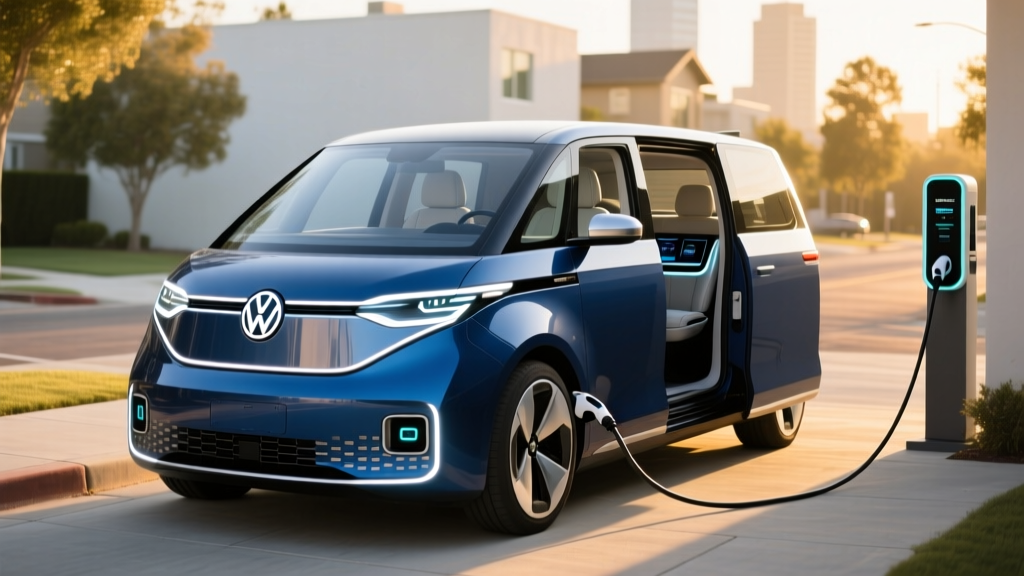
The 2025 Volkswagen ID. Buzz channels 1960s microbus nostalgia into a thoroughly modern three-row electric van. Underneath the retro two-tone paint sits VW's MEB platform with a 91 kWh (usable) NMC battery, rear- or all-wheel-drive layouts, and DC fast charging that peaks at 170 kW. It's the only three-row electric passenger van sold in the United States, which gives it a monopoly on a very specific buyer: families who need seven seats, cargo volume, and zero tailpipe emissions.
But nostalgia only carries you so far. With an EPA-estimated range topping out at 234 miles for the rear-wheel-drive model and a starting MSRP above $59,000, the ID. Buzz has to earn its keep on specs alone. We spent time with the numbers, the charging curves, and the real-world trade-offs so you don't have to guess.
2025 VW ID. Buzz: Core Specifications
| Spec | RWD (Pro S) | AWD (Pro S Plus) |
|---|---|---|
| Drivetrain | Rear-Wheel Drive (single motor) | All-Wheel Drive (dual motor) |
| Horsepower | 282 hp | 335 hp |
| Torque | 406 lb-ft | 406 lb-ft (front) + 406 lb-ft (rear combined system) |
| 0-60 mph | ~7.9 seconds | ~5.9 seconds |
| Battery (usable) | 91 kWh NMC | 91 kWh NMC |
| EPA Range | 234 miles | 217 miles |
| MPGe (combined) | 90 MPGe | 84 MPGe |
| Efficiency | ~37 kWh/100 mi | ~40 kWh/100 mi |
| Max DC Charge Rate | 170 kW | 170 kW |
| 10-80% DC Time | ~26 minutes | ~26 minutes |
| Level 2 Charge Rate | 11 kW (AC) | 11 kW (AC) |
| Base MSRP | $59,995 | $69,995 |
| Battery Warranty | 8 yr / 100,000 mi | 8 yr / 100,000 mi |
Sources: fueleconomy.gov, VW USA
VW ID. Buzz 0-60 and Performance: Adequate, Not Athletic
Let's address the keyword in the room: the VW ID. Buzz 0-60 time. The rear-wheel-drive Pro S hits 60 mph in approximately 7.9 seconds. That's leisurely by modern EV standards — a Tesla Model Y Long Range does it in under 5 seconds — but it's perfectly in line with the ID. Buzz's mission. This is a family hauler, not a performance SUV.
The AWD Pro S Plus model, with its dual-motor setup producing 335 hp, drops the 0-60 time to roughly 5.9 seconds. That's a meaningful improvement for merging onto fast-moving highways or climbing mountain passes with a full load of passengers and cargo. In real-world driving, both powertrains deliver the instant low-end torque that makes EVs feel responsive around town, even if the stopwatch numbers aren't eye-popping.
The MEB platform's low center of gravity keeps body roll reasonable for a tall van, but don't expect sports-SUV handling. The steering is light and numb, and the suspension prioritizes comfort over corner-carving. At highway speeds above 75 mph, wind noise from the large, flat windshield becomes noticeable — a trade-off of the upright, aerodynamically challenged silhouette.
Real-World Range vs. EPA Estimates
RWD EPA: 234 miles | AWD EPA: 217 miles
Real-world highway (70-80 mph): Expect 185-210 miles (RWD) and 170-195 miles (AWD). The ID. Buzz's boxy shape creates significant aerodynamic drag at speed, cutting efficiency by 15-20% versus mixed driving.
Cold-weather (below 32°F): Plan for 155-180 miles. The large cabin volume demands significant energy for heating, and NMC batteries lose efficiency in extreme cold even with the standard heat pump.
Best-case city/mild weather: 240-255 miles (RWD) with frequent regenerative braking opportunities.
The 91 kWh usable battery capacity is generous, but the ID. Buzz is a heavy vehicle (curb weight exceeds 5,700 lbs for the AWD model) pushing a large frontal area through the air. Efficiency of 37-40 kWh per 100 miles means you'll consume energy faster than sleeker crossovers like the Hyundai Ioniq 5 or Tesla Model Y. For daily commuting under 80 miles round-trip, range is a non-issue. For road trips exceeding 200 miles between charging stops, you'll need to plan carefully — especially in winter or at sustained highway speeds.
Charging Speed: DC Fast, Level 2, and the Charge Curve
The ID. Buzz supports DC fast charging at up to 170 kW via its CCS connector (NACS adapter access to Tesla Superchargers is available through VW's partnership). Here's what the charging profile actually looks like:
| Charging Level | Power | Speed / Time | Notes |
|---|---|---|---|
| Level 1 (120V household) | ~1.4 kW | ~3-4 miles per hour | Emergency/trickle only; full charge in 60+ hours |
| Level 2 (240V home/public) | 11 kW (max) | ~22-25 miles per hour; full 0-100% in ~9 hours | Requires a 48-amp or higher Level 2 station for peak rate |
| DC Fast Charge | Up to 170 kW (peak) | 10-80% in ~26 minutes | Peak rate sustained to ~35% SoC, then tapers; 50-80% is slower (~40-60 kW average) |
Understanding the charge curve: The 170 kW peak is achieved at low states of charge (10-35%) and with a preconditioned battery. As the battery fills past 50%, the charge rate tapers significantly — a physics-driven reality of lithium-ion charging, not a VW-specific limitation. If you arrive at a DC fast charger at 50% SoC instead of 10%, your average charge rate will be much lower, and a 50-80% top-up may take 18-22 minutes instead of the headline 26-minute figure for 10-80%.
For home charging, the 11 kW onboard charger is competitive. On a 48-amp Level 2 station (such as a ChargePoint Home Flex or Wallbox Pulsar Plus hardwired on a 60-amp circuit), you'll add roughly 25 miles of range per hour. An overnight charge from 20% to 100% takes about 7-8 hours — perfectly suited for daily replenishment. Note that the ID. Buzz uses a CCS1 connector natively; a NACS-to-CCS adapter is required for Tesla Supercharger access, and VW has confirmed compatibility with the Tesla network.
Pricing, Trims, and Federal Tax Credit Eligibility
The 2025 ID. Buzz is offered in three trims for the US market:
| Trim | Drivetrain | MSRP | Key Features |
|---|---|---|---|
| Pro S | RWD | $59,995 | 91 kWh battery, 12.9" infotainment, heated front seats, IQ.DRIVE assists |
| Pro S Plus | RWD or AWD | $64,995 (RWD) / $69,995 (AWD) | Panoramic fixed glass roof, power-folding third row, Harman Kardon audio, 360° camera |
| 1st Edition | AWD | $72,995 | Limited-run launch edition, exclusive two-tone colors, unique interior trim, all Pro S Plus features |
Federal tax credit (§30D) — the hard truth: As of 2025, the ID. Buzz does not qualify for the full $7,500 federal EV tax credit. Under current IRS rules, the credit is split into two $3,750 halves — one for battery-component sourcing and one for critical-mineral sourcing. The ID. Buzz's battery supply chain does not currently meet the critical-minerals requirement, making it eligible for at most $3,750 (battery components) and potentially $0 depending on annual IRS guidance updates. Buyers must also meet income caps ($150,000 single / $300,000 joint for new EVs) and the vehicle must be under the $80,000 MSRP cap for vans/SUVs.
- Buyer AGI: ≤$150K single, ≤$225K head of household, ≤$300K joint filers
- Vehicle MSRP cap: ≤$80,000 (vans/SUVs/pickups)
- Battery component sourcing: must be manufactured/assembled in North America ($3,750)
- Critical minerals sourcing: must be extracted/processed in US or FTA-partner country ($3,750)
- Point-of-sale transfer: eligible buyers can transfer credit to dealer for instant discount
Verify current eligibility at fueleconomy.gov and consult a tax professional. Rules change annually. Source: IRS.gov
Interior, Cargo, and Technology
The ID. Buzz's cabin is its strongest selling point. The flat floor and upright walls maximize interior volume in ways no crossover can match:
- Passenger capacity: 7 seats (2 front / 3 second row / 2 third row)
- Cargo behind third row: 18.6 cu ft
- Cargo behind second row (third row folded): ~58 cu ft
- Max cargo (second and third rows folded): ~112 cu ft
- Second-row legroom: ~37.4 inches
- Third-row legroom: ~33.5 inches
The second-row bench slides fore and aft, allowing you to prioritize either legroom or cargo space. The available power-folding third row (Pro S Plus and above) is a practical upgrade — manually folding the third row in a vehicle this size is a two-person job.
Infotainment: A 12.9-inch touchscreen runs VW's ID. Software 4.0, which is a significant improvement over the laggy, buggy ID.4 launch software. Wireless Apple CarPlay and Android Auto are standard. A 5.3-inch digital driver display sits behind the steering wheel. The available Harman Kardon 9-speaker system is a worthwhile upgrade for audio quality.
Driver Assistance (IQ.DRIVE): Standard features include adaptive cruise control with stop-and-go, lane-keeping assist, automatic emergency braking with pedestrian detection, blind-spot monitoring, and rear cross-traffic alert. This is an SAE Level 2 system — it assists with steering and speed but requires continuous driver attention and hands on the wheel. It is not autonomous driving.
Notable drawbacks: The ID. Buzz lacks a front trunk (frunk) — the space under the hood houses HVAC and electronics. There is no tow rating published for the US market (European models are rated for ~2,200 lbs, but VW has not certified US towing). The second-row windows do not open (they're fixed pop-outs), which limits cross-ventilation. Rear visibility is compromised by the thick D-pillars, making the 360-degree camera nearly essential.
Who Should Buy the VW ID. Buzz?
- You need genuine 7-passenger seating with usable third-row space for adults on shorter trips
- You want a distinctive, conversation-starting design that stands apart from the crossover crowd
- Your daily commute is under 100 miles round-trip, with home Level 2 charging available
- You value cargo versatility — the van-style box beats every SUV for loading bulky items
- You're drawn to the microbus heritage and want the modern electric equivalent
- You need 300+ miles of range for frequent long road trips (consider the Rivian R1S or Tesla Model X)
- You need a tow-rated vehicle for trailers or boats
- Budget is a primary concern — the Kia EV9 starts ~$5,000 less and offers similar 3-row seating
- You want cutting-edge performance or autonomous-driving features
Competitor Comparison
| Vehicle | EPA Range | Seats | 0-60 mph | Starting MSRP | Max DC Charge |
|---|---|---|---|---|---|
| 2025 VW ID. Buzz (RWD) | 234 mi | 7 | ~7.9 sec | $59,995 | 170 kW |
| 2025 Kia EV9 (RWD LR) | 304 mi | 6-7 | ~8.0 sec | $54,900 | 236 kW |
| 2025 Rivian R1S (Dual Motor) | ~340 mi (Max Pack) | 7 | ~4.5 sec | $75,900 | 220 kW |
| 2025 Tesla Model X (LR) | 335 mi | 5-7 | ~3.8 sec | $79,990 | 250 kW |
The Kia EV9 is the ID. Buzz's most direct competitor — it's cheaper, goes farther, and charges faster. But it looks like an SUV and drives like an SUV. The ID. Buzz offers something the EV9 cannot: van-level interior volume, a flat load floor, and the emotional appeal of the microbus legacy. If you're shopping with a spreadsheet, the EV9 wins on numbers. If you're shopping with your heart and your cargo needs, the Buzz has no equal.
Pros, Cons, and Final Take
- Unique retro-modern design with strong curb appeal
- Spacious 7-seat interior with van-level cargo versatility
- Comfortable, quiet ride quality
- Improved ID. Software 4.0 infotainment
- Standard IQ.DRIVE Level 2 driver assists
- 8-year/100,000-mile battery warranty
- Below-average EPA range (234 mi max) for the price
- Highway and cold-weather range drops are significant
- No federal tax credit (or partial at best) under current §30D rules
- No frunk, no published US tow rating
- 170 kW DC peak is outpaced by competitors (EV9 at 236 kW)
- Fixed rear windows; poor rear visibility without 360° camera
- High starting MSRP vs. the Kia EV9
The 2025 VW ID. Buzz is a niche vehicle that executes its niche brilliantly. If you need a three-row electric van with character, interior space that embarrasses every SUV in its class, and the practicality of home Level 2 charging for daily use, there is literally nothing else on the US market. But at $60,000+ with limited range, middling charge speeds, and uncertain tax-credit eligibility, it demands a buyer who values space and style over efficiency and value. It's not the smartest EV purchase on paper — but it might be the most enjoyable one.
Frequently Asked Questions
What is the real-world range of the VW ID. Buzz?
The EPA rates the RWD model at 234 miles and the AWD at 217 miles. In real-world highway driving at 70-80 mph, expect 185-210 miles (RWD) or 170-195 miles (AWD). In freezing temperatures, range can drop to 155-180 miles due to cabin heating demands and reduced battery efficiency. For mixed city/suburban driving in mild weather, owners report achieving close to or slightly above EPA estimates thanks to regenerative braking.
How fast does the VW ID. Buzz charge at home and on the road?
On DC fast chargers, the ID. Buzz peaks at 170 kW and can charge from 10-80% in approximately 26 minutes, though the charge rate tapers significantly above 50% SoC. At home on a 48-amp Level 2 station (240V), the 11 kW onboard charger adds roughly 22-25 miles of range per hour, with a full 0-100% charge taking about 9 hours. Level 1 (120V) charging is impractical for daily use at only 3-4 miles per hour.
Does the VW ID. Buzz qualify for the $7,500 federal EV tax credit?
As of 2025, the ID. Buzz does not qualify for the full $7,500 §30D credit. Its battery supply chain partially meets the battery-component sourcing requirement (potentially $3,750) but does not meet the critical-minerals requirement. Buyers must also fall under IRS income caps ($300K joint / $150K single) and the vehicle must be under the $80K MSRP cap for vans. Always verify current eligibility at fueleconomy.gov and consult a tax professional before purchasing.
Is the VW ID. Buzz worth buying over the Kia EV9?
It depends on your priorities. The Kia EV9 offers more range (304 mi vs. 234 mi), faster DC charging (236 kW vs. 170 kW), a lower starting price (~$54,900 vs. $59,995), and currently qualifies for the full $7,500 tax credit. If you're optimizing for value and efficiency, the EV9 is the rational choice. If you need maximum interior volume, prefer the van form factor, or simply love the microbus design, the ID. Buzz offers an experience the EV9 cannot replicate.
What is the VW ID. Buzz battery warranty?
Volkswagen covers the ID. Buzz battery with an 8-year / 100,000-mile warranty (whichever comes first) against defects and capacity loss below 70% of original capacity. The general vehicle warranty is 4 years / 50,000 miles. This is competitive with the industry standard for EV battery coverage.
Can the VW ID. Buzz tow a trailer?
Volkswagen has not published an official US tow rating for the ID. Buzz. European-spec models are rated for approximately 2,200 lbs (1,000 kg braked), but this has not been certified for the US market. If towing is a requirement, consider the Rivian R1S (rated up to 7,700 lbs) or the Tesla Model X (rated up to 5,000 lbs).