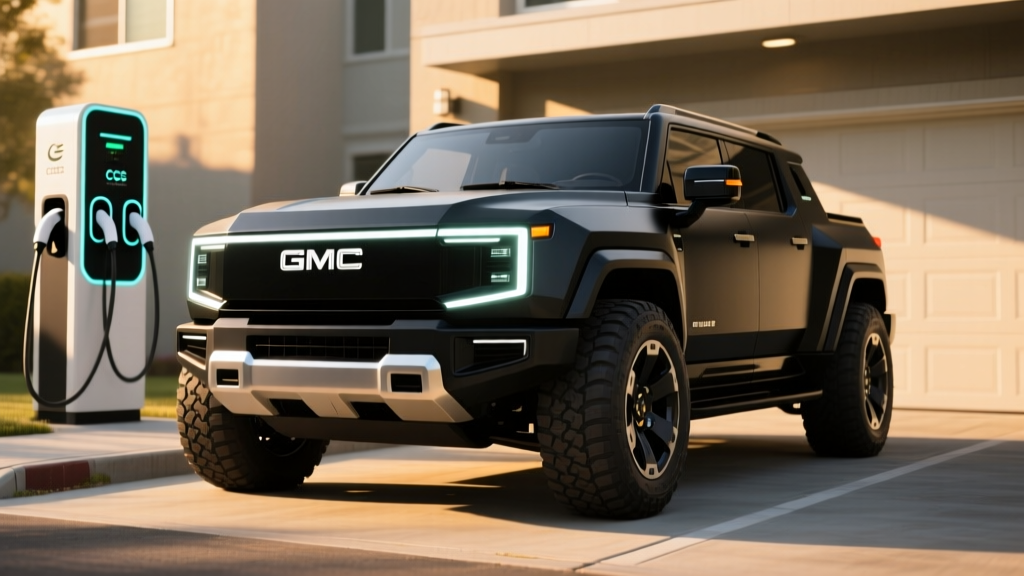
The GMC Hummer EV remains one of the most polarizing vehicles on the road — a 9,000-pound electric supertruck that pairs absurd performance with genuine off-road capability. For 2025, GMC has streamlined the lineup and expanded availability beyond early reservation holders, making this the first model year where most buyers can actually walk into a dealership and drive one home. But does a vehicle this massive make sense as a daily-driver EV? We break down every spec that matters.
2025 Hummer EV at a Glance: Core Specifications
| Spec | Pickup (3X) | SUV (3X) |
|---|---|---|
| EPA Range | 314 miles | 314 miles |
| Battery (usable) | ~212 kWh, NMC (Ultium) | ~212 kWh, NMC (Ultium) |
| Horsepower | 830 hp (up to 1,000 hp w/Watts to Freedom) | 830 hp |
| 0-60 mph | ~3.0 sec (WTF mode) | ~3.5 sec |
| Drivetrain | Tri-motor AWD (e4WD) | Tri-motor AWD (e4WD) |
| Max DC Fast Charge | 350 kW (peak) | 350 kW (peak) |
| 10-80% DCFC Time | ~35 minutes (est.) | ~35 minutes (est.) |
| Level 2 Home Charge | 11.5 kW (~25 mi/hr) | 11.5 kW (~25 mi/hr) |
| Efficiency (MPGe) | 47 MPGe combined | 47 MPGe combined |
| Base MSRP (2X) | $98,845 | $106,395 |
| As-Tested (3X w/ Infinity Roof) | ~$119,000+ | ~$125,000+ |
| Battery/Powertrain Warranty | 8 yr / 100,000 mi | 8 yr / 100,000 mi |
Range and Efficiency: The Real-World Truth
The EPA rates the 2025 Hummer EV Pickup and SUV at 314 miles on a full charge when equipped with the 3X tri-motor powertrain and the standard 24-module Ultium battery pack. That number sounds respectable — until you consider the 212 kWh (usable) battery required to achieve it. For context, that's roughly twice the capacity of a Tesla Model Y Long Range, delivering only about 15% more range.
- EPA Sticker: 314 miles (3X Pickup/SUV)
- Highway (70-75 mph, moderate climate): ~240-265 miles
- Cold Weather (below 32°F, highway): ~200-230 miles (30-35% reduction typical for a pack this size without aggressive preconditioning)
- City/Mixed (regenerative braking advantage): ~280-300 miles
- Off-Road/Low-Speed Crawling: Range drops unpredictably; plan for ~220-250 miles equivalent
Efficiency lands at approximately 47 MPGe combined (per fueleconomy.gov), translating to roughly 72 kWh per 100 miles. That's among the least efficient EVs sold new — physics doesn't forgive 9,000+ pounds of curb weight and a brick-like frontal area.
The 2X dual-motor variant (available on the Pickup) trades some range — EPA-estimated around 300 miles — for a lower starting price. If maximum range is your priority, the 3X with its additional motor doesn't actually help; it's the battery pack size and driving conditions that dictate your real distance.
Charging Speed: 350 kW Peak, But Mind the Curve
GMC equips the Hummer EV with an 800-volt electrical architecture, enabling a peak DC fast-charge rate of 350 kW at compatible stations. On paper, that's class-leading. In practice, the charge curve tells a more nuanced story.
| Charging Level | Power / Rate | Miles Added per Hour | Notes |
|---|---|---|---|
| Level 1 (120V) | ~1.4 kW | ~2 mi/hr | Emergency/trickle only; full charge in 6+ days |
| Level 2 (240V, 48A) | 11.5 kW | ~25 mi/hr | Full charge in ~18-20 hours; overnight practical |
| DC Fast (peak) | 350 kW | N/A (curve-dependent) | Only at 800V stations; sustained rate lower |
| DC Fast (10-80%) | Avg ~180-200 kW sustained | N/A | ~35 minutes on a 350 kW charger |
| DC Fast (80-100%) | Significantly tapered | N/A | Add 30+ additional minutes; avoid unless needed |
Here's what most spec sheets won't tell you: a 350 kW peak on a 212 kWh battery doesn't mean you're sustaining 350 kW for long. The Hummer EV's charge curve peaks early (typically between 10-30% state of charge) and tapers progressively. Expect an average sustained rate closer to 180-200 kW across the 10-80% window, yielding roughly 35 minutes at a properly equipped Electrify America or EVgo 350 kW station.
At a more common 150 kW DC fast charger — still the majority of public infrastructure — expect 10-80% in roughly 55-65 minutes. Battery preconditioning is critical: navigate to a fast charger using the built-in navigation, and the Hummer EV will warm the pack to optimize charge acceptance. Skip this step in cold weather, and your charge times will stretch considerably.
Home charging on a Level 2, 240V/48A circuit (the recommended setup for any EV with a pack this large) delivers about 25 miles of range per hour. A full overnight charge from 20% to 100% takes roughly 14-16 hours. Most owners will charge from 20-80% overnight, which takes about 10-11 hours and is perfectly practical for daily use if you're not draining the full pack regularly.
Performance: Watts to Freedom and Tri-Motor Muscle
The 2025 Hummer EV 3X uses a tri-motor configuration — one motor on the front axle and two on the rear — producing 830 horsepower and an estimated 1,200 lb-ft of torque in standard driving modes. Engage Watts to Freedom (WTF) launch mode, and output rises to an estimated 1,000 horsepower, dropping the 0-60 mph time to approximately 3.0 seconds in the Pickup. The heavier SUV runs the sprint in roughly 3.5 seconds.
Those numbers are staggering for a vehicle with the footprint of a small studio apartment. The e4WD system provides torque vectoring across the rear axle, and the available CrabWalk feature (four-wheel steering that angles all wheels in the same direction) lets the Hummer EV move diagonally — genuinely useful on tight off-road trails.
Additional off-road hardware includes:
- Adaptive Air Ride suspension with up to 16 inches of ground clearance in Extract Mode
- Underbody armor and skid plates across the full length
- 35-inch all-terrain tires (37-inch available)
- Front and rear electronic locking differentials (eLocker)
- Up to 11,500 lbs towing capacity (Pickup)
On pavement, the Hummer EV rides surprisingly well for its mass — the air suspension soaks up imperfections, and the instant torque makes merging and passing effortless. But make no mistake: you feel the weight in corners and during hard braking. This is a straight-line bruiser and off-road specialist, not a canyon carver.
Pricing, Trims, and Federal Tax Credit Eligibility
GMC simplified the 2025 Hummer EV lineup compared to the chaotic early-Edition 1 reservation era. Here's where pricing stands:
| Trim / Configuration | Base MSRP | Est. As-Tested | Federal §30D Credit |
|---|---|---|---|
| Pickup 2X (Dual-Motor) | $98,845 | $105,000-$110,000 | Eligibility uncertain — see below |
| Pickup 3X (Tri-Motor) | $106,395 | $115,000-$125,000 | Eligibility uncertain — see below |
| SUV 2X (Dual-Motor) | $106,395 | $112,000-$118,000 | Eligibility uncertain — see below |
| SUV 3X (Tri-Motor) | $112,595 | $120,000-$130,000+ | Eligibility uncertain — see below |
Does the 2025 Hummer EV Qualify for the $7,500 Federal Tax Credit?
The answer is complicated and trim-dependent. Under current IRS §30D rules, the Hummer EV faces several hurdles:
- MSRP Cap: Pickup models must have an MSRP at or below $80,000; SUVs at or below $80,000. Every 2025 Hummer EV trim exceeds this cap, meaning no Hummer EV configuration currently qualifies for the new-vehicle §30D credit.
- Buyer Income Limits: Even if a trim were under the MSRP cap, adjusted gross income must not exceed $150,000 (single) / $300,000 (joint) — relevant for buyers considering future lower-priced trims.
- Battery Sourcing: The Ultium battery's critical mineral and component sourcing must meet phased-in domestic content requirements. GM has made progress here, but the MSRP cap is the binding constraint.
- Point-of-Sale Transfer: For qualifying vehicles, the credit can now be transferred to the dealer at purchase, reducing your out-of-pocket cost immediately — but again, this doesn't apply if the MSRP cap is exceeded.
Always verify current eligibility on IRS.gov and consult a tax professional before relying on credit assumptions. Rules can shift with model-year updates and manufacturer sourcing changes.
Interior, Cargo, and Daily Livability
The Hummer EV's cabin is a significant step up from the H2/H3 era. GMC uses premium materials throughout — leather-trimmed seats, real metal accents, and a 13.4-inch diagonal infotainment touchscreen running Google Built-In (Google Maps, Google Assistant, and Play Store apps natively). A 12.3-inch driver information cluster sits behind the steering wheel.
Cargo and passenger dimensions (Pickup):
- Front legroom: 45.6 inches
- Rear legroom: 42.5 inches (surprisingly generous)
- Bed length: 5 feet (short bed — a trade-off for the massive battery)
- Front trunk (frunk): Limited — the front motor and electronics consume most of the space; a small eTrunk is available on some configurations
- Interior storage: Large center console bin, deep door pockets
SUV-specific:
- Rear cargo volume: ~35.9 cu ft (behind second row)
- Max cargo (seats folded): ~81.8 cu ft
- Available third row is extremely tight — best suited for children on short trips
The Infinity Roof with removable transparent panels is the signature party trick — it opens the cabin to the sky and genuinely transforms the experience on warm days. The panels store in the frunk or a dedicated bag in the bed. Just be aware: the panels are heavy (each weighs roughly 35 lbs) and require two people for comfortable installation/removal.
Notable tech includes Super Cruise (GM's hands-free Level 2 driver-assistance system) on compatible mapped highways, a comprehensive surround-view camera system useful for off-road obstacle spotting, and over-the-air update capability that has added features post-delivery.
Pros, Cons, and Who Should Buy
Pros
- Tri-motor performance is genuinely thrilling — 3-second 0-60 in a 9,000-lb truck
- Best-in-class off-road EV capability with CrabWalk, Extract Mode, and eLockers
- 314-mile EPA range is strong for a vehicle this large
- 350 kW peak DC charging architecture (800V) enables fast road-trip stops
- Super Cruise hands-free driving on highways is excellent for long hauls
- Premium, modern interior far exceeding legacy Hummer quality
- 11,500-lb towing capacity (Pickup) makes it a legitimate work/tow rig
Cons
- Efficiency is brutal — 47 MPGe / ~72 kWh per 100 miles makes charging expensive
- No federal tax credit due to MSRP cap exceedance on all trims
- Short 5-foot bed (Pickup) limits utility compared to full-size gas trucks
- Home Level 2 charging takes 18-20 hours for a full charge — large battery penalty
- Pricing starts near $100K and easily crosses $120K with options
- Weight impacts tire wear, braking distance, and handling dynamics
- Limited public charging infrastructure in rural/off-road areas where you'd use it most
Who Is the 2025 Hummer EV For?
- Choose it if: You want the most capable off-road EV available, need genuine towing capacity, enjoy head-turning presence, and have home Level 2 charging to manage the massive battery overnight.
- Look elsewhere if: Efficiency and low operating cost are priorities, you need a long truck bed, you're counting on the federal tax credit, or you primarily drive in urban environments where the size is a liability.
- Consider the Rivian R1T if: You want a more efficient, compact, and better-priced electric truck with strong off-road chops (EPA ~352 mi, starting ~$75K, potential tax credit eligibility).
- Consider the Ford F-150 Lightning if: You need a full-size bed, lower pricing (from ~$55K), and broader tax credit eligibility.
- Consider the Tesla Cybertruck if: Range efficiency and the Supercharger network are top priorities, and you can accept the polarizing design and stainless-steel quirks.
Ownership Costs: Charging, Insurance, and Depreciation
Running a Hummer EV isn't cheap, even setting aside the purchase price. Here's what to budget for:
- Home electricity cost: At the US average of ~$0.17/kWh, fully charging the 212 kWh battery costs roughly $36. At 314 miles per charge, that's about $0.115 per mile — or $11.50 per 100 miles on electricity alone. Compare that to a gas F-150 at 20 MPG and $3.50/gallon: $17.50 per 100 miles. The Hummer EV saves money per mile vs. gas, but far less than a more efficient EV.
- Public DC fast charging: At $0.40-$0.50/kWh (common at Electrify America and EVgo), a 10-80% charge (~148 kWh) costs $59-$74. Road-trip fueling costs approach or exceed a comparable gas truck.
- Insurance: Expect premiums 25-40% higher than a gas GMC Sierra 1500, driven by the high replacement cost, repair complexity, and vehicle weight. Budget $3,000-$4,500/year depending on your profile.
- Tires: 35-inch all-terrain tires on a 9,000-lb EV wear faster than on a gas truck. Budget for replacement every 25,000-35,000 miles at ~$400-$500 per tire.
- Depreciation: Early data suggests the Hummer EV holds value reasonably well due to limited supply and enthusiast demand, but the high MSRP means large absolute-dollar depreciation. Expect 35-45% loss over 5 years.
Frequently Asked Questions
What is the real-world range of the 2025 Hummer EV?
The EPA rates it at 314 miles (3X trim). In real-world highway driving at 70-75 mph, expect 240-265 miles. In cold weather (below 32°F), plan for 200-230 miles. City driving with regenerative braking can push closer to 280-300 miles.
How fast does the Hummer EV charge at home and on the road?
At home on Level 2 (240V/48A), it charges at 11.5 kW, adding about 25 miles of range per hour — a full charge takes 18-20 hours. On a 350 kW DC fast charger, 10-80% takes approximately 35 minutes. On a 150 kW charger, expect 55-65 minutes for the same window.
Does the 2025 Hummer EV qualify for the federal EV tax credit?
No. All 2025 Hummer EV trims exceed the IRS §30D MSRP cap of $80,000 for pickups and $80,000 for SUVs. This means no configuration qualifies for the up-to-$7,500 new clean vehicle credit, regardless of buyer income or battery sourcing. Always verify current rules at IRS.gov.
How much does the 2025 Hummer EV cost?
The Pickup 2X starts at $98,845. The 3X Pickup starts at $106,395. The SUV 2X starts at $106,395, and the 3X SUV at $112,595. With popular options (Infinity Roof, Extreme Off-Road package, premium audio), as-tested prices commonly reach $115,000-$130,000.
Is the Hummer EV worth buying over the Rivian R1T or Ford F-150 Lightning?
It depends on your priorities. The Hummer EV wins on raw power, off-road spectacle, and presence. The Rivian R1T offers better efficiency, a longer bed with the Gear Tunnel, and lower pricing. The F-150 Lightning provides a conventional full-size truck experience at a far lower entry price with tax credit eligibility. If you want the ultimate electric statement truck and can absorb the cost, the Hummer EV delivers. If practicality and value matter more, the R1T or Lightning are stronger choices.
What is the Hummer EV's battery warranty?
GMC covers the Ultium battery pack and electric powertrain for 8 years or 100,000 miles, whichever comes first. The warranty guarantees the battery will retain a minimum percentage of its original capacity (typically 60-70% threshold, per GM's published terms — check your specific warranty booklet for exact retention figures).
Can the Hummer EV tow, and how does towing affect range?
The Pickup is rated to tow up to 11,500 lbs (properly equipped). Towing a heavy trailer (7,000+ lbs) can cut range by 40-50%, dropping real-world towing range to roughly 130-170 miles. Plan charging stops accordingly and precondition the battery before each DC fast charge while towing.
Is Super Cruise included, and is it self-driving?
Super Cruise is available on the Hummer EV (standard on higher trims, optional on others). It is an SAE Level 2 driver-assistance system — not self-driving. You must remain attentive and keep your eyes on the road. It operates on pre-mapped divided highways only and does not navigate city streets, parking lots, or unmapped roads.
Sources: EPA fuel economy data via fueleconomy.gov; GMC official specifications via gmc.com/hummer-ev; IRS §30D credit rules via irs.gov.