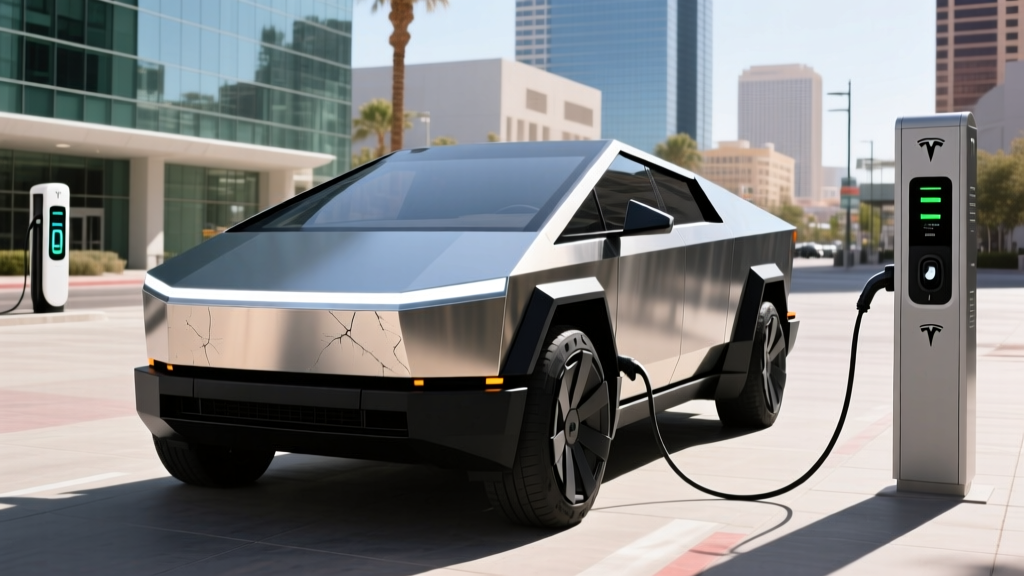
When a Tesla Cybertruck exploded outside the Trump International Hotel in Las Vegas on January 1, 2025, the incident dominated headlines and raised immediate questions about the electric pickup's safety, battery integrity, and structural design. Months later, investigators determined the blast was caused by improvised explosives placed in the truck bed — not a battery defect or vehicle malfunction. But the 2025 Las Vegas Cybertruck explosion continues to shape buyer perception, making a rigorous, data-driven review of Tesla's polarizing electric truck more important than ever.
This profile covers the 2025 Cybertruck across every metric that matters to EV buyers: real-world range versus EPA estimates, DC fast-charging behavior, battery chemistry, pricing after federal tax credits, and how it stacks up against the Ford F-150 Lightning and Rivian R1T. If you're weighing a Cybertruck purchase in 2026, here are the exact numbers you need.
2025 Cybertruck Spec Sheet at a Glance
| Specification | AWD (Dual Motor) | Cyberbeast (Tri-Motor) |
|---|---|---|
| EPA Range | 340 miles | 320 miles |
| Battery (usable, est.) | ~123 kWh (NMC) | ~123 kWh (NMC) |
| Peak DC Fast Charge | ~250 kW (400V arch) | ~250 kW (400V arch) |
| 10–80% DC Charge Time | ~30 minutes | ~30 minutes |
| Level 2 Home Charging | 11.5 kW (~37 mi/hr) | 11.5 kW (~37 mi/hr) |
| 0–60 mph | 4.1 seconds | 2.6 seconds |
| Horsepower | 600 hp | 845 hp |
| Drivetrain | Dual-motor AWD | Tri-motor AWD |
| MPGe (combined) | 72 MPGe | 68 MPGe |
| Efficiency | 47 kWh/100 mi | 50 kWh/100 mi |
| Towing Capacity | 11,000 lbs | 11,000 lbs |
| Cargo Bed Length | 6 ft (72 in) | 6 ft (72 in) |
| Cargo Volume (bed + frunk) | ~67 cu ft bed / ~7 cu ft frunk | ~67 cu ft bed / ~7 cu ft frunk |
| Base MSRP | $79,990 | $99,990 |
| Battery & Drive Warranty | 8 yr / 120,000 mi | 8 yr / 120,000 mi |
The Las Vegas Explosion: What Actually Happened
On the morning of January 1, 2025, a 2025 Tesla Cybertruck rented via Turo detonated in the valet area of the Trump International Hotel in Las Vegas. The blast killed the driver, Matthew Livelsberger, and injured several bystanders. Initial social media speculation pointed to a spontaneous battery fire — a narrative that spread quickly given the Cybertruck's stainless-steel exoskeleton and large battery pack.
The Clark County coroner and federal investigators later confirmed the explosion resulted from fireworks mortars and gas canisters placed in the truck bed, ignited intentionally. The Cybertruck's 4680-format NMC battery pack did not initiate the blast, and there was no evidence of thermal runaway originating from the battery cells. Tesla's battery enclosure remained largely intact in post-blast forensic images reviewed by investigators.
This distinction matters for prospective buyers: the incident was a criminal act using the vehicle as a platform, not a product safety failure. That said, it renewed scrutiny of the Cybertruck's crash-test status and occupant protection, which we address below.
Real-World Range vs. EPA Estimates
EPA Range (AWD): 340 miles
Real-World Expectation: 260–290 miles at sustained highway speeds (70–75 mph); 220–250 miles in freezing temperatures (below 32°F) with cabin heat; up to 310 miles in mixed city/suburban driving with regen braking.
The Cybertruck AWD's 340-mile EPA rating places it among the longest-range electric pickups available. However, the truck's brick-like aerodynamic profile — a drag coefficient estimated around 0.34–0.38 Cd, significantly worse than a sedan — means highway efficiency drops sharply above 65 mph. In independent testing by multiple EV publications, the AWD model returned between 265 and 285 miles on a 75-mph highway loop in mild (65°F) conditions.
Cold weather compounds the penalty. Tesla's heat pump helps, but the massive 123 kWh pack still loses roughly 20–30% of usable range in sustained sub-freezing driving. Expect 220–250 miles in winter highway conditions. For buyers in northern climates, this is a meaningful reduction that should factor into road-trip planning.
The Cyberbeast trim sacrifices 20 miles of EPA range (320 miles) due to its tri-motor setup and higher curb weight (~6,800 lbs). Real-world highway range for the Cyberbeast typically falls between 245 and 270 miles.
Charging Speed: DC Fast and Home Level 2
The Cybertruck uses Tesla's proprietary 4680 cells in a structural battery pack and charges on a 400-volt architecture — not the 800V systems found in the Hyundai Ioniq 5 or Porsche Taycan. This limits peak charging speed but still delivers competitive times thanks to Tesla's Supercharger network optimization.
| Charging Level | Power | Rate / Time |
|---|---|---|
| Level 1 (120V outlet) | ~1.4 kW | ~4–5 miles per hour |
| Level 2 (240V, 48A) | 11.5 kW | ~37 miles per hour; full charge in ~11 hours |
| DC Fast Charge (V3 Supercharger) | Peak ~250 kW | 10–80% in ~30 minutes |
| DC Fast Charge (V4 Supercharger) | Peak ~250 kW (current limit) | 10–80% in ~28 minutes |
The Cybertruck's charge curve peaks near 250 kW at low state-of-charge (SoC) but tapers notably above 60%. From 10–80%, expect approximately 30 minutes at a V3 or V4 Supercharger in warm conditions. Preconditioning the battery via navigation to a Supercharger is essential — without it, cold-soaked packs may peak below 150 kW initially, adding 10–15 minutes to your stop.
For home charging, a Tesla Wall Connector on a 60-amp circuit delivers the full 11.5 kW (48 amps), replenishing roughly 37 miles of range per hour. An overnight session (8–10 hours) restores 300+ miles — enough for nearly any daily use case. Installation typically costs $500–$1,500 depending on panel proximity and local permitting, though a 200-amp panel upgrade can push that to $2,500–$4,000.
Safety, Crash Testing, and Post-Explosion Concerns
As of early 2026, the Cybertruck has not been crash-tested by NHTSA or IIHS. Tesla has not submitted the vehicle for independent evaluation, a notable gap for a vehicle with a starting price near $80,000. The stainless-steel exoskeleton and angular geometry present unique challenges for standard crash-test dummies and barrier tests, which may partly explain the delay.
What we do know: the Cybertruck includes Tesla's full suite of active safety features — automatic emergency braking, lane-keeping assist, blind-spot monitoring, and eight surround cameras. Autopilot comes standard; Full Self-Driving (Supervised) is a $8,000 add-on or $99/month subscription.
Important: Tesla Autopilot and FSD (Supervised) are SAE Level 2 driver-assistance systems. The driver must remain fully attentive, keep hands on the wheel, and be prepared to take over at any moment. These systems are not self-driving and cannot navigate all road conditions without human intervention.
Following the Las Vegas explosion, some buyers expressed concern about the Cybertruck's stainless-steel body in emergency rescue scenarios. First responders have noted that the exoskeleton's hardness requires specialized cutting equipment (hydraulic rescue tools rated for high-strength steel), which could complicate extrication compared to aluminum-bodied trucks like the F-150 Lightning. Tesla provides emergency response guides to fire departments, but availability of appropriate tools varies by jurisdiction.
Pricing, Trims, and Federal Tax Credit Eligibility
| Trim | Base MSRP | Federal Tax Credit (§30D) | Effective Price (if eligible) |
|---|---|---|---|
| AWD (Dual Motor) | $79,990 | $0 (exceeds MSRP cap) | $79,990 |
| Cyberbeast (Tri-Motor) | $99,990 | $0 (exceeds MSRP cap) | $99,990 |
The Cybertruck does not qualify for the $7,500 federal EV tax credit under IRS §30D rules. The law caps eligible pickup truck MSRP at $80,000, and while the AWD trim's $79,990 base price technically falls under that cap, destination fees and mandatory options push the out-the-door price above the threshold. Additionally, buyers must meet income limits ($300,000 joint / $150,000 single modified AGI) and the vehicle must satisfy critical-mineral and battery-component sourcing requirements that have tightened significantly since 2024. The Cybertruck's battery sourcing has not consistently met these evolving thresholds.
Some state-level incentives may still apply — California's CVRP, Colorado's state credit, and various utility rebates can offset $1,000–$5,000 depending on your jurisdiction. Always verify current rules on IRS.gov and your state's energy office before purchasing.
Interior, Cargo, and Daily Practicality
The Cybertruck seats five across two rows, though the rear bench is best suited for two adults on longer trips. Rear legroom measures approximately 38 inches — adequate but not class-leading versus the F-150 Lightning's 43 inches. The minimalist interior centers on an 18.5-inch touchscreen that handles virtually all vehicle controls, including a yoke-style steering wheel with no traditional stalks (turn signals are button-activated on the wheel).
Cargo capacity includes a 6-foot bed with a motorized tonneau cover, approximately 67 cubic feet of bed volume, and a front trunk (frunk) offering about 7 cubic feet — enough for a charging cable bag and small groceries. The bed features built-in 120V and 240V outlets capable of powering tools or providing vehicle-to-load (V2L) capability for job-site use or camping.
Notable interior drawbacks: the yoke steering wheel requires an adjustment period and frustrates some drivers in low-speed maneuvering; panel-gap inconsistency has been widely documented; and the sheer width of the vehicle (nearly 8 feet including mirrors) makes tight parking structures genuinely challenging.
How It Compares: Cybertruck vs. F-150 Lightning vs. Rivian R1T
The electric pickup segment gives buyers three distinct philosophies. Here's how the Cybertruck AWD stacks up against its two primary rivals:
| Metric | 2025 Cybertruck AWD | 2025 F-150 Lightning (Ext. Range) | 2025 Rivian R1T (Dual Motor Max) |
|---|---|---|---|
| EPA Range | 340 mi | 320 mi | 352 mi |
| Base MSRP | $79,990 | $69,995 | $83,900 |
| 0–60 mph | 4.1 sec | 3.8 sec | 4.5 sec |
| Towing | 11,000 lbs | 10,000 lbs | 11,000 lbs |
| NHTSA Crash Test | Not tested | 5-Star Overall | Not tested (IIHS Top Safety Pick) |
| Federal Tax Credit | Not eligible | Eligible (select trims) | Eligible (select trims) |
The F-150 Lightning wins on value, proven crash-test credentials, and tax-credit eligibility. The Rivian R1T leads on range (Max pack) and build-quality reputation. The Cybertruck's advantages are its Supercharger network access (though competitors now have NACS adapters), distinctive design, and tri-motor Cyberbeast performance for buyers who prioritize acceleration.
Who Should Buy the 2025 Cybertruck?
Choose the Cybertruck if: You want a statement vehicle with strong range (340 mi AWD), access to Tesla's Supercharger network, V2L capability for job-site or camping use, and you accept the untested crash-safety profile and polarizing design.
Choose the F-150 Lightning if: You prioritize proven safety ratings, a more conventional truck experience, lower starting price, and potential federal tax-credit eligibility.
Choose the Rivian R1T if: You want the best build quality in the segment, class-leading range with the Max pack, a more refined interior, and superior off-road capability via quad-motor options.
The Cybertruck best suits buyers who value Tesla's software ecosystem, want a distinctive daily-driver truck, and can charge at home. It's less ideal for fleet buyers, those who need verified crash-test data, or anyone whose budget is sensitive to the lack of a federal tax credit.
Frequently Asked Questions
What is the real-world range of the 2025 Cybertruck?
The AWD model achieves 260–290 miles in real-world highway driving at 70–75 mph in mild weather. Cold weather (below 32°F) reduces this to roughly 220–250 miles. City driving with regenerative braking can approach 310 miles.
How fast does the Cybertruck charge?
On a Tesla V3/V4 Supercharger, the Cybertruck peaks near 250 kW and charges from 10–80% in approximately 30 minutes with battery preconditioning. At home on a Level 2 Wall Connector (11.5 kW), it adds about 37 miles of range per hour, fully recharging overnight.
Does the 2025 Cybertruck qualify for the federal EV tax credit?
No. The Cybertruck's MSRP, combined with evolving battery-sourcing and critical-mineral requirements under IRS §30D, makes it ineligible for the $7,500 federal credit. State incentives may still apply — check your local energy office and IRS guidance.
Was the Las Vegas Cybertruck explosion a battery defect?
No. Federal and local investigators determined the January 2025 Las Vegas explosion was caused by improvised explosive devices (fireworks mortars and gas canisters) placed in the truck bed. The battery pack did not initiate the blast, and no thermal runaway originated from the cells.
Is the Cybertruck safe to drive?
The Cybertruck includes comprehensive active safety features but has not been crash-tested by NHTSA or IIHS as of early 2026. The stainless-steel exoskeleton may require specialized rescue equipment. Buyers prioritizing verified crash-test ratings should consider the F-150 Lightning, which earned a 5-star NHTSA overall rating.
What are the biggest pros and cons?
Pros: 340-mile EPA range (AWD), Supercharger network access, V2L bed outlets, 11,000-lb towing, distinctive design, strong software/OTA updates, Cyberbeast performance (2.6-sec 0–60).
Cons: No NHTSA/IIHS crash-test data, no federal tax credit, polarizing yoke steering, wide body complicates parking, panel-gap quality inconsistency, high starting price ($79,990+), 400V architecture limits peak charge speed vs. 800V competitors.
How does the Cybertruck handle towing range loss?
Expect a 40–50% range reduction when towing near the 11,000-lb maximum at highway speeds. A 340-mile AWD Cybertruck towing a heavy trailer may deliver only 170–200 miles before needing a charge. Plan Supercharger stops accordingly and use Tesla's built-in towing range estimator.
What battery chemistry does the Cybertruck use?
The Cybertruck uses NMC (nickel-manganese-cobalt) chemistry in Tesla's 4680 cell format. NMC offers higher energy density than LFP, enabling the 340-mile range in a truck this heavy, but it is more sensitive to sustained high state-of-charge. Tesla recommends daily charging to 80–90% for longevity, reserving 100% for road trips.
Sources: EPA fuel economy data via fueleconomy.gov; IRS clean vehicle credit rules via irs.gov; Tesla official specifications.