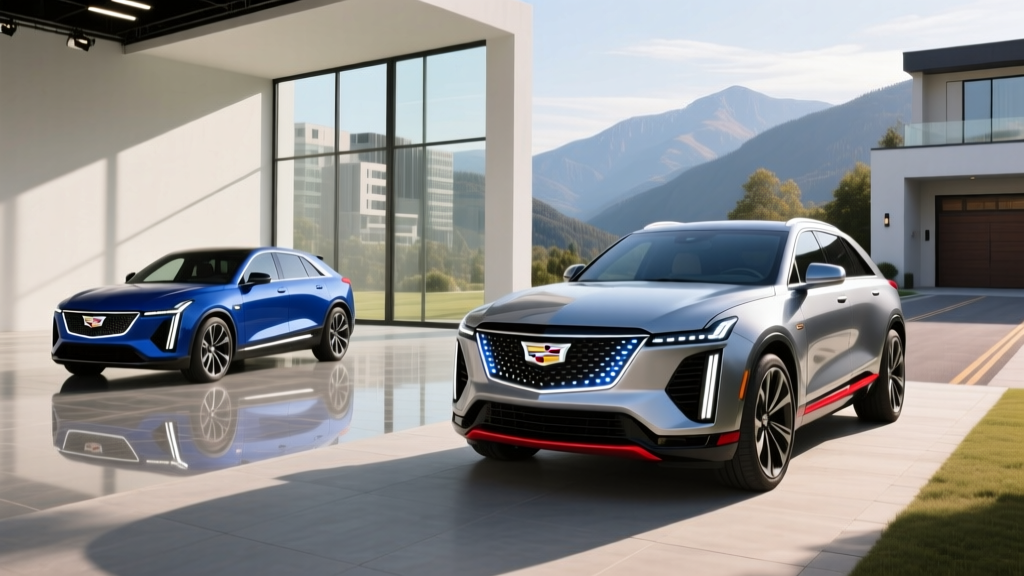
Quick Answer: Cadillac's 2025 electric lineup includes three models built on GM's Ultium platform: the Lyriq midsize SUV (314 miles EPA, starting ~$58,590), the newly introduced Optiq compact SUV (~300 miles EPA, starting ~$54,090), and the flagship Escalade IQ full-size SUV (~450 miles EPA, starting ~$129,990). All three support DC fast charging above 190 kW and qualify for varying levels of the federal §30D tax credit depending on battery sourcing and buyer income. The Lyriq remains the volume seller and best value proposition; the Optiq targets urban buyers; the Escalade IQ is a luxury statement with genuine long-distance capability.
The 2025 Cadillac EV Lineup at a Glance
General Motors has committed Cadillac to an all-electric future, and by the 2025 model year the brand fields a credible three-model battery-electric lineup. Each vehicle rides on the Ultium battery architecture—a modular platform using pouch-style NMC (nickel manganese cobalt) cells arranged in large, flat packs. This is not a compliance exercise; these are purpose-built EVs with competitive range, fast charging, and the kind of luxury isolation Cadillac buyers expect.
Here is how the three models stack up on paper:
| Spec | 2025 Lyriq | 2025 Optiq | 2025 Escalade IQ |
|---|---|---|---|
| Segment | Midsize SUV | Compact SUV | Full-size Luxury SUV |
| Battery (usable) | 102 kWh (NMC) | ~85 kWh (NMC) | ~200 kWh (NMC) |
| EPA Range | 314 mi (RWD) | ~300 mi (est.) | ~450 mi (est.) |
| Drivetrain | RWD or AWD | AWD | AWD (e4) |
| Horsepower | 340 hp (RWD) / 500 hp (AWD) | ~340 hp | ~680 hp |
| 0-60 mph | 6.0s (RWD) / 4.6s (AWD) | ~6.0s | ~3.8s |
| Max DC Fast Charge | 190 kW | ~190 kW | ~350 kW (800V) |
| 10-80% DCFC Time | ~30 min | ~28 min | ~20 min |
| Level 2 (240V) Rate | 19.2 kW | 19.2 kW | 19.2 kW |
| Base MSRP | $58,590 | $54,090 | $129,990 |
| Battery Warranty | 8 yr / 100,000 mi | 8 yr / 100,000 mi | 8 yr / 100,000 mi |
Sources: fueleconomy.gov, Cadillac official specifications. Escalade IQ and Optiq figures marked (est.) are based on GM preliminary data and may shift at final EPA certification.
Real-World Range: What the EPA Sticker Doesn't Tell You
The EPA range figure is a blended cycle—part city, part highway, moderate temperatures, gentle acceleration. Real-world driving rarely mirrors that mix perfectly. Here is what Cadillac EV buyers should actually expect:
Lyriq RWD (314 mi EPA): Expect 260–280 miles on a sustained 75 mph highway run in mild weather. In freezing temperatures (below 30°F), range drops to approximately 210–230 miles due to battery chemistry resistance and cabin heating load. The Lyriq includes a heat pump on AWD trims, which partially mitigates cold-weather loss compared to resistive heaters.
Optiq (~300 mi EPA): Smaller battery and lighter curb weight yield similar highway efficiency. Expect ~250 miles highway, ~200 miles in deep cold.
Escalade IQ (~450 mi EPA): The massive 200 kWh pack gives this three-row SUV genuine cross-country legs. Expect ~380 miles highway, ~310 miles in cold weather. This is among the longest real-world ranges of any production EV.
One often-overlooked factor: the Ultium platform's thermal management system actively preconditions the battery when you navigate to a DC fast charger. This means you will actually see close to peak charge rates upon arrival—something not all competitors manage consistently.
Charging Speed and Infrastructure: The Daily Reality
Owning a Cadillac EV means engaging with three charging tiers. Understanding the difference between kW (power—the rate of energy flow) and kWh (energy—the total capacity of your battery) is essential. A 190 kW charger does not deliver 190 kW continuously; it peaks early and tapers as the battery fills, which is why we quote 10-80% times rather than "full charge" times.
| Level | Power | Lyriq Miles Added/Hour | Typical Use Case |
|---|---|---|---|
| Level 1 (120V) | ~1.4 kW | ~5 mi/hr | Emergency/overnight trickle |
| Level 2 (240V, 48A) | 11.5 kW | ~40 mi/hr | Home daily charging |
| Level 2 (240V, 80A) | 19.2 kW | ~65 mi/hr | Home fast fill / commercial |
| DC Fast Charge | Up to 190 kW | ~185 mi in 10 min (peak) | Road trips, public stations |
Home charging reality: Most Lyriq and Optiq owners will install a Level 2 wall connector on a 60-amp circuit (delivering 48 amps continuous). This replenishes a depleted Lyriq battery in roughly 9.5 hours—easily overnight. Installation costs typically run $800–$2,500 depending on panel proximity, conduit length, and whether your electrical panel needs an upgrade from 100A to 200A service. Always get a quote from a licensed electrician before assuming a simple install.
Public charging: GM has transitioned new Cadillac EVs to the NACS (North American Charging Standard) connector, meaning native access to Tesla Supercharger stalls with no adapter. For Electrify America and other CCS networks, a NACS-to-CCS adapter is included. This dual-network access is a genuine competitive advantage over brands locked to a single standard.
Cost of Ownership: Cadillac EV vs. Gas Equivalent
The upfront price of a Cadillac EV is higher than a comparably equipped gas Cadillac XT5 or Escalade. But total cost of ownership tells a different story—especially when you factor in fuel savings, reduced maintenance, and available tax credits.
| Cost Factor | Lyriq AWD ($62,590) | Cadillac XT5 AWD (~$52,000) |
|---|---|---|
| Purchase Price (MSRP) | $62,590 | $52,000 |
| Federal Tax Credit (§30D) | Up to $7,500* | $0 |
| Effective Purchase Price | ~$55,090 | $52,000 |
| Fuel/Energy (5 yr, 15k mi/yr) | ~$4,200 (electricity) | ~$11,250 (premium gas) |
| Maintenance (5 yr) | ~$1,800 | ~$4,500 |
| Insurance (5 yr avg.) | ~$14,500 | ~$11,000 |
| 5-Year Total Cost | ~$75,590 | ~$78,750 |
*Federal §30D credit eligibility depends on MSRP caps (SUVs: $80,000), buyer income limits ($150K single / $300K joint AGI), and battery critical-mineral and component sourcing requirements. Rules are subject to change—verify current eligibility at IRS.gov or with a tax professional. Point-of-sale transfer is available, reducing your dealer price directly.
The Lyriq crosses into cost-parity territory within 3–4 years of ownership, primarily driven by the ~$7,000 fuel savings and eliminated oil changes, transmission fluid, and spark plug replacements. The EV's brake pads also last significantly longer due to regenerative braking handling most deceleration.
Insurance caveat: EV insurance premiums run 15–30% higher than gas equivalents, driven by higher repair costs for battery-adjacent damage and specialized labor. Get quotes from your carrier before committing.
Federal Tax Credit and Incentive Eligibility
Understanding §30D eligibility is critical because not every Cadillac EV buyer will qualify, and the rules have tightened significantly. Here is the current framework:
- MSRP Cap: SUVs must be below $80,000 MSRP. The Lyriq and Optiq qualify; the Escalade IQ does not (priced well above $80K).
- Buyer Income Cap: Modified AGI must not exceed $150,000 (single), $225,000 (head of household), or $300,000 (joint filing).
- Battery Sourcing: A percentage of critical minerals and battery components must be sourced from the US or free-trade-agreement countries. This threshold increases annually, and some trims or build dates may not qualify for the full $7,500.
- Point-of-Sale Transfer: You can transfer the credit to the dealer at purchase, reducing your out-of-pocket price immediately rather than waiting for a tax refund.
- State Incentives: Vary widely—check your state energy office or the AFDC state incentive database for local rebates, HOV lane access, and utility charging credits.
The Optiq and base Lyriq are the strongest candidates for the full credit. Higher-trim Lyriq AWD models near the $80K cap still qualify, but loaded Sport trims approach the threshold closely—verify the exact MSRP on your build sheet.
Common Misconceptions About Cadillac EVs
| Myth | Fact |
|---|---|
| "Cadillac EVs are just rebadged Chevrolets." | While they share the Ultium platform, Cadillac models have unique tuning, sound insulation, interior materials, suspension calibration, and Super Cruise integration not found on Chevrolet counterparts. |
| "The battery will need replacing in 5 years." | GM warrants the Ultium battery for 8 years/100,000 miles with a capacity retention threshold (typically 60-70% of original capacity). Real-world degradation data from early Ultium vehicles shows approximately 5-8% loss over the first 60,000 miles—well within warranty. |
| "I can't take a Cadillac EV on a road trip." | With 190+ kW DC fast charging and NACS access to Tesla's 50,000+ Supercharger network, a Lyriq can add 185 miles in roughly 15 minutes at a functioning fast charger. The Escalade IQ's ~450-mile range means fewer stops altogether. |
| "Home charging requires a full electrical upgrade." | Many homes with 200-amp panels can add a 60-amp EV circuit without a panel upgrade. Only older homes with 100-amp service or heavily loaded panels typically require an upgrade ($2,000–$5,000). Get an electrician's assessment before assuming the worst. |
| "Super Cruise means the car drives itself." | Super Cruise is an SAE Level 2 driver-assistance system. It handles steering, acceleration, and braking on mapped divided highways, but the driver must remain attentive and hands-free operation is monitored via a driver-facing camera. It is not autonomous driving. |
SAE Level 2 — Not Self-Driving: Cadillac's Super Cruise and GM's Ultra Cruise are classified as SAE Level 2 partial automation. The vehicle can control steering and speed under specific conditions, but the driver is legally and practically responsible for safe operation at all times. True driverless operation (Level 4) is currently limited to geofenced robotaxi services like Waymo in select cities.
Decision Framework: Which 2025 Cadillac EV Is Right for You?
Choose the Lyriq if:
- You want the best balance of range (314 mi), price (~$58K–$65K), and luxury features
- You have a 2-car household and this is your primary daily driver
- You road-trip 3-5 times per year and need reliable DC fast charging
- You want Super Cruise availability for highway commuting
- Federal tax credit eligibility matters to your budget
Choose the Optiq if:
- You live in an urban or suburban area with shorter daily commutes (under 50 miles round-trip)
- You want Cadillac luxury at the lowest entry price (~$54K)
- Parking footprint matters—this is roughly 18 inches shorter than the Lyriq
- You prioritize maneuverability over maximum cargo space
Choose the Escalade IQ if:
- You need three-row seating for 6-7 passengers with genuine cargo room behind the third row
- Budget is not a primary constraint (~$130K+)
- You want the longest possible range (~450 mi) and fastest charging (350 kW, 800V architecture)
- You are replacing a gas Escalade and want to eliminate $5,000+/year in fuel costs
- Federal tax credit is irrelevant at this price point (above MSRP cap)
Choose a gas or hybrid Cadillac instead if:
- You lack reliable home or workplace charging access
- You regularly tow heavy loads (the Lyriq is rated for 1,500 lbs; the Escalade IQ handles more but EV towing range loss is 30-50%)
- You live in a region with extreme cold and limited public charging infrastructure
- You drive more than 400 miles in a single day regularly and cannot tolerate 20-30 minute charge stops
What First-Time Cadillac EV Buyers Should Know
If you are transitioning from a gas Cadillac—or any gas vehicle—here is what changes and what does not:
What gets better: Instant torque from a stop (no turbo lag, no transmission hunting), near-silent operation, one-pedal driving via regenerative braking that reduces brake wear, pre-conditioning your cabin from your phone while plugged in, and never visiting a gas station for daily driving.
What requires adjustment: Planning longer road trips around charging stops (use the built-in navigation, which auto-routes through chargers and preconditions the battery), understanding that range fluctuates with temperature and driving style, and learning to trust the charge-time estimates rather than the range-anxiety instinct to charge to 100% every night (daily charging to 80% is better for NMC battery longevity).
Before you buy, confirm:
- Your electrical panel has room for a 60-amp breaker (get an electrician's quote for Level 2 installation)
- Your daily driving pattern fits within 80% of the EPA range (leaving buffer for cold weather and detours)
- You have downloaded the myCadillac app and reviewed the public charging networks in your area
- You have verified your §30D tax credit eligibility with a tax professional or the IRS calculator
Frequently Asked Questions
Do 2025 Cadillac EVs use the Tesla Supercharger network?
Yes. Starting with the 2025 model year, Cadillac EVs are equipped with the NACS charge port, granting native access to Tesla's Supercharger network (over 50,000 stalls in North America) without an adapter. For CCS-based networks like Electrify America, a NACS-to-CCS adapter is provided.
How long does it take to charge a Lyriq at home overnight?
On a Level 2 home charger at 19.2 kW (80 amps), a fully depleted Lyriq (102 kWh battery) charges from 0% to 100% in roughly 6 hours. On a more common 48-amp circuit (11.5 kW), expect about 9.5 hours. Most owners arrive home with 30-50% remaining and wake up fully charged.
Will the Escalade IQ qualify for the $7,500 federal tax credit?
No. The Escalade IQ's MSRP ($129,990 base) far exceeds the §30D SUV cap of $80,000. Buyers will not be eligible for the federal new clean vehicle credit on this model. State and utility incentives may still apply.
How does the Lyriq compare to the Tesla Model Y or BMW iX?
The Lyriq offers more rear-seat legroom and a quieter cabin than the Model Y, with comparable range (314 vs. 310 miles for Model Y Long Range). It charges slightly slower than the Model Y (190 kW vs. 250 kW peak). Against the BMW iX, the Lyriq is less expensive ($58K vs. $70K+ for the iX xDrive50) but offers less horsepower and a slightly shorter range. The Lyriq's advantage is its traditional luxury aesthetic and Super Cruise availability.
What happens if the Ultium battery fails out of warranty?
Out-of-warranty Ultium battery replacement costs are not yet widely established, as the platform launched in 2022 and most packs remain under warranty. Industry estimates for large NMC packs (100+ kWh) range from $15,000–$25,000 including labor. However, module-level repair (replacing individual failed modules rather than the entire pack) may reduce costs significantly. GM's battery diagnostics via OnStar can flag degradation early.
Can I tow with a Cadillac Lyriq?
The Lyriq is rated for 1,500 pounds of towing capacity when properly equipped. This is suitable for a small utility trailer or bike rack but not for boats or campers. Expect a 30-40% range reduction while towing at highway speeds due to increased aerodynamic drag and weight.
Always verify current pricing, specifications, and incentive eligibility with your local Cadillac dealer and IRS.gov, as rules and model configurations can change. Safety ratings can be reviewed at NHTSA.gov and IIHS.org.