Quick Verdict: The Fastest Electric Luxury Sedan You Can Actually Daily-Drive
The 2025 BMW i7 M70 occupies a rare position in the EV market: it's a full-size luxury sedan that delivers supercar-rivaling acceleration while functioning as a credible daily driver with over 300 miles of EPA-rated range. With 650 horsepower from its dual-motor all-wheel-drive system, BMW's M division has proven that electrification doesn't require sacrificing the brand's performance DNA. But at a starting MSRP above $168,000, the i7 M70 must justify its price against rivals like the Mercedes-Benz EQS 580, Porsche Taycan Turbo S, and Tesla Model S Plaid — each with different trade-offs in range, charging speed, and luxury execution.
This review covers the exact numbers that matter: real-world range in highway and cold-weather conditions, DC fast-charging curve behavior, Level 2 home charging practicality, and the current federal tax credit landscape under IRS §30D rules. If you're cross-shopping six-figure electric sedans, the data below will clarify whether the i7 M70 earns its premium.
Range and Efficiency: EPA vs. Real-World Expectations
The 2025 BMW i7 M70 carries a 101.7 kWh gross battery pack (approximately 94.8 kWh usable) using NMC (nickel manganese cobalt) chemistry. BMW prioritizes energy density and cold-weather performance with NMC over the longer cycle life of LFP (lithium iron phosphate), a sensible choice for a premium vehicle where weight and packaging matter.
The EPA rates the i7 M70 at 318 miles of combined range on its standard 20-inch wheels. Opting for the available 22-inch M Sport wheels reduces that figure to approximately 295 miles due to increased rolling resistance and aerodynamic drag.
- EPA Combined: 318 miles (20-inch wheels)
- Highway (70-80 mph, moderate temps): ~265–285 miles
- City / Suburban mixed driving: ~300–320 miles (regen-friendly)
- Cold weather (below 32°F, highway): ~220–250 miles (20–30% loss typical for NMC packs without aggressive preconditioning)
The i7 M70's heat pump and battery preconditioning system help mitigate cold-weather losses, but physics still applies. Plan for a 20–30% reduction in freezing temperatures, especially at sustained highway speeds where cabin heating and battery warming draw significant energy.
Efficiency is rated at 82 MPGe combined (EPA), which translates to roughly 41 kWh per 100 miles. For a 5,800-pound sedan producing 650 horsepower, that's respectable — though the lighter Porsche Taycan Turbo S and more aerodynamic Mercedes EQS 580 achieve higher MPGe figures. The i7 M70 prioritizes performance and presence over efficiency maximization, and the range reflects that compromise.
Charging Speed: DC Fast Charging and Home Level 2
BMW equips the i7 M70 with a peak DC fast-charging rate of 195 kW via its CCS1 connector (or NACS with the included adapter for Tesla Supercharger access). On a 350 kW-capable charger from networks like Electrify America or EVgo, the i7 M70 can add approximately 10–80% state of charge in about 34 minutes.
However, the charging curve tells the full story. The i7 M70 sustains near-peak rates up to roughly 40% SoC, then tapers progressively. By 80%, charge power drops to approximately 50–60 kW. This is standard behavior for NMC packs managed conservatively to preserve long-term battery health, but it means the final 20% takes nearly as long as the first 60%. For road-trip planning, plan to charge to 80% and move on rather than waiting for a full top-off.
| Charging Level | Power (kW) | Speed (miles of range per hour) | Time (10–80%) |
|---|---|---|---|
| Level 1 (120V household) | 1.4 kW | ~3–4 mi/hr | N/A (not practical) |
| Level 2 (240V, 48A home charger) | 11.5 kW | ~28–32 mi/hr | ~7.5 hours (0–100%) |
| DC Fast Charge (peak) | 195 kW | ~600+ mi/hr (at peak) | ~34 minutes (10–80%) |
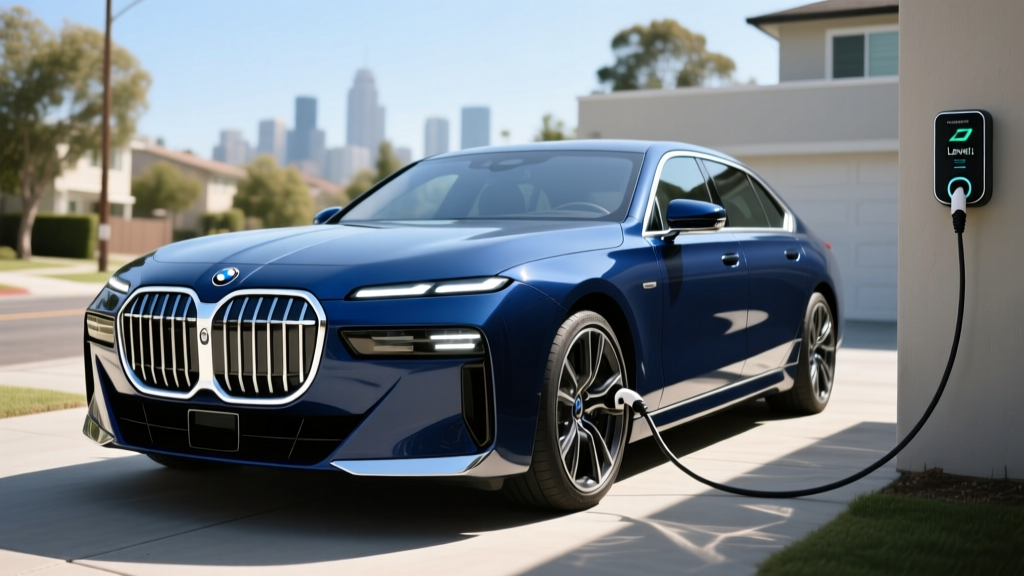
For home Level 2 charging, the i7 M70 accepts up to 11.5 kW on a 48-amp, 240-volt circuit (such as a BMW Wallbox or ChargePoint Home Flex). A full overnight charge from near-empty takes roughly 8–9 hours. Most owners will arrive home with 30–50% remaining and wake to a full battery in 5–6 hours. Installation typically requires a 60-amp dedicated circuit; budget $800–$2,000 for electrician labor and permits depending on panel proximity and local code requirements.
The included NACS adapter is a significant practical advantage for 2025, granting access to Tesla's Supercharger network — the most reliable DC fast-charging infrastructure in the U.S. This eliminates one of the biggest ownership pain points for non-Tesla EVs on road trips.
Performance: 650 HP, Dual Motors, and M Division Tuning
The i7 M70 is BMW's most powerful electric production vehicle. Its dual-motor all-wheel-drive system produces 650 horsepower and 749 lb-ft of torque, launching the sedan from 0–60 mph in 3.5 seconds (BMW's figure; independent testing has recorded 3.3 seconds with rollout). Top speed is electronically limited to 155 mph.
What separates the M70 from the standard i7 xDrive60 (which produces 536 hp and hits 60 mph in 4.5 seconds) is more than straight-line speed. BMW's M division retuned the adaptive air suspension, rear-wheel steering, and active roll stabilization for sharper cornering response. The result is a 5,800-pound sedan that corners with composure that defies its mass — though it can't fully mask that mass during aggressive direction changes the way a Porsche Taycan can.
Driving modes include Sport, which firms the suspension and sharpens throttle response, and an M-specific Launch Control for maximum acceleration runs. Regenerative braking is adjustable via paddle shifters, with a one-pedal-driving mode available for city commuting.
| Specification | Value |
|---|---|
| EPA Range (20" wheels) | 318 miles |
| Battery (gross / usable) | 101.7 kWh / ~94.8 kWh |
| Battery Chemistry | NMC (Nickel Manganese Cobalt) |
| Drivetrain | Dual-motor AWD |
| Horsepower | 650 hp |
| Torque | 749 lb-ft |
| 0–60 mph | 3.5 seconds |
| Top Speed | 155 mph (electronically limited) |
| DC Fast Charge (peak) | 195 kW |
| 10–80% DC Charge Time | ~34 minutes |
| Level 2 Charge Rate | 11.5 kW (48A) |
| MPGe (combined) | 82 MPGe |
| Efficiency | 41 kWh/100 mi |
| Curb Weight | ~5,840 lbs |
Interior, Technology, and Cargo Space
The i7 M70's cabin is where BMW justifies its flagship pricing. The dashboard is dominated by BMW's Curved Display — a 12.3-inch digital instrument cluster merged with a 14.9-inch central touchscreen running iDrive 8.5. The system supports wireless Apple CarPlay and Android Auto, over-the-air updates, and a natural-language voice assistant.
Available rear-seat entertainment includes twin 31.3-inch 8K displays mounted from the ceiling (the "Theater Screen"), transforming the rear cabin into a mobile cinema with Amazon Fire TV integration. This is a genuine differentiator against the EQS and Model S, neither of which offers comparable rear-seat immersion.
The driver-assistance suite includes BMW Driving Assistant Professional, which provides highway assist with lane-centering and adaptive cruise control. This is an SAE Level 2 system — meaning the driver must remain attentive with hands on or near the wheel at all times. It is not autonomous driving. Highway Assistant can operate hands-free at speeds up to 85 mph on divided highways when the driver monitoring camera confirms eye attention, a competitive feature against GM's Super Cruise and Ford's BlueCruise.
Cargo and passenger space reflect the i7's full-size sedan proportions:
- Trunk volume: 17.7 cubic feet (no frunk — the front hood houses HVAC and power electronics)
- Rear legroom: 42.0 inches (executive-lounge seating available with power recline and massage)
- Front headroom: 40.1 inches
- Rear headroom: 38.6 inches (slightly compromised by the panoramic glass roof)
The 17.7 cu-ft trunk is generous for a sedan but less versatile than a hatchback or SUV. The Porsche Taycan offers a rear hatch and a front trunk (frunk), providing more total cargo flexibility. The i7 prioritizes cabin luxury over cargo practicality.
Pricing, Tax Credits, and Total Cost
The 2025 BMW i7 M70 starts at an MSRP of $168,800 (including destination). With options — including the Executive Package, Bowers & Wilkins surround sound, the Theater Screen, and 22-inch wheels — as-tested prices commonly reach $185,000–$195,000.
| Item | Amount |
|---|---|
| Base MSRP (i7 M70 xDrive) | $168,800 |
| Typical as-tested (with popular options) | $185,000–$195,000 |
| Federal §30D EV Tax Credit | $0 (exceeds MSRP cap) |
| State incentives (varies by jurisdiction) | Check local programs |
Federal tax credit eligibility: The i7 M70 does not qualify for the IRS §30D Clean Vehicle Credit. Under current rules, new EVs must have an MSRP below $55,000 (sedans) to be eligible. At $168,800, the i7 M70 far exceeds this cap. Additionally, the credit has adjusted gross income limits ($150,000 single / $300,000 joint filers) and battery critical-mineral sourcing requirements. Even if the MSRP cap didn't apply, most i7 M70 buyers would exceed the income thresholds. Consult IRS.gov §30D guidelines for current-year eligibility rules, as these are subject to legislative change.
For buyers in this price bracket, the absence of a federal credit is typically not a purchase driver. The i7 M70 competes on performance, luxury, and technology — not incentive optimization.
Warranty and Battery Longevity
BMW provides the following coverage for the 2025 i7 M70:
- Limited vehicle warranty: 4 years / 50,000 miles
- Battery and powertrain warranty: 8 years / 100,000 miles (covers battery capacity below 70% of original)
- Corrosion warranty: 12 years / unlimited miles
- Complimentary maintenance: 3 years / 36,000 miles
The 8-year/100,000-mile battery warranty with a 70% capacity retention threshold is industry-standard, matching Tesla, Mercedes-Benz, and Audi. NMC chemistry typically degrades 10–15% over the first 100,000 miles under normal use, meaning most owners will retain 85–90% capacity well within the warranty period. BMW's battery thermal management system — liquid cooling with active preconditioning — is designed to minimize degradation during DC fast charging and extreme temperatures.
Full battery replacement, should it be needed out of warranty, is estimated at $20,000–$30,000 based on current NMC pack pricing for ~100 kWh systems. However, module-level repairs (replacing individual degraded cells or modules) can cost significantly less, and most i7 owners will trade or sell well before reaching that threshold.
Pros, Cons, and Who Should Buy the i7 M70
- 650 hp and 3.5-second 0–60 in a full-size luxury sedan
- 318-mile EPA range is strong for the performance class
- Best-in-class rear-seat technology (Theater Screen)
- NACS adapter included — full Supercharger network access
- Highway Assistant offers hands-free Level 2 driving on divided highways
- Exceptional cabin quietness and ride quality with adaptive air suspension
- 195 kW peak DC charge rate lags behind Porsche Taycan (270 kW+) and Lucid Air (300+ kW)
- No front trunk (frunk) — reduced cargo versatility
- No federal tax credit eligibility (MSRP cap)
- 5,840-lb curb weight is felt during aggressive cornering
- 82 MPGe trails more efficiency-focused rivals (Lucid Air, EQS)
- Starting price above $168K puts it in ultra-luxury territory
- Choose the i7 M70 if: You want the fastest BMW sedan ever built, prioritize rear-seat luxury and technology, need a daily-drivable EV with 300+ mile range, and value Supercharger network access for road trips.
- Choose the Porsche Taycan Turbo S if: Driving dynamics and charging speed (270+ kW) matter more than rear-seat space and you prefer a sportier, lower-slung profile.
- Choose the Lucid Air Grand Touring if: Maximum range (516 miles EPA) and efficiency are your top priorities, and you're willing to accept a less established service network.
- Choose the Mercedes-Benz EQS 580 if: You prioritize aerodynamic efficiency (97 MPGe), a more spacious hatchback cargo area, and MBUX Hyperscreen technology.
Competitive Comparison: i7 M70 vs. Key Rivals
The i7 M70 doesn't exist in a vacuum. Here's how it stacks up against the electric luxury sedans it most directly competes with:
| Spec | BMW i7 M70 | Porsche Taycan Turbo S | Lucid Air Grand Touring | Mercedes EQS 580 |
|---|---|---|---|---|
| EPA Range | 318 mi | 280 mi | 516 mi | 371 mi |
| Horsepower | 650 hp | 750 hp (Launch Control) | 1,050 hp | 536 hp |
| 0–60 mph | 3.5 sec | 2.4 sec | 3.0 sec | 4.1 sec |
| Peak DC Charge | 195 kW | 270 kW | 300+ kW | 200 kW |
| Battery (usable) | ~94.8 kWh | 83.7 kWh | 112 kWh | 107.8 kWh |
| Base MSRP | $168,800 | $197,400 | $125,600 | $127,350 |
| MPGe (combined) | 82 | 73 | 131 | 97 |
The i7 M70 sits in a unique position: it's not the fastest (Porsche and Lucid beat it), not the longest-range (Lucid dominates), and not the most efficient (Lucid and Mercedes lead). What it delivers is the best balance of M-performance credibility, full-size luxury, and daily usability in a single package — particularly for buyers who value BMW's dealer network, build quality, and the Theater Screen rear-seat experience.
Frequently Asked Questions
What is the real-world range of the 2025 BMW i7 M70?
The EPA rates the i7 M70 at 318 miles on 20-inch wheels. In real-world highway driving at 70–80 mph in moderate temperatures, expect approximately 265–285 miles. In freezing weather with cabin heating, range can drop to 220–250 miles. City driving with regenerative braking recovers energy and can match or slightly exceed the EPA figure.
How fast does the i7 M70 charge at home and on DC fast chargers?
On a DC fast charger, the i7 M70 peaks at 195 kW and charges from 10–80% in approximately 34 minutes, though charge rate tapers significantly above 60% SoC. At home on a Level 2 (240V, 48A) charger, it accepts 11.5 kW, adding roughly 30 miles of range per hour and fully charging overnight in about 8–9 hours.
Does the 2025 BMW i7 M70 qualify for the federal EV tax credit?
No. The IRS §30D Clean Vehicle Credit requires sedans to have an MSRP below $55,000. The i7 M70 starts at $168,800, far exceeding this cap. Additionally, buyer income limits ($300,000 joint / $150,000 single) and battery sourcing requirements apply. See IRS.gov for current rules.
Is the i7 M70 worth buying over the Porsche Taycan or Lucid Air?
It depends on priorities. If you value rear-seat luxury, the Theater Screen, and a comfortable daily-driver character with strong (if not class-leading) performance, the i7 M70 excels. If outright track performance and fastest charging matter most, the Taycan Turbo S wins. If range and efficiency are paramount, the Lucid Air Grand Touring is the clear choice. The i7 M70 is the luxury-first, performance-second option.
Does the i7 M70 have self-driving capability?
No. BMW's Driving Assistant Professional is an SAE Level 2 driver-assistance system. It provides highway lane-centering and adaptive cruise control, and can operate hands-free on divided highways when the driver monitoring system confirms attention. However, the driver must remain fully engaged and responsible for vehicle operation at all times. This is not autonomous or self-driving technology.
What is the battery warranty and expected longevity?
BMW covers the i7 M70's high-voltage battery for 8 years or 100,000 miles, warranting capacity retention above 70% of original. NMC packs in BMW's thermal management system typically degrade 10–15% over 100,000 miles under normal use. Full pack replacement out of warranty is estimated at $20,000–$30,000, though module-level repairs cost less.
Can I charge the i7 M70 at Tesla Superchargers?
Yes. The 2025 i7 M70 includes a NACS adapter that enables access to Tesla's Supercharger network, which is the largest and most reliable DC fast-charging network in the United States. This is a significant practical advantage for road-trip charging.
Sources: EPA fuel economy data via fueleconomy.gov, BMW USA official specifications, IRS §30D Clean Vehicle Credit guidelines via irs.gov.