Quick Verdict: The i4 Electric Gran Coupe, Refined for 2026
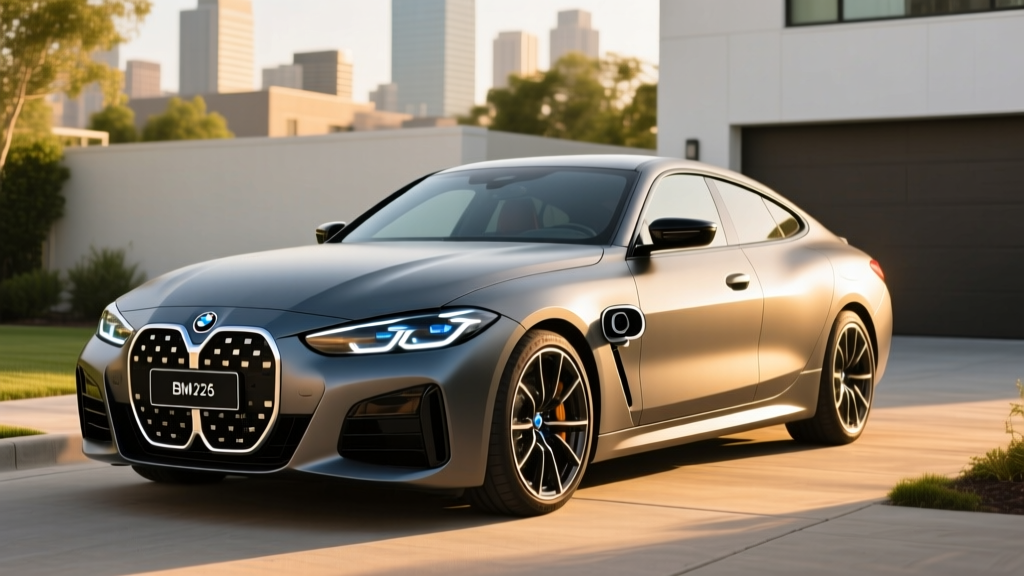
The BMW i4 remains one of the most convincing arguments for electrifying a traditional sport sedan. Rather than forcing buyers into an unfamiliar silhouette, BMW took the proven 4 Series Gran Coupe platform and threaded an 81.5 kWh (usable) NMC battery pack underneath. The result for 2026 is an EV that drives like a BMW first and an electric car second — with the efficiency, range, and charging speed to back it up on real road trips.
Three trims anchor the lineup: the rear-wheel-drive eDrive40, the dual-motor all-wheel-drive xDrive40, and the performance flagship M50. Each targets a different buyer, but all share the same fundamental promise: 300+ miles of EPA range (on the eDrive40), premium build quality, and access to Tesla's Supercharger network via BMW's NACS adoption.
Range, Efficiency, and Real-World Expectations
The i4 eDrive40 carries an EPA-estimated 318 miles of range on its 81.5 kWh usable battery, translating to roughly 100 MPGe combined or about 33 kWh per 100 miles. The dual-motor xDrive40 drops to an EPA-estimated 282 miles, while the M50 — with its 536 horsepower and sportier tuning — sits at 269 miles (fueleconomy.gov).
EPA estimates assume a mix of city and highway driving at moderate temperatures. In practice:
- Highway cruising (75 mph, 70°F): Expect roughly 270–285 miles from the eDrive40 before needing a charger. Aerodynamic drag cuts efficiency noticeably above 70 mph.
- Cold weather (30°F, mixed driving): Plan for 220–250 miles of usable range. The i4's heat pump (standard on 2026 models) mitigates cabin-heating losses, but battery chemistry still suffers in the cold.
- City/regenerative driving: You may exceed the EPA sticker, approaching 320–330 miles thanks to aggressive regen braking recapturing energy.
Bottom line: budget around 260 miles of comfortable range for road-trip planning in the eDrive40, less for the M50.
Charging Speed: DC Fast, Level 2, and the NACS Advantage
Charging infrastructure access is where the 2026 i4 makes a significant leap. BMW now equips all new i4 models with a native NACS (Tesla-style) charge port, eliminating the need for a CCS-to-NACS adapter at Supercharger stalls. This opens access to over 20,000 Tesla V3 and V4 Superchargers across North America — currently the most reliable DC fast-charging network available.
| Charge Level | Power / Rate | Time / Range Added | Notes |
|---|---|---|---|
| Level 1 (120V household) | ~1.4 kW | ~3–4 miles per hour | Emergency/trickle only; ~80+ hours for full charge |
| Level 2 (240V home/public) | Up to 11 kW (48A) | ~30–35 miles per hour; full charge in ~9 hours | Requires 60A circuit; typical home install |
| DC Fast Charge (peak) | Up to 205 kW | 10–80% in ~31 minutes | Peak rate held to ~30% SoC, then tapers |
| DC Fast Charge (average 10–80%) | ~140 kW sustained avg | ~180 miles added in 31 min | Real-world curve: strong below 50%, steep taper above 80% |
Charging curve reality: The i4's peak 205 kW is achievable only when the battery is preconditioned (via the navigation system's automatic battery prep) and the state of charge is below roughly 30%. Above 50% SoC, the rate drops to approximately 100–120 kW, and above 80% it falls below 50 kW. This is typical for NMC chemistry — if you're road-tripping, plan your stops between 10% and 80% for the fastest sessions.
Performance and Drivetrain Breakdown
The i4 lineup offers three distinct personalities, all built on BMW's CLAR platform with a low-slung battery pack that contributes to a near 50/50 weight distribution.
| Spec | eDrive40 | xDrive40 | M50 |
|---|---|---|---|
| Drivetrain | RWD (single motor) | AWD (dual motor) | AWD (dual motor, M-tuned) |
| Horsepower | 335 hp | 396 hp | 536 hp |
| Torque | 317 lb-ft | 435 lb-ft | 586 lb-ft |
| 0–60 mph | 5.5 seconds | 4.6 seconds | 3.7 seconds |
| EPA Range | 318 miles | 282 miles | 269 miles |
| Top Speed | 118 mph | 130 mph | 140 mph (electronically limited) |
The eDrive40 is the volume seller and the range champion. Its single rear motor delivers smooth, linear acceleration that's more than adequate for daily driving and highway merging. The xDrive40 adds a front motor for all-weather confidence and a meaningful bump in passing power. The M50 is a legitimate sports sedan — its 3.7-second 0–60 time puts it in the territory of a Porsche Taycan 4S, though the M50 is heavier and less agile at the limit.
All trims feature adaptive regenerative braking that adjusts recuperation based on traffic and navigation data, plus a traditional one-pedal driving mode selectable through the iDrive menu.
Pricing, Trims, and Federal Tax Credit Eligibility
The 2026 BMW i4 starts at $52,200 MSRP (eDrive40, before destination). Here's how the lineup stacks up:
| Trim | Base MSRP | As-Tested (Typical Options) | Est. Federal Credit (§30D) | Effective Price |
|---|---|---|---|---|
| eDrive40 | $52,200 | $57,500 | Up to $7,500* | From ~$44,700* |
| xDrive40 | $57,200 | $63,000 | Up to $7,500* | From ~$49,700* |
| M50 | $68,300 | $78,000 | Up to $7,500* | From ~$60,800* |
*Federal tax credit caveats (IRS §30D, 2026 rules): The full $7,500 credit is not guaranteed for every buyer or every i4. Eligibility depends on:
- MSRP cap: Sedans must be at or below $55,000 MSRP. The eDrive40 base qualifies; adding packages can push it over. The xDrive40 and M50 base MSRPs exceed the sedan cap — check your exact build sheet (irs.gov).
- Buyer income limits: Modified AGI must not exceed $150,000 (single), $225,000 (head of household), or $300,000 (joint).
- Battery sourcing requirements: Increasingly strict critical-mineral and battery-component rules apply. BMW's supply chain has been adapting, but eligible credit amounts may be reduced (e.g., $3,750 if only one of two sourcing requirements is met). Confirm with your dealer and a tax professional before relying on the full credit.
- Point-of-sale transfer: You can transfer the credit to the dealer at purchase, reducing your out-of-pocket cost immediately — even if your tax liability is lower than the credit amount.
Interior, Cargo, and Daily Livability
The i4 shares its interior architecture with the 4 Series Gran Coupe, meaning you get BMW's latest Curved Display — a 12.3-inch instrument cluster fused with a 14.9-inch infotainment touchscreen running iDrive 8.5. Wireless Apple CarPlay and Android Auto are standard, along with a Wi-Fi hotspot and over-the-air update capability.
Passenger space:
- Front legroom: 41.5 inches
- Rear legroom: 34.4 inches — adequate for adults on shorter trips, but the sloping roofline limits headroom for taller passengers
- Front headroom: 39.1 inches (without moonroof)
Cargo volume:
- Behind rear seats: 16.6 cubic feet (hatchback-style liftgate aids loading)
- Rear seats folded: 45.7 cubic feet
- No front trunk (frunk) — the space is occupied by drive electronics
The hatchback design is a practical advantage over traditional trunk sedans, but cargo space trails SUV-style EVs like the Tesla Model Y (30.2 cu ft rear) and Hyundai Ioniq 5 (27.2 cu ft rear). If you regularly haul bulky items or a family, the i4's Gran Coupe form factor is a compromise.
Driver Assistance, Technology, and Safety
Every 2026 i4 comes with BMW's Active Driving Assistant Professional, which bundles:
- Adaptive cruise control with stop-and-go
- Lane-keeping assist with active side-collision protection
- Extended traffic jam assist (hands-off at up to 40 mph on divided highways, eyes-off monitoring via interior camera)
- Parking Assistant Plus with surround-view cameras and automated parking
BMW's Active Driving Assistant Professional is a Level 2 driver-assistance system. The driver must remain engaged, keep hands near the wheel (or eyes on the road in traffic-jam mode), and be prepared to take over at any moment. This is not autonomous driving. No production BMW offers Level 3 or higher automation in the U.S. market.
The i4 earned top marks from the IIHS, including a Top Safety Pick+ designation when equipped with the LED adaptive headlights. NHTSA ratings carry over at 5 stars overall (nhtsa.gov).
Notable tech drawbacks:
- The iDrive 8.5 system buries climate controls in the touchscreen — there are no physical buttons for temperature or fan speed, which frustrates some drivers.
- BMW's subscription model for certain features (heated seats, remote start in some markets) has drawn criticism, though most 2026 U.S. models now include these as standard on higher trims.
- The driver-monitoring camera can be overly sensitive, issuing warnings even when the driver is clearly attentive.
Battery Warranty, Degradation, and Long-Term Ownership
BMW covers the i4's high-voltage battery with an 8-year / 100,000-mile warranty that guarantees the battery will retain at least 70% of its original capacity. The broader powertrain warranty runs 4 years / 50,000 miles, matching BMW's standard new-vehicle coverage.
The i4 uses NMC (nickel manganese cobalt) lithium-ion cells supplied by CATL and Samsung SDI, depending on production batch. NMC offers higher energy density than LFP (which is why the i4 achieves 318 miles in a relatively compact pack), but it is more sensitive to sustained high states of charge. BMW recommends:
- Setting a daily charge limit of 80–85% for routine use
- Charging to 100% only before long road trips
- Using the built-in battery preconditioning when navigating to a DC fast charger
Real-world degradation data from European i4 fleets (2022–2025 models) suggests approximately 5–8% capacity loss after 60,000 miles of mixed use — well within the warranty threshold. Battery replacement cost, if ever needed out of warranty, is estimated at $14,000–$18,000 for the full pack, though individual module replacement may be possible at lower cost.
Who Should Buy the BMW i4 Electric — and Who Shouldn't
Pros
- Class-leading driving dynamics — genuinely engaging for a sport sedan
- 318-mile EPA range on eDrive40 is competitive with Tesla Model 3 Long Range
- Native NACS port opens Tesla Supercharger access without adapters
- Premium interior materials and build quality exceed Model 3
- Hatchback utility adds practicality over traditional sedans
- Strong resale value relative to luxury EV segment
Cons
- Rear seat and cargo space trail SUV-style EV competitors
- xDrive40 and M50 MSRPs exceed the $55K sedan cap for full federal credit
- 205 kW peak DC charge rate is slower than Hyundai Ioniq 5 (240 kW) and Lucid Air (300+ kW)
- No front trunk (frunk) for additional storage
- iDrive 8.5 touchscreen-only climate controls are a step backward for ergonomics
- M50's weight (4,890 lbs) is noticeable on twisty roads
- Choose the i4 eDrive40 if: You want a premium daily-driver EV with 300+ miles of range, sporty handling, and a luxury badge — and you don't need SUV-level cargo space.
- Choose the i4 xDrive40 if: You need all-wheel drive for snow-belt winters and value passing power, but accept the ~36-mile range penalty.
- Look elsewhere if: You need maximum rear-seat room, family-friendly cargo capacity (consider the BMW iX, Tesla Model Y, or Genesis Electrified GV70), or you want the fastest possible DC charging (Hyundai Ioniq 5 or Kia EV6).
Frequently Asked Questions
What is the real-world range of the BMW i4 electric?
The eDrive40 is EPA-rated at 318 miles, but expect roughly 270–285 miles on highway road trips and 220–250 miles in freezing weather. City driving with regenerative braking can push you past the EPA estimate.
How fast does the i4 charge at home and on the road?
At home on a Level 2 (240V, 48A) charger, the i4 adds about 30–35 miles of range per hour, reaching a full charge overnight in roughly 9 hours. On a DC fast charger, it peaks at 205 kW and charges from 10–80% in about 31 minutes, though sustained rates average closer to 140 kW.
Does the BMW i4 qualify for the $7,500 federal EV tax credit?
It depends on the trim, your income, and battery sourcing. The eDrive40's base MSRP of $52,200 falls under the $55,000 sedan cap, making it potentially eligible for the full $7,500 credit if you meet income limits (§30D: $150K single, $300K joint) and battery-sourcing requirements. The xDrive40 and M50 base prices exceed the cap. Always verify with IRS guidelines and a tax professional.
Is the BMW i4 worth buying over the Tesla Model 3 or Hyundai Ioniq 5?
If you prioritize driving dynamics, interior quality, and a traditional luxury-sedan experience, the i4 is hard to beat. The Tesla Model 3 Highland offers more range (341 mi Long Range) and faster Supercharging at a lower price, but can't match the i4's cabin refinement. The Hyundai Ioniq 5 charges faster (10–80% in ~18 min) and offers more cargo space, but its driving feel is less engaging. It comes down to what you value most.
What is the battery warranty on the 2026 BMW i4?
BMW provides an 8-year / 100,000-mile battery warranty guaranteeing at least 70% capacity retention. The new-vehicle and powertrain warranty is 4 years / 50,000 miles.
Does the 2026 i4 have a NACS or CCS charge port?
All 2026 BMW i4 models sold in North America come with a native NACS (Tesla-style) charge port, providing direct access to Tesla Superchargers without an adapter. CCS adapters are available if you need access to older Electrify America or ChargePoint stations that haven't added NACS cables.