The 2025 Audi Q6 e-tron arrives on Volkswagen Group's dedicated Premium Platform Electric (PPE) architecture, co-developed with Porsche. It slots between the Q4 e-tron and the larger Q8 e-tron, targeting the premium midsize electric SUV segment against the BMW iX, Tesla Model X, and Mercedes-Benz EQE SUV. Below, we break down every spec that matters to buyers — from the 100 kWh battery pack to the 270 kW DC fast-charging peak — and translate marketing numbers into what you'll actually experience on the road and at the charger.
2025 Audi Q6 e-tron Core Specifications at a Glance
| Specification | Q6 e-tron (RWD) | Q6 e-tron quattro (AWD) | SQ6 e-tron (Performance) |
|---|---|---|---|
| EPA Range | 321 mi | 308 mi | 284 mi |
| Battery (usable) | 94.9 kWh (NMC) | 94.9 kWh (NMC) | 94.9 kWh (NMC) |
| Horsepower | 456 hp (launch control) | 456 hp (launch control) | 509 hp (launch control) |
| 0-60 mph | 5.0 sec | 4.7 sec | 4.3 sec |
| Drivetrain | Rear-Wheel Drive | Dual-Motor AWD | Dual-Motor AWD |
| Max DC Fast Charge | 270 kW | 270 kW | 270 kW |
| 10-80% DC Charge Time | ~21 min | ~21 min | ~21 min |
| Level 2 Charge Rate | 11.5 kW (AC) | 11.5 kW (AC) | 11.5 kW (AC) |
| MPGe (combined) | 96 MPGe | 92 MPGe | 87 MPGe |
| Base MSRP | $65,095 | $67,095 | $73,295 |
Source: fueleconomy.gov and Audi USA. Specs reflect the 2025 model year. SQ6 e-tron EPA figures are estimated pending final certification.
Range, Efficiency, and Real-World Expectations
EPA Estimated Range: 321 miles (RWD) / 308 miles (quattro AWD)
Real-World Expectation: Plan for 260–280 miles on sustained highway driving at 70+ mph. In cold weather (below 32°F), expect a 20–30% reduction, bringing usable range to roughly 200–240 miles on the AWD variant. City driving with heavy regenerative braking recovers energy and can match or slightly exceed the EPA figure.
The Q6 e-tron's 94.9 kWh usable battery (100 kWh gross) uses nickel-manganese-cobalt (NMC) chemistry, chosen for its high energy density. This gives Audi the cell-level efficiency to push past 300 miles in a midsize luxury SUV without excessive weight.
Efficiency comes in at approximately 33 kWh per 100 miles for the RWD model — competitive with the BMW iX xDrive50 (35 kWh/100 mi) but trailing the more aerodynamically optimized Tesla Model X (31 kWh/100 mi). The PPE platform's 800-volt electrical architecture contributes meaningfully here: thinner cables, lower resistive losses, and more efficient power electronics.
One practical note for road-trippers: Audi's navigation system includes route-based battery preconditioning. When you set a DC fast charger as your destination, the thermal management system warms or cools the pack to its optimal charging temperature before you arrive. This is essential for achieving that advertised 270 kW peak — skip preconditioning and your first several minutes at the charger will be noticeably slower.
Charging Speed: DC Fast, Level 2, and What It Means for Owners
The 800V architecture is the Q6 e-tron's strongest ownership advantage. Here's the full charging picture:
| Charging Level | Max Power | Speed | Typical Use Case |
|---|---|---|---|
| Level 1 (120V household) | 1.4 kW | ~4 mi/hr added | Emergency top-up only |
| Level 2 (240V home/public) | 11.5 kW | ~32 mi/hr added | Daily home charging; full 10-100% in ~9.5 hours |
| DC Fast Charge (CCS/NACS) | 270 kW peak | 10-80% in ~21 min | Road trips; ~160 miles added in 10 min at peak |
The charging curve matters more than the peak number. The Q6 e-tron sustains above 200 kW from roughly 10% to 45% state of charge before tapering. From 45% to 80%, power drops progressively to around 120-150 kW. Above 80%, charging slows dramatically to protect the NMC cells — a 70-100% top-off can take as long as the 10-70% session. For road trips, the optimal strategy is to charge to 80% and go; the time penalty for pushing to 100% at a DC fast charger rarely justifies the extra ~60 miles.
Audi has confirmed the Q6 e-tron will ship with a NACS (Tesla Supercharger) port in North America, granting access to the Supercharger network's 350 kW V4 stalls. A CCS-to-NACS adapter will be included for compatibility with Electrify America, EVgo, and other legacy CCS networks during the transition period.
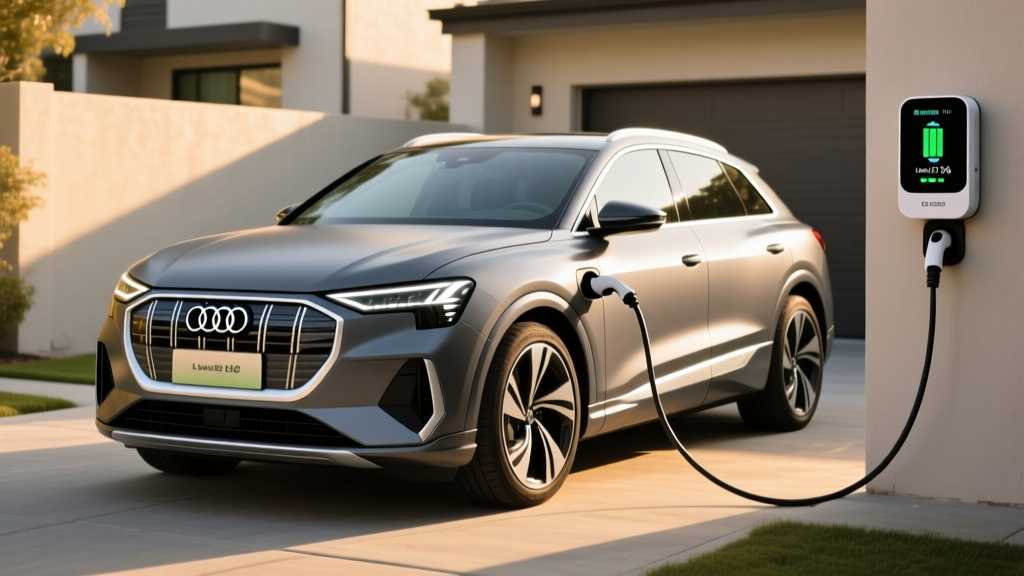
For home Level 2 charging, plan on a 48-amp circuit with a hardwired wall connector to deliver the full 11.5 kW. A typical overnight session (10 hours) adds approximately 300 miles — enough to fully replenish the battery for most daily drivers. Installation costs for a Level 2 home setup typically run $800–$2,000 depending on panel capacity and conduit distance; if your home has a 100-amp electrical panel, a panel upgrade to 200 amps may add $1,500–$3,000.
Performance and Driving Dynamics
The Q6 e-tron lineup offers three powertrain configurations:
- Q6 e-tron (RWD): Single rear motor, 456 hp with launch control (435 hp sustained), 5.0-second 0-60. This is the efficiency-focused variant and the range leader at 321 miles.
- Q6 e-tron quattro (AWD): Dual-motor all-wheel drive, 456 hp with launch control, 4.7-second 0-60. The front motor is a permanently excited synchronous unit that disengages under light loads to reduce drag losses.
- SQ6 e-tron: Dual-motor AWD with a performance-oriented rear motor, 509 hp with launch control, 4.3-second 0-60. The sport-tuned adaptive air suspension and rear-axle torque vectoring sharpen handling, though the 284-mile range is the trade-off.
All variants feature Audi's two-stage launch control system. Hold the brake and accelerator simultaneously, and the system pre-tensions the drivetrain for maximum off-the-line acceleration. Engage it twice in quick succession, and the battery management system will impose a cooldown to protect cell temperatures — a detail worth knowing if you're demonstrating the car to a friend at a stoplight.
The adaptive air suspension (standard on Prestige trim, optional on Premium Plus) offers five ride-height settings and adjusts damping continuously. In Dynamic mode, the Q6 e-tron hunkers down 20mm for improved aerodynamics on the highway; in Off-Road mode, it raises 25mm for light trail use. Ground clearance ranges from approximately 6.9 to 8.5 inches depending on setting.
Towing capacity is rated at 4,400 pounds with the factory tow package — sufficient for a small boat trailer or a lightweight camping trailer, but not heavy horse trailers or large campers.
Interior Space, Cargo, and Technology
The Q6 e-tron's PPE platform gives it a flat floor and a generous 110.6-inch wheelbase, translating to interior volume that punches above its midsize classification:
- Front legroom: 41.2 inches
- Rear legroom: 38.4 inches
- Cargo behind second row: 28.7 cu ft
- Cargo with rear seats folded: 60.4 cu ft
- Front trunk (frunk): 2.3 cu ft (sufficient for charging cables and a small bag)
The dashboard is dominated by Audi's new "Digital Stage" — an 11.9-inch OLED driver display seamlessly curved into a 14.5-inch central infotainment screen, with an available 10.9-inch passenger display featuring an active privacy filter so the driver isn't distracted. The infotainment runs a new Android Automotive-based operating system with native Google Maps navigation, Google Assistant voice control, and over-the-air update capability.
An augmented-reality head-up display projects navigation arrows and ADAS alerts onto what appears to be the road 650 feet ahead. It's one of the most legible AR-HUD implementations in the segment, with minimal latency in curve guidance.
Notable technology includes:
- Adaptive Cruise Assist with Lane Guidance: SAE Level 2 driver assistance combining adaptive cruise, lane centering, and traffic-jam assist. The driver must keep hands on the wheel (capacitive sensing) and eyes on the road.
- Park Assist Plus with Remote Parking: The car can autonomously pull into and out of tight spaces while the driver stands outside using the myAudi app.
- Matrix LED headlights with digital light signatures: Eight customizable daytime running light patterns selectable from the infotainment screen — a personalization touch unique to Audi's EV lineup.
ADAS Limitation Notice: Adaptive Cruise Assist is an SAE Level 2 system. It does not drive the car autonomously. The driver must remain fully engaged, monitor traffic, and be prepared to take over instantly. It is not comparable to Waymo's Level 4 robotaxi service. Hands-off driving is not permitted or supported.
Pricing, Trim Levels, and Federal Tax Credit Eligibility
The 2025 Q6 e-tron is offered in three trim tiers across its powertrain variants:
| Model / Trim | Base MSRP | Federal Tax Credit (§30D) | Effective Price (if eligible) |
|---|---|---|---|
| Q6 e-tron Premium (RWD) | $65,095 | Up to $7,500 | ~$57,595 |
| Q6 e-tron Premium Plus (RWD) | $69,095 | Up to $7,500 | ~$61,595 |
| Q6 e-tron Prestige (RWD) | $73,095 | Up to $7,500 | ~$65,595 |
| Q6 e-tron quattro Premium Plus | $71,095 | Up to $7,500 | ~$63,595 |
| SQ6 e-tron Premium Plus | $73,295 | Up to $7,500 | ~$65,795 |
| SQ6 e-tron Prestige | $77,295 | Up to $7,500 | ~$69,795 |
Federal tax credit eligibility is not automatic. Under IRS §30D rules, the Q6 e-tron must satisfy several requirements to qualify for the full $7,500 credit:
- MSRP cap: SUVs must have an MSRP at or below $80,000. All Q6 e-tron trims clear this threshold.
- Buyer income cap: Adjusted gross income must not exceed $150,000 (single), $225,000 (head of household), or $300,000 (married filing jointly).
- Battery sourcing requirements: At least a specified percentage of critical minerals must be sourced from the U.S. or a free-trade-agreement partner, and battery components must be manufactured or assembled in North America. The Q6 e-tron's PPE battery pack is assembled in Audi's facility, and Audi has indicated compliance, but the IRS periodically updates the qualified vehicle list. Always verify before purchasing.
- Point-of-sale transfer: Buyers can elect to transfer the credit to the dealer at the time of purchase, reducing the purchase price directly rather than waiting for a tax refund.
As-tested pricing for a well-equipped Q6 e-tron quattro Premium Plus with the S Line package, panoramic glass roof, and 21-inch wheels landed at approximately $78,400 before destination charges. This positions it firmly against the BMW iX xDrive50 ($87,250 base) as the more affordable option, though the Tesla Model X Long Range ($79,990) undercuts on price while offering more range.
Warranty Coverage and Long-Term Ownership
Audi backs the Q6 e-tron with its standard EV warranty package:
- Basic vehicle warranty: 4 years / 50,000 miles
- Battery and high-voltage powertrain: 8 years / 100,000 miles, covering defects and capacity loss below 70% of original capacity
- Roadside assistance: 4 years / unlimited miles, including out-of-charge towing to the nearest charger
- Corrosion perforation: 12 years / unlimited miles
The 70% capacity retention threshold over 8 years is industry-standard and consistent with BMW, Mercedes, and Hyundai's battery warranties. Real-world NMC degradation data from similar 800V packs (Porsche Taycan, Hyundai Ioniq 5) suggests most owners will retain 88–92% capacity at the 100,000-mile mark under normal charging habits — well above the warranty threshold.
To maximize battery longevity: avoid routinely charging to 100% on DC fast chargers, use Level 2 for daily charging with the charge limit set to 80%, and take advantage of the Q6 e-tron's scheduled charging feature to minimize time spent at high state-of-charge in hot weather.
Pros, Cons, and Who the Q6 e-tron Suits Best
Pros
- 270 kW DC fast charging is among the fastest in the segment — 10-80% in 21 minutes
- 800V architecture enables sustained high-power charging, not just a brief peak
- NACS port standard for direct Tesla Supercharger access
- Augmented-reality HUD and triple-screen Digital Stage are genuinely useful, not gimmicky
- Air suspension with adjustable ride height adds versatility
- MSRP stays below the $80,000 §30D SUV cap across all trims
- Build quality and material finish exceed Tesla and match BMW iX
Cons
- 321-mile max range (RWD) trails the Tesla Model X (348 mi) and Rivian R1S (352 mi)
- 2.3 cu ft frunk is disappointingly small — barely fits charging cables
- No hands-free Level 2+ driving system comparable to GM Super Cruise or Ford BlueCruise
- Cargo volume (28.7 cu ft) is tight for a vehicle in this price class
- SQ6 e-tron's 284-mile range is a significant penalty for the performance upgrade
- Base price of $65,095 is steep, even with the tax credit
Who Should Buy the Q6 e-tron?
Choose the Q6 e-tron if: You prioritize charging speed over maximum range, value Audi's interior craftsmanship, want native Supercharger access without adapter dependency, and regularly take road trips where the 21-minute 10-80% charge saves meaningful time.
Look elsewhere if: Maximum range is your top priority (consider the Tesla Model X or Lucid Gravity), you need maximum cargo space for a growing family (Rivian R1S offers 105 cu ft with seats folded), or you want a true hands-free highway driving system (GM Super Cruise on the Cadillac Lyriq).
Frequently Asked Questions
What is the real-world range of the 2025 Audi Q6 e-tron?
The EPA rates the RWD model at 321 miles and the quattro AWD at 308 miles. In real-world highway driving at 70-75 mph, expect 260-280 miles. In cold weather below freezing, range drops to approximately 200-240 miles depending on cabin heating use. The standard heat pump mitigates some cold-weather loss by scavenging waste heat from the drivetrain.
How fast does the Q6 e-tron charge at home and on the road?
At a DC fast charger, the Q6 e-tron peaks at 270 kW and charges from 10-80% in approximately 21 minutes, adding roughly 160 miles in the first 10 minutes at peak power. At home on a 240V Level 2 charger (11.5 kW), it adds about 32 miles per hour — a full overnight session restores the entire battery.
Does the 2025 Audi Q6 e-tron qualify for the federal EV tax credit?
The Q6 e-tron is expected to qualify for up to $7,500 under IRS §30D, as all trims fall below the $80,000 MSRP cap for SUVs. However, eligibility depends on the buyer's income (capped at $150K single / $300K joint), battery critical-mineral sourcing compliance, and the vehicle appearing on the IRS qualified vehicle list at time of purchase. The credit can be transferred to the dealer at point of sale for an immediate price reduction. Verify current eligibility at IRS.gov before finalizing your order.
Is the Q6 e-tron worth buying over the BMW iX or Tesla Model X?
The Q6 e-tron's advantage is charging speed — its 270 kW peak and 800V architecture outpace both the BMW iX (200 kW peak) and Tesla Model X (250 kW peak). The BMW iX offers a more spacious cabin and a more comfortable ride, while the Model X wins on range (348 mi) and Supercharger network maturity. If fast road-trip charging and Audi's tech interface are your priorities, the Q6 e-tron is the strongest pick. If maximum space and range matter more, the Model X or Rivian R1S are worth cross-shopping.
What connector does the Q6 e-tron use?
The 2025 Q6 e-tron for North America ships with a NACS (North American Charging Standard) port, providing direct access to Tesla Superchargers without an adapter. A CCS adapter is included in the vehicle for use at Electrify America, EVgo, and other public CCS stations during the network transition.
How does the SQ6 e-tron differ from the standard Q6 e-tron?
The SQ6 e-tron adds 53 hp (509 total with launch control), drops 0-60 from 4.7 to 4.3 seconds, and includes a sport-tuned adaptive air suspension with stiffer damping. The trade-off is range: the SQ6 is rated at approximately 284 miles versus 308 for the standard quattro. If driving engagement is a priority and you charge at home nightly, the range sacrifice is manageable. For frequent road-trippers, the standard quattro is the better balance.