Quick Verdict: The Refined Luxury EV That Plays It Safe
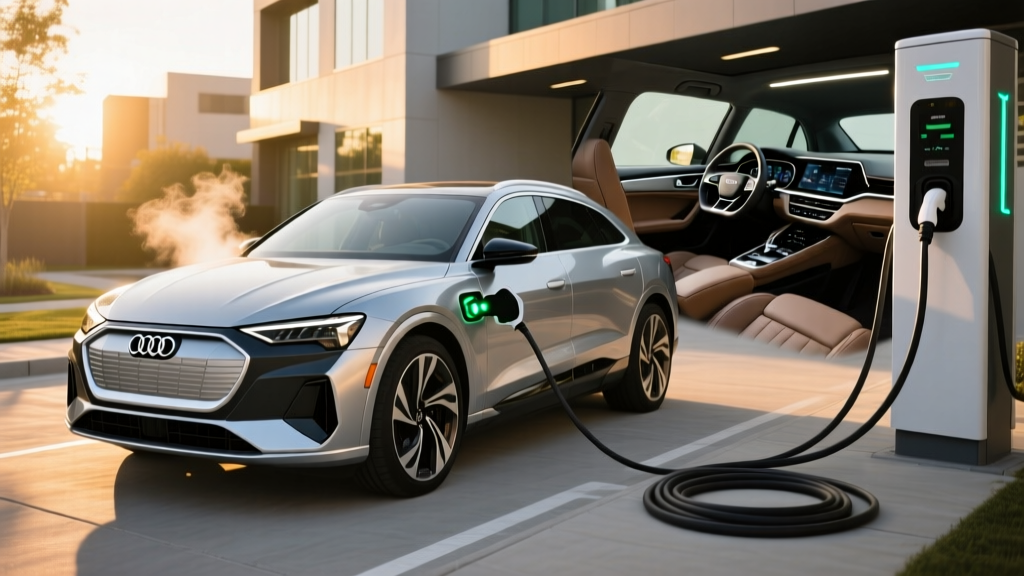
Audi renamed its pioneering e-tron SUV to the Q8 e-tron for the 2024 model year, and the 2025 Audi e-tron — officially badged as the 2025 Audi Q8 e-tron — carries forward with meaningful battery and range improvements over the original. If you're searching for the 2025 Audi e-tron, you're looking at a midsize luxury electric SUV that prioritizes cabin refinement, ride comfort, and understated design over headline-grabbing range or acceleration numbers.
The 2025 Q8 e-tron delivers up to 285 miles of EPA-estimated range (Premium Plus trim with 20-inch wheels), a usable battery of 106 kWh, and peak DC fast-charging at 170 kW. It's a compelling pick for luxury buyers who want a quiet, well-built daily driver with Audi's virtual cockpit and MMI infotainment — but it faces stiff competition from the BMW iX, Mercedes EQE SUV, and Tesla Model X on range and charging speed.
| Spec | Q8 e-tron (SUV) | Q8 Sportback e-tron |
|---|---|---|
| EPA Range (max) | 285 mi | 300 mi |
| Battery (usable / gross) | 106 kWh / 114 kWh | 106 kWh / 114 kWh |
| Battery Chemistry | NMC (Nickel Manganese Cobalt) | NMC |
| Peak DC Fast Charge | 170 kW | 170 kW |
| 10–80% DC Charge Time | ~22 min | ~22 min |
| Level 2 Home Charging | 19.2 kW (48A) | 19.2 kW (48A) |
| Drivetrain | Dual-motor AWD (quattro) | Dual-motor AWD (quattro) |
| Horsepower (Boost Mode) | 402 hp | 402 hp |
| 0–60 mph | 5.5 sec | 5.5 sec |
| MPGe (combined) | 83 MPGe | 87 MPGe |
| Efficiency | 40 kWh/100 mi | 38 kWh/100 mi |
| Cargo Volume (rear seats up) | 28.5 cu ft | 27.2 cu ft |
| Cargo Volume (rear seats folded) | 56.4 cu ft | 53.5 cu ft |
| Base MSRP (Premium) | $75,695 | $79,095 |
Real-World Range: What to Expect Beyond the EPA Sticker
The EPA rates the 2025 Audi Q8 e-tron SUV at 285 miles on the Premium Plus trim with 20-inch wheels, dropping to approximately 271 miles on Prestige trims with 21-inch wheels due to increased rolling resistance and weight. The Sportback variant, with its sleeker roofline, achieves up to 300 miles EPA — a meaningful 15-mile bump from aerodynamics alone.
Real-World Range Expectations — Q8 e-tron SUV (285 mi EPA):
- Mixed city/suburban driving (65–75°F): ~270–290 mi — regenerative braking in stop-and-go traffic helps recover energy
- Highway cruising at 70–75 mph: ~235–255 mi — the boxy SUV profile creates significant drag above 65 mph
- Cold weather (20–35°F) with cabin heat: ~200–230 mi — NMC chemistry loses efficiency in cold; the heat pump (standard) mitigates some loss
- Towing (max 4,000 lbs): ~150–180 mi — expect roughly 40–50% range reduction under load
Source: EPA estimates via fueleconomy.gov; real-world figures based on owner reports and independent testing.
The Q8 e-tron's 114 kWh gross battery (106 kWh usable) provides a substantial energy buffer. Audi uses a conservative top and bottom buffer to protect long-term battery health — you'll never see 100% of the gross capacity accessible on the dash. The standard heat pump is a welcome inclusion for cold-climate owners; it uses roughly 30–40% less energy for cabin heating compared to resistive PTC heaters found in some competitors.
One practical note: the Q8 e-tron's efficiency of 40 kWh/100 mi (combined) is on the higher side for this segment. For comparison, the BMW iX xDrive50 achieves 35 kWh/100 mi, and the Tesla Model X Long Range sits around 38 kWh/100 mi. That means you'll pay slightly more per mile to charge the Audi, though the difference is measured in pennies per mile at typical electricity rates.
Charging Speed: DC Fast Charging and Home Setup
Charging speed is where the 2025 Audi e-tron story gets nuanced. The Q8 e-tron peaks at 170 kW on DC fast chargers, which is respectable but trails competitors like the Hyundai Ioniq 5 (240 kW), BMW iX (200 kW+), and Lucid Air (300+ kW). Here's what that translates to in real charging sessions:
| Charging Level | Power / Voltage | Miles Added per Hour | Typical Use Case |
|---|---|---|---|
| Level 1 (120V outlet) | ~1.4 kW | ~3–4 mi/hr | Emergency/overnight trickle |
| Level 2 (240V, 48A) | 19.2 kW | ~50–55 mi/hr | Home daily charging (full charge ~6.5 hrs) |
| Level 2 (240V, 32A) | 7.7 kW | ~20–22 mi/hr | Portable/mobile charger |
| DC Fast Charge (peak) | 170 kW (CCS) | ~550+ mi/hr (at peak) | Road trips; 10–80% in ~22 min |
Understanding the DC Charging Curve
The 170 kW peak is not sustained across the entire charging session. The Q8 e-tron holds strong charging power from roughly 10% to 40% State of Charge (SoC), then begins tapering. From 40–60%, expect ~120–140 kW. From 60–80%, the rate drops to ~80–100 kW. Above 80%, charging slows dramatically to protect battery health — plan to unplug at 80% on road trips to maximize your time-to-miles ratio.
The 10–80% charge time of approximately 22 minutes is competitive for highway rest stops but means you'll wait a few minutes longer than Ioniq 5 or EV6 owners at the same charger. On Electrify America or ChargePoint 350 kW stations, the Q8 e-tron will only pull what it can accept — no benefit from ultra-fast infrastructure beyond its 170 kW ceiling.
Connector note: The 2025 Q8 e-tron uses the CCS1 (Combined Charging System) connector for DC fast charging and the J1772 connector for Level 2 AC. Audi has confirmed future models will adopt the NACS (Tesla) connector, but the 2025 model year retains CCS. You can use Tesla Superchargers with a CCS-to-NACS adapter (sold separately, ~$200–250), which significantly expands your fast-charging network options.
Home Charging Setup
The Q8 e-tron's onboard charger supports up to 19.2 kW on Level 2 (48 amps on a 240V circuit). To take advantage of this, you'll need a hardwired Level 2 station rated for 60 amps (EV chargers require a circuit rated at 125% of continuous load). A typical home installation with a ChargePoint Home Flex or Wallbox Pulsar Plus on a 60A circuit will fully recharge the 106 kWh usable battery in approximately 6–7 hours.
If your home has a 50A circuit (common for older panels), you'll charge at ~40A / 9.6 kW, extending a full charge to ~12 hours — still fine for overnight replenishment of a partially depleted battery. Most owners who charge nightly from 30–70% SoC will see a full top-up in 3–4 hours at 9.6 kW.
Performance and Driving Dynamics
The 2025 Q8 e-tron uses a dual-motor all-wheel-drive powertrain (Audi's electric quattro system) producing 355 hp in standard mode and 402 hp in boost mode (activated via kickdown or launch control). Torque peaks at 490 lb-ft. The 0–60 mph time of 5.5 seconds is brisk but not thrilling by EV standards — the BMW iX xDrive50 hits 60 in 4.4 seconds, and the Tesla Model X Plaid is in a different universe at 2.5 seconds.
Where the Q8 e-tron excels is ride quality and isolation. Standard adaptive air suspension soaks up road imperfections with composure, and the cabin is remarkably quiet at highway speeds — Audi's acoustic glass and extensive sound deadening make this one of the quietest EVs in its class. The steering is light and precise, though not sporty. This is a grand-touring cruiser, not a corner carver.
The SQ8 e-tron variant (separate review) bumps output to 496 hp and 0–60 in 4.4 seconds, with sport-tuned suspension and larger brakes, at a starting price around $96,495.
Regenerative Braking
Audi offers three regen levels selectable via steering-wheel paddles, plus an "Auto" mode that uses radar and navigation data to modulate regen based on traffic and terrain ahead. Unlike some competitors, the Q8 e-tron does not offer true one-pedal driving to a complete stop — the vehicle creeps at very low speeds unless you apply the brake. This is a deliberate Audi design choice and may frustrate drivers accustomed to Nissan Leaf or Chevrolet Bolt-style one-pedal operation.
Interior, Cargo, and Technology
The Q8 e-tron's cabin is a showcase of Audi's material quality: standard leather upholstery, real aluminum and wood inlays, and a triple-screen dashboard layout. The 12.3-inch Virtual Cockpit (driver display), 10.1-inch upper MMI touchscreen (infotainment/navigation), and 8.6-inch lower touchscreen (climate/shortcuts) create a tech-forward but slightly button-heavy environment.
Passenger Space
- Front headroom: 38.6 inches
- Front legroom: 41.2 inches
- Rear headroom: 38.0 inches
- Rear legroom: 39.2 inches
Rear-seat space is generous for two adults and acceptable for three across. The flat floor (no transmission tunnel) helps middle-passenger comfort. However, the Sportback's sloping roofline cuts rear headroom by roughly an inch — taller passengers will notice.
Cargo Capacity
The SUV offers 28.5 cu ft behind the rear seats and 56.4 cu ft with seats folded. The front trunk (frunk) is a modest ~2.5 cu ft — enough for a charging cable bag but not much else. This is a weak point versus the Tesla Model X (which has a far larger frunk) and even the Rivian R1S.
Driver Assistance
Audi's Adaptive Cruise Assist bundles adaptive cruise control, lane centering, and traffic-jam assist. It's an SAE Level 2 system — the driver must keep hands on the wheel and remain attentive. It's competent for highway driving but lacks the automated lane-change confidence of GM's Super Cruise or Ford's BlueCruise on mapped highways. Audi does not currently offer a hands-free driving system in the U.S. market.
Pricing, Trims, and Federal Tax Credit Eligibility
The 2025 Audi Q8 e-tron lineup starts at $75,695 for the Premium trim (SUV body style) including destination. Here's the trim breakdown:
| Trim | Body Style | MSRP (incl. destination) | Est. After §30D Credit* |
|---|---|---|---|
| Premium | SUV | $75,695 | See eligibility below |
| Premium Plus | SUV | $81,395 | See eligibility below |
| Prestige | SUV | $87,095 | See eligibility below |
| Premium | Sportback | $79,095 | See eligibility below |
| Premium Plus | Sportback | $84,795 | See eligibility below |
| Prestige | Sportback | $90,495 | See eligibility below |
*Federal tax credit eligibility depends on battery sourcing, buyer income, and MSRP caps. See details below.
Does the 2025 Audi Q8 e-tron Qualify for the Federal EV Tax Credit?
This is where the Q8 e-tron faces challenges under current IRS §30D rules. The federal EV tax credit offers up to $7,500, split into two halves: $3,750 for battery-component sourcing and $3,750 for critical-minerals sourcing. To qualify, a vehicle must meet all of the following requirements:
- MSRP cap: SUVs must have an MSRP at or below $80,000. The Q8 e-tron Premium ($75,695) and Premium Plus ($81,395) trims straddle this line — the Premium SUV qualifies on price, but Premium Plus and Prestige exceed the cap.
- Buyer income cap: Modified adjusted gross income (MAGI) must not exceed $300,000 (married filing jointly), $225,000 (head of household), or $150,000 (single).
- Battery sourcing: Battery components must be manufactured or assembled in North America (phased thresholds increase yearly), and critical minerals must be sourced from the U.S. or free-trade-agreement countries. Audi's battery supply chain for the Q8 e-tron has historically struggled to meet these requirements.
- Point-of-sale transfer: If eligible, the credit can now be transferred to the dealer at purchase, reducing the purchase price directly rather than waiting for a tax refund.
Current status: As of the 2025 model year, the Q8 e-tron has had limited or partial eligibility for the §30D credit depending on the specific build date and battery batch. Always verify current eligibility on the IRS's official qualifying vehicles list before purchasing. Do not assume the full $7,500 applies — confirm with your Audi dealer and a tax professional.
Battery Warranty, Longevity, and Ownership Costs
Audi provides a 8-year / 100,000-mile battery warranty for the Q8 e-tron's high-voltage battery, covering defects and capacity loss below 70% of original capacity. The general vehicle warranty is 4 years / 50,000 miles (bumper-to-bumper), which is competitive with BMW and Mercedes but trails Hyundai/Kia's 5-year/60,000-mile coverage.
The 106 kWh usable NMC battery is liquid-cooled with an active thermal management system that preconditions the battery during navigation to a charger — a critical feature for maintaining fast-charge speeds and long-term health. Based on data from the original e-tron (which used a smaller 84 kWh usable pack), owners have reported 5–8% degradation over 100,000 miles, which is well within the warranty threshold.
Estimated 5-Year Ownership Cost
Assuming 12,000 miles/year, $0.14/kWh home electricity, and partial DC fast charging:
- Annual electricity cost: ~$670 (at 40 kWh/100 mi)
- Comparable gas SUV (22 MPG, $3.50/gal): ~$1,910/year
- Annual fuel savings: ~$1,240
- 5-year fuel savings: ~$6,200
Factor in potentially higher insurance premiums (EVs typically cost 10–20% more to insure than comparable gas vehicles), and the net savings narrow. Depreciation on luxury EVs has been steep in recent years — expect the Q8 e-tron to retain roughly 40–48% of its value after 5 years, based on current market trends for the segment.
How It Compares: Q8 e-tron vs. Key Rivals
Range Winner: BMW iX xDrive50 — 324 mi EPA vs. 285 mi for the Q8 e-tron, with similar luxury positioning and a more efficient powertrain.
Charging Speed Winner: Hyundai Ioniq 5 / Kia EV6 — 240 kW peak on 800V architecture (10–80% in ~18 min), though these are priced $25K+ lower.
Ride Comfort Winner: Audi Q8 e-tron — Air suspension and cabin isolation are best-in-class for this price bracket.
Tech/Infotainment Winner: BMW iX — Curved display with iDrive 8.5 is more modern; Audi's triple-screen feels dated by 2025 standards.
Cargo Practicality Winner: Tesla Model X — Far more frunk space, available third row, and standard NACS Supercharger access.
Value Winner: Genesis Electrified GV70 — Similar luxury feel, 236-mi range, starts ~$10K lower, and eligible for the full $7,500 credit.
Pros and Cons
Pros
- Exceptionally quiet and refined cabin — among the best NVH in the luxury EV segment
- Standard air suspension provides a supple, adaptive ride
- 106 kWh usable battery offers solid range buffer for road trips
- Strong build quality with premium materials throughout
- 19.2 kW Level 2 onboard charger is among the fastest in class for home charging
- 4,000-lb towing capacity is practical for light trailers and boats
Cons
- 170 kW peak DC charging trails key rivals (iX, Ioniq 5, Model X)
- Efficiency of 40 kWh/100 mi is below average — costs more per mile to charge
- Tiny frunk (~2.5 cu ft) wastes the space advantage of an EV platform
- Partial or no federal tax credit eligibility depending on trim and sourcing
- Infotainment triple-screen layout feels busy and dated vs. newer competitors
- No true one-pedal driving mode — a missed opportunity for EV-native driving
- Higher MSRP than rivals with more range (iX starts ~$3K less with 324 mi)
Who Should Buy the 2025 Audi Q8 e-tron?
Choose the Q8 e-tron if:
- You prioritize ride comfort, cabin quietness, and build quality over maximum range
- You have reliable home Level 2 charging and don't rely heavily on DC fast charging
- You want a luxury SUV with understated styling that doesn't scream "EV"
- You value Audi's dealer network and service infrastructure in your area
- You need 4,000-lb towing capability in an electric SUV
Look elsewhere if:
- Maximum range is your top priority (consider the BMW iX xDrive50 at 324 mi or the Tesla Model X at 335 mi)
- You road-trip frequently and want the fastest possible DC charging (Hyundai Ioniq 5, Kia EV6, or Porsche Macan EV)
- You want the full $7,500 federal tax credit (Genesis Electrified GV70, certain Tesla Model Y builds)
- You want a third row (Tesla Model X, Rivian R1S, Kia EV9)
- You prefer cutting-edge infotainment and OTA updates (Tesla, BMW iX with iDrive 8.5)
Frequently Asked Questions
What is the real-world range of the 2025 Audi Q8 e-tron?
The EPA rates it at 285 miles (SUV, 20-inch wheels). In real-world mixed driving, expect 250–270 miles in moderate weather, dropping to 200–230 miles in cold conditions or sustained highway driving above 70 mph. The Sportback variant achieves up to 300 miles EPA due to better aerodynamics.
How fast does the Q8 e-tron charge at home and on the road?
At home on a 240V/48A Level 2 charger, it accepts up to 19.2 kW, adding roughly 50–55 miles of range per hour and fully charging in about 6.5 hours. On DC fast chargers, it peaks at 170 kW and charges from 10–80% in approximately 22 minutes, tapering significantly above 80% SoC.
Does the 2025 Audi Q8 e-tron qualify for the $7,500 federal tax credit?
Eligibility is limited and uncertain. The Premium SUV trim ($75,695) falls under the $80,000 MSRP cap for SUVs, but battery-component and critical-mineral sourcing requirements under IRS §30D may disqualify some or all of the credit. Always check the official IRS qualifying list and consult a tax professional before relying on the credit in your purchase decision.
Is the Q8 e-tron worth buying over the BMW iX or Tesla Model X?
It depends on your priorities. The Q8 e-tron wins on ride comfort and cabin refinement. The BMW iX offers more range (324 mi), faster charging, and a more modern interior at a similar price. The Tesla Model X provides Supercharger access, more cargo space, and an available third row. If ride quality and understated luxury matter most, the Audi is the strongest pick in this trio.
What is the battery warranty on the 2025 Q8 e-tron?
Audi covers the high-voltage battery for 8 years or 100,000 miles, whichever comes first. The warranty guarantees the battery will retain at least 70% of its original capacity during that period. The general bumper-to-bumper warranty is 4 years / 50,000 miles.
Can I use Tesla Superchargers with the Q8 e-tron?
Not natively — the 2025 Q8 e-tron uses the CCS1 connector. However, you can purchase a CCS-to-NACS adapter (~$200–250) to access Tesla's Supercharger network, which adds thousands of fast-charging locations to your options. Audi has indicated future models will adopt NACS natively.
How much does it cost to charge the Q8 e-tron vs. fueling a gas SUV?
At a national average of $0.14/kWh for home electricity, a full charge (106 kWh usable) costs roughly $14.84 and provides ~265 real-world miles. A comparable gas SUV at 22 MPG with $3.50/gallon fuel costs about $42 for the same distance. Annual fuel savings are approximately $1,200–1,400 for a driver covering 12,000 miles/year, depending on local electricity and gas prices.