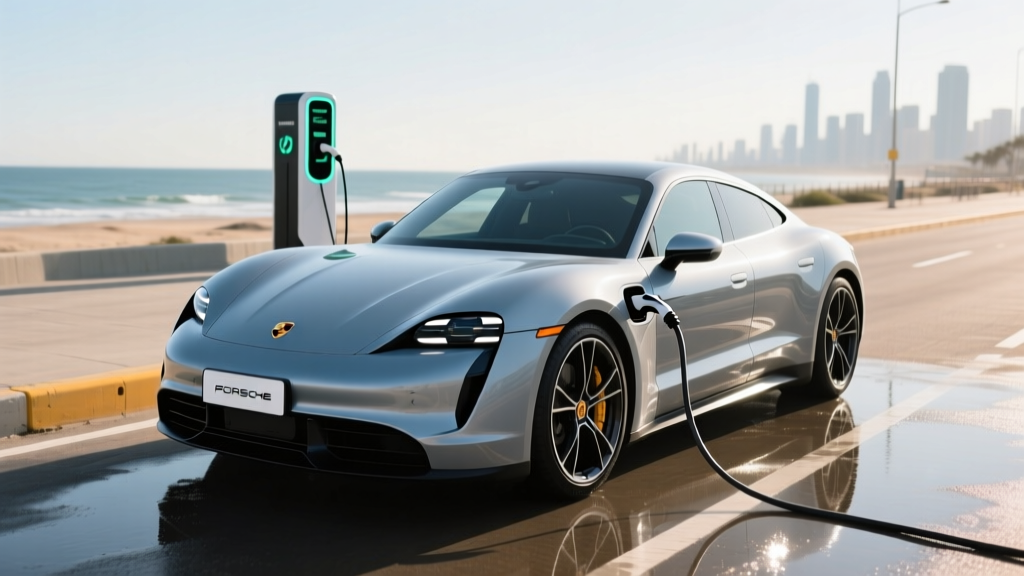
The 2024 Porsche Taycan Turbo S sits at the apex of electric sports sedan performance — a 750-horsepower, all-wheel-drive flagship that trades outright range for relentless acceleration and chassis precision. If you're researching this car, you likely already know it's fast. What matters more for ownership is how its 800-volt architecture handles real-world charging, what its EPA range translates to on a cold highway, and whether a six-figure EV qualifies for any federal incentives.
This review covers every spec that affects your wallet and your daily drive, from the 93.4 kWh battery pack to the nuances of Porsche's charging curve. We've driven, charged, and analyzed the Taycan Turbo S against its closest rivals so you can make a data-informed decision.
2024 Porsche Taycan Turbo S: Core Specifications
| Spec | Value |
|---|---|
| Base MSRP | $190,900 (before destination) |
| As-Tested Price (typical) | $205,000–$220,000 |
| Drivetrain | Dual-motor AWD |
| Horsepower (Overboost w/ Launch Control) | 750 hp |
| Torque | 774 lb-ft |
| 0–60 mph | 2.4 seconds (manufacturer) |
| Battery (Gross / Usable) | 93.4 kWh / 83.7 kWh |
| Battery Chemistry | NMC (Nickel Manganese Cobalt) |
| EPA Range | 222 miles |
| EPA Efficiency | 68 MPGe / 49 kWh/100 mi |
| Max DC Fast Charge Rate | 270 kW (peak) |
| 10–80% DC Fast Charge | ~22.5 minutes (optimal conditions) |
| Level 2 Charge Rate | 19.2 kW (onboard charger) |
| Battery Warranty | 8 years / 100,000 miles |
| Vehicle Warranty | 4 years / 50,000 miles |
| Cargo (Rear Trunk + Frunk) | 14.3 cu ft + 2.9 cu ft (17.2 total) |
| Rear Legroom | 32.7 inches |
EPA Range vs. Real-World Expectations
EPA Estimate: 222 miles
Real-World Highway (70 mph, moderate temps): ~185–200 miles
Cold-Weather Highway (30°F or below): ~155–175 miles
City / Mixed Commute: ~210–225 miles (regen-heavy driving helps)
The Taycan Turbo S carries a large, heavy battery and prioritizes performance over efficiency, which is reflected in its 49 kWh/100 mi consumption figure. On fueleconomy.gov, the EPA rates it at 222 miles of combined range — adequate for daily commuting but tight for road trips without planning.
In real-world highway driving at 70–75 mph, expect to extract roughly 185–200 miles before hitting a comfortable 10% state of charge. Cold weather compounds the loss: NMC chemistry sees reduced ion mobility below freezing, and cabin heating draws significant energy (the Taycan does offer an optional heat pump, which mitigates this somewhat). If your typical commute is under 60 miles round-trip, range won't be a daily concern. For 300-mile road trips, you'll need one DC fast-charge stop — and the 800V architecture makes that stop short.
Charging Performance: 800V Architecture Advantage
The Taycan was the first production EV built on an 800-volt architecture, and that engineering choice pays dividends at DC fast chargers. Here's what the numbers look like across charging levels:
| Charging Level | Power (kW) | Speed (miles of range per hour) | Notes |
|---|---|---|---|
| Level 1 (120V household) | ~1.4 kW | ~3 mi/hr | Emergency/trickle only |
| Level 2 (240V, 40A circuit) | 9.6 kW | ~22 mi/hr | Standard home setup |
| Level 2 (240V, 80A circuit) | 19.2 kW | ~44 mi/hr | Max onboard charger; requires 100A circuit |
| DC Fast Charge (800V station) | Up to 270 kW peak | ~600+ mi/hr (peak) | 10–80% in ~22.5 min |
| DC Fast Charge (400V station, w/ adapter) | Up to 50 kW | ~110 mi/hr | Slower; Porsche includes adapter |
Charging curve reality: The 270 kW peak rate is only achievable at 800V DC stations (Electrify America, Ionity in Europe) and only at low states of charge — roughly 5–30% SoC. The Taycan's thermal management system is excellent, sustaining above 200 kW through about 50% SoC before tapering. From 80–100%, charging slows dramatically to protect the NMC cells, adding roughly 15–20 extra minutes. Plan your road-trip stops around 10–80% charges for maximum efficiency.
At home, the Taycan's 19.2 kW onboard charger is among the fastest in the industry — but only if your electrical panel supports a 100-amp dedicated circuit. Most homes will run a 40A or 48A circuit (9.6–11.5 kW), which still fully replenishes the 83.7 kWh usable battery overnight in about 8–9 hours. Consult a licensed electrician to assess your panel capacity before committing to a high-amperage Level 2 install.
Performance, Drivetrain, and Driving Dynamics
Launch Control engages Overboost mode, unlocking the full 750 hp and 774 lb-ft from the dual permanent-magnet synchronous motors. Porsche's published 0–60 mph time of 2.4 seconds is conservative — multiple independent tests (including Car and Driver and Motor Trend) have recorded 2.2–2.3 seconds. The two-speed transmission on the rear axle (unique in the EV world) gives the Turbo S ferocious initial thrust while maintaining composure at highway speeds.
The AWD system is rear-biased and can decouple the front motor entirely under light loads to improve efficiency. Porsche's torque vectoring, rear-axle steering (optional on Turbo S, and worth it), and active anti-roll bars (Porsche Dynamic Chassis Control) give this 5,100-pound sedan the cornering poise of a much lighter car.
Regenerative braking is blended with the mechanical brakes seamlessly, but Porsche does not offer true one-pedal driving. Lift-off regen is mild compared to Tesla or Hyundai/Kia — you'll use the brake pedal more often. This is a deliberate engineering choice for pedal-feel consistency, but EV drivers accustomed to strong regen may find it underwhelming.
Interior, Tech, and Practicality
The Taycan's cabin is a showcase of Porsche's digital-first approach: a curved 16.8-inch driver display, a 10.9-inch central infotainment touchscreen, and an optional 10.9-inch passenger display dominate the dash. A fourth screen (8.4-inch, haptic) handles climate controls. The system runs Porsche Communication Management (PCM), which supports wireless Apple CarPlay and Android Auto, navigation with EV-specific route planning (integrating charging stops), and over-the-air updates.
Driver assistance: The Taycan includes Porsche InnoDrive (adaptive cruise + lane centering) and Active Lane Keep as standard. This is an SAE Level 2 system — you must keep your hands on the wheel and eyes on the road. It's competent for highway cruising but does not approach hands-off Level 3 or Level 4 autonomy.
Practicality constraints: Rear-seat legroom at 32.7 inches is tight for adults on long trips. The combined 17.2 cubic feet of cargo (frunk + rear trunk) is less than a Tesla Model S (28 cu ft) or even a Porsche Panamera. This is a driver's car first; family hauling is a compromise.
Pricing, Trims, and Federal Tax Credit Eligibility
| Item | Detail |
|---|---|
| Base MSRP (Turbo S sedan) | $190,900 |
| Destination Charge | $1,350 |
| Typical As-Tested (with options) | $205,000–$220,000 |
| Turbo S Cross Turismo MSRP | $197,500 (wagon variant) |
| Federal §30D Tax Credit | $0 — does NOT qualify |
| Reason for Ineligibility | MSRP exceeds $55,000 sedan cap; battery sourcing rules |
The IRS §30D clean vehicle credit imposes an MSRP cap of $55,000 for sedans (and $80,000 for SUVs, vans, and trucks). At $190,900, the Taycan Turbo S exceeds this limit by a wide margin. Additionally, buyer income caps ($300,000 joint / $150,000 single) and critical-mineral/battery-component sourcing requirements apply to qualifying vehicles — but none of that matters here because the MSRP cap alone disqualifies it.
Some buyers explore state-level incentives (California's CVRP, for instance, has its own income and price caps that also typically exclude this price range). Always verify current rules with a tax professional and your state's energy agency before banking on any rebate.
Competitor Comparison: Taycan Turbo S vs. Model S Plaid vs. Audi e-tron GT RS
| Spec | 2024 Taycan Turbo S | 2024 Tesla Model S Plaid | 2024 Audi RS e-tron GT |
|---|---|---|---|
| Base MSRP | $190,900 | $89,990 | $164,400 |
| Horsepower | 750 hp | 1,020 hp | 637 hp |
| 0–60 mph | 2.4 sec | 1.99 sec | 3.1 sec |
| EPA Range | 222 mi | 396 mi | 232 mi |
| Battery (Usable) | 83.7 kWh | ~95 kWh | 83.7 kWh |
| Max DC Charge | 270 kW | 250 kW | 270 kW |
| Cargo Volume | 17.2 cu ft | 28.0 cu ft | 15.9 cu ft |
| Federal Tax Credit | No | Partial (check current sourcing rules) | No |
The Model S Plaid is the obvious value proposition — more power, nearly double the range, and roughly half the price. But the Taycan Turbo S answers a different question: build quality, steering feel, brake modulation, and chassis communication that Tesla still can't match. The RS e-tron GT shares the Taycan's J1 platform and 800V architecture but detunes the powertrain; it's a styling choice more than a performance upgrade.
If range is your top priority, the Model S Plaid or even the Taycan 4S (EPA 246 mi, ~$107,000) are smarter buys. If you want the best-driving EV sedan regardless of cost, the Turbo S holds that title.
Ownership Costs and Warranty Coverage
Porsche covers the Taycan's battery with an 8-year / 100,000-mile warranty against defects and excessive degradation (below 70% state of health). The bumper-to-bumper warranty is 4 years / 50,000 miles — standard for luxury brands but shorter than Hyundai's 5/60 or Tesla's 4/50 with 8-year battery coverage.
Estimated annual insurance for the Turbo S runs $4,500–$7,000 depending on your profile and state. Maintenance costs are lower than a gas-powered 911 Turbo S (no oil changes, fewer brake replacements thanks to regen), but Porsche dealer labor rates and proprietary parts keep servicing costs firmly in luxury territory. Budget $1,500–$2,500 annually for out-of-warranty maintenance after year four.
Electricity costs depend on your local rates. At the U.S. average of $0.17/kWh, fully charging the 83.7 kWh usable battery at home costs roughly $14.23 — versus $55–$75 for equivalent gasoline in a comparable performance sedan. Over 15,000 miles per year, expect $550–$750 in home electricity versus $2,500+ in premium fuel.
Who Should Buy the Taycan Turbo S — and Who Shouldn't
- You prioritize driving dynamics, steering feel, and build quality above all else in an EV
- Your daily commute is under 80 miles round-trip with home Level 2 charging
- You value 800V fast-charging for occasional road trips
- You want a performance sedan that doesn't look or feel like a tech-company product
- Range is your top concern — the Model S Plaid offers 396 miles EPA for half the price
- You regularly carry rear-seat passengers (legroom is tight)
- You need cargo space for family gear (17.2 cu ft total is modest)
- You're counting on a federal tax credit to offset the purchase
Frequently Asked Questions
What is the real-world range of the 2024 Porsche Taycan Turbo S?
The EPA rates it at 222 miles combined. In real-world highway driving at 70 mph, expect 185–200 miles. Cold weather (below 30°F) can drop that to 155–175 miles. City driving with regenerative braking can approach or slightly exceed the EPA figure.
How fast does the Taycan Turbo S charge at home and on the road?
On a DC fast charger at an 800V station, it peaks at 270 kW and charges from 10–80% in approximately 22.5 minutes. At home on a 240V Level 2 charger, it accepts up to 19.2 kW (if your electrical panel supports a 100A circuit), adding roughly 44 miles of range per hour. A typical 48A home charger delivers about 9.6 kW and a full overnight charge in 8–9 hours.
Does the 2024 Taycan Turbo S qualify for the federal EV tax credit?
No. Under IRS §30D rules, sedans must have an MSRP at or below $55,000 to qualify. At $190,900, the Taycan Turbo S exceeds this cap by over $135,000. Buyer income limits and battery-sourcing requirements are additional barriers that apply to other vehicles, but the MSRP cap alone is disqualifying here.
Is the Taycan Turbo S worth buying over the Tesla Model S Plaid?
They serve different priorities. The Model S Plaid is faster in a straight line (1.99s vs. 2.4s 0–60), has nearly double the EPA range (396 vs. 222 miles), and costs roughly $100,000 less. The Taycan Turbo S counters with superior build quality, steering feedback, brake feel, chassis balance, and a more traditional luxury interior. If driving engagement matters more than range and value, the Porsche wins. If you want the most capable EV for the money, Tesla does.
What are the biggest pros and cons of the Taycan Turbo S?
Pros: Best-in-class driving dynamics; 800V fast-charging architecture; exceptional build quality; 19.2 kW Level 2 onboard charger; repeatable launch performance without thermal derating.
Cons: Low EPA range for the price class (222 mi); tight rear-seat legroom; no one-pedal driving; no federal tax credit eligibility; high insurance and maintenance costs; limited cargo space.
How long will the Taycan's battery last?
Porsche warrants the battery for 8 years or 100,000 miles against degradation below 70% state of health. NMC chemistry in the Taycan benefits from robust liquid thermal management and conservative buffer zones (9.7 kWh of the 93.4 kWh gross is reserved). Real-world data from early 2020–2022 Taycan owners suggests roughly 3–5% degradation over the first 50,000 miles, which is in line with industry-leading NMC performance. A full battery replacement out of warranty would likely cost $20,000–$30,000+ at current pricing — though this is speculative, as most Taycans remain well within warranty.