Quick Answer: Is the Mercedes Electric CLA Worth Buying in 2026?
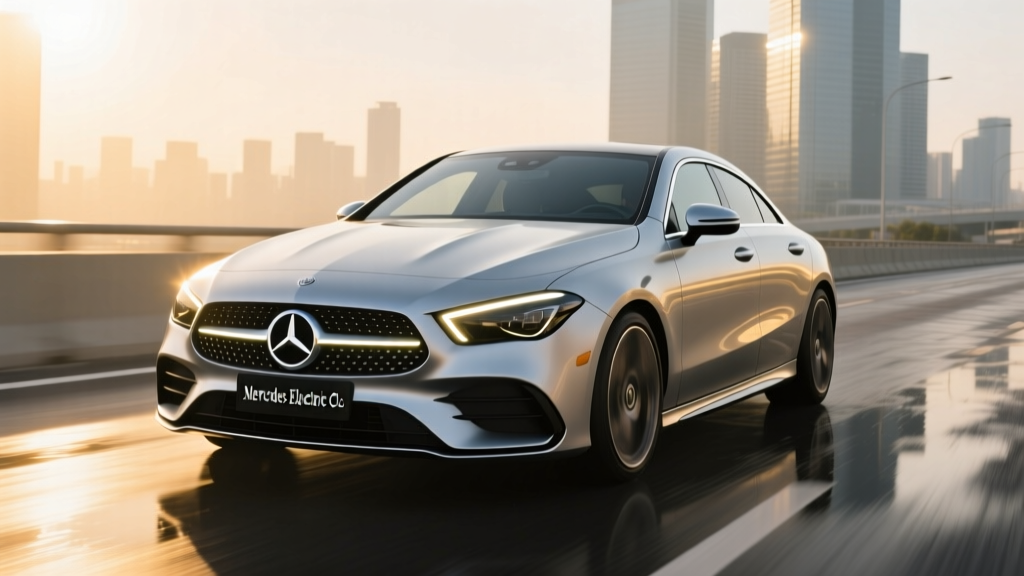
The Mercedes Electric CLA (officially the CLA EV, built on the MMA platform) is Mercedes-Benz's entry into the premium compact electric sedan segment. For 2026, it targets an EPA-estimated range of up to 310 miles on the rear-wheel-drive variant, with an 85 kWh usable NMC battery, DC fast charging at up to 250 kW (10–80% in approximately 17 minutes), and a starting MSRP around $43,000. It qualifies for a partial or full §30D federal tax credit depending on battery sourcing and buyer income — but final eligibility must be confirmed at point of sale. For buyers cross-shopping the Tesla Model 3, BMW i4, and Hyundai Ioniq 6, the Electric CLA's main draw is Mercedes interior refinement and MBUX tech, while its main trade-off is a slightly higher price of entry and a newer charging ecosystem compared to Tesla's Supercharger network.
Range, Battery, and Efficiency: What the Numbers Actually Mean
The 2026 Electric CLA rides on Mercedes' modular MMA (Mercedes Modular Architecture) platform, designed from the ground up for battery-electric propulsion. Here is the full specification breakdown for the announced variants:
| Specification | CLA EV RWD | CLA EV 4MATIC (AWD) |
|---|---|---|
| Usable Battery Capacity | 85 kWh (NMC) | 85 kWh (NMC) |
| EPA-Est. Range | ~310 mi | ~285 mi |
| Real-World Highway Range | ~260–275 mi | ~240–255 mi |
| Efficiency (MPGe Combined) | ~120 MPGe | ~108 MPGe |
| Peak DC Fast Charge Rate | 250 kW | 250 kW |
| 10–80% DC Charge Time | ~17 min | ~17 min |
| Level 2 (AC) Charge Rate | 11 kW | 11 kW |
| Horsepower | 268 hp | 349 hp |
| 0–60 mph | ~6.2 sec | ~4.8 sec |
| Drivetrain | Rear-Wheel Drive | Dual-Motor AWD |
Real-World Range Reality Check
The EPA sticker says ~310 miles for the RWD variant, but real-world conditions change that figure significantly. In highway testing at 70–75 mph with moderate climate control, expect 260–275 miles in mild weather. In cold conditions (below 32°F), battery chemistry and cabin heating can reduce range by 20–30%, bringing effective range down to roughly 215–250 miles. The Electric CLA uses a heat pump (standard on most trims), which mitigates cold-weather losses compared to resistive heating — but the drop is still measurable. If your typical commute is under 50 miles round-trip, this is a non-issue. For road trips exceeding 250 miles, plan one DC fast-charge stop.
The 85 kWh NMC (nickel-manganese-cobalt) pack offers high energy density but trades some cycle longevity versus LFP chemistry. Mercedes backs the battery with an 8-year/100,000-mile warranty guaranteeing at least 70% capacity retention — industry standard for the segment.
Charging Speed and Infrastructure: NACS, CCS, and Home Setup
Mercedes has committed to adopting the NACS (North American Charging Standard) connector for its US-market EVs starting with the MMA platform vehicles. This means the Electric CLA will be able to use Tesla Superchargers natively (or via adapter for early-production units), significantly expanding fast-charging access beyond the Electrify America, EVgo, and ChargePoint networks.
| Charging Level | Power (kW) | Miles of Range Added per Hour | Typical Use Case |
|---|---|---|---|
| Level 1 (120V household) | ~1.4 kW | ~4–5 mi/hr | Emergency/overnight trickle |
| Level 2 (240V home charger) | 11 kW | ~35–40 mi/hr | Daily home charging (~8 hr for full charge) |
| DC Fast Charging | Up to 250 kW | ~600+ mi/hr (peak) | Road trips, 10–80% in ~17 min |
Charging curve reality: The 250 kW peak rate is not sustained across the entire session. Like all modern EVs, the Electric CLA's charge rate tapers as the battery fills — you'll see peak speeds between roughly 10–40% SoC, with rates dropping to ~150 kW by 60% and ~50 kW above 80%. This is why manufacturers quote 10–80% times rather than 0–100%. Charging past 80% on DC fast chargers is slow and generates excess heat; for daily use, set your charge limit to 80% and only charge to 100% before long trips.
For home Level 2 charging, expect to install a 240V/48A hardwired wallbox. The Electric CLA's 11 kW onboard charger means it can accept the full output of a 48A circuit (11.5 kW theoretical, ~11 kW actual). A full charge from 10% takes roughly 7–8 hours — easily overnight.
Pricing, Trims, and Federal Tax Credit Eligibility
The 2026 Mercedes Electric CLA is positioned as a premium compact sedan, undercutting the EQE but sitting above entry-level competitors like the Hyundai Ioniq 6.
| Trim | Est. Base MSRP | Key Features |
|---|---|---|
| CLA 250 EV (RWD) | ~$43,000 | 85 kWh battery, MBUX, 11 kW AC charging, heat pump, Level 2 ADAS |
| CLA 250 EV 4MATIC | ~$47,000 | Dual-motor AWD, 349 hp, sport-tuned suspension |
| CLA 35 AMG EV | ~$55,000 | Performance AMG tuning, enhanced aero, upgraded interior |
§30D Federal Tax Credit Checklist (2026 Rules)
The Electric CLA may qualify for up to $7,500 in federal tax credits under IRS §30D, but eligibility depends on multiple factors:
- MSRP cap: Sedans must be priced at or below $55,000 — the CLA 250 RWD and 4MATIC qualify; the AMG variant may exceed the cap.
- Buyer income limits: AGI must not exceed $150,000 (single), $225,000 (head of household), or $300,000 (joint filers).
- Battery sourcing: A percentage of critical minerals and battery components must be sourced from the US or FTA partners. Mercedes has been ramping North American battery supply via partnerships, but the exact credit amount ($3,750 or $7,500) depends on the specific model year's sourcing compliance.
- Point-of-sale transfer: As of 2024+, buyers can transfer the credit to the dealer at purchase, reducing the purchase price directly rather than waiting for a tax refund.
- Verify before buying: Always confirm eligibility with your dealer and consult a tax professional — rules change and vary by build date.
Electric CLA vs. Gas CLA vs. Competing EVs: Cost Comparison
The previous-generation CLA was offered with a turbocharged 2.0L four-cylinder. Here is how the Electric CLA stacks up in annual fueling/charging costs:
| Metric | Electric CLA (RWD) | Gas CLA 250 (2024, 2.0T) | Tesla Model 3 RWD |
|---|---|---|---|
| EPA Combined Efficiency | ~120 MPGe (28 kWh/100 mi) | 30 MPG combined | 132 MPGe (25 kWh/100 mi) |
| Annual "Fuel" Cost (12,000 mi) | ~$470 (home charging @ $0.14/kWh) | ~$1,400 (gas @ $3.50/gal) | ~$420 (home charging @ $0.14/kWh) |
| Annual Maintenance Est. | ~$300 | ~$700 | ~$250 |
| Avg. Annual Insurance | ~$2,100 | ~$1,700 | ~$1,900 |
| Base MSRP | ~$43,000 | ~$38,000 | ~$39,000 |
| Est. Price After $7,500 Credit | ~$35,500 | N/A | ~$31,500 |
Key takeaway: The Electric CLA's operating cost advantage is substantial — roughly $930/year in fuel savings and $400/year in maintenance savings versus the gas CLA. Over a 5-year ownership period, that's approximately $6,650 in operating savings. However, insurance premiums for EVs tend to run 15–25% higher, partially offsetting savings. Net 5-year savings versus a gas CLA are approximately $4,500–5,500 after accounting for higher insurance and the federal tax credit applied to the EV's purchase price.
Real-World Ownership: What First-Time EV Buyers Must Know
Buying the Electric CLA — or any EV — requires different preparation than a gas car purchase. Here are the practical realities:
Home Charging Access Is the Single Biggest Factor
If you can install a Level 2 charger at home, EV ownership is seamless: plug in each evening, wake up to a full battery, and visit a DC fast charger only on road trips. A Level 2 installation typically costs $800–2,500 (charger unit + electrician + permit), depending on your panel capacity and wiring distance. If your electrical panel is maxed out at 100A, a panel upgrade to 200A can add $1,500–3,500. Get a quote from a licensed electrician before committing to the vehicle.
If you cannot charge at home (apartment, street parking, no garage), EV ownership becomes significantly more inconvenient. You'll rely on public Level 2 or DC fast charging, which costs 2–3x more per kWh than home charging and requires time and planning. The Electric CLA's NACS access to Superchargers helps, but daily public charging is not a sustainable long-term strategy for most owners.
Climate Matters More Than You Think
If you live in a region with harsh winters (sustained temps below 32°F), plan for 20–30% range loss in cold months. The heat pump helps, but physics is physics — cold lithium-ion cells have higher internal resistance, and cabin heating draws significant power. In contrast, hot climates (Arizona, Texas) have less range impact but can accelerate long-term battery degradation if the vehicle is regularly fast-charged in extreme heat. Mercedes' thermal management system actively cools the pack, mitigating this.
Driving Patterns Determine Whether EV Makes Sense
The Electric CLA is ideal if:
- Your daily commute is under 80 miles round-trip
- You have home or workplace Level 2 charging
- You take road trips 2–4 times per year (manageable with one DC stop per 250 miles)
- You value low operating costs and smooth, quiet acceleration
Consider a PHEV or gas car instead if:
- You regularly drive 300+ miles per day with no time to stop
- You have zero access to home or workplace charging
- You live in an area with extremely sparse public charging infrastructure
Smart Driving and Technology: MBUX and ADAS
The Electric CLA comes equipped with Mercedes' latest MBUX infotainment system on a hyperscreen-style display spanning the dashboard, along with the brand's suite of Level 2 driver-assistance features:
SAE Automation Level: Level 2
Mercedes' driver-assistance systems (Active Distance Assist DISTRONIC, Active Steering Assist, Active Lane Change Assist) are SAE Level 2 — the vehicle can manage speed, steering, and lane changes under specific conditions, but the driver must remain fully attentive and keep hands near the wheel at all times. This is not autonomous or "self-driving" capability. Only Level 4 services like Waymo operate without a human driver in the loop.
Mercedes has previously received approval for Level 3 (conditional automation, eyes off in limited traffic-jam scenarios) on the EQS in select jurisdictions, but this feature is not expected on the compact MMA platform at launch. Expect standard Level 2 ADAS with optional upgraded packages for automated lane changes and navigation-based speed adjustment.
Decision Framework: Should You Buy the Mercedes Electric CLA?
Choose the Electric CLA If:
- You want a premium compact EV sedan with Mercedes build quality and MBUX tech
- Your budget is $40,000–$50,000 after incentives
- You have home Level 2 charging or can install it
- You value NACS/Supercharger access for road trips
- You want 250+ miles of real-world range for daily driving and moderate road trips
Look Elsewhere If:
- Price is the top priority — the Tesla Model 3 and Hyundai Ioniq 6 offer similar range for $5,000–$10,000 less
- You need maximum cargo space — the CLA's sedan trunk is smaller than hatchback competitors
- You cannot charge at home and public charging infrastructure in your area is limited
- You want proven long-term reliability data — the MMA platform is new for 2026, so real-world longevity data doesn't yet exist
Common Misconceptions About the Electric CLA
| Myth | Fact |
|---|---|
| "The battery will need replacing in 5 years" | Modern NMC batteries with active thermal management typically retain 85–90% capacity after 100,000 miles. Mercedes warranties 70% retention at 8 years/100,000 miles. Most packs outlast the car. |
| "It charges as fast as filling a gas tank" | Even at 250 kW peak, a 10–80% charge takes ~17 minutes. A gas fill-up takes 3 minutes. EV charging is faster than ever, but not yet equivalent for road-trip convenience. |
| "The $7,500 tax credit applies to everyone" | The §30D credit has income caps ($150K single / $300K joint), MSRP caps ($55K for sedans), and battery-sourcing requirements. Not every buyer or every trim qualifies. |
| "It's just a gas CLA with a battery" | The Electric CLA sits on the dedicated MMA EV platform, not a converted ICE chassis. This means optimized weight distribution, a flat floor, and purpose-built thermal management. |
| "I can't take road trips" | With 250+ real-world miles and 250 kW DC fast charging (adding ~150 miles in 10 minutes), road trips require brief stops every 2.5–3 hours — roughly normal rest-stop cadence. |
Frequently Asked Questions
When will the Mercedes Electric CLA be available in the US?
Mercedes announced the production CLA EV for the 2025 model year in global markets, with US deliveries expected to begin in late 2025 as a 2026 model-year vehicle. Check with your local Mercedes-Benz dealer for availability, as initial supply may be limited.
Does the Electric CLA use NACS or CCS?
Mercedes has committed to NACS for its US-market EVs. The Electric CLA should ship with a native NACS port, giving it direct access to Tesla Superchargers without an adapter. Confirm with your dealer, as early-production vehicles may still ship with CCS and a NACS adapter included.
How much does it cost to charge the Electric CLA at home?
At the US average residential electricity rate of ~$0.14/kWh, a full 85 kWh charge costs approximately $11.90, yielding ~310 miles of EPA range. That's roughly $0.04 per mile — compared to $0.12–$0.14 per mile in a gas CLA at $3.50/gallon and 30 MPG.
Is the Electric CLA eligible for the $7,500 federal tax credit?
It may be, but eligibility depends on the specific build date's battery-sourcing compliance, your income, and the trim's MSRP. The RWD and 4MATIC trims (under $55,000 MSRP) are within the sedan cap. Verify with your dealer and consult the IRS clean vehicle credit page and fueleconomy.gov for the latest eligibility lists.
What is the warranty coverage?
Mercedes provides a 4-year/50,000-mile new-vehicle limited warranty and an 8-year/100,000-mile high-voltage battery warranty guaranteeing at least 70% state-of-health retention. This is standard for the luxury EV segment.
How does the Electric CLA compare to the Tesla Model 3?
The Model 3 offers slightly better efficiency (132 vs. ~120 MPGe), a lower starting price (~$39,000 vs. ~$43,000), and the mature Supercharger network. The Electric CLA counters with a more traditional luxury interior, Mercedes brand cachet, and MBUX tech. If interior quality and brand prestige matter more than price optimization, the CLA wins. If value and proven infrastructure are paramount, the Model 3 remains the benchmark.