Quick Verdict: The Driver's EV That Charges Like a Tesla
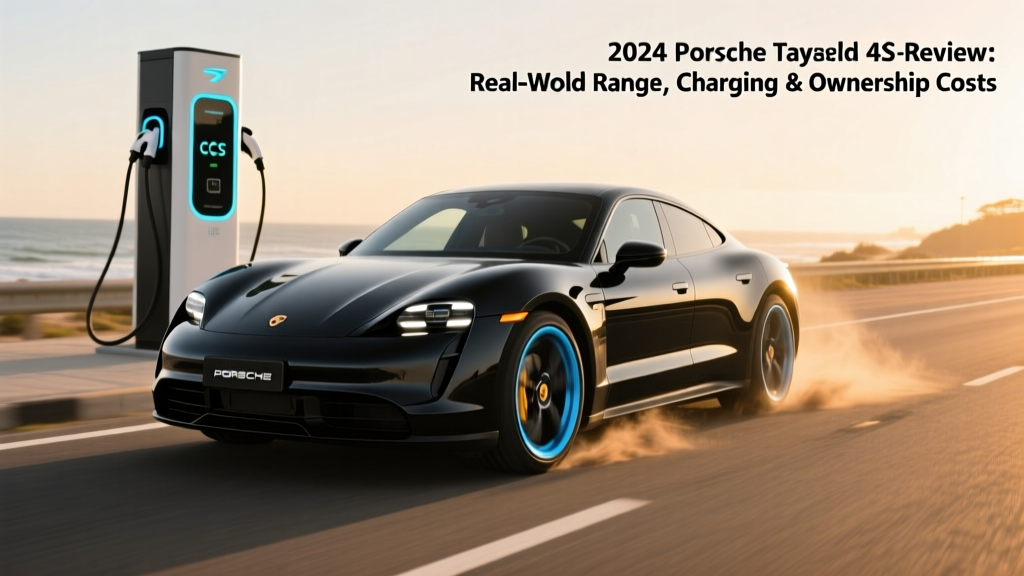
The 2024 Porsche Taycan 4S occupies a narrow but compelling niche: it's the electric sedan that prioritizes driving dynamics above all else while delivering charging speeds that rival or exceed anything from Tesla, Hyundai, or Lucid. With its 800-volt architecture, the Taycan 4S can accept up to 270 kW at a DC fast charger, adding roughly 180 miles of range in about 22 minutes under ideal conditions. But the 2024 model year carries a starting MSRP of $106,350 — well above the IRS §30D federal tax credit's MSRP cap for sedans — which means buyers should not expect the $7,500 credit to apply.
If you want the most range per dollar, look at a Tesla Model S or Lucid Air. If you want the sharpest chassis, the most repeatable performance, and the fastest public charging curve in the luxury-sedan segment, the Taycan 4S makes a strong case for itself. This review breaks down every number that matters.
Range and Efficiency: EPA vs. the Real World
Real-World Expectation: ~190–210 miles highway at 70 mph; ~160–180 miles in freezing temperatures with climate control active
The 2024 Taycan 4S comes standard with the Performance Battery (79.2 kWh usable, 710 lb-ft overboost) and is available with the larger Performance Battery Plus (93.4 kWh usable, 774 lb-ft overboost). The 227-mile EPA figure applies to the Battery Plus variant with 19-inch wheels; stepping to 20- or 21-inch wheels drops that to roughly 215–220 miles.
Porsche's 800-volt powertrain is remarkably efficient for a 4,900-pound AWD sedan. The EPA rates the Taycan 4S (Battery Plus) at 79 MPGe combined, translating to approximately 42 kWh per 100 miles. On the EPA's fueleconomy.gov listing, the Taycan 4S posts consistent numbers between city and highway driving, a rarity among performance EVs.
In real-world highway testing at sustained 70–75 mph speeds, expect to use around 38–44 kWh/100mi depending on temperature, elevation, and tire choice. Cold weather (below 32°F) typically reduces usable range by 15–25% due to cabin heating demands and battery chemistry limitations, even with the Taycan's standard heat pump. City driving with frequent regenerative braking opportunities pushes efficiency closer to the EPA sticker or slightly better.
| Spec | Performance Battery (Std) | Performance Battery Plus |
|---|---|---|
| Usable Battery Capacity | 79.2 kWh (NMC) | 93.4 kWh (NMC) |
| EPA Range | 206 mi | 227 mi (19" wheels) |
| Overboost Horsepower | 522 hp | 562 hp |
| 0–60 mph | 3.8 seconds | 3.8 seconds |
| Drivetrain | AWD (dual motor) | AWD (dual motor) |
| Top Track Speed | 155 mph | 155 mph |
| Max DC Fast Charge | 225 kW | 270 kW |
| MPGe (Combined) | 79 MPGe | 79 MPGe |
| Base MSRP | $106,350 | $112,640 (add ~$6,290) |
Charging Speed: 800V Architecture Pays Off
The Taycan's 800-volt electrical architecture is its most underappreciated advantage. While most EVs use 400V systems, doubling the voltage allows the Taycan to push more kilowatts through thinner cables with less heat buildup. The result is sustained fast-charging performance that few competitors match.
| Charging Level | Power | Speed / Time |
|---|---|---|
| Level 1 (120V household) | ~1.4 kW | ~3–4 miles per hour |
| Level 2 (240V home, 48A) | 11.5 kW (onboard charger) | ~27–30 miles per hour; full charge ~8–9 hours |
| DC Fast Charge (Battery Plus) | Up to 270 kW peak | 10–80% in ~22 minutes (ideal conditions) |
| DC Fast Charge (Std Battery) | Up to 225 kW peak | 10–80% in ~22 minutes (ideal conditions) |
Charging curve reality check: The 270 kW peak applies to the Battery Plus model at a compatible 350 kW charger (such as Electrify America's latest stalls) and only between approximately 10–40% state of charge. The curve tapers significantly above 55%, dropping to around 150 kW, and further to under 50 kW past 80%. This is normal lithium-ion behavior driven by cell-protection protocols, but it means a 10–90% session takes closer to 35–40 minutes, not 22.
For home charging, the Taycan 4S's 11.5 kW onboard AC charger is generous. A full charge from near-empty takes roughly 8–9 hours on a 48-amp Level 2 wall connector — easily overnight for any daily commute. Porsche recommends preconditioning the battery via the Porsche Charging Planner before arriving at a DC fast charger; this warms the cells to optimal temperature and can shave 3–5 minutes off your 10–80% time, especially in cooler weather.
The Taycan 4S uses the CCS1 connector standard for DC fast charging in North America. With the broader industry shift toward NACS (Tesla's connector), Porsche has confirmed future models will adopt NACS, but the 2024 Taycan remains CCS1. Adapters for Tesla Supercharger access are available from third-party manufacturers, though compatibility varies.
Performance and Driving Dynamics
The Taycan 4S's dual-motor all-wheel-drive system delivers 522 hp (standard battery) or 562 hp (Battery Plus) during overboost, which activates under hard acceleration via Launch Control. The 0–60 mph time of 3.8 seconds places it firmly in sports-sedan territory — quicker than a BMW M550i and within striking distance of the Tesla Model S Dual Motor (3.1 seconds, though the Model S costs less).
Where the Taycan separates itself from every EV competitor is chassis tuning. The standard adaptive air suspension with Porsche Active Suspension Management (PASM) delivers a ride quality that absorbs highway imperfections while maintaining flat cornering posture. Rear-axle steering (standard on 4S) shrinks the car's effective wheelbase at low speeds for tight parking maneuvers and extends it at highway speeds for stability. The brake pedal feel — often a weak point in EVs blending regenerative and friction braking — is among the most linear in the industry.
Thermal management is another Porsche strength. The Taycan's liquid-cooled battery and power electronics allow repeated hard launches without power derating. In back-to-back acceleration testing, the Taycan 4S delivers consistent 0–60 times where some competitors pull timing after two or three runs.
Interior, Tech, and Cargo Practicality
The Taycan's cabin is unmistakably Porsche: minimal, material-rich, and oriented around the driver. The 16.8-inch curved instrument cluster replaces a traditional gauge pod, flanked by a 10.9-inch central infotainment touchscreen and an optional 10.9-inch passenger display. A fourth screen (8.4-inch) handles climate controls and handwriting input on the center console.
Passenger space is adequate for four adults but not generous:
- Front legroom: 41.2 inches
- Rear legroom: 32.7 inches (tight for taller passengers)
- Front headroom: 38.9 inches
- Rear headroom: 36.5 inches
Cargo volume reflects the sedan's performance-first packaging:
- Trunk: 14.3 cubic feet (rear)
- Frunk (front trunk): 2.8 cubic feet — enough for a charging cable bag and a small duffel
The Taycan 4S is not a family hauler. Rear-seat space is tighter than a Tesla Model S (which offers 35.4 inches of rear legroom and 28 cu ft of cargo), and there is no third row or hatchback versatility. If cargo capacity is a priority, the Taycan Cross Turismo wagon variant offers significantly more utility.
Driver assistance is competent but conservative. Porsche InnoDrive (adaptive cruise + lane centering) is a SAE Level 2 system — the driver must keep hands on the wheel and eyes on the road at all times. It does not offer hands-free highway driving like GM's Super Cruise or Ford's BlueCruise. Night vision assist and surround-view cameras are available options.
Pricing, Trims, and Federal Tax Credit Eligibility
| Item | Amount |
|---|---|
| Base MSRP (Performance Battery) | $106,350 |
| Performance Battery Plus upgrade | +$6,290 |
| Typical as-tested price (well-equipped) | $120,000–$135,000 |
| Federal §30D Tax Credit | $0 — MSRP exceeds $55,000 sedan cap |
| Destination charge | $1,350 |
The 2024 Taycan 4S starts at $106,350 before destination. With the Battery Plus upgrade, premium packages (Adaptive Sport Seats Plus, Burmester audio, Sport Chrono), and 21-inch wheels, most well-equipped examples land between $120,000 and $135,000.
Federal tax credit eligibility: Under current IRS §30D rules, new clean vehicle credits are capped at $55,000 MSRP for sedans (and $80,000 for SUVs, vans, and trucks). The Taycan 4S, at $106,350 base, exceeds the sedan cap by more than double and does not qualify for the $7,500 federal credit regardless of buyer income or battery sourcing. Buyers should also be aware that §30D imposes adjusted gross income limits ($150,000 single / $300,000 joint filers) and critical-mineral/battery-component sourcing requirements — none of which matter here since the MSRP cap alone disqualifies the vehicle.
Some states offer additional rebates or HOV-lane access that may apply regardless of federal eligibility. Check your state's energy office or DMV for current programs. A tax professional can confirm whether any state-level credits apply to your situation.
Ownership Costs and Warranty
Warranty coverage:
- New vehicle limited warranty: 4 years / 50,000 miles
- Battery warranty: 8 years / 100,000 miles (guarantees minimum 70% state of health retention)
- Roadside assistance: 4 years / 50,000 miles
The battery warranty's 70% capacity retention threshold is industry-standard. Porsche's NMC (nickel manganese cobalt) cells have demonstrated strong longevity in early Taycan models; high-mileage examples exceeding 100,000 miles have shown degradation in the 8–12% range, though individual results vary based on charging habits, climate, and DC fast-charging frequency.
Estimated 5-year cost of ownership: Electricity costs for the Taycan 4S average roughly $0.04–$0.06 per mile (at $0.14/kWh national average, home charging). Insurance premiums run higher than average for the segment — expect $2,500–$4,000 annually depending on your profile. Scheduled maintenance is minimal (cabin air filter, brake fluid, tire rotation), with Porsche offering a complimentary first-year maintenance visit.
Tires are a significant ownership cost. The Taycan 4S wears through high-performance rubber (typically Michelin Pilot Sport EV or Pirelli P Zero) every 15,000–25,000 miles depending on driving style, with a set of four running $1,200–$1,800.
Taycan 4S vs. Key Competitors
- Class-leading DC fast-charge speed (270 kW peak, 800V)
- Exceptional chassis balance, steering feel, and ride quality
- Repeatable performance — no power derating after hard use
- Premium interior materials and build quality
- Strong regenerative braking blending (no grabby pedal feel)
- Heat pump standard for cold-climate efficiency
- EPA range trails Tesla Model S (405 mi) and Lucid Air (419 mi) significantly
- No federal tax credit eligibility (MSRP cap)
- Rear seat legroom is tight (32.7 in) for a $100K+ sedan
- Small frunk (2.8 cu ft) limits practical cargo storage
- ADAS is basic — no hands-free highway driving feature
- CCS1 connector only; NACS adapter needed for Supercharger access
vs. Tesla Model S Dual Motor ($74,990): The Model S delivers 405 miles of EPA range, access to the Supercharger network, and comparable 0–60 performance for $31,000 less. But the Porsche's build quality, chassis sophistication, and charging speed on non-Tesla networks are meaningfully better. The Model S interior feels dated by comparison.
vs. Lucid Air Pure ($69,900): The Lucid Air offers an extraordinary 419 miles of EPA range and a spacious interior, undercutting the Taycan on price and efficiency. However, Lucid's service network is still growing, and the driving dynamics lack the Porsche's precision. The Air is a luxury cruiser; the Taycan is a sports sedan.
vs. BMW i5 M60 ($84,100): The i5 M60 offers 295 miles of EPA range, a more spacious rear seat, and hands-free highway driving capability (with the Driving Assistant Professional package). It's a more practical daily driver but cannot match the Taycan's steering feel or charging speed.
Who Should Buy the 2024 Porsche Taycan 4S?
- You prioritize driving dynamics, steering feel, and chassis communication above all else
- You take regular road trips and value the fastest DC charging curve available in a luxury sedan
- You want a daily-drivable EV that can handle track days without overheating
- Build quality, material selection, and brand prestige matter to you
- Maximum range is your top priority (consider Lucid Air or Tesla Model S)
- You need a spacious rear seat for adults or child seats (BMW i5, Mercedes EQS)
- You want hands-free highway driving (GM Super Cruise, Ford BlueCruise vehicles)
- Federal tax credit eligibility is important to your purchase math
Frequently Asked Questions
What is the real-world range of the 2024 Porsche Taycan 4S?
The EPA rates the Taycan 4S with Performance Battery Plus at 227 miles. In real-world highway driving at 70 mph, expect 190–210 miles. In freezing temperatures with cabin heat active, plan for 160–180 miles. The Taycan's range estimator is notably conservative — many owners report exceeding the displayed range estimate under moderate conditions.
How fast does the Taycan 4S charge at home and on the road?
On a Level 2 home charger (240V, 48A), the Taycan 4S charges at up to 11.5 kW, adding roughly 27–30 miles per hour — a full overnight charge in 8–9 hours. At a 350 kW DC fast charger, the Battery Plus model peaks at 270 kW and reaches 10–80% in approximately 22 minutes under ideal conditions, with a taper above 55% that extends a 10–90% session to roughly 35–40 minutes.
Does the 2024 Porsche Taycan 4S qualify for the federal EV tax credit?
No. Under IRS §30D rules, the federal clean vehicle credit is limited to sedans with an MSRP of $55,000 or less. The Taycan 4S starts at $106,350, making it ineligible regardless of buyer income or battery sourcing. Some state-level incentives may still apply — consult your state energy office or a tax professional.
How much does a well-equipped Taycan 4S actually cost?
Starting at $106,350 (plus $1,350 destination), most buyers add the Performance Battery Plus ($6,290), premium wheel options ($2,000–$4,500), and packages like Adaptive Sport Seats Plus and Sport Chrono. A typical well-equipped Taycan 4S lands between $120,000 and $135,000 before taxes and registration.
Is the Taycan 4S worth buying over a Tesla Model S or Lucid Air?
If driving dynamics, build quality, and DC fast-charge speed are your top three priorities, the Taycan 4S is the segment benchmark. If range and value matter more, the Tesla Model S (405 mi, $74,990) or Lucid Air Pure (419 mi, $69,900) deliver substantially more miles per dollar. The Taycan trades range for precision — understand that trade-off before purchasing.
What battery chemistry does the Taycan 4S use?
The Taycan 4S uses NMC (nickel manganese cobalt) lithium-ion cells supplied by LG Energy Solution. NMC offers higher energy density than LFP (lithium iron phosphate), which is why Porsche chose it for a performance-oriented sedan. The trade-off is that NMC cells benefit more from avoiding prolonged 100% state of charge — Porsche recommends daily charging to 85% and reserving 100% for road trips.