Quick Verdict: The Lyriq Sport Trades Ultimate Speed for Luxury and Range
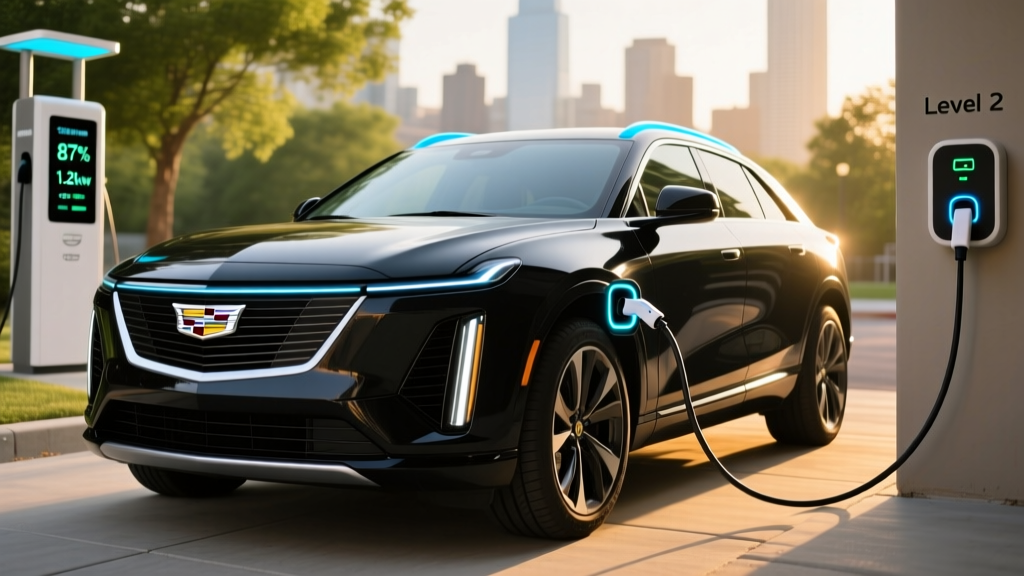
The 2025 Cadillac Lyriq Sport is the dual-motor, all-wheel-drive variant of GM's flagship Ultium-based electric luxury crossover. It sacrifices a modest amount of EPA range compared to the rear-wheel-drive Luxury and Premium Luxury trims but gains meaningful traction, a quicker 0-60 time, and the same opulent 33-inch LED infotainment display that defines the cabin. Starting at $62,695 (including destination), the Sport positions itself against the BMW iX xDrive50, Audi Q8 e-tron, and Tesla Model X — undercutting all three on price while delivering competitive range and a quieter ride.
The trade-off? The Lyriq Sport's 190 kW peak DC fast-charging speed lags behind the 800-volt architectures of rivals like the Hyundai Ioniq 5 and Kia EV6, and its cargo space trails the segment leaders. But for buyers prioritizing ride comfort, cabin isolation, and a traditional luxury aesthetic over Nürburgring lap times, the Lyriq Sport is one of the most compelling EVs in the midsize luxury segment.
| Spec | Value |
|---|---|
| Drivetrain | Dual-motor AWD |
| Horsepower | 500 hp |
| Torque | 450 lb-ft |
| 0-60 mph | 4.6 seconds |
| Battery (usable) | 102 kWh (NMC) |
| EPA Range | 314 miles |
| MPGe (combined) | 89 MPGe |
| Efficiency | 38 kWh/100 mi |
| Max DC Fast Charge | 190 kW |
| 10-80% DC Time | ~33 minutes |
| Level 2 Home Charge | 11.5 kW (~31 mi/hr) |
| Cargo (behind 2nd row) | 28.0 cu ft |
| Cargo (seats folded) | 60.9 cu ft |
| Base MSRP | $62,695 |
| Battery Warranty | 8 yr / 100,000 mi |
Range and Efficiency: 314 Miles EPA, but Plan for Less on the Highway
The 2025 Lyriq Sport carries a 102 kWh usable Ultium battery pack using nickel-manganese-cobalt (NMC) pouch cells — a chemistry that prioritizes energy density and cold-weather performance over the extreme cycle life of lithium iron phosphate (LFP). The EPA rates the Sport at 314 miles of combined range, down from the RWD Luxury trim's 314 miles (the RWD achieves a slightly higher 314-mile figure on the combined cycle due to lower drivetrain losses, though both AWD and RWD share the same battery).
- City / suburban driving: 310-330 miles — regenerative braking recovers energy in stop-and-go traffic, often matching or exceeding the EPA combined estimate.
- Highway (70-75 mph sustained): 250-275 miles — the Lyriq Sport's 5,300+ lb curb weight and boxy crossover profile increase consumption at speed. Expect ~42-44 kWh/100 mi on flat interstate.
- Cold weather (below 32°F): 220-260 miles — NMC chemistry loses roughly 15-25% of range in freezing temperatures, even with the Lyriq's heat pump and battery preconditioning.
- Towing (3,500 lb max): 150-180 miles — towing essentially halves range at highway speeds.
The EPA also rates the Lyriq Sport at 89 MPGe combined (88 city / 90 highway), which translates to roughly 38 kWh per 100 miles. That's competitive with the BMW iX xDrive50 (86 MPGe) but trails the lighter, more aerodynamic Tesla Model X Long Range (102 MPGe). On fueleconomy.gov, the Lyriq Sport's efficiency profile is listed alongside its RWD sibling for direct comparison.
Charging Speed: Adequate for Road Trips, Not Class-Leading
The Lyriq Sport's Ultium platform operates on a 400-volt architecture, capping its peak DC fast-charge rate at 190 kW. That's a meaningful step behind 800V rivals — the Hyundai Ioniq 5 peaks at 240 kW, the Porsche Macan EV at 270 kW — but it's competitive within the luxury midsize segment. The BMW iX xDrive50, for example, peaks at roughly 200 kW.
| Charging Level | Power / Voltage | Miles Added per Hour | Notes |
|---|---|---|---|
| Level 1 (120V) | ~1.4 kW | ~3-4 mi/hr | Emergency/top-up only; ~80+ hours for full charge |
| Level 2 (240V, 48A) | 11.5 kW | ~31 mi/hr | Full charge in ~10.5 hours; ideal for overnight home charging |
| DC Fast Charge | Up to 190 kW | Up to ~195 mi in 10 min (peak) | 10-80% in ~33 min; tapers significantly above 80% |
The charging curve matters more than the peak number. The Lyriq Sport sustains close to 190 kW between roughly 10-30% state of charge (SoC), then gradually steps down through the 150-120 kW range through 60%, and tapers to under 60 kW above 80%. This is typical for NMC packs on 400V systems. If you're road-tripping, plan your stops around 10-80% charges — pushing past 80% at a DC fast charger adds significant time for diminishing range gains.
For home charging, the onboard 11.5 kW AC charger is a strong point. With a properly installed 48-amp Level 2 wall connector on a 60-amp circuit, you'll recover roughly 31 miles of range per hour — enough to fully replenish the 102 kWh pack overnight. A licensed electrician should confirm your panel can support the dedicated 60A circuit; many homes with 200A service can accommodate this without a panel upgrade, but older 100A panels may require one ($1,500-$3,000+).
Cadillac provides two years of unlimited DC fast charging at Electrify America stations for new Lyriq purchasers, which meaningfully offsets road-trip charging costs in the early ownership period. The Lyriq uses the CCS1 connector for DC fast charging; GM is transitioning to NACS (Tesla's connector) for future models, but the 2025 Lyriq ships with CCS. A NACS adapter is available for Supercharger access.
Performance: 500 HP Dual-Motor AWD with Composed Dynamics
The Lyriq Sport's dual-motor setup produces 500 horsepower and 450 lb-ft of torque, delivering a 0-60 mph time of 4.6 seconds. That's quick enough to merge confidently and overtake without drama, though it's not in the same league as the Tesla Model X Plaid (2.5 seconds) or even the BMW iX M60 (3.6 seconds). The Sport's mission isn't track performance — it's composed, effortless luxury acceleration with the traction security of all-wheel drive.
Ride quality is where the Lyriq Sport distinguishes itself. The five-link rear suspension and available air ride (standard on Sport trims for 2025) absorb highway expansion joints and potholes with genuine sophistication. Cabin noise levels are among the lowest in the EV segment, aided by acoustic laminated glass and active noise cancellation. The steering is light and numb by sporty standards, but it's appropriate for the luxury-cruiser brief.
Towing capacity is rated at 3,500 pounds with the factory tow package — sufficient for a small utility trailer or a pair of jet skis, but well below the Rivian R1S (7,700 lb) or Tesla Model X (5,000 lb). If towing is a priority, the Lyriq Sport is not the right tool.
Interior, Tech, and Cargo: A Stunning Screen, Modest Cargo Volume
The Lyriq's cabin centerpiece is a 33-inch diagonal LED display that spans the driver cluster and infotainment touchscreen in a single curved panel running Google Built-In. That means native Google Maps navigation, Google Assistant voice control, and access to the Play Store for apps — no phone projection required, though wireless Apple CarPlay and Android Auto are both supported. The interface is responsive, the resolution is sharp, and the physical knobs for volume and climate are a welcome ergonomic choice that Cadillac wisely retained.
Material quality is genuinely premium: open-pore wood, aluminum trim, and available semi-aniline leather with diamond-quilted stitching. The 19-speaker AKG Studio audio system (standard on Sport) delivers concert-quality sound. Ambient lighting with 26 color options and a panoramic fixed glass roof contribute to an airy, upscale atmosphere.
Space and cargo dimensions:
- Front headroom: 39.8 inches
- Front legroom: 44.3 inches
- Rear headroom: 38.6 inches
- Rear legroom: 39.6 inches
- Cargo behind 2nd row: 28.0 cu ft
- Cargo with 2nd row folded: 60.9 cu ft
- Frunk: None — the Ultium platform's front subframe houses electronics, leaving no front trunk
The 28.0 cu ft cargo figure is the Lyriq Sport's most notable weakness versus competitors. The BMW iX offers 35.5 cu ft behind its second row, and the Tesla Model X provides a massive 42.5 cu ft (plus a frunk). If you regularly haul large cargo or a family of five with luggage, the Lyriq's trunk will feel tight. The lack of a frunk compounds this — there's no secondary storage area for charging cables or groceries.
Driver Assistance: Super Cruise on the Lyriq Sport
The 2025 Lyriq Sport comes with GM's Super Cruise hands-free driving system on mapped divided highways (over 750,000 miles of compatible roads in the U.S. and Canada as of late 2024). Super Cruise uses a combination of LiDAR-mapped HD road data, cameras, radar, and a driver-facing infrared camera to monitor attention. When active, you can take your hands off the wheel — but your eyes must remain on the road.
Super Cruise is a Level 2 driver-assistance system per SAE International. The driver remains fully responsible for vehicle operation and must supervise at all times. It is not "self-driving." Level 4 driverless operation (no human needed) is currently limited to geofenced robotaxi services like Waymo in select cities.
In practice, Super Cruise is one of the most polished Level 2 systems available. Lane-centering is stable, the attention-monitoring camera is less intrusive than Ford BlueCruise's, and the automatic lane-change feature (activated by turn signal) works reliably. It's a genuine highway fatigue reducer on long road trips — arguably the Lyriq Sport's strongest technology feature.
The standard Active Safety Suite includes automatic emergency braking with pedestrian detection, forward collision alert, lane keep assist, blind spot monitoring, rear cross-traffic alert, and reverse automatic braking. A Night Vision camera and HD Surround Vision (360° camera) are available on higher option packages.
Pricing, Trims, and Federal Tax Credit Eligibility
The 2025 Lyriq Sport starts at $62,695 including the $1,395 destination charge. Key option packages can push a well-equipped Sport to $70,000-$74,000. Here's the trim breakdown:
| Trim | Base MSRP | Drivetrain | Est. §30D Credit | Effective Price* |
|---|---|---|---|---|
| Luxury (RWD) | $58,595 | RWD | Up to $7,500 | ~$51,095 |
| Premium Luxury (RWD) | $62,095 | RWD | Up to $7,500 | ~$54,595 |
| Sport (AWD) | $62,695 | AWD | Up to $7,500 | ~$55,195 |
| Premium Luxury (AWD) | $64,095 | AWD | Up to $7,500 | ~$56,595 |
*Effective price assumes full §30D credit eligibility. Actual credit depends on buyer income, battery sourcing, and MSRP caps. Consult a tax professional.
- MSRP cap: SUVs, vans, and trucks must have an MSRP at or below $80,000. The Lyriq qualifies across all trims.
- Buyer income cap: Modified AGI must not exceed $150,000 (single), $225,000 (head of household), or $300,000 (married filing jointly).
- Battery sourcing: Increasing percentages of critical minerals and battery components must be sourced from the U.S. or FTA partners. The Lyriq's Ultium battery is assembled in the U.S. (Lansing, MI and Spring Hill, TN plants), but exact critical-mineral sourcing compliance varies by build date. Check the vehicle's VIN on the IRS qualified vehicles list before purchase.
- Point-of-sale transfer: The credit can be applied as a down-payment reduction at the dealer, or claimed on your tax return. The point-of-sale option requires dealer registration with the IRS.
As-tested, a 2025 Lyriq Sport with the available Technology Package (Night Vision, head-up display, AKG Reference audio upgrade) and Celestial Metallic paint lands around $69,500. That's still $15,000-$25,000 less than a comparably equipped BMW iX or Audi Q8 e-tron.
Ownership Costs: Warranty, Insurance, and Maintenance
Cadillac covers the Lyriq Sport's battery and powertrain for 8 years or 100,000 miles, whichever comes first. The battery warranty guarantees at least 60% capacity retention over that period — a threshold that's standard but less generous than Hyundai's 70% guarantee or Tesla's 70%. The bumper-to-bumper limited warranty runs 4 years / 50,000 miles, and Cadillac includes 1 year / 1 visit of complimentary scheduled maintenance.
Insurance premiums for the Lyriq Sport average roughly $2,200-$2,800 annually depending on state, driving record, and coverage level — higher than a comparable ICE Cadillac XT5 but in line with luxury EVs. Get quotes before purchasing; EV insurance varies significantly by carrier.
Maintenance costs are minimal: no oil changes, no spark plugs, brake pad life is extended dramatically by regenerative braking (many EV owners report 80,000+ miles on original pads). Cabin air filter replacement and tire rotation are the primary recurring items. Budget $300-$500/year for maintenance — roughly 40-50% less than an equivalent ICE luxury SUV.
- 33-inch Google Built-In display is the best infotainment in the luxury EV segment
- Super Cruise hands-free driving on 750,000+ miles of mapped highways
- Exceptional ride comfort and cabin quietness
- Competitive pricing vs. BMW iX, Audi Q8 e-tron, and Tesla Model X
- 11.5 kW Level 2 home charging is faster than many rivals
- Two years of free Electrify America DC fast charging included
- Qualifies for up to $7,500 federal tax credit across all trims
- Cargo volume (28.0 cu ft) trails BMW iX, Tesla Model X, and Rivian R1S
- No front trunk (frunk) — charging cables eat into rear cargo
- 190 kW DC fast charging is outpaced by 800V competitors
- Heavy at 5,300+ lbs — highway efficiency drops noticeably at speed
- Steering feel is numb; not engaging for spirited driving
- 3,500 lb tow rating limits utility for boat/trailer owners
- 60% battery capacity retention warranty threshold is below some competitors
Who Should Buy the 2025 Cadillac Lyriq Sport?
- You want a quiet, comfortable luxury EV for commuting and road trips, not a performance crossover
- All-wheel drive is a must for snow, rain, or mountain driving
- You value hands-free highway driving (Super Cruise) and will use it regularly
- Your household has access to Level 2 home charging and you don't rely on DC fast charging daily
- You want to stay under $70,000 after options while getting genuine luxury materials and tech
- Cargo capacity is critical — check the BMW iX (35.5 cu ft) or Tesla Model X (42.5 cu ft + frunk)
- You need the fastest possible DC charging — the Hyundai Ioniq 5, Kia EV6, or Porsche Macan EV are significantly quicker
- You tow frequently — the Rivian R1S or Tesla Model X offer substantially higher tow ratings
- You want engaging, sporty driving dynamics — the BMW iX or Porsche Macan EV are more rewarding behind the wheel
Frequently Asked Questions
What is the real-world range of the 2025 Cadillac Lyriq Sport?
The EPA rates the Lyriq Sport at 314 miles combined. In real-world driving, expect 310-330 miles in city conditions with regenerative braking, 250-275 miles on sustained highway driving at 70-75 mph, and 220-260 miles in freezing temperatures. Range varies significantly with driving style, terrain, and climate control usage.
How fast does the Lyriq Sport charge at home and on the road?
At home on a 240V Level 2 charger (11.5 kW), the Lyriq Sport adds about 31 miles of range per hour, fully charging in roughly 10.5 hours. On DC fast chargers, it peaks at 190 kW and charges from 10-80% in approximately 33 minutes. Charging slows significantly above 80% SoC — plan road-trip stops around the 10-80% window.
Does the 2025 Lyriq Sport qualify for the $7,500 federal EV tax credit?
The Lyriq Sport's MSRP ($62,695) is well under the $80,000 SUV cap, and its U.S.-assembled Ultium battery positions it favorably for sourcing requirements. However, eligibility depends on your modified adjusted gross income (under $150K single / $300K joint), the specific vehicle's battery mineral sourcing (verify the VIN on the IRS qualified vehicle list), and whether you have sufficient tax liability. The credit can be transferred to the dealer at point of sale as a price reduction. Always consult a tax professional before relying on credit eligibility.
Is the Lyriq Sport worth buying over the BMW iX or Tesla Model X?
The Lyriq Sport wins on price (undercutting both by $15,000-$25,000), ride comfort, and cabin quietness. The BMW iX offers more cargo space (35.5 cu ft), slightly faster DC charging, and more engaging handling. The Tesla Model X leads on cargo volume, Supercharger network access, and acceleration, but its interior quality doesn't match Cadillac's. If luxury and value are your priorities, the Lyriq Sport is the strongest pick. If cargo, charging speed, or sportiness matter more, test-drive the iX and Model X.
Does the Lyriq Sport have a frunk (front trunk)?
No. The Ultium platform's front subframe houses power electronics and the front drive motor, leaving no space for a front trunk. This is a notable omission versus the Tesla Model X, Rivian R1S, and Ford Mustang Mach-E, all of which offer front cargo storage. Plan to use some rear cargo space for charging cables and accessories.
What is the battery warranty on the 2025 Lyriq Sport?
Cadillac covers the battery and powertrain for 8 years or 100,000 miles, guaranteeing at least 60% of original capacity retention. The bumper-to-bumper warranty is 4 years / 50,000 miles. The 60% retention threshold is industry-standard but less generous than Hyundai/Kia (70%) or Tesla (70%).