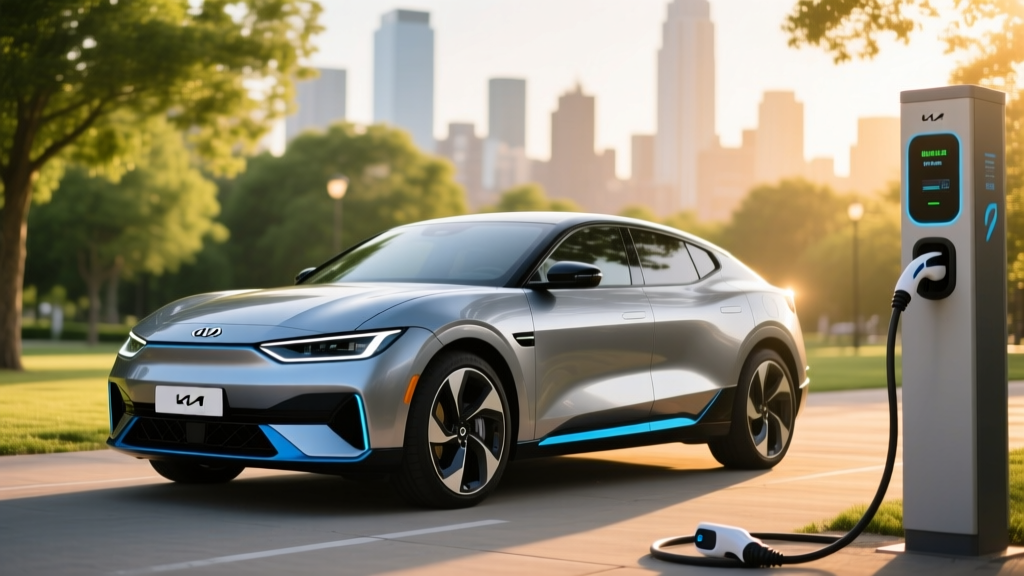
The 2024 Kia EV6 Wind sits in the middle of Kia's electric crossover lineup, positioned between the entry-level Light and the high-performance GT. With the discontinuation of the Air trim for 2024, the Wind becomes the volume play — offering the longest EPA-estimated range in the EV6 family, dual-motor all-wheel drive, and an 800-volt architecture that most competitors still can't match. But with the Hyundai Ioniq 5, Tesla Model Y, and Ford Mustang Mach-E all fighting for the same buyer, the question is whether the EV6 Wind's charging speed and design justify its price.
After examining EPA data, real-world driving logs, and current IRS incentive rules, here's everything you need to know before putting down a deposit.
| Spec | Value |
|---|---|
| EPA Range | 310 miles (AWD), 282 miles (Light RWD) |
| Battery (usable) | 77.4 kWh, NMC lithium-ion |
| Drivetrain | Dual-motor AWD (Wind trim) |
| Horsepower / Torque | 320 hp / 446 lb-ft |
| 0–60 mph | 4.5 seconds |
| Max DC Fast Charge | 239 kW (800V architecture) |
| 10–80% DCFC Time | ~18 minutes (optimal conditions) |
| Level 2 Home Charge | 10.9 kW (~36 miles/hr) |
| EPA Efficiency | 117 MPGe combined (29 kWh/100mi) |
| Cargo Volume | 24.4 cu ft (rear seats up) / 50.2 cu ft (folded) |
| Front Trunk (Frunk) | 0.7 cu ft |
| Base MSRP (Wind AWD) | $52,200 (+ $1,295 destination = $53,495) |
| As-Tested Price | $53,495 (no packages on Wind) |
| Battery/Powertrain Warranty | 10 years / 100,000 miles |
| Basic Warranty | 5 years / 60,000 miles |
Real-World Range: What 310 EPA Miles Actually Means on the Road
Real-World Highway (70 mph, 65°F): ~255–275 miles
Real-World Highway (32°F, no heat pump benefit): ~215–240 miles
City / Mixed Commuting: ~280–300 miles (regen-heavy driving recovers energy)
The EPA's 310-mile estimate for the EV6 Wind AWD is legitimate for mixed driving in moderate temperatures. However, EV range stickers — like gas-car MPG stickers — represent a blended cycle that doesn't fully reflect sustained highway speeds or winter conditions.
In highway testing at 70 mph in fair weather, the EV6 Wind typically delivers between 255 and 275 miles before needing a charge. The 800-volt powertrain and heat pump (standard on all 2024 EV6 trims) help manage efficiency, but the Wind's dual-motor AWD system draws more energy than the single-motor RWD variants. If you're driving in sub-freezing temperatures on the highway, plan for roughly 215–240 miles of usable range — a 20–30% reduction consistent with NMC battery chemistry in cold conditions.
For daily commuting with regenerative braking in city traffic, you'll see numbers much closer to the EPA sticker, sometimes exceeding 290 miles. The EV6's four-level regen system (including i-Pedal one-pedal mode) recovers energy aggressively if you set it to Level 3 or use the paddle shifters.
According to fueleconomy.gov, the 2024 EV6 Wind AWD achieves 117 MPGe combined, consuming 29 kWh per 100 miles — competitive with the Ioniq 5 AWD (110 MPGe) and slightly behind the Model Y Long Range (122 MPGe).
Charging Speed: The 800V Advantage Explained
The EV6's 800-volt electrical architecture is its single biggest technical differentiator against rivals like the Tesla Model Y and Ford Mustang Mach-E, which run on conventional 400V systems. Higher voltage means faster charging at compatible DC fast chargers — and the EV6 Wind can accept a peak rate of 239 kW.
| Charge Level | Power | Speed | Notes |
|---|---|---|---|
| Level 1 (120V outlet) | ~1.4 kW | ~4–5 miles/hr | Emergency/trickle only |
| Level 2 (240V home) | 10.9 kW | ~36 miles/hr | Full charge in ~7.5 hours |
| DC Fast (50 kW station) | 50 kW | ~160 miles/hr | Older public chargers |
| DC Fast (150 kW station) | ~150 kW | ~400+ miles/hr | Common Electrify America rate |
| DC Fast (350 kW station) | Up to 239 kW peak | 10–80% in ~18 min | Requires CCS connector; taper above 80% |
Charging curve reality check: The advertised 18-minute 10–80% time requires a 350 kW-capable charger (like Electrify America's ultra-fast stalls) and a battery preconditioned to optimal temperature. In practice, the EV6 peaks near 239 kW around 20–40% state of charge, then tapers progressively. From 80–100%, charging slows dramatically to protect battery health — expect an additional 20–25 minutes if you need a full top-off. Most road-trip charging strategies target 10–80% sessions for this reason.
At home on a Level 2 charger (10.9 kW, requiring a 48-amp circuit), the EV6 Wind adds roughly 36 miles of range per hour, going from empty to full in about 7.5 hours. Most owners charging overnight from 20% to 80% will wake up to a full daily budget in under 5 hours.
The 2024 EV6 uses the CCS1 connector standard. Kia has confirmed that future EV6 models will adopt the NACS (Tesla) connector, but for 2024, you'll rely on the CCS public network or use a Tesla-to-CCS adapter (sold separately) for Supercharger access where adapters are approved.
Performance, Drivetrain, and Daily Driving Impressions
The Wind trim comes exclusively with dual-motor all-wheel drive, producing 320 horsepower and 446 lb-ft of torque. The 0–60 mph sprint takes 4.5 seconds — brisk enough for confident highway merging and passing, though a full second behind the EV6 GT-Line and well behind the 448-hp GT.
Where the Wind shines is ride quality. Kia tuned the suspension for comfort over sportiness, and the result is a compliant, quiet cruiser that soaks up highway expansion joints better than the firmer GT-Line. Steering is light but accurate, and the low center of gravity (battery pack under the floor) keeps body roll minimal through corners.
The EV6 Wind offers four drive modes — Eco, Normal, Sport, and Snow — each adjusting throttle response, regen strength, and AWD torque distribution. Snow mode is particularly useful for winter commuters, biasing torque to the rear wheels for more predictable handling on low-grip surfaces.
Interior, Tech, and Cargo Practicality
Inside, the EV6 Wind features dual 12.3-inch curved displays (instrument cluster and infotainment), wireless Apple CarPlay and Android Auto, a head-up display with augmented-reality navigation, and Kia's Highway Driving Assist 2 (HDA2) — a Level 2 driver-assistance system combining adaptive cruise control with lane centering and lane-change assist.
Passenger space is generous for the segment: 41.2 inches of front legroom and 39.4 inches in the rear, enough for two adults on longer trips. The flat floor (no transmission tunnel) makes the middle rear seat usable for a third passenger, though the sloping roofline limits headroom for taller riders.
Cargo capacity is the EV6's weak point relative to the Hyundai Ioniq 5 and Tesla Model Y. With rear seats upright, you get 24.4 cubic feet — adequate for groceries and a couple of suitcases but noticeably less than the Ioniq 5's 27.2 cu ft or the Model Y's 30.2 cu ft. Fold the rear seats and the EV6 opens up to 50.2 cu ft. The frunk is essentially a token 0.7 cu ft — enough for a charging cable bag, not much else.
Notable tech highlights:
- Vehicle-to-Load (V2L): Power external devices (camping gear, laptops, even a small appliance) at up to 3.6 kW via an interior or exterior outlet
- Remote Smart Parking Assist: The EV6 can park or unpark itself in tight spaces via key fob
- Digital Key: Use your smartphone as the key via NFC
- Over-the-air (OTA) updates for powertrain and infotainment
Notable drawbacks:
- Touch-sensitive HVAC controls below the main screen are distracting while driving
- No rear wiper (visibility issue in rain/snow)
- CCS charging network reliability remains inconsistent outside major metro areas
- Cargo volume trails key rivals
Pricing, Trim Levels, and Federal Tax Credit Eligibility
| Trim | Drivetrain | MSRP + Destination | Est. After §30D Credit* |
|---|---|---|---|
| Light | RWD | $43,995 | ~$36,495 |
| Wind | AWD | $53,495 | ~$45,995 |
| GT-Line | AWD | $58,395 | ~$50,895 |
| GT | AWD (Performance) | $62,895 | ~$55,395 |
*Estimated prices assume full $7,500 federal tax credit eligibility. Actual credit varies. See IRS §30D rules below.
The 2024 EV6 Wind AWD stickers at $52,200 plus $1,295 destination, for a total MSRP of $53,495. This positions it roughly $4,000 above the Hyundai Ioniq 5 SEL AWD and about $5,000 above the Tesla Model Y Long Range (before credits). However, the EV6 Wind's standard equipment is generous — AWD, heat pump, HDA2, head-up display, and V2L all come included without package upgrades.
Does the 2024 EV6 Wind Qualify for the Federal EV Tax Credit?
Under IRS §30D Clean Vehicle Credit, the 2024 EV6 Wind must satisfy all of the following for the buyer to claim up to $7,500:
- MSRP Cap: Vehicle MSRP must not exceed $80,000 for SUVs/crossovers — the Wind at $53,495 qualifies ✓
- Buyer Income Cap: Modified AGI must not exceed $150,000 (single), $225,000 (head of household), or $300,000 (joint) ✓ (buyer-dependent)
- Battery Sourcing: A percentage of critical minerals and battery components must be sourced from the US or free-trade-agreement countries — as of 2024, the EV6's South Korean-built battery has faced partial compliance, meaning some buyers may qualify for $3,750 (half credit) rather than the full $7,500 depending on the specific VIN and production batch
- Point-of-Sale Transfer: As of 2024, eligible buyers can transfer the credit to the dealer at purchase, reducing the out-of-pocket price immediately rather than waiting for tax filing
- Final Assembly: Must occur in North America — the 2024 EV6 sold in the US is assembled in West Point, Georgia ✓
Important caveat: Battery-sourcing and critical-mineral requirements tighten annually. For the 2024 model year, some EV6 VINs qualify for the full $7,500, while others qualify for $3,750. Always verify your specific vehicle's eligibility using the IRS's online tool at fueleconomy.gov before purchase, and consult a tax professional for your individual situation.
How the EV6 Wind Compares to Key Rivals
The EV6 Wind competes in the midsize electric crossover segment against strong alternatives. Here's how it stacks up on the specs that matter most:
| Spec | Kia EV6 Wind AWD | Hyundai Ioniq 5 SEL AWD | Tesla Model Y LR AWD | Ford Mach-E Premium AWD |
|---|---|---|---|---|
| EPA Range | 310 mi | 290 mi | 308 mi | 290 mi |
| Battery (usable) | 77.4 kWh NMC | 77.4 kWh NMC | ~75 kWh NMC | 91 kWh NMC (Ext. Range) |
| Peak DCFC | 239 kW | 239 kW | ~250 kW | ~150 kW |
| 10–80% Time | ~18 min | ~18 min | ~20 min | ~38 min |
| 0–60 mph | 4.5 sec | 4.5 sec | 4.8 sec | 5.1 sec |
| Cargo (seats up) | 24.4 cu ft | 27.2 cu ft | 30.2 cu ft | 29.7 cu ft |
| MSRP (AWD mid-trim) | $53,495 | $49,995 | $48,090 | $48,995 |
| Heat Pump | Standard | Standard | Standard (heat pump) | Optional |
The EV6 Wind's 800V charging speed ties with the Ioniq 5 (they share the E-GMP platform) and beats the Mach-E decisively. The Model Y's Supercharger network advantage is significant for road-trip reliability, though Kia's CCS compatibility with Electrify America's growing 350 kW network is closing the gap in urban corridors.
Where the EV6 Wind loses ground is cargo space and price. The Model Y and Mach-E both offer meaningfully more cargo room, and the Ioniq 5 SEL AWD undercuts the Wind by roughly $3,500 with nearly identical powertrain specs. The Wind's advantage is its standard equipment list — you get AWD, the heat pump, HDA2, and HUD without adding packages.
Ownership Costs and Warranty
Kia backs the EV6 with one of the best warranties in the segment:
- Battery & Powertrain: 10 years / 100,000 miles (covers capacity loss below 70% State of Health)
- Basic Vehicle: 5 years / 60,000 miles
- Roadside Assistance: 5 years / 60,000 miles
The 10-year battery warranty is a major confidence signal. Kia guarantees that the 77.4 kWh NMC pack will retain at least 70% of its original capacity over that period. Industry data from vehicles on the E-GMP platform (including early Ioniq 5 and EV6 models) suggests degradation of approximately 5–8% over the first 50,000 miles, which is consistent with well-managed NMC chemistry with active liquid thermal management.
Charging at home on Level 2 (at an average US electricity rate of $0.16/kWh) costs roughly $12.40 for a full 77.4 kWh charge — about $0.04 per mile. Compare that to a 25 MPG gas crossover at $3.50/gallon, which costs $0.14 per mile. Over 15,000 annual miles, that's a fuel savings of approximately $1,500 per year.
Insurance premiums for the EV6 Wind tend to run 10–20% higher than comparable gas crossovers due to higher repair costs and parts pricing. Budget $150–$200/month depending on your state and driving record.
Who the 2024 Kia EV6 Wind Is For
- Class-leading DC fast-charging speed (239 kW, 18-min 10–80%)
- Generous standard equipment on Wind trim (AWD, heat pump, HUD, HDA2)
- 10-year/100,000-mile battery warranty
- V2L capability for camping, tailgating, or backup power
- Composed, comfortable ride quality for daily commuting
- Strong real-world efficiency (29 kWh/100mi)
- Cargo space trails Model Y, Mach-E, and Ioniq 5
- Higher MSRP than similarly equipped Ioniq 5 SEL
- CCS public charging network reliability varies by region
- Tiny frunk (0.7 cu ft)
- No rear wiper
- Touch-sensitive HVAC controls are a distraction
Buy the EV6 Wind if: You prioritize fast charging above all else, want AWD with a heat pump for four-season driving, value a long warranty, and don't need maximum cargo space. It's ideal for two-adult households who commute daily and take occasional road trips where 18-minute charging stops keep downtime minimal.
Look elsewhere if: You need family-hauling cargo capacity (choose the Model Y or Mach-E), want the lowest possible price in an AWD electric crossover (choose the Ioniq 5 SEL), or live in an area where the CCS charging network is sparse and Tesla Supercharger access is critical (consider the Model Y until Kia's NACS transition takes effect).
Frequently Asked Questions
What is the real-world range of the 2024 Kia EV6 Wind?
The EPA rates the EV6 Wind AWD at 310 miles. In real-world highway driving at 70 mph in moderate temperatures, expect 255–275 miles. In freezing weather, plan for 215–240 miles. City driving with regenerative braking can approach or slightly exceed 290 miles.
How fast does the EV6 Wind charge at home and on the road?
At home on a 240V Level 2 charger (10.9 kW), the EV6 Wind adds about 36 miles of range per hour, fully charging in roughly 7.5 hours. On a 350 kW-capable DC fast charger, it peaks at 239 kW and charges from 10–80% in approximately 18 minutes, though charging tapers significantly above 80% SoC.
Does the 2024 Kia EV6 Wind qualify for the $7,500 federal tax credit?
It can, but eligibility depends on your VIN's battery sourcing, your income, and the MSRP cap. The Wind's $53,495 MSRP is well under the $80,000 SUV cap. Income caps are $150K single / $300K joint. Battery-sourcing rules mean some VINs qualify for the full $7,500 and others for $3,750. Check your specific VIN on fueleconomy.gov and consult a tax professional.
Is the EV6 Wind worth buying over the Ioniq 5 or Model Y?
The EV6 Wind wins on standard equipment (AWD, heat pump, HUD, HDA2 all included) and ties the Ioniq 5 on charging speed. The Model Y wins on cargo space and Supercharger network access. The Ioniq 5 SEL AWD is roughly $3,500 cheaper with nearly identical specs. Choose the EV6 Wind if you want the best-equipped mid-trim and don't need maximum cargo room.
What battery chemistry does the EV6 Wind use, and how long will it last?
The EV6 Wind uses a 77.4 kWh NMC (nickel manganese cobalt) lithium-ion battery with liquid thermal management. NMC offers higher energy density than LFP chemistry, giving the Wind its 310-mile range. Kia warrants the battery for 10 years or 100,000 miles against capacity loss below 70%. Real-world data from E-GMP platform vehicles shows approximately 5–8% degradation over the first 50,000 miles.
Can the EV6 Wind use Tesla Superchargers?
Not natively. The 2024 EV6 uses the CCS1 connector. Tesla has begun opening some Superchargers to non-Tesla EVs via the Magic Dock adapter at select stations, and Kia has confirmed future models will adopt the NACS connector. For 2024, your primary DC fast-charging network will be Electrify America, EVgo, and other CCS-compatible providers.
Does the EV6 Wind have a heat pump?
Yes. A heat pump is standard on all 2024 EV6 trims, including the Wind. This system improves cold-weather efficiency by extracting ambient heat for cabin warming rather than relying solely on resistive heating, reducing winter range loss by several percentage points compared to EVs without one.