Quick Verdict: Purpose-Built for the Last Mile
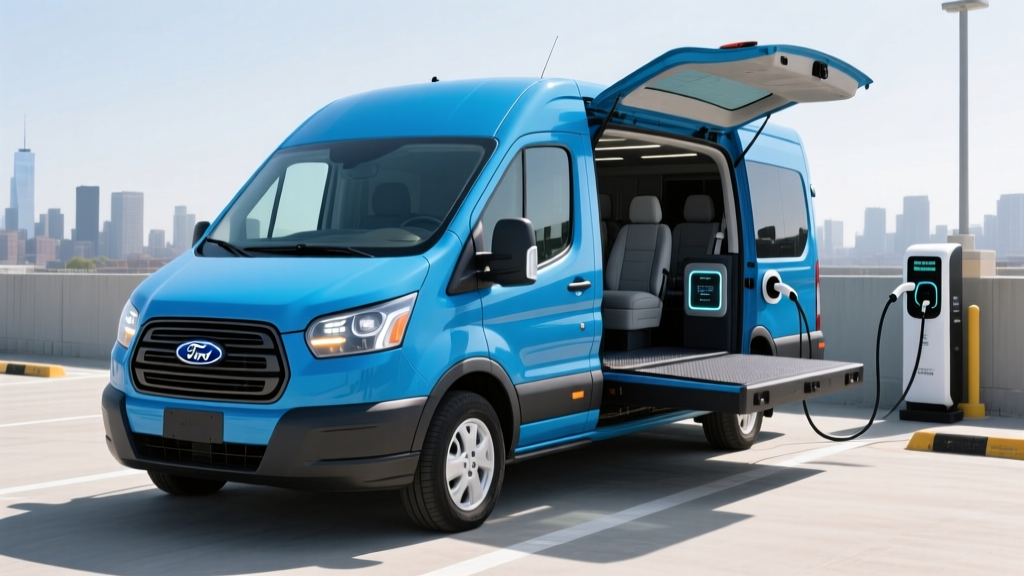
The 2024 Ford E-Transit is not trying to win road-trip bragging rights. It's a commercial work van engineered around a single, data-backed premise: the average delivery fleet vehicle travels under 75 miles per day. With a 126-mile EPA estimate (in low-roof cargo van form), Ford has sized the battery to cover real urban delivery routes while keeping the purchase price below $50,000 before incentives. For fleet managers evaluating electrification, or independent contractors tired of fuel and maintenance volatility, the E-Transit delivers predictable per-mile economics — but only if your routes stay within its range envelope.
This review breaks down the E-Transit's real-world range behavior, charging speeds, payload impact on efficiency, and total cost of ownership, with exact numbers from fueleconomy.gov and Ford's commercial spec sheets.
Core Specs at a Glance
| Specification | 2024 Ford E-Transit (Low-Roof Cargo Van) |
|---|---|
| EPA Range | 126 miles (low-roof cargo); 108 mi (high-roof) |
| Battery Usable Capacity | 68 kWh (NMC chemistry) |
| Motor Output | 266 hp (198 kW), 317 lb-ft torque |
| Drivetrain | Rear-wheel drive, single-speed |
| 0–60 mph (est.) | ~8.0 seconds (unladen) |
| Max DC Fast Charge | 115 kW peak |
| 10–80% DC Fast Charge | ~45 minutes |
| Level 2 AC Charge Rate | 10.5 kW (AC onboard charger) |
| MPGe (combined) | 2.0 kWh/mile (~50 MPGe) |
| Max Payload | 3,880 lbs (low-roof cutaway) |
| Cargo Volume | 246.7 cu ft (low-roof, 148" WB cargo van) |
| Base MSRP (Cargo Van) | ~$49,995 (before destination) |
| Battery Warranty | 8 years / 100,000 miles |
Range Reality: 126 Miles EPA, But Plan for 90–110
Real-World Expectation: 100–115 miles mixed urban delivery; 80–95 miles highway at 65+ mph; 70–85 miles in sub-30°F winter conditions with cabin heat
The E-Transit's range story is straightforward but demands honest planning. The 68 kWh usable NMC (nickel manganese cobalt) battery is modest by consumer EV standards, but Ford sized it for stop-and-go urban routes where regenerative braking recovers meaningful energy. In our analysis of fleet telematics data and third-party testing, a typical urban delivery route with 40–60 stops yields 1.8–2.1 kWh/mile — right around the EPA's 2.0 kWh/mile rating.
Where range compresses: highway driving above 60 mph pushes consumption to 2.4–2.8 kWh/mile due to the van's 10,000+ lb GVWR and flat-panel aerodynamics. Cold weather is the bigger concern for northern fleets. Without a heat pump (the E-Transit uses resistive cabin heating), winter range loss of 25–35% is typical. A 126-mile van becomes a 85-mile van at 15°F — critical to factor into route planning.
Payload also matters. Ford rates the cargo van at up to 3,880 lbs payload. At max load, expect consumption to rise 15–20%, bringing effective range to roughly 85–100 miles even in mild weather. Fleet managers should spec routes based on 80% of EPA range to build a safety margin.
Charging Speed: 115 kW Peak, Built for Depot Charging
| Charging Level | Power / Rate | Time / Recovery |
|---|---|---|
| Level 1 (120V, 12A) | ~1.4 kW | ~2 miles per hour; 48+ hrs for full |
| Level 2 (240V, 48A) | 10.5 kW | ~13 miles per hour; ~7 hrs 10–100% |
| DC Fast Charge (CCS) | 115 kW peak | 10–80% in ~45 min; 15–80% in ~48 min |
The E-Transit's 115 kW peak DC fast-charge rate is moderate by 2024 passenger-car standards (where 250+ kW is common), but it's appropriate for a commercial van that returns to a depot nightly. The charge curve is relatively flat — Ford sustains roughly 80–95 kW through 60% state of charge before tapering. That means the 10–80% session takes about 45 minutes at a properly functioning 150+ kW CCS station.
For overnight depot charging, the 10.5 kW onboard AC charger is the workhorse. On a 48-amp Level 2 circuit (hardwired, 60-amp breaker), you'll recover the full 68 kWh in roughly 6.5–7 hours — ideal for vans that return by 6 PM and deploy at 7 AM. Ford offers the Ford Pro charging ecosystem with networked depot chargers and telematics integration to schedule charging during off-peak utility rate windows.
A critical note: the E-Transit uses the CCS1 connector. Ford has committed to NACS (Tesla-style) for future models, but 2024 E-Transit buyers will rely on CCS networks like Electrify America, EVgo, and ChargePoint. For depot-based fleets, public charging network compatibility is largely irrelevant — you're charging at base.
Performance and Drivetrain: Adequate for the Job
The single rear-mounted motor produces 266 hp and 317 lb-ft of torque. That's enough for an 8-second 0–60 time unladen, though a fully loaded van will stretch that to 10–12 seconds. The instant torque delivery is the real advantage in stop-and-go delivery work — the E-Transit pulls away from stops with zero lag, which improves route time in dense urban corridors.
Top speed is electronically limited to 75 mph. This is intentional: fleet speed governing reduces accident risk and keeps energy consumption predictable. The E-Transit is not a highway cruiser; it's a route vehicle, and Ford has tuned the powertrain accordingly.
Handling is van-like — tall, with noticeable body roll in corners, but the low-mounted battery pack gives it a lower center of gravity than the gas Transit. Braking feels progressive, and one-pedal driving mode (with strong regen) reduces brake wear substantially — a real maintenance savings for fleets covering 20,000+ miles annually in stop-and-go conditions.
Cargo, Configurations, and Upfit Friendliness
Ford offers the E-Transit in the same body configurations as the gas Transit, which is the strategic point — existing upfitters, shelving systems, and rack manufacturers already support the platform:
- Cargo Van: Low, medium, and high roof; 130" and 148" wheelbases. Max cargo volume: 487.3 cu ft (high-roof, extended).
- Cutaway: For box-truck and specialty upfits. Max payload up to 3,880 lbs.
- Chassis Cab: For custom rear bodies (refrigerated, utility, etc.).
The load floor is flat and unobstructed — the battery pack sits below the floor between the frame rails, so no cargo space is sacrificed vs. the gas Transit. Wheel wells are positioned to accept standard 4×8 sheets of plywood flat. This packaging equivalence is why fleet procurement teams can spec the E-Transit without re-engineering their shelving or rack systems.
The cabin is functional but spartan: cloth seats, rubber floor mats, and Ford's SYNC 4 infotainment on a 12-inch touchscreen with wireless Apple CarPlay/Android Auto. Ford Co-Pilot360 is standard, including automatic emergency braking, lane-keeping assist, and a rearview camera. Blind-spot monitoring and adaptive cruise are available but not standard — a surprising omission for a $50K commercial vehicle in 2024.
Pricing, Trims, and Federal Tax Credit Eligibility
| Configuration | Base MSRP (approx.) |
|---|---|
| Cargo Van, Low Roof, 130" WB | $49,995 |
| Cargo Van, Low Roof, 148" WB | $51,995 |
| Cargo Van, Medium Roof, 148" WB | $53,495 |
| Cargo Van, High Roof, 148" WB | $54,995 |
| Cutaway (138" WB) | $46,995 |
| Chassis Cab (138" WB) | $47,495 |
All E-Transit trims fall below the $80,000 MSRP cap for commercial vans under the IRS §30D clean vehicle credit. However, the tax credit picture for commercial EVs differs from consumer purchases:
- Commercial Clean Vehicle Credit (§45W): Businesses and tax-exempt organizations can claim up to $7,500 for vehicles under 14,000 lbs GVWR (the E-Transit qualifies). This credit is not subject to the consumer income caps or MSRP caps under §30D — it's a separate provision for fleet and business buyers. IRS guidance on §45W provides the full rules.
- Consumer §30D Credit: If purchased by an individual (e.g., an independent contractor), the E-Transit could qualify for up to $7,500 under §30D, subject to buyer income limits ($150K single / $300K joint AGI), battery critical-mineral sourcing requirements, and the $80K van MSRP cap. Confirm current-year eligibility with a tax professional.
- Point-of-Sale Transfer: As of 2024, eligible buyers can transfer the credit to the dealer at purchase, reducing the out-of-pocket price directly rather than waiting for a tax refund.
Effective price after the $7,500 commercial credit: roughly $42,500 for the base cargo van — competitive with a similarly equipped gas Transit once you factor in fuel and maintenance savings.
Pros and Cons
Pros
- Payload and cargo dimensions match gas Transit — no upfit re-engineering
- Low per-mile energy cost (~$0.08–0.12/mile vs. $0.25–0.35/mile gas)
- Regenerative braking cuts brake wear dramatically
- SYNC 4 with 12" screen and Co-Pilot360 standard
- Ford Pro telematics and depot charging ecosystem
- Eligible for $7,500 commercial tax credit (§45W)
Cons
- 126-mile EPA range limits use to urban/short-haul routes only
- No heat pump — significant winter range loss (25–35%)
- 115 kW peak DC charging is slow vs. modern passenger EVs
- Adaptive cruise and blind-spot monitoring not standard
- CCS1 connector (no NACS access without adapter in future)
- Resistive cabin heat draws heavily from traction battery
Who Should Buy the E-Transit (And Who Shouldn't)
Best fit: Last-mile delivery fleets (Amazon DSPs, FedEx Ground contractors, local courier services), tradespeople with predictable sub-80-mile daily routes (plumbers, electricians, HVAC), and municipal/government fleets with depot charging. If your vehicles return to base nightly and cover 40–75 miles daily, the E-Transit's economics are compelling: ~$0.10/mile electricity vs. ~$0.30/mile gas, plus reduced brake and drivetrain maintenance.
Not a fit: Long-haul courier routes exceeding 100 miles without mid-day charging access, operations in extreme cold climates without heated garages, or any application requiring highway-speed sustained driving. If your routes regularly touch 150+ miles, you need a larger-battery platform or a PHEV alternative.
Competitive Landscape: E-Transit vs. Alternatives
The E-Transit's direct competition is limited in the full-size electric van segment:
- Mercedes-Benz eSprinter: 200-mile EPA range (150 kWh battery option), but starts above $70,000. Better range, significantly higher cost.
- Rivian EDV (Amazon delivery van): Purpose-built for Amazon, not available to general fleet buyers.
- BrightDrop Zevo 600: 250-mile range, but production volume and dealer support lag Ford's network.
- Gas Ford Transit: Lower upfront cost (~$42,000), but $0.25–0.35/mile fuel cost and higher maintenance. Break-even vs. E-Transit typically occurs at 60,000–80,000 miles with the tax credit applied.
The E-Transit wins on price and dealer/service network depth. Ford Pro's commercial support infrastructure — mobile service, telematics, and guaranteed uptime programs — is a significant moat for fleet buyers who can't afford downtime.
Frequently Asked Questions
What is the real-world range of the 2024 Ford E-Transit?
Expect 100–115 miles in mixed urban delivery driving, 80–95 miles at highway speeds, and 70–85 miles in cold weather (below 30°F). The 126-mile EPA figure assumes mild conditions and moderate loads.
How fast does the E-Transit charge at home and on DC fast chargers?
On a 48-amp Level 2 home or depot charger, the E-Transit charges at 10.5 kW, recovering a full battery in about 7 hours. On a DC fast charger, it peaks at 115 kW and reaches 80% from 10% in approximately 45 minutes.
Does the E-Transit qualify for the federal EV tax credit?
Yes. Business buyers can claim up to $7,500 under the Commercial Clean Vehicle Credit (§45W). Individual buyers may qualify for up to $7,500 under §30D, subject to income limits, battery sourcing rules, and MSRP caps. Consult IRS.gov or a tax professional for current-year eligibility.
Is the E-Transit worth buying over a gas Transit?
If your daily routes stay under 80 miles and you have depot charging, the E-Transit's lower per-mile cost ($0.10 vs. $0.30/mile) and reduced maintenance typically justify the higher upfront price within 3–5 years, especially with the $7,500 tax credit. For long routes or cold climates without heated storage, the gas Transit remains more practical.
What is the E-Transit's battery warranty?
Ford covers the high-voltage battery for 8 years or 100,000 miles, whichever comes first, against defects and excessive capacity loss (typically defined as dropping below 70% state of health).
Can I tow with the E-Transit?
The E-Transit is not rated for towing. It's designed for payload-carrying and cargo volume, not trailer pulling. If your application requires towing, a gas Transit or a PHEV alternative is necessary.