Quick Verdict: The ID.4 Pro S AWD at a Glance
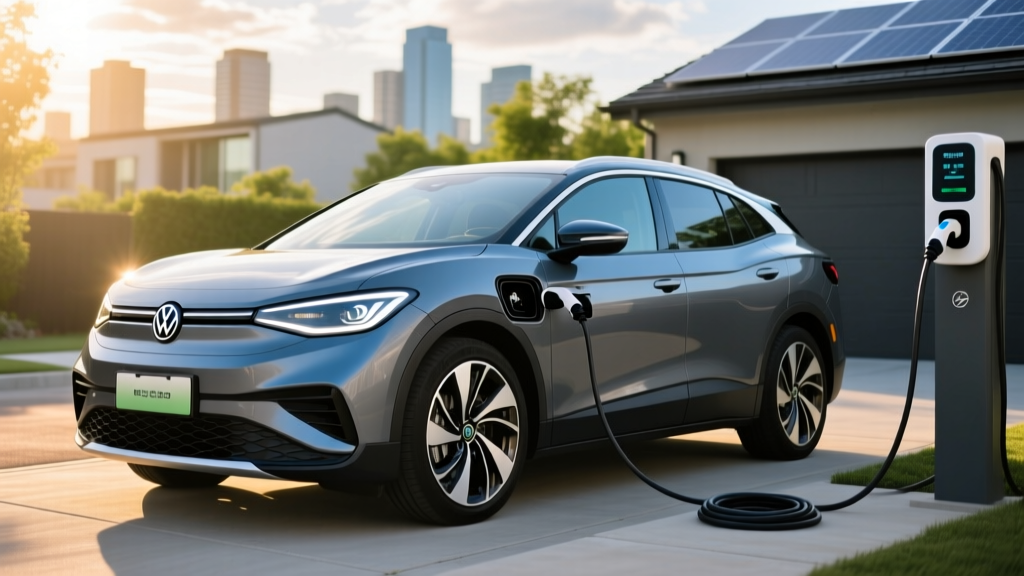
The 2023 Volkswagen ID.4 Pro S AWD occupies a specific niche in the compact electric SUV segment: practical family transportation with European driving dynamics, decent DC fast-charging speeds, and a usable 275-mile EPA range. The Opal White Pearl exterior finish (a $395 premium color for the 2023 model year) pairs with VW's dual-motor all-wheel-drive system producing 295 horsepower. It's not the fastest-charging or longest-range EV in its class, but its combination of interior space, ride comfort, and available federal tax credit eligibility make it a serious contender for buyers transitioning from a gas-powered compact SUV.
This review covers the 2023 model year specifically — important because VW updated the ID.4 significantly for 2024 with a larger battery, faster charging, and a revamped interior. If you're shopping the used or certified pre-owned market in 2026, or evaluating leftover 2023 inventory, these specs apply to that generation.
| Spec | Value |
|---|---|
| EPA Range | 275 miles |
| Battery (Usable / Gross) | 82 kWh usable / 91 kWh gross, NMC (nickel-manganese-cobalt) |
| Drivetrain | Dual-motor AWD |
| Horsepower / Torque | 295 hp / 339 lb-ft |
| 0–60 mph | 5.4 seconds (Car and Driver tested) |
| Max DC Fast Charge | 170 kW peak |
| 10–80% DC Charge Time | ~36 minutes |
| Level 2 Home Charging | 11 kW (approx. 30–33 miles/hr) |
| Efficiency | 104 MPGe combined / 32 kWh/100 mi |
| Cargo Volume (rear seats up / down) | 30.3 cu ft / 64.2 cu ft |
| Base MSRP (Pro S AWD) | $48,990 (+ $1,220 destination = $50,210) |
| Battery / Powertrain Warranty | 8 years / 100,000 miles |
Range and Efficiency: EPA Sticker vs. Reality
EPA Estimated: 275 miles
Real-World Highway (70 mph, moderate temps): ~235–250 miles
Real-World Cold Weather (below 32°F, mixed driving): ~190–215 miles
City / Low-Speed Commuting: ~265–280 miles (regen-friendly)
The 2023 ID.4 Pro S AWD carries an EPA-estimated 275 miles of range, which places it mid-pack among compact electric SUVs. The rear-wheel-drive ID.4 Pro S achieves 275 miles as well, while the smaller-battery Standard trims drop to approximately 209 miles.
In real-world driving, expect to use about 32 kWh per 100 miles in mixed conditions — that's the efficiency figure the EPA publishes, and it tracks with independent testing. On sustained highway driving at 70–75 mph, efficiency drops to roughly 35–38 kWh/100 mi, cutting effective range to around 235–250 miles. Cold weather compounds this: lithium-ion batteries lose efficiency in freezing temperatures, and cabin heating (the ID.4 uses a resistive PTC heater on AWD trims rather than a heat pump, which was only standard on RWD models) draws significant energy. Plan for 190–215 miles of usable range in sub-freezing winter conditions.
The 82 kWh usable battery capacity (from a 91 kWh gross pack) uses NMC (nickel-manganese-cobalt) chemistry, which offers higher energy density than LFP but benefits from staying between 20–80% state of charge for daily use to minimize long-term degradation. VW's battery management system includes a buffer that protects against deep discharge and overcharge, which helps longevity.
Charging Performance: DC Fast, Level 2, and Level 1
| Charging Level | Power / Rate | Time / Speed |
|---|---|---|
| DC Fast Charge (peak) | 170 kW max | 10–80% in ~36 minutes |
| DC Fast Charge (sustained avg.) | ~110–130 kW avg (10–80%) | Charge curve tapers significantly above 80% |
| Level 2 (240V home/public) | 11 kW onboard charger | ~8.5 hours (0–100%); ~30–33 miles per hour of charging |
| Level 1 (120V standard outlet) | ~1.4 kW | ~3–4 miles per hour; 60+ hours for full charge |
The ID.4 Pro S AWD peaks at 170 kW on DC fast chargers, which was competitive for 2023 but trails the Hyundai Ioniq 5 (240 kW) and Kia EV6 (240 kW) on the same 400V architecture class. The 10–80% charge time of approximately 36 minutes is acceptable for road trips, but the charge curve matters more than the peak number.
VW's charge curve holds near peak power from roughly 10–30% state of charge, then progressively tapers. By 60% SoC, you're seeing approximately 100–110 kW, and above 80%, the rate drops sharply to under 50 kW. This means charging from 80–100% at a DC fast charger is painfully slow — plan to charge to 80% and move on during road trips for the best time efficiency.
For home charging, the 11 kW onboard charger is a strong point. On a 48-amp Level 2 home charger (hardwired, 240V), you'll add roughly 30–33 miles of range per hour, meaning a full overnight charge from near-empty takes about 8.5 hours. This is faster than many competitors limited to 7.2 kW or 9.6 kW onboard chargers. A kW (kilowatt) measures the rate of power delivery — think of it as the width of the pipe — while kWh (kilowatt-hour) measures total energy stored, like gallons in a tank. The 11 kW charger fills the 82 kWh battery in roughly 82 ÷ 11 = ~7.5 hours theoretically, with some overhead losses accounting for the ~8.5-hour real-world figure.
The ID.4 uses the CCS1 (Combined Charging System) connector standard for 2023. VW has committed to transitioning to NACS (Tesla's connector) for future models, and adapters are increasingly available for accessing Tesla Supercharger networks with CCS-equipped vehicles.
Performance and Driving Dynamics
The dual-motor AWD powertrain in the Pro S produces 295 horsepower and 339 lb-ft of torque, with the rear motor handling most driving duties and the front motor engaging for acceleration, low-traction conditions, and all-wheel-drive demand. The result is a 0–60 mph time of approximately 5.4 seconds — brisk for a family SUV and noticeably quicker than the RWD model's 7.7-second sprint.
Where the ID.4 earns praise is ride quality. VW tuned the suspension for comfort over sportiness, and the result is a compliant, quiet ride that absorbs highway imperfections well. The steering is light and precise if not particularly communicative. Regenerative braking offers multiple levels adjustable via the gear selector (D for coasting, B for stronger regen), but the ID.4 does not offer true one-pedal driving to a complete stop — you'll still need the friction brakes at very low speeds.
Towing capacity is rated at 2,700 pounds with the factory tow package, adequate for a small utility trailer or a pair of dirt bikes but not a camper. This is a segment-typical figure.
Interior, Cargo, and Technology
The ID.4's cabin prioritizes minimalism and space. The Pro S trim includes premium touches: perforated leatherette seats, heated front seats, a panoramic fixed glass roof, and a 12-inch infotainment touchscreen (upgraded from the 10-inch on lower trims). Passenger space is generous:
- Front headroom: 41.1 inches
- Front legroom: 41.1 inches
- Rear headroom: 38.4 inches
- Rear legroom: 37.6 inches
- Cargo (seats up): 30.3 cubic feet
- Cargo (seats folded): 64.2 cubic feet
The cargo area is competitive with the Toyota RAV4 and slightly smaller than the Hyundai Ioniq 5's 27.2/59.3 cu ft, though the ID.4's taller roofline makes loading bulkier items easier. There is no front trunk (frunk) — VW uses that space for power electronics and the HVAC system.
Technology is the ID.4's most-cited weakness. The infotainment system in the 2023 model year uses capacitive touch sliders for volume and climate control that lack backlighting and are frustrating to use while driving. Wireless Apple CarPlay and Android Auto are standard, and the IQ.DRIVE suite includes adaptive cruise control, lane-keeping assist, automatic emergency braking, and a semi-automated lane-change feature on higher trims. These are SAE Level 2 driver-assistance features — the driver must remain fully engaged and hands-on-wheel at all times.
Pricing, Trims, and Federal Tax Credit
| Trim | Drivetrain | MSRP + Destination |
|---|---|---|
| Standard | RWD | $38,995 + $1,220 = $40,215 |
| Standard S | RWD | $43,995 + $1,220 = $45,215 |
| Pro | RWD | $43,995 + $1,220 = $45,215 |
| Pro S | RWD | $47,495 + $1,220 = $48,715 |
| Pro S AWD (this review) | AWD | $48,990 + $1,220 = $50,210 |
| Pro S Plus AWD | AWD | $51,490 + $1,220 = $52,710 |
The Opal White Pearl paint adds $395, and the available Gradient Package (two-tone roof, silver accents) adds $225. A well-equipped Pro S AWD with these options lands around $50,830 before any incentives.
- Maximum credit: Up to $7,500 for new qualifying EVs
- MSRP cap: SUVs must be under $80,000 — the ID.4 qualifies
- Buyer income cap: AGI must not exceed $150,000 (single), $225,000 (head of household), or $300,000 (joint filing)
- Battery sourcing: Critical minerals and battery component requirements phase in annually — check IRS.gov for the specific model-year and build-date requirements
- Point-of-sale transfer: As of 2024, buyers can transfer the credit to the dealer at purchase for an immediate price reduction
The 2023 ID.4 was assembled in Emden, Germany (later shifting to Chattanooga, Tennessee for 2023+ production). Battery sourcing rules determine whether you receive the full $7,500, a partial $3,750, or no credit. Consult a tax professional and verify your specific VIN on the IRS qualified vehicles list before purchase.
If you qualify for the full $7,500 credit, the effective price of a Pro S AWD drops from ~$50,210 to approximately $42,710 — a significant reduction that makes the ID.4 highly competitive against the Tesla Model Y Long Range (~$47,990 before credit) and Ford Mustang Mach-E Premium AWD (~$48,995 before credit).
Warranty and Long-Term Ownership
Volkswagen backs the ID.4's battery and electric drivetrain with an 8-year / 100,000-mile warranty, which covers defects and capacity loss below 70% of original capacity. The basic vehicle warranty is 4 years / 50,000 miles, and VW includes 2 years of scheduled maintenance at no extra cost.
NMC battery degradation for the ID.4 platform has tracked well with industry averages: owners report approximately 5–8% capacity loss over the first 50,000 miles, with the curve flattening significantly afterward. Best practices for longevity include:
- Set daily charge limit to 80% (the ID.4's infotainment allows this)
- Avoid frequent DC fast charging when Level 2 is available
- Minimize time spent at 100% state of charge — charge to full only before road trips
- Precondition the battery in cold weather before fast charging (the ID.4 does this automatically when a charger is set as a navigation destination)
Pros and Cons
- Comfortable, quiet ride quality — best-in-class for highway comfort
- Strong 11 kW onboard charger for fast Level 2 home charging
- Generous rear-seat legroom and cargo space
- Available $7,500 federal tax credit (subject to eligibility)
- Competitive AWD performance (5.4 sec 0–60)
- Panoramic glass roof standard on Pro S
- Infotainment capacitive sliders are frustrating and poorly lit
- DC fast charging (170 kW peak) trails Hyundai/Kia competitors
- No front trunk (frunk) for extra storage
- No heat pump on AWD trims — cold-weather range suffers
- No true one-pedal driving to a complete stop
- Infotainment learning curve and occasional software lag
Who Should Buy the 2023 ID.4 Pro S AWD?
- You prioritize ride comfort and cabin quietness over sporty handling
- You have access to Level 2 home charging and mostly drive under 200 miles/day
- You need AWD for snow/ice but don't want a truck-based SUV
- You qualify for the federal tax credit and want a sub-$43K effective price
- You value VW's build quality and dealer service network
- You frequently road-trip 300+ miles and need the fastest possible DC charging (consider Ioniq 5 or EV6)
- You want maximum range — the Tesla Model Y Long Range AWD offers 330 miles EPA
- You need a frunk for extra cargo or want one-pedal driving
- You prefer cutting-edge infotainment and UI over traditional comfort
Frequently Asked Questions
What is the real-world range of the 2023 ID.4 Pro S AWD?
Expect 235–250 miles on highway road trips at 70 mph in moderate temperatures, and 190–215 miles in freezing winter conditions. City driving with regenerative braking can approach the 275-mile EPA estimate. The lack of a heat pump on AWD trims means winter range loss is more pronounced than on some competitors.
How fast does the ID.4 Pro S AWD charge?
On DC fast chargers, it peaks at 170 kW and charges from 10–80% in approximately 36 minutes. On a 48-amp Level 2 home charger (11 kW), it adds roughly 30–33 miles of range per hour, with a full charge taking about 8.5 hours. Level 1 (120V) adds only 3–4 miles per hour.
Does the 2023 ID.4 qualify for the $7,500 federal tax credit?
It can, but eligibility depends on your income (AGI under $150K single / $300K joint), the vehicle's MSRP (under $80K — the ID.4 qualifies), and battery sourcing requirements that vary by build date and VIN. Chattanooga-built 2023 models generally qualify for at least partial credit. Verify your specific vehicle on IRS.gov and consult a tax professional.
Is the ID.4 Pro S AWD worth buying vs. the Tesla Model Y or Hyundai Ioniq 5?
It depends on priorities. The Model Y Long Range AWD offers more range (330 mi EPA), faster Supercharger access, and a more advanced infotainment system, but a firmer ride and polarizing styling. The Ioniq 5 charges significantly faster (240 kW peak, 10–80% in ~18 min) and has a frunk, but slightly less cargo volume. The ID.4 wins on ride comfort, cabin quietness, and traditional SUV ergonomics — it feels most familiar to buyers switching from a gas SUV.
What is the battery warranty on the 2023 ID.4?
Volkswagen provides an 8-year / 100,000-mile battery and powertrain warranty covering defects and capacity degradation below 70% of original capacity. This is standard for the EV segment and matches competitors like Hyundai, Kia, and Ford.
Does the ID.4 have a heat pump?
The 2023 ID.4 includes a heat pump only on RWD trims. AWD models (including the Pro S AWD reviewed here) use a resistive PTC heater, which consumes more battery energy in cold weather. This is a notable drawback for buyers in northern climates.