Quick Verdict: The Fastest SUV Money Can Buy — With Caveats
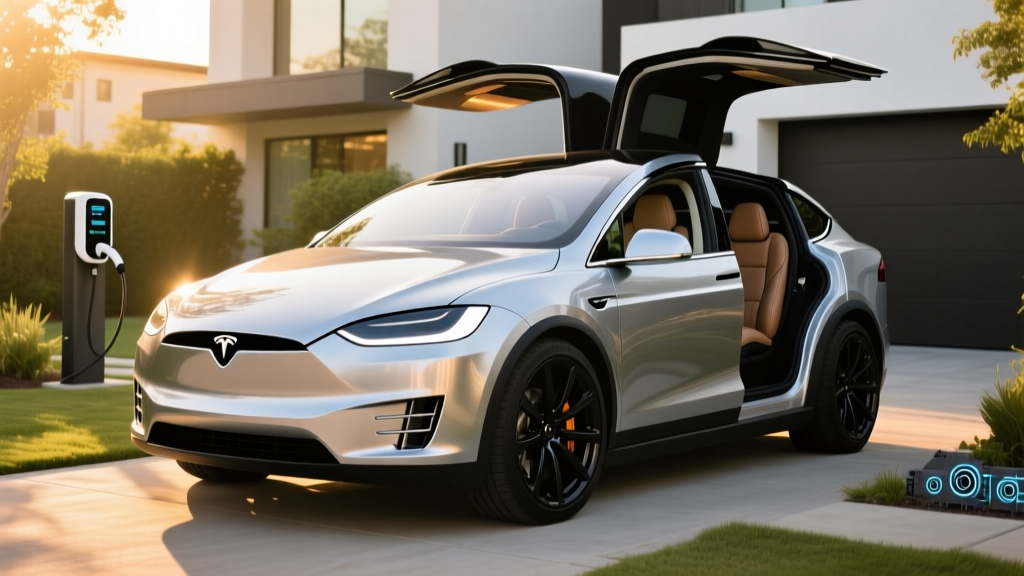
The 2023 Tesla Model X Plaid remains an engineering paradox: a three-row, 5,100-pound SUV that sprints to 60 mph in 2.5 seconds while delivering over 300 miles of EPA-estimated range. For the $108,490 base price (before incentives), you get supercar acceleration, access to Tesla's Supercharger network, and the practicality of falcon-wing rear doors. But the Plaid trim's performance focus comes with real-world trade-offs in efficiency, ride comfort, and interior material quality that prospective buyers should weigh carefully.
Real-World Range Reality Check
EPA Estimated Range: 333 miles (20" wheels) / 311 miles (22" wheels)
What to Actually Expect: In mixed driving at 70°F, plan for 280–310 miles before needing to charge. Highway cruising at 75+ mph drops this to 240–270 miles. Cold weather (below 32°F) can reduce range by 20–30%, meaning winter road trips may yield just 210–250 miles. The Plaid's tri-motor setup and performance tuning prioritize power over efficiency compared to the dual-motor Long Range variant.
Battery, Efficiency, and the kWh Breakdown
The 2023 Model X Plaid uses a ~100 kWh battery pack (approximately 95 kWh usable) with NMC (nickel manganese cobalt) chemistry. Unlike the LFP packs in some standard-range Teslas, NMC offers higher energy density—critical for a heavy SUV—but requires more careful state-of-charge management for long-term longevity. Tesla recommends daily charging to 80–90% for NMC packs, reserving 100% for road trips.
| Specification | Value |
|---|---|
| Battery Capacity | ~100 kWh total / ~95 kWh usable |
| Battery Chemistry | NMC (Nickel Manganese Cobalt) |
| EPA Range (20" wheels) | 333 miles |
| EPA Range (22" wheels) | 311 miles |
| Efficiency | 102 MPGe combined / 33 kWh/100mi |
| Drivetrain | Tri-Motor AWD (1 front, 2 rear) |
| Horsepower | 1,020 hp |
| 0–60 mph | 2.5 seconds |
| Top Speed | 163 mph |
| Curb Weight | 5,185 lbs |
| Cargo Volume (behind 3rd row) | 15.8 cu ft |
| Cargo Volume (3rd row folded) | 41.1 cu ft |
| Max Cargo Volume | 81.5 cu ft |
| Towing Capacity | 5,000 lbs |
Efficiency is the Plaid's weakest metric relative to its siblings. At 33 kWh per 100 miles, it consumes roughly 15% more energy than the Long Range AWD model (28 kWh/100mi). Over 15,000 annual miles, that translates to approximately 750 additional kWh—about $110–$150 extra per year depending on your local electricity rates.
Charging Speed: DC Fast, Level 2, and the Supercharger Advantage
The 2023 Model X Plaid peaks at 250 kW on DC fast chargers, specifically at V3 Tesla Superchargers. In controlled testing, the Plaid sustains above 200 kW from 10% to roughly 40% state-of-charge, then tapers progressively. A 10–80% charge takes approximately 30–32 minutes—competitive but not class-leading against newer 800V architectures like the Hyundai Ioniq 5 or Kia EV6, which can hit 10–80% in 18 minutes.
| Charging Method | Power | Speed (miles/hour) | Time (10–80%) |
|---|---|---|---|
| DC Fast Charge (V3 Supercharger) | 250 kW peak | ~200 mi/hr (peak) | ~30 minutes |
| DC Fast Charge (CCS adapter, 150 kW station) | 150 kW | ~120 mi/hr | ~45 minutes |
| Level 2 (Tesla Wall Connector, 48A) | 11.5 kW | 34 mi/hr | ~7 hours |
| Level 2 (32A public charger) | 7.7 kW | 23 mi/hr | ~10 hours |
| Level 1 (120V household) | 1.4 kW | 4 mi/hr | ~60+ hours |
For home charging, Tesla's Wall Connector at 48 amps delivers 11.5 kW—adding about 34 miles of range per hour. A full overnight charge easily replenishes daily driving. Installation typically costs $800–$2,000 depending on electrical panel proximity and whether a 200-amp service upgrade is needed. Third-party Level 2 chargers (ChargePoint, Enel X) work via Tesla's J1772 adapter, included with the vehicle.
Access to Tesla's Supercharger network remains a key ownership advantage. As of 2026, the network includes over 50,000 V3 and V4 stalls across North America, with industry-leading uptime. However, Tesla has opened the network to non-Tesla EVs via NACS adoption, meaning peak-time congestion at popular corridors is increasing.
Performance: 1,020 Horsepower in a Family Hauler
The tri-motor Plaid powertrain generates 1,020 horsepower and launches the Model X to 60 mph in 2.5 seconds—faster than a Lamborghini Huracán STO. Quarter-mile times hover around 9.9 seconds at 145 mph. This performance is accessible via a "Plaid" drive mode that conditions the battery for maximum power delivery.
But the Plaid isn't just about straight-line speed. The torque-vectoring rear motors provide exceptional cornering stability for a vehicle this heavy, and the adaptive air suspension adjusts damping in real time. That said, the Model X Plaid's 5,185-pound mass is physics you can't fully mask—body roll is present in aggressive cornering, and the brake pedal feel is numb compared to dedicated performance SUVs like the Porsche Cayenne Turbo GT.
The 2023 Model X comes standard with Tesla's Basic Autopilot (SAE Level 2), which includes traffic-aware cruise control and lane-centering. Full Self-Driving (Supervised) capability is a $15,000 add-on or $199/month subscription, adding features like automatic lane changes and traffic light recognition. Neither system makes the vehicle autonomous—the driver must remain engaged with hands on the wheel and eyes on the road at all times.
Pricing, Tax Credits, and Total Cost of Ownership
The 2023 Tesla Model X Plaid started at $108,490, with common options (22" wheels, FSD, premium interior colors) pushing as-tested prices to $120,000–$130,000. For 2026 buyers shopping used 2023 models, prices have settled into the $75,000–$95,000 range depending on mileage and condition.
Federal Tax Credit Eligibility (IRS §30D)
For new 2023 Model X purchases, the federal tax credit situation was complex:
- MSRP Cap: SUVs must be below $80,000 MSRP. The Model X Plaid at $108,490 did not qualify for the new-vehicle §30D credit.
- Used EV Credit: Buying a used 2023 Model X Plaid in 2026 may qualify for up to $4,000 (30% of sale price, capped at $4,000) if the sale price is $25,000+ and buyer income is below $150,000 (single) / $300,000 (joint). However, the vehicle must be at least 2 model years old, and the credit applies once per VIN.
- Battery Sourcing Rules: Even qualifying models must meet critical mineral and battery component sourcing requirements that tightened annually through 2025.
Always verify current eligibility at IRS.gov and consult a tax professional before purchase.
5-Year Ownership Cost Estimate (based on 15,000 miles/year, $0.15/kWh electricity, no tax credit):
- Energy cost: ~$7,400 (vs. ~$13,500 for a comparable gas SUV at 20 MPG)
- Maintenance: ~$1,500 (no oil changes, minimal brake wear due to regen)
- Insurance: ~$18,000–$24,000 (Model X premiums run 40–60% above average)
- Depreciation: ~$45,000–$55,000 (Tesla depreciation has stabilized but remains steep for Plaid trims)
- Total 5-year cost: ~$72,000–$88,000 (excluding purchase price)
Interior, Technology, and Daily Livability
The Model X cabin is dominated by a 17-inch landscape touchscreen running Tesla's proprietary OS. The 2023 refresh added a rear-seat entertainment display, ventilated front seats, and an updated yoke-style steering wheel (a conventional wheel is available). Build quality improved over earlier model years, though panel gaps and interior material quality still lag behind Mercedes-Benz and BMW at this price point.
The falcon-wing rear doors are the Model X's signature feature. They provide excellent access to the second and third rows in tight parking spaces, opening vertically with obstacle sensors. However, they add mechanical complexity, and some owners report intermittent sensor issues. The second row offers 41.1 inches of legroom; the third row is best suited for children at 32.7 inches.
Tech highlights include:
- Over-the-air software updates that add features post-purchase
- Gaming capability (Cyberpunk 2077, Stardew Valley) using the vehicle's GPU
- Dashcam and Sentry Mode surveillance using external cameras
- HEPA air filtration with "Bioweapon Defense Mode"
- Phone-as-key with automatic walk-up unlock
Notable drawbacks: The absence of Apple CarPlay/Android Auto (Tesla uses its own navigation and media apps), the controversial yoke steering in low-speed maneuvers, and limited physical button controls for climate and mirrors.
Warranty Coverage and Long-Term Reliability
Tesla provides an 8-year/150,000-mile battery and drive unit warranty, retaining at least 70% capacity over that period. The basic vehicle limited warranty covers 4 years/50,000 miles. This battery warranty is competitive with industry standards, though some rivals like Hyundai offer 10-year/100,000-mile coverage on electrified powertrains.
Long-term data on the Plaid's tri-motor configuration is still limited, but Tesla's earlier dual-motor Model X variants have shown battery degradation of approximately 10–12% over 100,000 miles—meaning a 333-mile new vehicle might deliver ~295 miles after 5–7 years of typical use. NMC chemistry is proven but more sensitive to repeated 100% charges and deep discharges compared to LFP.
Competition: How the Model X Plaid Stacks Up
The 2023 Model X Plaid occupies a narrow niche. Its closest competitors include:
- BMW iX M60 ($111,500): 610 hp, 296-mile range, superior interior quality, slower 0–60 (3.6s)
- Mercedes EQS SUV 580 ($126,000): 536 hp, 305-mile range, more luxurious cabin, less sporty
- Rivian R1T/R1S Quad-Motor ($99,000+): 835 hp, 352-mile range, superior off-road capability, smaller third row
- Tesla Model X Long Range ($79,990): 670 hp, 348-mile range, better efficiency, $28,500 less expensive
Pros
- Unmatched acceleration for a three-row SUV (2.5s 0–60)
- Access to Tesla's extensive Supercharger network
- Practical falcon-wing doors and spacious cargo area
- Continuous OTA updates add new features
- Strong safety ratings (5-star NHTSA overall)
- 5,000-lb towing capacity
Cons
- Does not qualify for new-vehicle federal tax credit (MSRP cap)
- Efficiency lags Long Range variant (33 vs 28 kWh/100mi)
- Interior quality doesn't match German rivals at this price
- Yoke steering is polarizing and impractical for some maneuvers
- No Apple CarPlay/Android Auto support
- Insurance premiums significantly above average
Who Should Buy the 2023 Model X Plaid?
This SUV suits a specific buyer: someone who needs three-row practicality, values access to the Supercharger network for frequent road trips, and wants absurd performance as a daily-driver novelty. It works for tech-forward families who prioritize acceleration and software features over traditional luxury materials.
It's the wrong choice if you prioritize interior refinement (look at the BMW iX or Mercedes EQS SUV), need maximum efficiency (the Long Range variant saves $28,500 and 5 kWh/100mi), or require the full $7,500 federal tax credit. The Plaid's performance premium only makes sense if you'll actually use it—otherwise, you're paying extra for reduced range and higher insurance.
Frequently Asked Questions
What is the real-world range of the 2023 Tesla Model X Plaid?
Expect 280–310 miles in mixed driving, 240–270 miles on the highway, and 210–250 miles in cold weather. The EPA's 333-mile estimate assumes ideal conditions rarely achieved in practice.
How fast does the Model X Plaid charge at home and on the road?
At a V3 Supercharger (250 kW), 10–80% takes about 30 minutes. At home on a 48-amp Level 2 charger, you'll add 34 miles per hour, fully recharging overnight in roughly 7 hours.
Does the 2023 Model X Plaid qualify for the federal EV tax credit?
No. The new-vehicle §30D credit has an $80,000 MSRP cap for SUVs, and the Plaid's $108,490 base price exceeds this. Used models may qualify for up to $4,000 under the used-EV credit if buyer income and vehicle age requirements are met. Verify details at IRS.gov.
Is the Model X Plaid worth it over the Long Range version?
Only if you value the 2.5-second 0–60 time and tri-motor traction enough to pay $28,500 more and sacrifice 15 miles of EPA range plus 5 kWh/100mi of efficiency. For most families, the Long Range is the smarter buy.
How reliable is the Model X Plaid's battery and drivetrain?
Tesla's 8-year/150,000-mile warranty covers the battery and drive units with a 70% capacity retention guarantee. Historical data suggests ~10–12% degradation over 100,000 miles. The tri-motor Plaid configuration is newer, so long-term data is still accumulating.
Can the Model X Plaid tow, and how does that affect range?
Yes, it's rated for 5,000 pounds. Towing at maximum capacity typically reduces range by 30–50%, meaning a 333-mile SUV might deliver 170–230 miles while towing. Plan charging stops accordingly.
What are the biggest complaints from Model X Plaid owners?
Common issues include falcon-wing door sensor glitches, yoke steering frustration in parking lots, panel gap inconsistencies, and the lack of CarPlay/Android Auto. Insurance costs also surprise many buyers—get quotes before purchasing.