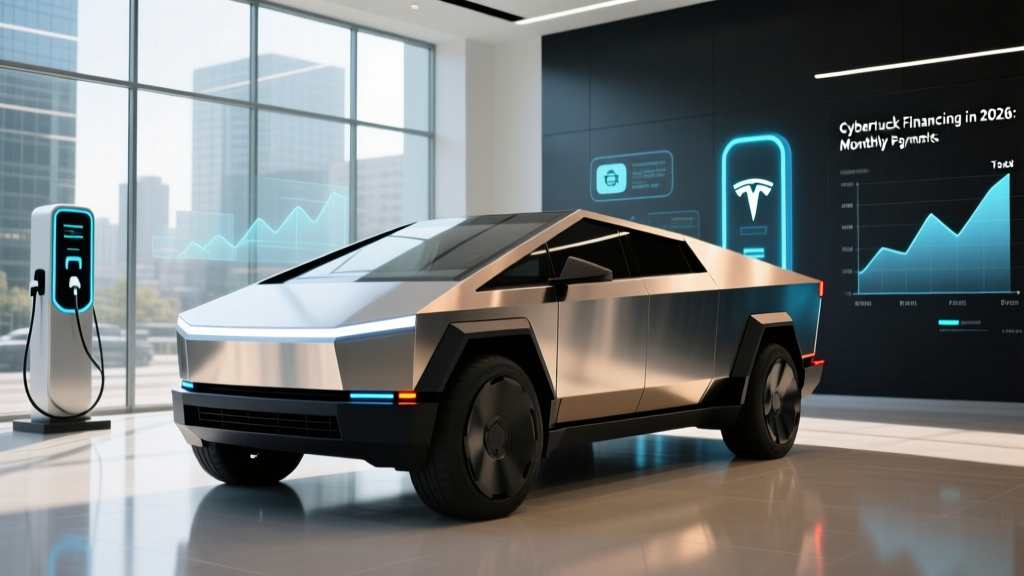
The Tesla Cybertruck entered deliveries in late 2023, and by 2026 it has settled into its role as one of the most polarizing — and closely analyzed — electric pickups on the market. For buyers moving past the hype and into the spreadsheet phase, the real question isn't whether the stainless-steel exoskeleton turns heads. It's whether the numbers work.
This review dissects Cybertruck financing from every angle a serious buyer needs: monthly payment estimates at current rates, federal tax credit eligibility under IRS §30D, real-world range versus the EPA sticker, charging logistics, and how the total cost of ownership stacks up against the Ford F-150 Lightning and Rivian R1T. Every figure below reflects 2026 model-year data.
2026 Cybertruck Trim Lineup and Pricing
Tesla currently offers the Cybertruck in three trims for the 2026 model year. The long-promised base Rear-Wheel-Drive model has not materialized at scale, leaving the lineup anchored by dual- and tri-motor configurations.
| Trim | Drivetrain | Base MSRP | Destination | As-Tested (typical) |
|---|---|---|---|---|
| Long Range AWD | Dual Motor AWD | $79,990 | $1,990 | $82,500–$85,000 |
| Cyberbeast | Tri-Motor AWD | $99,990 | $1,990 | $102,000–$106,000 |
Options remain limited by Tesla's streamlined configuration approach. The primary add-ons include the Foundation Series package (when available), Full Self-Driving (Supervised) at $8,000, and select wheel/accessory bundles. A well-equipped Long Range AWD typically lands between $82,500 and $88,000 before any incentives.
Federal Tax Credit: Does the Cybertruck Qualify?
Short answer: No — not under current §30D rules.
The IRS §30D Clean Vehicle Credit imposes an MSRP cap of $80,000 for trucks, vans, and SUVs (source: irs.gov). The Cybertruck Long Range AWD starts at $79,990, but once the mandatory $1,990 destination fee and any single option are added, the vehicle's total MSRP exceeds the $80,000 threshold. The Cyberbeast, at $99,990, is well above it.
Additional §30D requirements that would apply even if MSRP qualified:
- Buyer income caps: Modified AGI ≤ $300,000 (joint), $225,000 (head of household), $150,000 (single)
- Battery component sourcing: Increasing percentages of components must be manufactured/assembled in North America
- Critical minerals: Increasing percentages must be sourced from the U.S. or FTA partners
- Point-of-sale transfer: Eligible buyers can apply the credit at purchase — but only if the vehicle qualifies first
Bottom line: Budget for the Cybertruck at full MSRP. Consult a tax professional for your specific situation, but plan your financing without assuming a $7,500 offset.
Cybertruck Financing: Monthly Payment Scenarios
With no federal tax credit to reduce the purchase price, financing structure becomes the primary lever for managing cash flow. Below are estimated monthly payments for the two available trims at typical 2026 auto loan rates. These assume a 72-month term, which remains the most common new-vehicle loan duration.
| Scenario | Loan Amount | APR | Monthly Payment | Total Interest |
|---|---|---|---|---|
| Long Range AWD (20% down) | $65,600 | 6.49% | $1,088 | $12,736 |
| Long Range AWD (10% down) | $73,800 | 6.49% | $1,224 | $14,328 |
| Long Range AWD (0% down) | $81,980 | 6.99% | $1,399 | $18,748 |
| Cyberbeast (20% down) | $81,600 | 6.49% | $1,354 | $15,888 |
| Cyberbeast (10% down) | $91,800 | 6.49% | $1,523 | $17,856 |
Key financing considerations:
- Tesla does not have a captive finance arm like Ford Credit or GM Financial. Buyers arrange financing through Tesla's partner lenders (e.g., US Bank, Wells Fargo) or their own bank/credit union. Rates vary significantly — the 6.49%–6.99% range above reflects typical 2026 rates for borrowers with 720+ credit scores.
- Leasing is available through Tesla's partner lessors, but residual values on the Cybertruck remain uncertain given its novelty, which can inflate lease payments.
- No state EV rebates universally apply to the Cybertruck due to its price, though some states (e.g., Colorado) offer credits that phase out at higher MSRPs. Check your state's current rules.
- Insurance costs run 20–35% higher than comparable full-size pickups due to repair complexity with the stainless-steel body and integrated structural battery pack. Budget $2,500–$4,000 annually depending on your profile.
Range, Battery, and Real-World Efficiency
The Cybertruck Long Range AWD carries an EPA-estimated range of 340 miles, while the Cyberbeast is rated at 320 miles. Both trims use a ~123 kWh usable battery pack with NMC (nickel manganese cobalt) chemistry — chosen for its higher energy density, which is essential in a vehicle this heavy (curb weight exceeds 6,600 lbs for the Long Range and approaches 6,800 lbs for the Cyberbeast).
EPA Range vs. What You'll Actually Get
| Condition | Long Range AWD | Cyberbeast |
|---|---|---|
| EPA Sticker | 340 miles | 320 miles |
| Mixed real-world driving | ~290–310 miles | ~270–290 miles |
| Sustained 75+ mph highway | ~250–275 miles | ~230–255 miles |
| Cold weather (below 30°F) | ~220–260 miles | ~200–240 miles |
| Towing (5,000 lb trailer) | ~150–180 miles | ~140–170 miles |
The Cybertruck's aerodynamic profile helps at highway speeds relative to conventional pickups, but its mass and frontal area still exact a toll. Cold weather reduces range more sharply than in sedans due to the larger cabin volume to heat and the energy demands of battery preconditioning. If your commute involves sustained mountain passes or regular towing, plan around 60–70% of the EPA figure.
Efficiency ratings (per fueleconomy.gov):
- Long Range AWD: 2.0 kWh/mile (combined) — approximately 169 MPGe
- Cyberbeast: 2.1 kWh/mile (combined) — approximately 161 MPGe
For context, that's less efficient than a Model Y (~2.8–3.0 mi/kWh) but competitive with the F-150 Lightning Extended Range (~2.0–2.2 kWh/mile). At a national average electricity cost of $0.16/kWh, fueling the Cybertruck costs roughly $0.32 per mile, versus $0.15–$0.18 per mile for a gas F-150 at 20 mpg and $3.50/gallon.
Charging Speed: DC Fast, Level 2, and Infrastructure
The Cybertruck uses the NACS (North American Charging Standard) connector natively — no adapter needed at Tesla Superchargers. It supports an 800V electrical architecture, enabling fast DC charging at compatible stations.
| Charging Level | Connector | Max Power | Speed / Time |
|---|---|---|---|
| Level 1 (120V household) | NACS / J1772 adapter | 1.4 kW | ~3–4 miles per hour |
| Level 2 (240V home) | NACS (Wall Connector) | 11.5 kW (48A) | ~34 miles per hour; 0–100% in ~11 hours |
| DC Fast Charge (V4 Supercharger) | NACS | Peak 250 kW | 10–80% in ~30 minutes |
| DC Fast Charge (350 kW CCS station w/ adapter) | NACS-to-CCS (Magic Dock or adapter) | Up to 250 kW | 10–80% in ~30 minutes (varies by station) |
Charging curve reality: The Cybertruck peaks near 250 kW at low states of charge (roughly 10–25% SoC), then tapers progressively. From 50–80%, expect sustained rates closer to 100–140 kW. This means the advertised 10–80% time of roughly 30 minutes is achievable at V3/V4 Superchargers in good conditions, but the last 20% (80–100%) adds another 35–45 minutes. For road trips, plan stops at 10–80% and skip topping off unless you're ending the day.
Home charging setup: A Tesla Wall Connector on a 60A circuit (48A continuous) delivers the full 11.5 kW, adding about 34 miles of range per hour. Most Cybertruck owners will need a 240V/60A circuit installed. Expect $800–$2,000 for a professional installation if your electrical panel has capacity; $2,000–$4,500+ if a panel upgrade (to 200A service) is required. The Wall Connector itself costs approximately $475.
Performance and Capability
| Spec | Long Range AWD | Cyberbeast |
|---|---|---|
| 0–60 mph | 4.1 seconds | 2.6 seconds |
| Horsepower | 600 hp | 845 hp |
| Torque | ~590 lb-ft | ~740 lb-ft |
| Top Speed | 112 mph | 130 mph |
| Towing Capacity | 11,000 lbs | 11,000 lbs |
| Payload Capacity | 2,500 lbs | 2,500 lbs |
| Bed Length | 6 ft (72 in) | 6 ft (72 in) |
The Cyberbeast's 2.6-second 0–60 time makes it one of the quickest production vehicles ever sold, regardless of powertrain. But the more relevant number for truck buyers is towing. The 11,000-lb rating is competitive with the F-150 Lightning (10,000 lbs max) and exceeds the Rivian R1T (11,000 lbs with the Max Pack). However, as the range table above shows, towing cuts the Cybertruck's range roughly in half. If you tow frequently over long distances, charging logistics become the limiting factor, not the truck's mechanical capability.
The Cybertruck's steer-by-wire system (no physical connection between the yoke and the wheels) remains a standout technology. It enables the variable-ratio steering that makes the yoke functional at low speeds, and it eliminates kickback from rough terrain. Some drivers adapt quickly; others find the lack of traditional feedback disconcerting in crosswinds or on crowned roads. A test drive is mandatory before committing.
Interior, Cargo, and Technology
Passenger space:
- Front headroom: 40.3 inches
- Front legroom: 41.5 inches
- Rear headroom: 37.2 inches
- Rear legroom: 38.4 inches
- Seating: 5 passengers (bench front seat in some configurations)
Cargo:
- Bed volume: 74 cu ft (with tonneau cover closed)
- Front trunk (frunk): 7.1 cu ft — lockable, drainable, useful for groceries or gear
- Bed length: 72 inches (6 feet) with tailgate down extends to ~8 feet
- The motorized tonneau cover is standard and can support ~300 lbs of distributed weight
Tech highlights:
- 18.5-inch front touchscreen with Tesla's latest UI (no physical gauges or instrument cluster)
- 9.4-inch rear touchscreen for passenger climate and media control
- Tesla Autopilot (Level 2 driver-assist) standard — adaptive cruise, lane centering, automatic emergency braking
- Full Self-Driving (Supervised) available for $8,000 — still requires active driver supervision at all times
- Over-the-air updates continue to add features post-delivery
- Integrated air compressor with bed and cabin outlets
- 120V and 240V bed outlets (Powershare) — can run tools or provide backup home power (with appropriate equipment)
⚠️ Autopilot / FSD Is NOT Self-Driving
Tesla's Autopilot and FSD (Supervised) are SAE Level 2 driver-assistance systems. The driver must remain fully attentive, keep hands on the yoke (or demonstrate engagement via the cabin camera), and be prepared to take over instantly. These systems do not make the Cybertruck autonomous. Misuse has resulted in serious crashes documented by NHTSA. Treat them as advanced cruise control with lane centering — not as a replacement for driving.
Notable drawbacks:
- The stainless-steel body is fingerprint-prone and difficult to repair — collision shops need specific training and equipment
- The yoke steering is non-traditional and not universally preferred; no round-wheel option is currently offered
- Rear visibility is compromised by the bed design and small rear window; reliance on cameras is heavy
- Panel gaps and build quality have improved since early production but remain inconsistent relative to legacy OEMs
- Third-party accessories and aftermarket support are growing but still limited compared to the F-150 platform
Warranty and Long-Term Ownership
| Component | Coverage |
|---|---|
| Basic Vehicle | 4 years / 50,000 miles |
| Battery & Drive Unit | 8 years / 120,000 miles (minimum 70% capacity retention) |
| Restraint System | 5 years / 60,000 miles |
| Corrosion | 12 years / unlimited miles (perforation only) |
The 8-year/120,000-mile battery warranty is slightly more generous in mileage than Tesla's sedan warranties (100,000 miles for Model 3/Y), reflecting the truck-use expectation. The 70% capacity retention threshold is standard for the industry — if your pack degrades below 70% of original capacity within the warranty period, Tesla will repair or replace it.
Battery replacement cost out of warranty: Based on current Tesla service data and the ~123 kWh pack size, a full battery replacement would likely cost $18,000–$28,000 including labor. However, catastrophic battery failures are rare; gradual degradation to 85–90% capacity over 150,000 miles is the more typical NMC experience based on Tesla's fleet data.
Cybertruck vs. Competitors: Which Electric Pickup Wins?
✅ Cybertruck Pros
- Class-leading acceleration (Cyberbeast: 2.6s 0–60)
- Native NACS connector + Tesla Supercharger network access
- 11,000-lb towing capacity
- Stainless-steel body resists dents and corrosion
- Steer-by-wire enables unique driving dynamics
- Powershare V2L/V2H capability for tools and home backup
- Over-the-air updates add features continuously
❌ Cybertruck Cons
- No federal tax credit eligibility (exceeds $80K MSRP cap)
- Real-world range drops sharply when towing or in cold weather
- Yoke steering is divisive — no round wheel option
- Higher insurance premiums vs. conventional trucks
- Limited rear visibility
- Stainless-steel repairs require specialized collision centers
- No qualifying for some state EV rebates due to price
Choose the Cybertruck If:
- You want the fastest production truck available and value tech-forward features
- You already have home Level 2 charging and access to the Supercharger network
- You prioritize the integrated Tesla ecosystem (solar, Powerwall, app, OTA updates)
- Your towing needs are moderate-distance (under 150 miles per trip)
Choose the Ford F-150 Lightning If:
- You need a proven fleet/work-truck platform with widespread service support
- You prefer a traditional steering wheel and conventional truck ergonomics
- You want access to Ford Pro charging infrastructure for commercial use
Choose the Rivian R1T If:
- You want the most off-road-capable electric truck with a quad-motor option
- You value a more traditional truck interior with premium materials
- You need a full-size spare tire (the Cybertruck does not include one)
Is Cybertruck Financing Worth It? The Bottom Line
The 2026 Cybertruck is an engineering achievement that delivers genuinely impressive performance, capability, and technology. But it is also a $82,000–$106,000 vehicle with no federal tax credit, higher-than-average insurance costs, and real-world range that demands honest planning — especially if you tow or live in a cold climate.
For buyers with home charging, a strong financial profile, and use cases that don't regularly push range limits, the Cybertruck Long Range AWD at ~$1,088/month (72 months, 20% down) delivers a unique ownership experience that nothing else matches. The Cyberbeast is a specialty product — thrilling, but harder to justify on pure utility.
If your budget is tighter or your use case involves frequent long-distance towing, the F-150 Lightning or Rivian R1T may offer more practical ownership at a similar or lower total cost. Test drive all three before signing.
Frequently Asked Questions
What is the real-world range of the Cybertruck?
The EPA rates the Long Range AWD at 340 miles and the Cyberbeast at 320 miles. In mixed real-world driving, expect 290–310 miles (Long Range) and 270–290 miles (Cyberbeast). Sustained highway driving at 75+ mph drops this to roughly 250–275 miles. Cold weather below 30°F can reduce range to 220–260 miles. Towing a 5,000-lb trailer cuts range approximately in half.
How fast does the Cybertruck charge at home and on the road?
At home on a 240V/60A circuit with the Tesla Wall Connector, the Cybertruck charges at up to 11.5 kW, adding about 34 miles of range per hour and reaching a full charge in approximately 11 hours. On DC fast chargers (Tesla V3/V4 Superchargers), it peaks at 250 kW and can go from 10–80% in roughly 30 minutes, though the charge curve tapers significantly above 50% SoC.
Does the Cybertruck qualify for the federal EV tax credit?
No. Under IRS §30D rules, trucks must have an MSRP at or below $80,000 to qualify. The Cybertruck Long Range AWD starts at $79,990, but the mandatory $1,990 destination charge pushes the total above the cap. The Cyberbeast at $99,990 is well above it. Always verify current rules at irs.gov and consult a tax professional.
How much does a Cybertruck cost per month with financing?
With a 72-month loan at approximately 6.49% APR and 20% down, the Long Range AWD costs roughly $1,088/month. The Cyberbeast under the same terms costs about $1,354/month. Zero-down financing pushes payments to $1,400+ for the Long Range. Insurance adds $200–$330/month on top.
Is the Cybertruck worth buying versus the F-150 Lightning or Rivian R1T?
It depends on your priorities. The Cybertruck wins on acceleration, Supercharger network access, and tech-forward features like steer-by-wire and Powershare. The F-150 Lightning wins on service network breadth, traditional ergonomics, and commercial fleet support. The Rivian R1T wins on off-road capability, interior quality, and spare tire inclusion. All three are excellent — your use case should determine the choice, not brand loyalty.
What is the Cybertruck's battery warranty?
Tesla covers the Cybertruck's battery and drive unit for 8 years or 120,000 miles, whichever comes first, with a minimum 70% capacity retention guarantee. The basic vehicle warranty is 4 years / 50,000 miles.