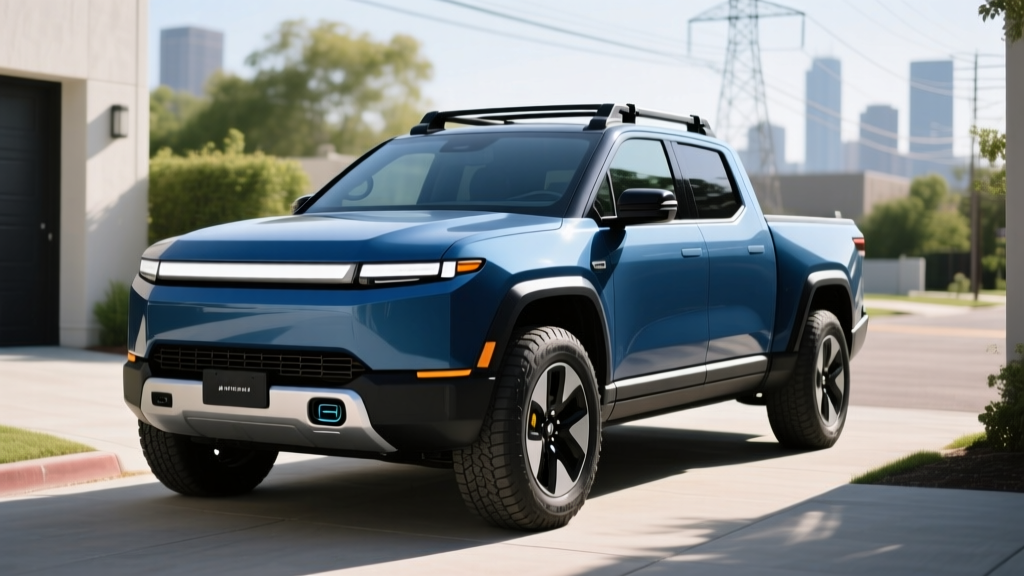
The 2023 Rivian R1T was the first production electric pickup to reach American driveways, beating the GMC Hummer EV and Ford F-150 Lightning to market by months. For buyers evaluating this truck from the used market in 2026 — or cross-shopping it against newer entrants — the R1T's blend of performance, off-road capability, and clever packaging remains compelling. But two years of real-world ownership data have also surfaced its quirks: a charging curve that tapers hard above 80%, cold-weather range losses typical of NMC packs, and a price point that puts it firmly in premium territory.
This review covers the 2023 model year Dual-Motor R1T with the Large (135 kWh) and Max (176 kWh) battery packs, drawing on EPA data, owner reports, and Rivian's published specifications to give you the numbers that matter.
2023 Rivian R1T: Core Specifications at a Glance
| Specification | Dual-Motor Large Battery | Dual-Motor Max Battery |
|---|---|---|
| EPA Range | 352 miles | 402 miles |
| Battery Capacity (usable) | ~128 kWh (NMC) | ~176 kWh (NMC, Samsung 2170 cells) |
| Horsepower | 533 hp | 533 hp |
| Torque | 610 lb-ft | 610 lb-ft |
| 0–60 mph | 3.9 seconds | 3.9 seconds |
| Drivetrain | Dual-Motor AWD | Dual-Motor AWD |
| Max DC Fast Charge | ~200 kW (peak) | ~200 kW (peak) |
| 10–80% DCFC Time | ~43 minutes | ~53 minutes |
| Level 2 Home Charging | 11.5 kW (~25 mi/hr) | 11.5 kW (~25 mi/hr) |
| EPA Efficiency | 70 MPGe (48 kWh/100mi) | 65 MPGe (52 kWh/100mi) |
| Towing Capacity | 11,000 lbs | 11,000 lbs |
| Payload | 1,760 lbs | 1,760 lbs |
| Base MSRP (2023) | $87,600 | $94,600 |
| Battery/Powertrain Warranty | 8 years / 175,000 miles | 8 years / 175,000 miles |
Sources: EPA Fueleconomy.gov, Rivian Official Specs
Real-World Range: What the EPA Number Doesn't Tell You
Real-World Expectation: 280–320 miles highway (Large), 330–370 miles highway (Max). Cold weather (below 32°F) reduces range by 20–30%, bringing the Large pack down to ~220–250 miles in winter highway driving.
The R1T's EPA numbers are generous by electric-truck standards, but they reflect mixed city/highway driving at moderate temperatures. On a sustained 75 mph highway run in 70°F weather, owners consistently report 280–310 miles from the Large pack before hitting 10% state of charge. The Max pack extends that to roughly 340–360 miles under the same conditions.
Cold weather is the equalizer. The R1T uses NMC (nickel manganese cobalt) chemistry in both the Large and Max packs, which suffers greater low-temperature capacity loss than LFP cells. At 20°F, expect a 25–30% reduction in usable range. Rivian's heat pump helps cabin efficiency, but the battery pack itself must be thermally managed — preconditioning the pack before DC fast charging is critical to hitting advertised charge speeds in cold weather.
For context, towing a 5,000-lb trailer at highway speeds roughly halves range. Owners report 150–180 miles from the Large pack under towing conditions. If towing is central to your use case, the Max pack is nearly mandatory.
Charging Speed: DC Fast, Level 2, and the Curve Reality
| Charging Level | Power / Rate | Miles Added per Hour | Notes |
|---|---|---|---|
| Level 1 (120V) | ~1.4 kW | ~3 mi/hr | Emergency/trickle only |
| Level 2 (240V, 48A) | 11.5 kW | ~25 mi/hr | Full charge in ~12–15 hrs |
| DC Fast (CCS) | Peak ~200 kW | Up to ~140 mi in 20 min | 10–80% in ~43 min (Large) |
The R1T charges via CCS1 connector (the 2023 model year predates Rivian's switch to NACS for newer models). On a 350 kW Electrify America or EVgo station, the R1T peaks around 190–200 kW — but that peak is short-lived.
Here's where the charge curve matters: the R1T holds strong power from roughly 10–50% state of charge, then tapers progressively. From 50–80%, speeds drop to 80–100 kW, and above 80%, charging slows dramatically to protect the battery. This is why the 10–80% time of ~43 minutes (Large) or ~53 minutes (Max) is the more useful metric than peak kW. Road-trip planning should target 20–25 minute stops from 15–65% rather than trying to push past 80%.
At home, the R1T accepts up to 11.5 kW on a Level 2 charger (48 amps on a 60-amp circuit). That translates to roughly 25 miles of range per hour, meaning a full recharge from 10% takes about 12–14 hours. For daily driving of 40–60 miles, an overnight session easily replenishes the pack.
Performance and Drivetrain: Supercar Truck Territory
The 2023 Dual-Motor R1T produces 533 horsepower and 610 lb-ft of torque, launching to 60 mph in 3.9 seconds. That's faster than most sports sedans and quicker than any body-on-frame truck sold in 2023. The dual-motor all-wheel-drive system provides independent torque vectoring front-to-rear, and Rivian's quad-motor variant (introduced later) pushes output even higher.
Off-road, the R1T's air suspension offers up to 14.9 inches of ground clearance in Max mode, with approach, departure, and breakover angles that rival purpose-built off-roaders. The hydraulic roll control system eliminates the need for traditional sway bars, improving wheel articulation on uneven terrain.
On pavement, the air suspension delivers a compliant ride in Standard mode and firms up in Sport mode. The R1T's 6,800+ lb curb weight is noticeable in transitions, but the low center of gravity from the skateboard battery platform keeps body roll manageable.
Cargo, Passenger Space, and the Gear Tunnel Advantage
The R1T is a crew-cab, short-bed truck with dimensions that prioritize passenger comfort over bed length:
- Bed length: 54.2 inches (4.5 feet) — short for a pickup, but the gear tunnel compensates
- Gear Tunnel: 11.7 cu ft of lockable, pass-through storage behind the cab, accessible from both sides. Unique to the R1T and ideal for skis, camping gear, or tools
- Frunk (front trunk): 11.0 cu ft, drainable, with a powered tonneau-style cover
- Front legroom: 41.3 inches
- Rear legroom: 38.2 inches — adequate for adults on longer trips
- Bed payload: 1,760 lbs
- Towing: 11,000 lbs maximum (with weight-distribution hitch)
The gear tunnel is the R1T's party trick. It spans the full width of the vehicle between the cab and bed, offering secure, weather-sealed storage that no competitor matches. The optional Camp Kitchen accessory slides out from the tunnel, integrating a two-burner induction cooktop, sink, and utensil storage.
The trade-off: a 4.5-foot bed limits what you can haul. Standard 4×8 sheets of plywood won't fit flat. If your truck use involves frequent lumber or large cargo runs, the F-150 Lightning's 5.5- or 6.5-foot bed may serve you better.
Pricing, Tax Credits, and What You'll Actually Pay
| Trim / Configuration | 2023 MSRP | Potential Federal Credit (§30D) | Effective Price |
|---|---|---|---|
| Dual-Motor Large Battery | $87,600 | Up to $7,500* | ~$80,100 |
| Dual-Motor Max Battery | $94,600 | Up to $7,500* | ~$87,100 |
| Adventure Package (Large) | $74,800 | Up to $7,500* | ~$67,300 |
*Federal tax credit eligibility under IRS §30D depends on multiple factors for the 2023 tax year and current 2026 used-EV rules:
- New vehicle (2023 purchase): The R1T's MSRP exceeded the $80,000 truck cap for the full $7,500 credit in most trims. The Adventure Dual-Motor Large at $74,800 qualified. Higher trims did not qualify for the new-vehicle credit due to MSRP limits.
- Used vehicle (2026 purchase): Under the used-EV credit (§25E), buyers may qualify for up to $4,000 or 30% of the sale price (whichever is lower) on a used R1T priced at $25,000 or below — unlikely for an R1T in 2026 given resale values. Higher-priced used R1Ts do not qualify.
- Income caps (new vehicle): AGI limits of $300,000 (joint), $225,000 (head of household), $150,000 (single).
- Battery sourcing: 2023 vehicles had transitional critical-mineral and battery-component requirements that phased in throughout the year.
Always verify current eligibility at IRS.gov and consult a tax professional. State incentives vary by jurisdiction.
Technology, Driver Assists, and the Software Experience
The R1T runs Rivian's proprietary infotainment system on a 15.6-inch center touchscreen and a 12.3-inch digital instrument cluster. Notable features include:
- Rivian Driver+: A Level 2 driver-assistance system with adaptive cruise control and lane centering. This is not autonomous driving — the driver must keep hands on the wheel and eyes on the road at all times.
- Over-the-air updates: Rivian regularly pushes software improvements, adding features like enhanced preconditioning logic, new drive modes, and UI refinements.
- Digital key and phone-as-key: Seamless entry and start via smartphone.
- Powered tonneau cover: Electric retractable bed cover, standard on most trims.
- Vehicle-to-Load (V2L): The R1T does not natively support V2L in the 2023 model year — a notable omission versus the F-150 Lightning's Pro Power Onboard.
The infotainment system is responsive and well-designed, but as of the 2023 model year it lacked wireless Apple CarPlay and Android Auto (wired only). Rivian has since added wireless support via OTA for newer model years — check whether a used 2023 has received this update.
Warranty and Long-Term Battery Outlook
Rivian covers the R1T's battery and drive system with an 8-year / 175,000-mile warranty, retaining at least 70% of original capacity. This is competitive with Tesla's 8-year/120,000-mile truck coverage and exceeds most legacy automakers.
The bumper-to-bumper warranty runs 5 years / 60,000 miles. One area of owner concern has been build-quality consistency on early 2022–2023 models — panel gaps, rattles, and minor electrical gremlins were reported more frequently than on established competitors. Rivian's service network has expanded significantly since then, but it remains smaller than Ford or GM's dealer footprint.
NMC battery degradation data from early R1T owners suggests roughly 3–5% capacity loss after 30,000–40,000 miles, which is within normal parameters. Frequent DC fast charging and regularly charging to 100% can accelerate degradation — Rivian recommends daily charging to 85–90% for battery longevity.
Who Should Buy the 2023 Rivian R1T?
Choose the R1T if:
- You want an electric truck that's genuinely capable off-road, not just a battery swap on a body-on-frame chassis
- The gear tunnel and frunk solve real storage problems for your lifestyle (camping, skiing, trades)
- You prioritize acceleration and driving dynamics in a truck
- You can charge at home and don't regularly need 400+ miles of single-charge range
Look elsewhere if:
- You need a full-size bed for work (lumber, equipment) — consider the F-150 Lightning
- Towing long distances is routine — range drops severely, and the charging network for trucks is still developing
- Budget is a primary concern — the R1T is a premium product at a premium price
- You want a proven dealer service network within 30 miles — Rivian's mobile service is good but not universal
Pros and Cons
- Class-leading acceleration (3.9s 0–60) and ride quality via air suspension
- Gear tunnel and frunk offer unmatched enclosed storage versatility
- Genuine off-road capability with 14.9" ground clearance and hydraulic roll control
- 11,000-lb towing capacity competitive with full-size gas trucks
- Strong OTA update cadence keeps the vehicle improving post-purchase
- 175,000-mile battery warranty exceeds most competitors
- Short 4.5-foot bed limits utility for large cargo
- DC charging tapers significantly above 60% SoC — road-trip stops take longer than peak kW suggests
- No V2L capability (unlike F-150 Lightning's Pro Power Onboard)
- Premium pricing; most trims exceeded the §30D MSRP cap for new-vehicle tax credit
- NMC pack loses 25–30% range in sub-freezing temperatures
- Service network still expanding — rural owners may face longer wait times
Frequently Asked Questions
What is the real-world range of the 2023 Rivian R1T?
The Large Battery pack delivers roughly 280–320 miles on the highway in moderate temperatures, versus the EPA's 352-mile combined rating. The Max pack extends that to 330–370 miles real-world. Cold weather (below freezing) reduces range by 20–30%, and towing cuts range roughly in half.
How fast does the R1T charge at home and on the road?
On DC fast charging (CCS), the R1T peaks around 200 kW and charges from 10–80% in approximately 43 minutes (Large pack) or 53 minutes (Max pack). At home on Level 2 (11.5 kW), it adds about 25 miles of range per hour, fully recharging overnight in 12–15 hours.
Does the 2023 Rivian R1T qualify for the federal EV tax credit?
For original 2023 new-vehicle purchases, only trims with an MSRP at or below $80,000 (like the Adventure Dual-Motor Large at $74,800) qualified for up to $7,500 under §30D, subject to buyer income limits and battery-sourcing rules. For 2026 used purchases, the §25E credit applies only to vehicles sold at $25,000 or below — unlikely for an R1T at current resale values. Always verify at IRS.gov.
Is the 2023 R1T worth buying versus the F-150 Lightning or Silverado EV?
The R1T wins on performance, off-road capability, and storage innovation (gear tunnel). The F-150 Lightning wins on bed size, V2L capability, dealer service access, and lower starting price. The Silverado EV offers the longest range (up to 440 miles EPA on the Max pack) and a larger bed. Your priority — adventure capability vs. work utility vs. range — determines the best fit.
What are the biggest drawbacks of the 2023 R1T?
The short bed, lack of V2L, charging-curve taper above 60%, cold-weather range loss, and premium pricing are the most-cited owner concerns. Early build-quality issues have improved, but the service network is still growing.
How long will the R1T's battery last?
Rivian warranties the battery for 8 years or 175,000 miles against degradation below 70% capacity. Early owner data shows 3–5% loss after 30,000–40,000 miles. With proper charging habits (avoiding frequent 100% charges and excessive DC fast charging), the pack should retain usable capacity well beyond 150,000 miles.