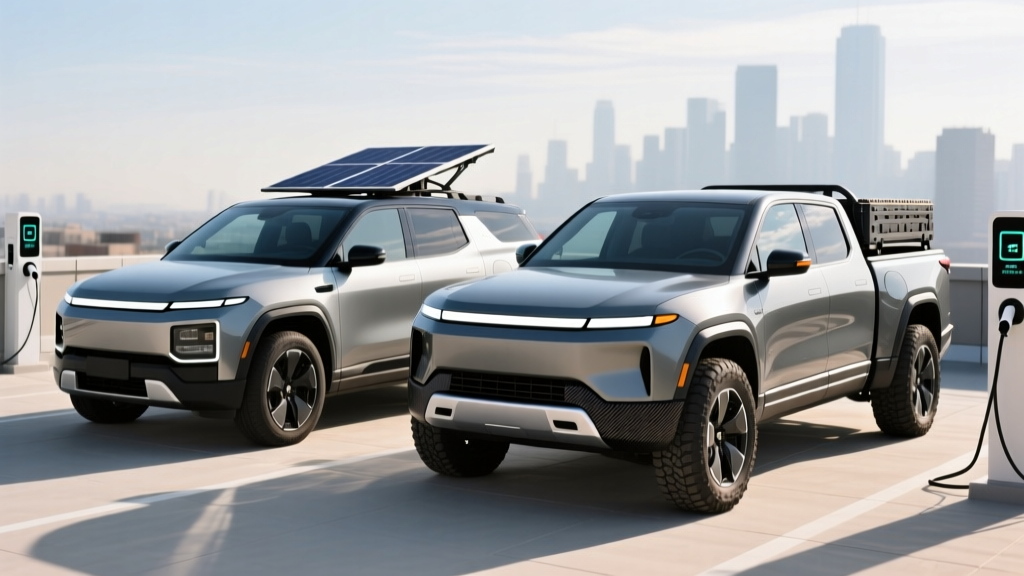
If you've searched "who is Rivian owned by" while researching the R1S SUV or R1T pickup, you're not alone. Rivian's corporate ownership structure is unusually complex for an automaker—and understanding it matters when you're committing $70,000+ to an electric vehicle. Below, we untangle who actually controls Rivian, then deliver the 2026 R1S and R1T data buyers need: real-world range, charging speeds, battery chemistry, tax-credit eligibility, and whether either truck earns your driveway.
Who Is Rivian Owned By? The Investor Breakdown
Rivian Automotive, Inc. is a publicly traded company listed on NASDAQ under the ticker RIVN since its November 2021 IPO. No single entity "owns" Rivian in the traditional sense, but a handful of institutional and strategic investors hold outsized stakes that shape the company's direction:
- Amazon — Amazon's $1.3 billion pre-IPO investment made it Rivian's largest early backer. Amazon also ordered 100,000 Electric Delivery Vans (EDVs), anchoring Rivian's commercial segment. As of early 2026, Amazon holds roughly 15–18% of Rivian stock, though it has trimmed its position from the ~20% peak.
- Vanguard Group & BlackRock — These two asset-management giants collectively hold approximately 12–15% through index funds and institutional accounts, typical for a mid-cap NASDAQ-listed company.
- Founder & CEO RJ Scaringe Scaringe retains significant voting control through a dual-class share structure. While his economic stake is smaller than Amazon's, his Class B shares carry supersized voting power, keeping strategic decisions founder-led.
- Public retail and institutional shareholders — The remainder floats among mutual funds, pension funds, and individual investors.
Why this matters for buyers: Rivian's ownership stability directly affects warranty honoring, software-update cadence, and Supercharger network access partnerships. Amazon's continued investment signals long-term commitment to Rivian's manufacturing scale, while Scaringe's voting control ensures the company isn't steered by short-term hedge-fund pressure. Rivian is not owned by a legacy automaker—it remains independent, unlike Polestar (Geely/Volvo) or Lucid (Saudi PIF majority).
2026 Rivian R1S: EPA Range, Battery, and Real-World Efficiency
The 2026 Rivian R1S is a three-row electric SUV built on Rivian's updated Gen 2 platform with a more efficient drive unit and refined thermal management. Here are the numbers that matter:
| Spec | Dual-Motor AWD (Standard) | Dual-Motor (Max Battery) |
|---|---|---|
| EPA Range | 270 mi | 410 mi |
| Battery Capacity (usable) | 92 kWh (LFP) | 141 kWh (NMC) |
| Horsepower | 533 hp | 533 hp |
| 0–60 mph | 4.5 sec | 4.5 sec |
| Drivetrain | AWD (dual-motor) | AWD (dual-motor) |
| MPGe (combined) | 73 MPGe | 69 MPGe |
| kWh/100 mi | 46 | 49 |
| Towing Capacity | 7,700 lb | 7,700 lb |
| Cargo Volume (behind 3rd row) | 10.4 cu ft (20.4 cu ft w/ 3rd row folded) | 10.4 cu ft |
| Base MSRP | $75,900 | $84,900 |
R1T Pickup: How the Truck Stacks Up
The 2026 R1T shares the Gen 2 platform and powertrain options with the R1S, but its pickup body changes the efficiency and utility equation:
| Spec | Dual-Motor (Standard) | Dual-Motor (Max Battery) |
|---|---|---|
| EPA Range | 270 mi | 420 mi |
| Battery Capacity (usable) | 92 kWh (LFP) | 141 kWh (NMC) |
| Horsepower | 533 hp | 533 hp |
| 0–60 mph | 4.5 sec | 4.5 sec |
| Bed Length | 54 in (4.5 ft) | 54 in |
| Towing Capacity | 7,700 lb | 7,700 lb |
| Payload Capacity | 1,760 lb | 1,760 lb |
| Base MSRP | $69,900 | $79,900 |
The R1T's 4.5-foot bed is shorter than a Ford F-150 Lightning's 5.5-foot box, but the Gear Tunnel—a lockable, pass-through storage compartment spanning the vehicle width behind the rear seats—adds 11.7 cu ft of secure, weather-sealed cargo space. This makes the R1T function closer to a midsize truck with an enclosed trunk than a traditional full-size pickup.
Charging Speed: DC Fast Charge and Home Level 2
Rivian's Gen 2 vehicles support the NACS (Tesla Supercharger) connector natively, eliminating the CCS-to-NACS adapter hassle that plagued earlier Rivian owners. Charging performance depends on battery pack:
| Charging Level | Standard Battery (92 kWh LFP) | Max Battery (141 kWh NMC) |
|---|---|---|
| Peak DC Fast Charge | 200 kW | 220 kW |
| 10–80% DCFC Time | ~28 min | ~41 min |
| Sustained DCFC (avg 10–80%) | ~140 kW | ~155 kW |
| Level 2 Home (11.5 kW / 48A) | ~16 mi/hr | ~16 mi/hr |
| Level 2 Home (full 0–100%) | ~9 hours | ~14 hours |
Charging-curve reality check: Rivian's Max Battery peaks at 220 kW but only holds that rate briefly between roughly 10–25% State of Charge. From 25–60%, it sustains around 170–180 kW, then tapers progressively above 80%. The LFP Standard pack charges more linearly but at a lower peak. For road trips, plan to charge to 80% and go—the time penalty from 80–100% (often 25+ extra minutes) isn't worth the last 20% of range.
At home, Rivian's onboard charger accepts up to 11.5 kW (48 amps) on a 60-amp Level 2 circuit. A full home installation (ChargePoint Home Flex or Tesla Wall Connector, NACS) typically costs $800–$2,500 depending on panel proximity and whether your electrical panel needs a 200-amp upgrade. Always get a quote from a licensed electrician before purchasing equipment.
Federal Tax Credit Eligibility: The §30D Rules for 2026
This is where Rivian buyers face a hard truth. Under current IRS §30D rules, the federal EV tax credit has strict MSRP caps:
- SUVs and pickups: MSRP must not exceed $80,000
- Sedans and other vehicles: MSRP must not exceed $55,000
- Buyer income caps: AGI ≤ $300,000 (joint), $225,000 (head of household), $150,000 (single)
- Battery sourcing: Critical minerals and battery components must meet escalating domestic-content thresholds
| Model / Trim | Base MSRP | §30D MSRP Cap | Eligible for $7,500 Credit? |
|---|---|---|---|
| R1T Dual-Motor Standard | $69,900 | $80,000 | Yes (if income & sourcing qualify) |
| R1T Dual-Motor Max | $79,900 | $80,000 | Borderline — options may push over cap |
| R1S Dual-Motor Standard | $75,900 | $80,000 | Yes (if income & sourcing qualify) |
| R1S Dual-Motor Max | $84,900 | $80,000 | No — exceeds MSRP cap |
Key caveats: Adding premium packages, the Max Battery upgrade, or quad-motor configurations can push trims above the $80,000 cap. The credit is available as a point-of-sale transfer (dealer reduces your purchase price by $7,500) or claimed on your federal tax return. Battery sourcing requirements tighten annually—check the latest fueleconomy.gov eligibility list for the specific VIN before purchasing. Consult a tax professional for your personal situation.
Tech, Driver Assistance, and Interior
Rivian's software stack is proprietary and receives regular over-the-air updates. Notable 2026 features include:
- 15.6-inch center touchscreen with native navigation, streaming, and Camp Mode (maintains cabin climate for overnight camping)
- Rivian Driver+ (SAE Level 2) — adaptive cruise + lane-centering on mapped highways. This is not self-driving; hands-on-wheel supervision is required at all times.
- Highway Assist with automated lane changes on compatible roads
- Powered tonneau cover (R1T) and air suspension with 6 inches of adjustable ride height
- Vehicle-to-Load (V2L): The R1T can power external devices up to 1,500W through bed and cabin outlets—useful for job sites and camping
- Three rows of seating (R1S) with 41.5 inches of front legroom; third row fits adults under 5'10" for short trips
Notable drawbacks: The R1S third row is tight for adults on long drives. The R1T's 4.5-foot bed is undersized for full sheets of plywood. Rivian's service center network, while expanding, remains sparse in rural areas—some owners drive 100+ miles for warranty work. Insurance premiums run 15–25% higher than comparable ICE trucks due to repair-cost data.
Warranty Coverage
| Coverage | Term |
|---|---|
| Limited Vehicle Warranty | 5 years / 60,000 miles |
| Battery & Drive Unit | 8 years / 175,000 miles |
| Battery Capacity Retention | ≥70% over 8 yr / 175,000 mi |
| Corrosion Perforation | 12 years / unlimited miles |
Rivian's 8-year/175,000-mile battery warranty is competitive with Tesla's 8-year/120,000–150,000-mile coverage and slightly more generous on mileage. The 70% capacity retention threshold is industry standard. Rivian's NMC Max packs have shown approximately 5–7% degradation at 50,000 miles based on owner-reported data; LFP Standard packs degrade more slowly but start with less total capacity.
Who Should Buy a Rivian R1S or R1T?
- You need three rows and 400+ miles of EPA range for family road trips
- You want a premium electric SUV with genuine off-road capability (8.9 inches ground clearance, wading to 36 inches)
- You can charge at home and keep most trips under 300 miles between stops
- You want a daily-drivable electric pickup with a lockable Gear Tunnel for gear
- You tow a boat or trailer under 7,700 lb and want instant torque off the line
- You value V2L capability for job-site or camping power
- You need a full-size truck bed (Ford F-150 Lightning or Chevy Silverado EV)
- Your budget is under $60,000 (consider the Tesla Model Y or Hyundai Ioniq 5)
- You live far from a Rivian service center and cannot tolerate mobile-service wait times
Pros and Cons at a Glance
- 410-mile EPA range (Max Battery) is among the highest of any production EV
- Native NACS Supercharger access without adapters
- Genuine off-road chops: air suspension, 8.9" clearance, tank turns (quad-motor)
- Over-the-air software updates add features post-purchase
- Founder-led company with long-term vision and Amazon-backed stability
- MSRP quickly exceeds the $80K tax-credit cap with options
- R1T bed is short; R1S third row is cramped for adults
- Service center network still thin outside major metros
- Insurance premiums higher than ICE truck equivalents
- 41-minute 10–80% DCFC on Max Battery is slower than Hyundai/Kia's 800V architecture (~18 min)
Frequently Asked Questions
Who is Rivian owned by in 2026?
Rivian is a publicly traded company (NASDAQ: RIVN) with no single owner. Amazon remains the largest strategic shareholder at approximately 15–18%, followed by Vanguard and BlackRock. CEO RJ Scaringe holds supersized voting control through a dual-class share structure, keeping Rivian independent and founder-directed.
What is the real-world range of the 2026 Rivian R1S and R1T?
The Max Battery (141 kWh NMC) delivers an EPA-estimated 410 miles (R1S) and 420 miles (R1T). Real-world highway driving at 70–75 mph yields approximately 330–350 miles. In cold weather below 30°F, expect 280–300 miles without preconditioning. The Standard LFP battery's 270-mile EPA rating drops to roughly 220 highway and 190 in winter.
How fast does a Rivian charge?
The Max Battery peaks at 220 kW on a DC fast charger, reaching 10–80% in about 41 minutes (averaging ~155 kW sustained). The Standard LFP battery peaks at 200 kW, hitting 10–80% in ~28 minutes. At home on a 48-amp Level 2 charger (11.5 kW), both packs add about 16 miles of range per hour.
Does the Rivian R1S or R1T qualify for the $7,500 federal EV tax credit?
Base-trim R1T ($69,900) and R1S Standard ($75,900) models fall under the $80,000 SUV/pickup MSRP cap and may qualify, provided the buyer meets income thresholds (≤$300K joint) and battery-sourcing requirements are met. The R1S Max Battery at $84,900 exceeds the cap and does not qualify. Always verify your specific VIN on fueleconomy.gov and consult a tax professional.
Is Rivian worth buying over the Tesla Model X or Ford F-150 Lightning?
The R1S offers more range, off-road capability, and a more adventure-focused design than the Model X, though Tesla's Supercharger network and lower service wait times remain advantages. Against the F-150 Lightning, the R1T is more nimble and tech-forward but has a shorter bed and higher starting price. If you prioritize range, build quality, and off-road utility, Rivian earns its premium. If bed length or budget is paramount, look to Ford.