Quick Verdict: The EV Benchmark Still Holds Up
The 2023 Tesla Model Y remains the electric vehicle against which all compact luxury crossovers are measured. With up to 330 miles of EPA-estimated range (Long Range AWD), access to Tesla's 50,000+ Supercharger network, and class-leading cargo space, it's easy to see why it became the best-selling vehicle globally in 2023. But two years on, with competitors like the Hyundai Ioniq 5, Ford Mustang Mach-E, and BMW iX closing the gap on interior quality and ride comfort, the Model Y's dominance now rests more on its charging ecosystem and software than on raw specs alone.
This review breaks down every number that matters — from real-world range in cold weather to the exact §30D tax credit rules that apply to 2023 Model Y purchases in the current market.
Range, Battery, and Efficiency: The Numbers That Matter
The 2023 Model Y was offered in three trims, each with distinct range and battery configurations. Tesla does not publish official usable battery capacities, but teardown data and third-party testing confirm the figures below.
| Trim | EPA Range | Battery (Usable) | Chemistry | MPGe (Combined) | kWh/100mi |
|---|---|---|---|---|---|
| Long Range AWD | 330 mi | ~75 kWh | NMC (2170 cells) | 122 MPGe | 28 |
| Performance AWD | 303 mi | ~75 kWh | NMC (2170 cells) | 111 MPGe | 30 |
| RWD (Standard Range) | 260 mi | ~57.5 kWh | LFP (CATL prismatic) | 128 MPGe | 26 |
The EPA sticker tells only part of the story. In highway testing at 70 mph in moderate temperatures (60-75°F), the Long Range AWD consistently delivers 280-300 miles before reaching a 5% state of charge. Push speeds to 80+ mph or drive in sub-30°F winter conditions, and expect that number to drop to 220-250 miles. The LFP-equipped RWD model loses less range to cold (LFP chemistry tolerates low temperatures slightly better at partial SoC), but its smaller battery means absolute highway range tops out around 210-230 miles in real-world mixed driving.
For road trips, plan charging stops at roughly 200-mile intervals to stay in the battery's fastest-charging SoC window (10-60%).
The Long Range and Performance trims use nickel-manganese-cobalt (NMC) chemistry in Tesla's 2170 cylindrical cells, offering higher energy density and stronger sustained power delivery. The RWD trim uses lithium iron phosphate (LFP) from CATL — heavier and less energy-dense, but with a longer cycle life, no cobalt, and Tesla recommends charging it to 100% daily (unlike NMC, which is best kept between 20-80% for longevity).
Charging Speed: Supercharger Network vs. Home Level 2
Charging remains the Model Y's strongest competitive advantage. Tesla's Supercharger network — now exceeding 50,000 stalls globally — offers plug-and-charge reliability that public CCS networks still struggle to match consistently.
| Charging Level | Max Power | Rate / Speed | Notes |
|---|---|---|---|
| Level 1 (120V household) | ~1.4 kW | ~3-4 mi/hr | Emergency/top-up only |
| Level 2 (240V home, 48A) | 11.5 kW | ~37-44 mi/hr | Full charge overnight in ~8 hrs |
| DC Fast (V3 Supercharger) | 250 kW peak | 10-80% in ~25 min | Peak rate sustained to ~50% SoC, then tapers |
| DC Fast (V4 Supercharger) | 250 kW (CCS adapter) | 10-80% in ~25 min | Same curve; V4 stalls offer cable for non-Tesla EVs |
Charging curve reality: The 250 kW peak is not sustained across the full session. On a V3 Supercharger with a preconditioned battery, the Long Range pulls roughly 240-250 kW from 10% to about 40% SoC, then tapers to ~150 kW by 60%, and drops below 100 kW past 75%. A 10-80% session takes approximately 25 minutes; a 10-100% session stretches to 40+ minutes. Always precondition the battery via the car's navigation (set a Supercharger as your destination) to hit peak rates — skipping preconditioning in cold weather can cut peak charge speed in half.
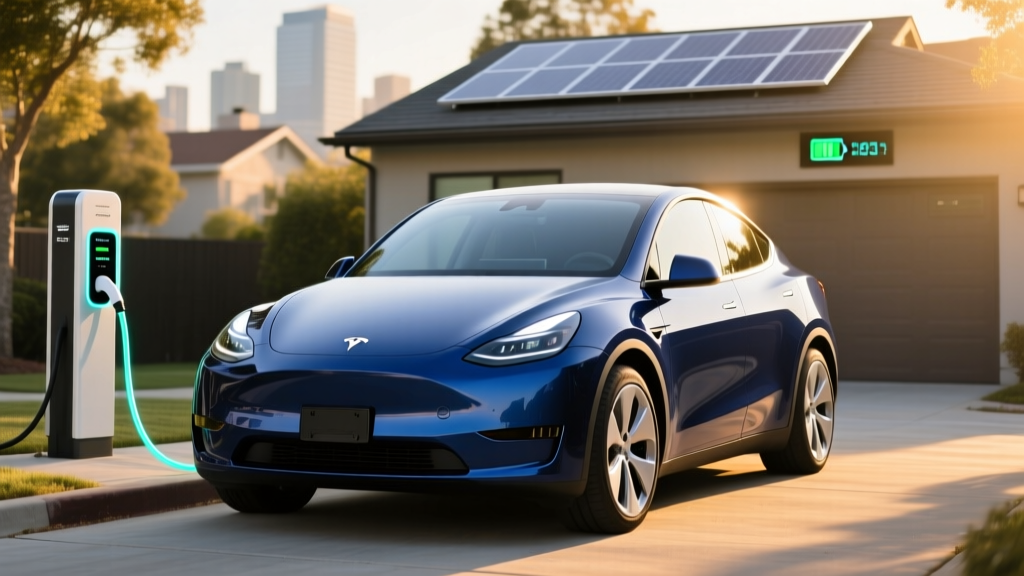
For home charging, the Model Y's onboard charger accepts up to 11.5 kW (48 amps) on a 240V Level 2 circuit. This requires a 60-amp dedicated breaker. A full Level 2 installation typically costs $800-$2,000 depending on panel proximity and local permit requirements — a licensed electrician should evaluate your panel's remaining capacity before committing to a 60A circuit.
Performance, Drivetrain, and Ride Quality
| Trim | Drivetrain | 0-60 mph | Horsepower | Top Speed |
|---|---|---|---|---|
| Long Range AWD | Dual-Motor AWD | 4.8 sec | 384 hp | 135 mph |
| Performance AWD | Dual-Motor AWD | 3.5 sec | 456 hp | 155 mph |
| RWD | Single-Motor RWD | 6.6 sec | 295 hp | 135 mph |
The Performance trim's 3.5-second 0-60 time puts it in sports-car territory, and the dual-motor AWD system provides confident traction in rain and light snow. However, the Model Y's ride quality is its most common criticism: the suspension tuning is firm, and road imperfections transmit noticeably into the cabin, especially on 21-inch wheels. Competitors like the Ioniq 5 and Mach-E offer more compliant rides, though neither matches the Model Y's straight-line acceleration at this price point.
Regenerative braking is strong and adjustable (Standard and Low modes), but unlike some competitors, the 2023 Model Y does not offer a true one-pedal driving mode that brings the car to a complete stop without brake pedal input. You will still use the friction brakes at low speeds.
Interior, Cargo, and Technology
The Model Y's minimalist interior is polarizing: a single 15-inch landscape touchscreen handles virtually every function, including climate controls, glovebox release, and mirror adjustment. There is no traditional instrument cluster — speed and navigation appear in the top-left corner of the center display.
Cargo and passenger dimensions:
- Cargo behind 2nd row: 30.2 cu ft (best in class for electric crossovers)
- Cargo with 2nd row folded: 72.1 cu ft
- Front trunk (frunk): 4.1 cu ft
- Rear legroom: 41.6 inches
- Front headroom: 41.0 inches
- Optional 3rd row: Available on Long Range (reduces cargo to 12.8 cu ft behind 3rd row; best suited for small children only)
Tech highlights:
- Tesla's infotainment is the fastest and most responsive in the EV segment, with native streaming apps, a strong browser, and over-the-air (OTA) updates that add features post-purchase
- Autopilot (basic) is standard — includes adaptive cruise control and lane-centering (SAE Level 2 driver assist; not self-driving)
- Full Self-Driving (Supervised) capability is a $15,000 option (or $199/month subscription as of 2023 pricing) — adds automatic lane changes, traffic-light recognition, and city-street navigation, but still requires full driver attention at all times
- Sentry Mode dashcam recording, Dog Mode climate control, and Tesla Profile driver settings are standout daily-use features
Notable drawbacks: The lack of physical buttons frustrates some drivers, especially for climate and wiper adjustments. Panel-gap quality improved in 2023 Fremont and Austin builds but still lags behind BMW and Mercedes standards. Road noise at highway speeds is more pronounced than in the Ioniq 5 or Mach-E. There is no Apple CarPlay or Android Auto — Tesla's native system is the only option.
Pricing, Trims, and Federal Tax Credit Eligibility
The 2023 Model Y launched with significant price cuts throughout the year. Below are the MSRPs as of late 2023, along with current tax credit context for buyers considering a used 2023 Model Y today.
| Trim | Late-2023 MSRP (New) | Used Market (2026 est.) | Used EV Credit (§25E) |
|---|---|---|---|
| RWD | $43,990 | $28,000-$33,000 | Up to $4,000 (30% of sale price, max $4,000) |
| Long Range AWD | $48,490 | $32,000-$38,000 | Up to $4,000 |
| Performance AWD | $52,490 | $35,000-$42,000 | Up to $4,000 |
Federal tax credit details for new 2023 purchases (historical context): When purchased new in 2023, the Model Y Long Range and Performance qualified for the full $7,500 §30D federal tax credit for eligible buyers, subject to the following IRS requirements:
- MSRP cap: Vehicle MSRP must not exceed $80,000 (all Model Y trims qualify)
- Buyer income cap (MAGI): $150,000 single / $225,000 head of household / $300,000 joint filers
- Battery sourcing: In 2023, 40% of critical minerals and 50% of battery components had to be sourced from the US or FTA partners — Tesla's supply chain met this threshold for US-built Model Y vehicles
- Point-of-sale transfer: Beginning January 1, 2024, buyers can transfer the credit to the dealer for an immediate price reduction; 2023 purchases were claim-only on tax returns
For used 2023 Model Y buyers in 2026: The §25E Used Clean Vehicle Credit offers up to $4,000 (30% of the sale price, capped at $4,000) for qualifying used EVs purchased from a licensed dealer. Income caps are lower: $75,000 single / $112,500 head of household / $150,000 joint. The vehicle must be at least two model years old (a 2023 model qualifies in 2025 and beyond), and the sale price must be $25,000 or less to be eligible — meaning only base RWD models in the lower end of the used market will qualify. Always verify current rules with a tax professional and the IRS.
Ownership Costs: Warranty, Insurance, and Maintenance
Warranty coverage:
- Basic vehicle: 4 years / 50,000 miles
- Battery & drive unit (Long Range/Performance): 8 years / 120,000 miles (minimum 70% capacity retention)
- Battery & drive unit (RWD/LFP): 8 years / 100,000 miles (minimum 70% capacity retention)
Tesla's battery warranty guarantees that the pack will retain at least 70% of its original capacity during the warranty period. Real-world degradation data from fleet monitoring services like TeslaFi and Recurrent Auto suggest the 2023 NMC packs lose approximately 8-12% capacity over the first 100,000 miles, with degradation slowing significantly after the initial break-in period. LFP packs in the RWD model show similar or slightly lower degradation curves but with less sensitivity to being held at 100% SoC.
Maintenance costs are minimal compared to gas vehicles: no oil changes, no spark plugs, no transmission fluid. Expect to replace cabin air filters ($30-$50 every 2 years), wiper fluid, brake fluid checks, and tires. The Model Y's weight (~4,400 lbs for Long Range) accelerates tire wear — budget for a set of four tires every 25,000-35,000 miles at roughly $200-$300 per tire.
Insurance remains a pain point. The Model Y consistently ranks among the most expensive mainstream EVs to insure, with average annual premiums of $2,200-$3,200 depending on state, driving record, and coverage level. Tesla Insurance (available in select states) can sometimes undercut traditional carriers by 10-20%, but availability is limited. Always get quotes before purchasing.
How the 2023 Model Y Stacks Up Against Key Competitors
By 2026, the compact electric crossover segment has matured significantly. Here's how the 2023 Model Y compares to the alternatives buyers most frequently cross-shop:
| Attribute | 2023 Model Y LR | 2023 Ioniq 5 AWD | 2023 Mach-E ER AWD | |
|---|---|---|---|---|
| EPA Range | 330 mi | 260 mi | 312 mi | |
| DC Fast Charge (peak) | 250 kW | 235 kW (350 kW capable on 800V) | 150 kW | |
| 0-60 mph | 4.8 sec | 5.0 sec | 5.1 sec | |
| Cargo (behind 2nd row) | 30.2 cu ft | 27.2 cu ft | 29.7 cu ft | |
| Charging Network | Tesla Supercharger (NACS native) | CCS (NACS adapter available) | CCS (NACS adapter available) | |
| Apple CarPlay/Android Auto | No | Yes (wireless) | Yes (wireless) |
The Ioniq 5's 800V architecture allows faster peak charging on compatible 350 kW Electrify America stations, and its interior materials and ride comfort surpass the Tesla. The Mach-E offers a more traditional crossover feel with Ford's dealer network for service. But neither can match the Model Y's combination of range, cargo space, and — critically — the Supercharger network advantage, which becomes the deciding factor for frequent road-trippers.
- Choose the Model Y if: You road-trip regularly and need reliable DC fast charging, you want maximum cargo space in an electric crossover, you value OTA software updates and Tesla's ecosystem, or you need optional 3rd-row seating for small children.
- Look elsewhere if: Ride comfort and cabin quietness are top priorities (consider Ioniq 5 or BMW iX), you want Apple CarPlay, you prefer physical buttons and a traditional instrument cluster, or you want a lower insurance cost.
Pros and Cons at a Glance
Pros
- Class-leading 330-mile EPA range (Long Range)
- Supercharger network: 50,000+ stalls with plug-and-charge reliability
- Best-in-class cargo volume (30.2 cu ft + 4.1 cu ft frunk)
- 250 kW DC fast charging, 10-80% in ~25 min
- Strong OTA update history adds features post-purchase
- Low maintenance costs vs. ICE vehicles
- Excellent safety ratings (IIHS Top Safety Pick+, 5-star NHTSA)
Cons
- Firm ride quality, especially on 21" wheels
- No Apple CarPlay or Android Auto
- All controls on touchscreen — no physical buttons
- Higher insurance premiums than most competitors
- Road noise at highway speeds exceeds segment rivals
- FSD (Supervised) is expensive and still requires full driver attention
- Panel-gap consistency still lags luxury German competitors
Frequently Asked Questions
What is the real-world range of the 2023 Tesla Model Y?
Expect 280-300 miles on the highway in mild weather for the Long Range AWD (EPA-rated 330 miles). In cold weather (below 30°F) or at sustained speeds above 80 mph, real-world range drops to 220-250 miles. The RWD/LFP model delivers roughly 210-230 miles in mixed real-world driving against its 260-mile EPA rating.
How fast does the 2023 Model Y charge?
On a V3 Supercharger (250 kW peak), the Long Range charges from 10-80% in approximately 25 minutes with a preconditioned battery. On a home Level 2 charger (11.5 kW / 48A), you'll add roughly 37-44 miles of range per hour, fully recharging overnight in about 8 hours.
Does the 2023 Model Y qualify for a federal tax credit?
When purchased new in 2023, it qualified for the full $7,500 §30D credit for buyers meeting income caps ($150K single / $300K joint). Today, buying a used 2023 Model Y from a dealer may qualify for the §25E Used Clean Vehicle Credit of up to $4,000, but only if the sale price is $25,000 or less and buyer income is under $75K single / $150K joint. Consult the IRS used vehicle credit page and a tax professional for your specific situation.
Is the 2023 Model Y worth buying over competitors in 2026?
Yes, if range and charging infrastructure are your top priorities. The Supercharger network remains the most reliable DC fast-charging option in the US, and 330 miles of EPA range still leads the segment. However, if interior refinement, ride comfort, or smartphone integration matter more, the Hyundai Ioniq 5 or Ford Mustang Mach-E are strong alternatives — and both now support NACS adapters for Supercharger access (with some limitations).
How long will the 2023 Model Y battery last?
Tesla warranties the NMC battery (Long Range/Performance) for 8 years / 120,000 miles with a 70% capacity retention guarantee. Real-world data from fleet tracking shows approximately 8-12% degradation over the first 100,000 miles, with the curve flattening significantly afterward. Many Tesla battery packs from earlier model years have exceeded 200,000 miles with 80%+ capacity remaining. A full battery replacement out of warranty currently costs between $12,000-$16,000 depending on the pack and service center.
Is Tesla Autopilot or FSD actually self-driving?
No. Both Autopilot and Full Self-Driving (Supervised) are SAE Level 2 driver-assistance systems. The driver must remain fully attentive, keep hands on the wheel, and be prepared to take over at any moment. FSD adds features like automatic lane changes and city-street navigation but does not make the vehicle autonomous. Only Level 4 services like Waymo's robotaxi operate without a human driver — and those are geofenced to specific cities.